Hubbry Logo
Birkeland currentBirkeland currentMain
Open search
Birkeland current
Community hub
Birkeland current
logo
8 pages, 0 posts
0 subscribers
Be the first to start a discussion here.
Birkeland current
Birkeland current
from Wikipedia

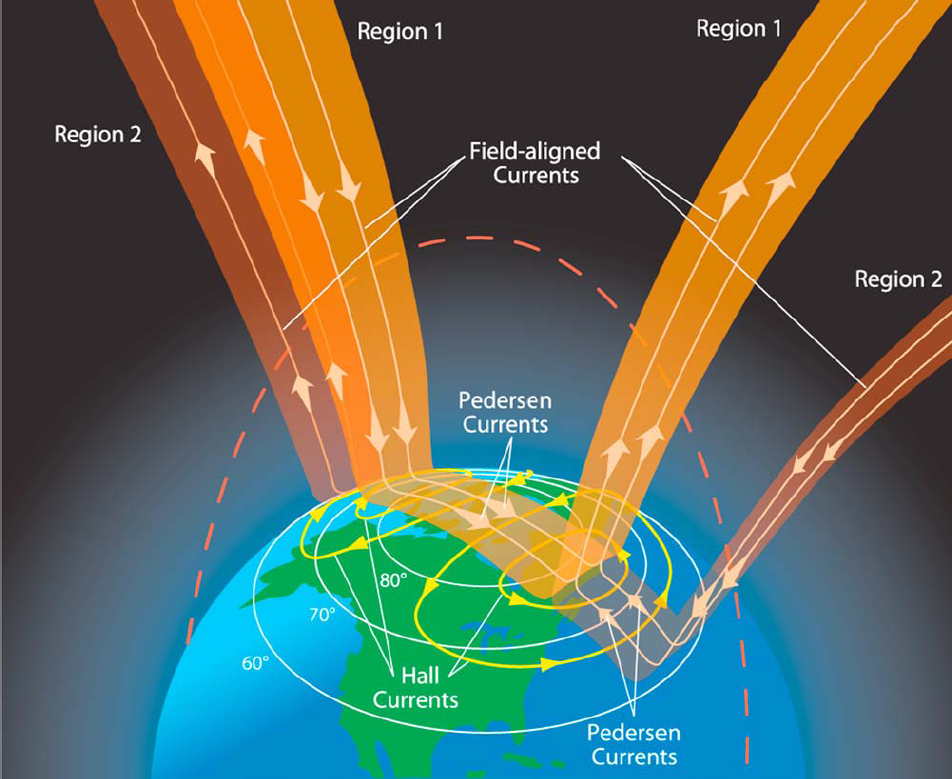
Schematic of the Birkeland or Field-Aligned Currents and the ionospheric current systems they connect to, Pedersen and Hall currents.[1]

A Birkeland current (also known as field-aligned current, FAC) is a set of electrical currents that flow along geomagnetic field lines connecting the Earth's magnetosphere to the Earth's high latitude ionosphere. In the Earth's magnetosphere, the currents are driven by the solar wind and interplanetary magnetic field (IMF) and by bulk motions of plasma through the magnetosphere (convection indirectly driven by the interplanetary environment). The strength of the Birkeland currents changes with activity in the magnetosphere (e.g. during substorms). Small scale variations in the upward current sheets (downward flowing electrons) accelerate magnetospheric electrons which, when they reach the upper atmosphere, create the Auroras Borealis and Australis.

In the high latitude ionosphere (or auroral zones), the Birkeland currents close through the region of the auroral electrojet, which flows perpendicular to the local magnetic field in the ionosphere. The Birkeland currents occur in two pairs of field-aligned current sheets. One pair extends from noon through the dusk sector to the midnight sector. The other pair extends from noon through the dawn sector to the midnight sector. The sheet on the high latitude side of the auroral zone is referred to as the Region 1 current sheet and the sheet on the low latitude side is referred to as the Region 2 current sheet. Together with the (partial) ring current, Region 1 and Region 2 currents form the convection circuit, which is associated with the Dungey cycle.[2] On the day-side, around noon, another type of FAC can be found: Region 0 currents, going into and out of the ionospheric polar cap, the direction of which is decided by the direction of the IMF.[2]

The currents were predicted in 1908 by Norwegian explorer and physicist Kristian Birkeland, who undertook expeditions north of the Arctic Circle to study the aurora. He rediscovered, using simple magnetic field measurement instruments, that when the aurora appeared the needles of magnetometers changed direction, confirming the findings of Anders Celsius and assistant Olof Hjorter more than a century before. This could only imply that currents were flowing in the atmosphere above. He theorized that somehow the Sun emitted a cathode ray,[3][4] and corpuscles from what is now known as a solar wind entered the Earth's magnetic field and created currents, thereby creating the aurora. This view was scorned by other researchers,[5] but in 1967 a satellite, launched into the auroral region, showed that the currents posited by Birkeland existed. In honour of him and his theory these currents are named Birkeland currents. A good description of the discoveries by Birkeland is given in the book by Jago.[6]

Professor Emeritus of the Alfvén Laboratory in Sweden, Carl-Gunne Fälthammar wrote:[7] "A reason why Birkeland currents are particularly interesting is that, in the plasma forced to carry them, they cause a number of plasma physical processes to occur (waves, instabilities, fine structure formation). These in turn lead to consequences such as acceleration of charged particles, both positive and negative, and element separation (such as preferential ejection of oxygen ions). Both of these classes of phenomena should have a general astrophysical interest far beyond that of understanding the space environment of our own Earth."

Auroral-like Birkeland currents created by scientist Kristian Birkeland in his terrella, featuring a magnetised anode globe in an evacuated chamber.

Electric currents in the shape of Birkeland Currents are ubiquitous in cosmic plasmas, having been observed at the planetary, solar, interstellar, and galactic levels.[8]

Characteristics

[edit]

Auroral Birkeland currents carry about 100,000 amperes during quiet times[9] and more than 1 million amperes during geomagnetically disturbed times.[10] Birkeland had estimated currents "at heights of several hundred kilometres, and strengths of up to a million amperes" in 1908.[4] The ionospheric currents that connect the field-aligned currents give rise to Joule heating in the upper atmosphere. The heat is transferred from the ionospheric plasma to the gas of the upper atmosphere, which consequently rises and increases drag on low-altitude satellites.

Birkeland currents can also be created in the laboratory with multi-terawatt pulsed power generators. The resulting cross-section pattern indicates a hollow beam of electrons in the form of a circle of vortices, a formation called the diocotron instability[11] (similar to the Kelvin–Helmholtz instability), that subsequently leads to filamentation. Such vortices can be seen in aurora as "auroral curls".[12]

Birkeland currents are also one of a class of plasma phenomena called a z-pinch, so named because the azimuthal magnetic fields produced by the current pinches the current into a filamentary cable. This can also twist, producing a helical pinch that spirals like a twisted or braided rope, and this most closely corresponds to a Birkeland current. Pairs of parallel Birkeland currents will also interact due to Ampère's force law: parallel Birkeland currents moving in the same direction will attract each other with an electromagnetic force inversely proportional to their distance apart whilst parallel Birkeland currents moving in opposite directions will repel each other. There is also a short-range circular component to the force between two Birkeland currents that is opposite to the longer-range parallel forces.[13]

Electrons moving along a Birkeland current may be accelerated by a plasma double layer. If the resulting electrons approach the speed of light, they may subsequently produce a Bennett pinch, which in a magnetic field causes the electrons to spiral and emit synchrotron radiation that may include radio, visible light, x-rays, and gamma rays.

Spatial distribution and responses to solar wind disturbances

[edit]

Auroral Birkeland currents are constrained along the geomagnetic field. Therefore, the current’s distribution in 3-dimensional space could be largely described using the 2-dimensional distribution of the current’s footprints at a given altitude in the ionosphere, e.g., 110 km. A classical 2-dimensional description was summarized from satellite observations by Iijima and Potemra.[14] The footprints of Auroral Birkeland currents exhibit ring-shaped structures. As the currents are driven by solar winds, their spatial distribution and intensity are also dynamically moderated by solar wind disturbances.[15] Under intensive solar wind disturbances, the rings can quickly shift by 10 degrees in latitude in about 10 minutes. The latitudinal shift takes on average 20 minutes to respond to a solar wind change during the daytime but 70–90 minutes at night.[16]

The field-aligned current density at its ionopsheric footprints (about110 km altitude) on 4 June 2007, a day under moderate solar wind disturbances, predicted by the open-source MFACE,[15][17] according to the solar wind conditions downloaded from the NASA OMNI serve.[18] MFACE is an empirical mode extracted from 10-years of CHAMP magnetic observations. The time interval between neighboring frames in this movie denotes 5 minutes. Similar movies but under quiet and active solar wind disturbance levels are available at, e.g.,[19].

History

[edit]
Kristian Birkeland predicted the auroral electrojets in 1908. He wrote p. 95[4] "the currents there are imagined as having come into existence mainly as a secondary effect of the electric corpuscles from the sun drawn in out of space, and thus far come under the second of the possibilities mentioned above". And p. 105, "Fig. 50a represents those in which the current-directions at the storm-centre are directed westwards, and 50b those in which the currents move eastwards".

After Kristian Birkeland first suggested in 1908 that "currents there [in the aurora] are imagined as having come into existence mainly as a secondary effect of the electric corpuscles from the sun drawn in out of space,"[4] the story appears to have become mired in politics.[20] Birkeland's ideas were generally ignored in favor of an alternative theory from British mathematician Sydney Chapman.[21]

In 1939, the Swedish Engineer and plasma physicist Hannes Alfvén promoted Birkeland's ideas in a paper[22] published on the generation of the current from the Solar Wind. In 1964 one of Alfvén's colleagues, Rolf Boström, also used field-aligned currents in a new model of auroral electrojets.[23]

Proof of Birkeland's theory of the aurora only came after a probe was sent into space. The crucial results were obtained from U.S. Navy satellite 1963-38C, launched in 1963 and carrying a magnetometer above the ionosphere. In 1966 Alfred Zmuda, J.H. Martin, and F.T.Heuring[24] analysed the satellite magnetometer results and reported their findings of magnetic disturbance in the aurora. In 1967 Alex Dessler and graduate student David Cummings wrote an article[25] arguing that Zmuda et al. had detected field-aligned currents. Alfvén subsequently acknowledged[26] that Dessler had "discovered the currents that Birkeland had predicted" and they should be called Birkeland-Dessler currents. 1967 is therefore taken as the date when Birkeland's theory was finally acknowledged to have been vindicated. In 1969 Milo Schield, Alex Dessler and John Freeman[27] used the name "Birkeland currents" for the first time. In 1970 Zmuda, Armstrong and Heuring wrote another paper[28] agreeing that their observations were compatible with field-aligned currents as suggested by Cummings and Dessler and by Boström.[23]

See also

[edit]

References

[edit]

Further reading

[edit]
[edit]
Revisions and contributorsEdit on WikipediaRead on Wikipedia
from Grokipedia
A Birkeland current is a type of field-aligned electrical current that flows along geomagnetic field lines, connecting the Earth's magnetosphere to the ionosphere and facilitating the transfer of energy from solar wind interactions to the polar atmosphere. Named after Norwegian physicist Kristian Birkeland, who first proposed their existence in the early 20th century through terrella experiments simulating Earth's magnetic field, these currents were experimentally confirmed in the 1960s by satellite observations measuring their flow at altitudes around 1100 km. These currents are concentrated in two primary regions encircling the geomagnetic poles: Region 1 (poleward, typically carrying downward currents of about 0.7 µA/m²) and Region 2 (equatorward, with upward currents around 1.1 µA/m²), forming large-scale sheets that couple the to the auroral . With total intensities ranging from 1 to 10 million amperes, Birkeland currents drive auroral displays by accelerating electrons downward, producing emissions such as ultraviolet light at 1356 , and they dissipate energy far exceeding that visible in auroras alone. Beyond auroras, Birkeland currents play a critical role in space weather dynamics, intensifying during solar storms to channel energy into Earth's upper atmosphere, which can overload power grids, disrupt satellite communications, and affect navigation systems. Continuous global monitoring, such as through the Active Magnetosphere and Planetary Electrodynamics Response Experiment () using data from 66 satellites, has revealed their two-stage response to inputs: an initial buildup near the noon sector followed by stronger midnight currents that merge and deposit most energy in polar regions, enabling potential short-term forecasting.

Fundamentals

Definition and Naming

Birkeland currents, also known as field-aligned currents (FACs), are electrical currents that flow parallel to geomagnetic field lines, connecting the Earth's to the and facilitating the transfer of energy and momentum between these regions. These currents are primarily carried by charged particles, such as electrons, that spiral along the lines due to the . Unlike other magnetospheric current systems, such as the ring current—which consists of azimuthal flows of charged particles trapped in the equatorial plane—Birkeland currents are distinctly aligned with the field and serve to couple distant plasma regions. The term "Birkeland current" honors Norwegian physicist Kristian Birkeland, who in his 1908 monograph The Norwegian Aurora Polaris proposed that streams of charged particles from the Sun, guided by lines, produce auroral displays and associated geomagnetic disturbances. Birkeland's hypothesis, developed through experiments and polar expeditions, envisioned these particle streams forming field-aligned electrical flows, a concept later formalized and named "Birkeland currents" by the International Union of Geodesy and Geophysics in 1967. This nomenclature distinguishes them from earlier, less accurate models of auroral electrodynamics. In terms of scale, Birkeland currents typically exhibit intensities on the order of 1 μA/m² during quiet conditions, increasing to around 10 μA/m² during intense geomagnetic activity, with total currents reaching several megaamperes across large-scale polar structures. These currents span thousands of kilometers along geomagnetic field lines, from ionospheric altitudes of about 100 km to magnetospheric distances exceeding 10,000 km.

Physical Principles

Birkeland currents arise in the through plasma dynamics driven by gradients, which generate perpendicular currents whose spatial divergence results in field-aligned components. These gradients, often on the order of 1.8 × 10^{-10} to 9 × 10^{-9} Pa over scales of about 3000 km, produce magnetic perturbations of 30–180 nT and link to the observed current densities via the momentum balance equation J=1B(p×B^)\mathbf{J}_\perp = \frac{1}{B} (\nabla p \times \hat{\mathbf{B}}), where pp is plasma . Another key generation mechanism involves momentum transfer from the , primarily through dayside that convects magnetospheric plasma tailward, slowing it and converting into electromagnetic energy via a process. This interaction polarizes the plasma, with inertial forces braking convective motion along field lines extending roughly 60 Earth radii into the magnetotail, yielding current densities up to 101010^{-10} A/m² at ionospheric altitudes. The of these currents, whether from variations or , redirects flow into parallel components along lines. These field-aligned currents close their circuits in the , where enhanced conductivity—due to particle and solar EUV —facilitates horizontal Pedersen and Hall currents to complete the loop and balance the system. Pedersen currents, driven by the perpendicular to both E\mathbf{E} and B\mathbf{B}, flow horizontally across conductivity gradients, while Hall currents contribute divergence-free closures but are modulated seasonally by effects. In contrast to these horizontal ionospheric currents, Birkeland currents remain distinctly field-aligned, connecting magnetospheric sources directly to the ionosphere without perpendicular components in the low-altitude mapping.

Current Systems

Region 1 Currents

Region 1 Birkeland currents, also known as the poleward field-aligned currents, are located at higher magnetic latitudes, typically spanning 70° to 80° magnetic latitude (MLAT), positioning them poleward of the auroral oval. These currents form a continuous ring around the polar cap, encircling the open magnetic flux region. In terms of directionality, Region 1 currents flow downward into the on the dawnside and upward out of the on the duskside, consistent with the overall antisymmetric pattern of the large-scale current system. This configuration arises from the interaction between magnetospheric plasma flows and the geomagnetic field. The total current IR1I_{R1} in the Region 1 system is approximated by the of the parallel over the cross-sectional area along the field lines: IR1JdA,I_{R1} \approx \int J_{\parallel} \, dA, where JJ_{\parallel} is the field-aligned and the integration occurs perpendicular to the lines. Typical current densities for Region 1 range from 0.2 to 0.6 μA/m² under quiet conditions, intensifying to 1.2 μA/m² or higher during periods of geomagnetic activity, such as substorms or storms. For example, during the May 2024 geomagnetic superstorm, current densities exceeded typical active values, highlighting their response to extreme conditions. These currents primarily transfer momentum from the to the , coupling solar wind-driven stresses to high-latitude ionospheric flows via the . Region 1 currents are closely associated with the plasma sheet boundary layer (PSBL), where they connect to tailward plasma flows, and with interactions at the lobe-plasma sheet interface, facilitating the closure of the current circuit through magnetotail processes.

Region 2 Currents

Region 2 Birkeland currents, also known as Region 2 field-aligned currents (FACs), form an equatorward system located equatorward of the Region 1 currents and on the equatorward boundary of the main auroral oval, typically at magnetic latitudes of approximately 60° to 70° in the , overlapping the subauroral region. This positioning distinguishes them from the more poleward Region 1 system and reflects their connection to inner magnetospheric dynamics rather than direct lobe interactions. In terms of directionality, Region 2 currents flow upward into the on the dawnside and downward on the duskside, opposite to the polarity of Region 1 currents, which facilitates the closure of the overall FAC circuit through azimuthal ionospheric Pedersen currents. Their intensity is generally weaker than that of Region 1, with typical current densities ranging from 0.2 to 1 μA/m², though values can reach up to 1.2 μA/m² during enhanced activity. This lower magnitude is tied to their role in carrying a fraction of the azimuthal pressure gradients associated with the partial ring current in the inner . The generation of Region 2 currents primarily arises from azimuthal pressure gradients in the hot plasma populations of the inner , particularly the partial ring current, which diverts current to the via these FACs. Centrifugal forces acting on co-rotating plasmas in the inner contribute to this process by enhancing the divergence of transverse currents, while feedback mechanisms, such as conductivity variations, modulate the current flow and closure. In the Cowley model, Region 2 currents serve as return paths that balance the divergence of Region 1 currents, completing the large-scale convection circuit driven by solar wind- coupling.

Distribution and Dynamics

Spatial Patterns

Birkeland currents form a global structure characterized by an oval-shaped pattern centered over the polar regions of both hemispheres, with the currents flowing along geomagnetic field lines to close through the . This configuration is largely symmetric between the Northern and Southern Hemispheres, exhibiting mirror symmetry in their spatial distribution, though the direction of current flow is reversed due to the antiparallel orientation of the magnetic dipoles. The Region 1 currents typically outline the poleward edge of this oval, while Region 2 currents occupy the equatorward boundary. The latitudinal extent of the Birkeland current displays a pronounced dawn-dusk asymmetry, with dusk-side currents often shifted equatorward relative to the dawn side by approximately 2.4° during geomagnetic storms. Under quiet conditions, the is confined to high latitudes around 70°–80° magnetic (MLAT), but during periods of high geomagnetic activity, the Region 1 can expand equatorward to as low as 50° MLAT, reflecting enhanced magnetospheric and input. Seasonal and diurnal variations further modulate the spatial patterns, with the oval exhibiting compression on the dayside due to enhanced ionospheric conductivity from sunlight illumination, which alters the current closure paths. Diurnally, current intensities peak in the prenoon to postnoon sectors, aligning with variations that boost Pedersen and Hall conductances. Seasonally, the currents are stronger in the summer hemisphere, where () ionization elevates ionospheric conductivity, facilitating greater current flow compared to the winter hemisphere. Statistical models of Birkeland current distributions reveal heavy-tailed probability density functions for current , indicating that extreme values dominate the total current . This underscores the filamentary and localized nature of these currents rather than a uniform distribution.

Temporal Variations and Solar Wind Influence

Birkeland currents display rapid temporal variations in response to conditions, particularly changes in the interplanetary (IMF). When the IMF z-component (Bz) turns southward, promoting dayside , the associated auroral oval expands equatorward, with the poleward boundary of Region 1 currents shifting within 10–20 minutes on the dayside. This reconfiguration is accompanied by a significant intensification of current , often increasing by 50–100% from baseline levels under northward IMF conditions. On shorter timescales, substorms trigger sudden enhancements in Birkeland currents, typically lasting minutes to hours. During substorm onset and expansion phases, Region 1 currents intensify first, particularly on the nightside, followed by Region 2 currents, reflecting the diversion of tail currents into the via the substorm current wedge. This sequence contributes to the overall strengthening of the current systems, with total currents potentially doubling in intensity. Over longer periods, Birkeland currents exhibit variability correlated with the 11-year . Current intensities are stronger during , when coronal mass ejections (CMEs) are more frequent, leading to enhanced disturbances and geomagnetic activity that drive larger reconnection rates and current flows. The ratio of maximum to minimum currents across the cycle reaches 2–3, underscoring the influence of heightened solar output. The primary driver of these temporal changes is the rate of at the , which governs the input of and energy into the . This rate depends on the southward component of the IMF, with enhanced reconnection for southward orientations (θ ≈ 180°), where θ is the IMF clock angle. Statistical analyses using superposed techniques further illustrate these dynamics during geomagnetic storms, defined by Dst index values below -50 nT. Such studies reveal peak Birkeland current densities occurring near storm maximum, with extreme values (>4 μA/m²) most probable in Region 2 systems on the dayside, highlighting the amplified response to prolonged southward IMF intervals. These peaks align with the global oval's expansion under storm forcing, emphasizing the solar wind's role in intensifying currents across multiple timescales.

Observation and Research

Historical Background

The concept of Birkeland currents originated with Norwegian physicist Kristian Birkeland's pioneering experiments conducted in the early 1900s. In these laboratory setups, Birkeland used a magnetized sphere () to simulate and directed —representing charged particles from the Sun—toward it, producing aurora-like luminous rings aligned with the magnetic field lines. His 1908 publication, The Norwegian Aurora Polaris, detailed how these field-aligned currents could generate the observed auroral displays and associated geomagnetic disturbances, marking the first theoretical proposal of such currents flowing between the and . Following Birkeland's work, post-World War II theories advanced understanding of solar-terrestrial interactions, though initial models downplayed particle-based mechanisms. The 1931 Chapman-Ferraro model described magnetic storms as resulting from ionized gas clouds from the Sun compressing Earth's , forming a cavity-like structure and inducing surface currents; however, it rejected the direct penetration of solar corpuscles into the auroral zones, attributing disturbances primarily to induced ionospheric currents. This perspective persisted until the , when observations of dynamics by Ludwig Biermann and Eugene Parker's theoretical formulation of a continuous plasma flow provided evidence for charged particle streams influencing the , reviving interest in Birkeland's particle-driven current ideas. In the , ground-based arrays across , , and began revealing anomalies in ionospheric current patterns during auroral activity, suggesting that observed electrojet flows could not close solely within the . These arrays, such as the Scandinavian East-West chain and North American meridian lines, measured magnetic perturbations indicating divergences and convergences in the auroral electrojets—intense eastward and westward currents—that implied compensating field-aligned currents to maintain continuity. Theoretical models, notably Boström's proposal, integrated these ground observations to describe two-sheet systems of field-aligned currents coupled to the electrojets, with upward and downward flows closing via Pedersen currents in the , providing an early framework for magnetosphere-ionosphere coupling without direct in-situ measurements. The definitive observational confirmation of structured Birkeland current systems came in the through data, shifting the from localized ionospheric electrojets to global field-aligned circuits. The low-altitude TRIAD , launched in 1972, detected persistent Region 1 and Region 2 current sheets during both quiet and active geomagnetic conditions in 1973–1974 passes over the northern auroral zone; Region 1 currents flowed into the on the dawnside and out on the duskside at higher latitudes, while Region 2 exhibited opposite polarity equatorward, with intensities up to several million amperes. This discovery, analyzed from vector data, validated Birkeland's concepts and Boström's models on a large scale. Throughout the decade, accumulating evidence from TRIAD and other platforms led to the widespread recognition of field-aligned currents as the primary mediators of auroral energy transfer, evolving terminology and models from "auroral electrojets" as isolated ionospheric phenomena to integrated components of the broader magnetospheric current system.

Modern Measurements

Modern measurements of Birkeland currents, also known as field-aligned currents (FACs), rely on a combination of satellite constellations and ground-based observatories to provide high-resolution, global-scale data. The Active Magnetosphere and Planetary Electrodynamics Response Experiment (AMPERE), operational since 2010, utilizes magnetic field data from the Iridium satellite constellation of 66 low-Earth-orbiting spacecraft at approximately 780 km altitude to derive global FAC maps. These maps are generated every 10 minutes with a spatial resolution of 0.25° in magnetic latitude and longitude, enabling continuous monitoring of current intensities and patterns. Complementing AMPERE, the European Space Agency's Swarm mission, launched in 2013, employs vector magnetometry from three satellites in a constellation configuration to measure high-precision perturbations associated with FACs. Swarm data facilitate detailed mapping of FAC structures, including small-scale features during geomagnetic disturbances, by resolving perturbations down to 0.1 nT accuracy. Similarly, NASA's Time History of Events and Macroscale Interactions during Substorms () mission provides multi-point plasma measurements in the plasma sheet, capturing FAC distributions and their relation to plasma flows at geocentric distances of 4–10 radii. Ground-based networks enhance these satellite observations by probing ionospheric closures of FAC circuits. The Super Dual Auroral Radar Network (SuperDARN) uses high-frequency radars across both hemispheres to measure ionospheric plasma convection velocities exceeding 900 m/s, which correlate with FAC boundaries and patterns. Magnetometer chains, such as the Canadian Array for Real-time Investigations of Magnetic Activity (CARISMA), formerly known as , detect ground-level magnetic perturbations from FAC-induced ionospheric currents along meridian lines in the auroral zone. Data analysis from these instruments typically involves inversion techniques to estimate FAC densities from observed magnetic perturbations. The parallel component of the current density JJ_\parallel is computed using Ampère's law as J=(×ΔB)μ0J_\parallel = \frac{(\nabla \times \Delta \mathbf{B})_\parallel}{\mu_0}, where ΔB\Delta \mathbf{B} is the perturbation and μ0\mu_0 is the permeability of free ; this method is applied in spherical expansions for global datasets like . Recent analyses of from 2010 to 2022 reveal that FAC density distributions are often heavy-tailed or leptokurtic, indicating a higher prevalence of extreme current events compared to Gaussian expectations, with q-exponential fits capturing tails extending beyond 1 μA/. During , these extreme currents show magnetic (MLT) dependence, being more probable in the dayside Region 2 FACs, where intensities can exceed 30 MA total, contrary to traditional nightside dominance. For instance, during the severe of May 10–12, 2024, revealed unprecedented intensities in nighttime Birkeland currents, highlighting their role in . Validation studies up to 2025 using Swarm data confirm within 10–20% accuracy for storm-time FACs.

Significance

Role in Auroral Phenomena

Birkeland currents, also known as field-aligned currents (FACs), play a central role in transporting energy from the magnetosphere to the ionosphere, powering auroral displays by precipitating energetic electrons along magnetic field lines. These currents carry up to 101210^{12} W of electric power into the upper atmosphere, with about 10% manifesting as auroral particle precipitation energy. The alignment of auroral arcs is closely mapped to Region 1 (R1) Birkeland currents, where upward-directed currents and morning sectors correlate with discrete auroral arcs. These upward currents facilitate electron acceleration through parallel electric fields, leading to structured precipitation that forms bright, narrow arcs. During magnetospheric substorms, intensification of R1 currents coincides with the onset of auroral , injecting electrons with energies of 10–100 keV into the atmosphere and producing dynamic, expanding auroral forms. Inverted-V structures in auroral spectra are directly associated with these upward R1 currents, resulting from field-aligned potential drops of 1–10 kV that accelerate to produce characteristic energy peaks. In contrast, Region 2 (R2) currents, located equatorward of R1, are linked to diffuse auroras through of lower-energy electrons and protons, contributing to broader, less structured glows without significant parallel acceleration.

Implications for Space Weather

Birkeland currents, or field-aligned currents (FACs), play a critical role in geomagnetic storm dynamics by intensifying during (CME) impacts, which enhance ionospheric currents and induce (GICs) in the ground. These GICs can overload power transformers and transmission lines, leading to widespread blackouts, as exemplified by the March 13, 1989, event where a severe caused a nine-hour outage affecting 21,000 MW of capacity due to induced DC currents up to 100 A in the grid. During such storms, Region 2 FACs exhibit extreme enhancements, contributing to the rapid magnetic field variations that drive these ground-level effects. Birkeland currents also modulate the ring current intensity in the inner , influencing the dynamics of the Van Allen radiation belts and thereby increasing hazards to satellites. Enhanced FACs during geomagnetic storms facilitate plasma transport that strengthens the ring current, leading to diamagnetic depressions in the geomagnetic field and elevated fluxes of relativistic electrons and protons in the belts, which can cause single-event upsets, surface charging, and degradation of satellite electronics. For instance, ring current particles accelerated through interactions tied to FAC-driven pose risks to in low-Earth by penetrating shielding and inducing internal charging. In the , FACs drive through Pedersen currents, resulting in thermal expansions and disturbances that alter (TEC) on regional scales, disrupting global navigation satellite systems (GNSS) like GPS and high-frequency communications. These heating effects generate large-scale traveling ionospheric disturbances (TIDs) with TEC perturbations up to 20-50% during storms, causing signal scintillations, phase delays, and loss-of-lock events that degrade positioning accuracy to meters or worse in polar and auroral regions. Forecasting models for incorporate Birkeland current observations from missions like to predict storm intensities and mitigate risks, with data integrated into tools such as the OVATION Prime auroral model for nowcasting electrodynamic responses. -derived FAC maps enable real-time estimation of energy deposition and current strengths, revealing that extreme FAC events—defined as densities exceeding 2 μA/m²—can surge by over 100% in less than 10 minutes during storm onsets, informing alerts for grid operators and satellite controllers. Such models highlight the probability of these rapid intensifications under southward interplanetary conditions, enhancing predictive lead times. Beyond Earth, analogous Birkeland currents operate in the magnetospheres of and Saturn, where they couple internal plasma sources to auroral ionospheres, providing insights into by illustrating how strong magnetic fields shield atmospheres from stellar winds. On , Juno observations confirm FACs up to 160 MA flowing along field lines, driving massive auroral power outputs that protect the planet's hydrogen envelope from , a process relevant to assessing environments and atmospheric retention on hot Jupiters. Similarly, Saturn's FAC system modulates ring current-like structures, informing models of magnetospheric protection for potentially habitable with internal dynamos. These planetary examples underscore how Birkeland currents contribute to long-term atmospheric stability, a key factor in zones.

References

Add your contribution
Related Hubs
User Avatar
No comments yet.