Hubbry Logo
Anders CelsiusAnders CelsiusMain
Open search
Anders Celsius
Community hub
Anders Celsius
logo
8 pages, 0 posts
0 subscribers
Be the first to start a discussion here.
Anders Celsius
Anders Celsius
from Wikipedia

Anders Celsius (Swedish: [ˈânːdɛʂ ˈsɛ̌lːsɪɵs]; 27 November 1701 – 25 April 1744)[1] was a Swedish astronomer, physicist and mathematician. He was professor of astronomy at Uppsala University from 1730 to 1744, but traveled from 1732 to 1735 visiting notable observatories in Germany, Italy and France. He founded the Uppsala Astronomical Observatory in 1741, and in 1742 proposed (an inverted form of) the centigrade temperature scale, which was later renamed Celsius in his honour.

Key Information

Early life and education

[edit]

Anders Celsius was born in Uppsala, Sweden, on 27 November 1701.[1] His family originated from Ovanåker in the province of Hälsingland.[2] Their family estate was at Doma, also known as Höjen or Högen (locally as Högen 2). The name Celsius is a latinization of the estate's name (Latin celsus 'mound').

As the son of an astronomy professor, Nils Celsius, nephew of botanist Olof Celsius and the grandson of the mathematician Magnus Celsius and the astronomer Anders Spole,[3][4][page needed] Celsius chose a career in science. He was a talented mathematician from an early age. Anders Celsius studied at Uppsala University, where his father was a teacher, and in 1730 he, too, became a professor of astronomy there. Noted Swedish dramatic poet and actor Johan Celsius was also his uncle.[5][6]

Career

[edit]

In 1730, Celsius published the Nova Methodus distantiam solis a terra determinandi (New Method for Determining the Distance from the Earth to the Sun). His research also involved the study of auroral phenomena, which he conducted with his assistant Olof Hiorter, and he was the first to suggest a connection between the aurora borealis and changes in the magnetic field of the Earth. He observed the variations of a compass needle and found that larger deflections correlated with stronger auroral activity. At Nuremberg in 1733, he published a collection of 316 observations of the aurora borealis made by himself and others over the period 1716–1732.[1]

Celsius traveled frequently in the early 1730s, including to Germany, Italy and France, when he visited most of the major European observatories. In Paris he advocated the measurement of an arc of the meridian in Lapland. In 1736, he participated in the expedition organized for that purpose by the French Academy of Sciences, led by the French mathematician Pierre Louis Maupertuis (1698–1759) to measure a degree of latitude.[1] The aim of the expedition was to measure the length of a degree along a meridian, close to the pole, and compare the result with a similar expedition to Peru, today in Ecuador, near the equator. The expeditions confirmed Isaac Newton's belief that the shape of the Earth is an ellipsoid flattened at the poles.[4][page needed]

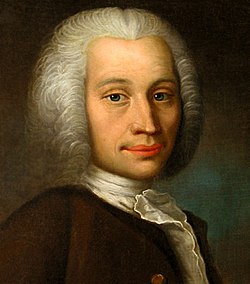
Anders Celsius c. 1730s

In 1738, he published the De observationibus pro figura telluris determinanda (Observations on Determining the Shape of the Earth). Celsius's participation in the Lapland expedition won him much respect in Sweden with the government and his peers, and played a key role in generating interest from the Swedish authorities in donating the resources required to construct a new modern observatory in Uppsala.[2] He was successful in the request, and Celsius founded the Uppsala Astronomical Observatory in 1741.[7] The observatory was equipped with instruments purchased during his long voyage abroad, comprising the most modern instrumental technology of the period.[3]

He made observations of eclipses and various astronomical objects and published catalogues of carefully determined magnitudes for some 300 stars using his own photometric system (mean error=0.4 mag).[4][page needed][8][9] In 1742 he proposed the Celsius temperature scale in a paper to the Royal Society of Sciences in Uppsala, the oldest Swedish scientific society, founded in 1710. His thermometer was calibrated with a value of 0 for the boiling point of water and 100 for the freezing point. In 1745, a year after Celsius's death, the scale was reversed by Carl Linnaeus to facilitate more practical measurement.[10]

The observatory of Anders Celsius, from a contemporary engraving

Celsius conducted many geographical measurements for the Swedish General map, and was one of the earliest to note that much of Scandinavia is slowly rising above sea level, a continuous process which has been occurring since the melting of the ice from the latest ice age. However, he wrongly posed the notion that the water was evaporating.[4][page needed]

In 1725 he became secretary of the Royal Society of Sciences in Uppsala, and served at this post until his death from tuberculosis in 1744. He supported the formation of the Royal Swedish Academy of Sciences in Stockholm in 1739 by Linnaeus and five others, and was elected a member at the first meeting of this academy. It was in fact Celsius who proposed the new academy's name.[11]

Works

[edit]
De novo in fluviis norlandiarum piscandi modo, 1738
  • De novo in fluviis norlandiarum piscandi modo (in Latin). Uppsala: Johan Höjer, änka. 1738.
  • "Observationer om twänne beständiga grader på en thermometer" [Observations about two stable degrees on a thermometer]. Kungliga Svenska Vetenskapsakademiens Handlingar (Proceedings of the Royal Swedish Academy of Sciences) (in Swedish). 3: 171–180. 1742.

See also

[edit]

References

[edit]
[edit]
Revisions and contributorsEdit on WikipediaRead on Wikipedia
from Grokipedia
Anders Celsius (27 November 1701 – 25 April 1744) was a Swedish , , and renowned for inventing the temperature scale, which sets the freezing point of at 0°C and the boiling point at 100°C under standard . Born in , , into a family of scholars—his father Nils Celsius was a professor of astronomy and his grandfather Magnus Celsius a —he studied astronomy, , and at , where he later succeeded his father as professor of astronomy in 1730. Celsius's early career included extensive travels across from 1732 to 1736, visiting observatories in , , , and , which broadened his scientific expertise and led to his election as a in 1736. In 1736, he joined Pierre Louis Maupertuis's expedition to Lapland to measure a , providing for Isaac Newton's theory that Earth is an oblate spheroid flattened at the poles. Upon returning to , he served as secretary of the Royal Society of Sciences from 1725 until his death and oversaw the construction of Sweden's first modern astronomical observatory, completed in 1741, which significantly advanced Swedish astronomy. His contributions extended beyond temperature measurement; Celsius pioneered photometric methods for cataloging star magnitudes, compiling lists of over 300 stars with notable accuracy, and was among the first to link the aurora borealis to through observations published in 1733. Although he originally proposed his temperature scale in 1742 with 100° for freezing and 0° for boiling—later reversed by shortly after his death from at age 42—the revised version became the international standard for metric thermometry and remains in widespread scientific and everyday use today.

Early Life

Birth and Family

Anders Celsius was born on November 27, 1701, in , . His family originated from Ovanåker in the province of Hälsingland, where their estate was located at Doma, also known as Högen or Högen 2; the surname Celsius is a Latinized form of this place name. Celsius's father, Nils Celsius (1658–1724), was a professor of astronomy at . His mother, Gunilla Maria Spole (1672–1756), was the daughter of the astronomer Anders Spole (1630–1699), who served as professor of mathematics and astronomy at and universities. Celsius's paternal grandfather, Magnus Celsius (1621–1679), was a and professor at . The Celsius family was deeply embedded in Swedish academia, with multiple generations contributing to fields such as astronomy, , and ; Celsius had a , Sara Märta Celsius.

Education

Anders Celsius, born into a family of prominent scholars in Uppsala, Sweden, demonstrated exceptional aptitude for from a young age, reportedly solving all the problems in a university textbook by the time he was twelve. His father, Nils Celsius, served as of astronomy at and headmaster of the Trivial School, while his grandfathers—Magnus Celsius, a , and Anders Spole, an —further embedded a scientific legacy in the family. This environment provided young Celsius with access to influential resources, including an early edition of Isaac Newton's . Celsius began his formal education at the Trivial School of Uppsala on June 12, 1711, where the curriculum emphasized classical subjects such as , , and logic. Upon completing secondary schooling, he enrolled at in the early 1720s to study astronomy, , and . During this period, he assisted Erik Burman with observations and was influenced by Anders Gabriel Duhre's lecture course on in 1724–1725. By 1724, Celsius had already published his first papers on the construction of barometers, marking an early foray into experimental science. In 1725, while still a , Celsius was elected of Uppsala's Scientific , reflecting his emerging prominence among peers. He completed his studies with two theses: one on the rotational motion of the , Disputatio astronomica de motu vertiginis lunae, examined on December 12, 1727, and another on the existence of the mind, Dissertatio gradualis de existentia mentis, examined on May 21, 1728. These works earned him a , after which he served as a substitute in at from approximately 1728 to 1731. This foundational education in the sciences positioned him for his later appointment as of astronomy in 1730.

Academic Career

University Positions

Celsius's academic career was centered at , where he held several progressive roles that culminated in a prominent professorship. Following his studies at the institution, he was elected assistant secretary of the Royal Society of Sciences in Uppsala in 1725, a position that evolved into full secretary by 1728 and which he maintained until his death in 1744. This role involved administrative oversight of scientific activities and publications, enhancing his influence within the university's scholarly community. After earning his , Celsius began teaching as a substitute lecturer in around 1728, filling in for Samuel Klingenstierna during his travels abroad; this arrangement continued with partial compensation from Klingenstierna until 1731. In 1729, following the death of astronomy professor Erik Burman, Celsius assumed Burman's lecturing duties in astronomy while continuing his responsibilities, and he was formally appointed deputy professor of astronomy that autumn. These interim positions allowed him to demonstrate his expertise and paved the way for his permanent appointment. In June 1730, at the age of 28, Celsius was inaugurated as full professor of astronomy at , succeeding Burman and building on the legacy of his father, Nils Celsius, who had held the chair of mathematics from 1706 until 1724. He retained this professorship until his death in 1744, during which time he modernized the astronomy program by acquiring advanced instruments from and overseeing the construction of the Uppsala Astronomical Observatory, completed in 1741 on the roof of a house on Svartbäcksgatan.

European Travels

In 1732, at the age of 31, Anders Celsius undertook a grand tour of lasting approximately four years, following in the footsteps of his grandfather Magnus Celsius, who had made similar scientific journeys decades earlier. Accompanied by Jonas Meldercreutz, Celsius aimed to visit prominent observatories, collaborate with leading astronomers, and acquire instruments to enhance the Uppsala observatory. This travel was supported by permission from the Swedish authorities granted on 23 May 1732, with the explicit goal of forging international links for the Royal Society of Sciences in Uppsala. Celsius's itinerary began with travels through , including a stop in in 1732–1733, where he purchased a high-precision quadrant for astronomical measurements. By 1733, he reached , , where he published a detailed catalog of 316 observations of the northern lights (aurora borealis), drawing on data collected earlier in his career. There, he also co-edited an astronomical periodical with the German scholar Michael Adelbulner, fostering early exchanges in . Later that year, Celsius moved southward to , assisting the astronomer Eustachio Manfredi at the Bologna observatory; their joint meridian observations were later documented in Manfredi's 1736 publication Liber de gnomon meridian Bononiensi. He continued to , conducting further astronomical observations at local facilities. In late 1734, Celsius arrived in , , immersing himself in the vibrant scientific community. He engaged in debates surrounding the shape of the , aligning with Pierre-Louis Maupertuis to support Newton's theory of an oblate spheroid, which contrasted with prevailing Cartesian views. This period strengthened his connections with French astronomers and prepared him for collaborative expeditions. By early 1736, he traveled to , , where he commissioned a zenith sector from the instrument maker and attended a meeting of the Society of Antiquaries, further expanding his network among British scholars. Upon returning from in April 1736, Celsius joined Maupertuis's expedition to Lapland, measuring a and returning in summer 1737, effectively concluding his extended travels. These European engagements not only enriched Celsius's expertise but also equipped him with tools and insights that he later applied to Swedish astronomy.

Scientific Contributions

Astronomical Observations

Celsius began his astronomical career with systematic observations during his European travels in the and early , utilizing a high-precision quadrant acquired in to measure celestial positions. These efforts included detailed records of eclipses and other transient phenomena, contributing to the refinement of contemporary astronomical data. A significant portion of his observational work focused on the aurora borealis, compiling 316 records spanning 1716 to 1732 from his own sightings and those of collaborators across and northern Europe. In 1733, while in , he published these findings in Observationes circa auream borealim, where he noted correlations between auroral displays and magnetic disturbances observed via deflections, marking an early link between the phenomenon and . Celsius also advanced stellar photometry by developing a method to quantify starlight intensity relative to known standards, applying it to catalog the magnitudes and positions of approximately 300 northern stars. His 1743 publication De stellis fixis, quae in constellatione Tauri detailed brightness measurements for stars in Taurus, while a posthumous 1748 work covered Aries, providing valuable data for later astronomers mapping the northern sky. In 1736, Celsius joined the French-led expedition to Swedish Lapland under to measure a near the , aiming to resolve debates on Earth's oblateness. His precise baseline and observations, conducted under harsh conditions, yielded a length of 57,437 toises for one degree of , supporting the ellipsoidal model of the planet and influencing . Celsius, who had been professor of astronomy since 1730, returned from the expedition in 1737 and advocated for and oversaw the construction of the Astronomical Observatory, completed in 1741 atop the university's castle hill. From this facility, he continued stellar and auroral monitoring until his health declined, establishing a legacy of institutional support for in .

Temperature Scale Development

Anders Celsius's development of a standardized temperature scale stemmed from his astronomical research, particularly efforts to measure Earth's using clocks during his travels to polar regions. In the early 1740s, while director of the Uppsala Astronomical Observatory, Celsius sought a more precise and reproducible method for to calibrate instruments accurately, as existing scales like those of Joseph-Nicolas Delisle varied and lacked fixed reference points. His work built on earlier thermometric advancements but emphasized empirical fixed points independent of local conditions. In 1741, Celsius conducted experiments using a , initially adapted from Delisle's design, to identify stable reference temperatures. He determined the of under standard atmospheric and the freezing point of ( of ), verifying through repeated trials that these points remained consistent regardless of or slight variations. Dividing the interval between these fixed points into 100 equal degrees, Celsius proposed an inverted scale where the was set at 0° and the freezing point at 100°, a configuration that facilitated logarithmic calculations in astronomical data but contrasted with intuitive human experience. This centigrade (hundred-grade) system was first recorded in his observatory log on December 25, 1741. Celsius formalized his proposal in a 1742 paper presented to the Royal Swedish Academy of Sciences, titled "Observations of two persistent degrees on a ," where he detailed the experiments and advocated for the scale's adoption in scientific thermometry. Although the inverted scale gained initial use in , it was reversed posthumously—likely by colleagues like or instrument maker Daniel Ekström— to place the freezing point at 0° and at 100° by 1745, aligning with prevailing conventions. This modified version, renamed the Celsius scale in his honor in 1948 by the International Metrological Congress, became a cornerstone of global scientific measurement due to its simplicity and reproducibility.

Other Interests

Meteorological Studies

Celsius initiated systematic meteorological observations in starting on 12 1722, in collaboration with Professor Erik Burman, recording daily measurements of , , and . These efforts marked one of the earliest sustained programs of monitoring in , establishing a foundational for long-term analysis. The series he began in 1722 was later extended by Pehr Wargentin and continues to this day as one of the world's longest continuous meteorological records, now encompassing nearly 300 years of data on , , and other variables, with modern supplemented by manual verification for historical accuracy. A significant aspect of Celsius's meteorological work involved the study of atmospheric phenomena, particularly the aurora borealis. From a young age, he collected observations of the northern lights across Swedish territories, compiling data from various sources. In 1733, while in , he published Aurorae Borealis, a comprehensive collection of 316 observations made by himself and others between 1716 and 1732, providing detailed accounts of the aurora's appearances, durations, and geographic variations. Celsius was among the first to propose a connection between the aurora borealis and , noting correlations between the lights and compass deviations observed alongside his colleague Olof Hiorter. This insight, detailed in his 1733 , represented an early recognition of the aurora's electromagnetic nature, influencing subsequent research into and geomagnetism. His work on the aurora complemented his broader meteorological interests, bridging with the study of upper atmospheric processes.

Botanical and Mineralogical Work

Celsius, while best known for his astronomical and thermometric contributions, was also regarded as a naturalist with interests extending to and , fields that were integral to the polymathic scientific endeavors of his era. His engagement with was influenced by his family's scholarly legacy, particularly his uncle Olof Celsius, a prominent whose work on Swedish flora, including the Flora Uplandica, advanced early systematic plant classification. Although specific botanical publications by Anders Celsius are not recorded, his participation in scientific travels across and Lapland likely exposed him to collecting practices in natural specimens, aligning with the interdisciplinary approach of 18th-century Swedish academia. In , Celsius's legacy is honored through the celsian (BaAl₂Si₂O₈), named in 1895 by Swedish mineralogist Hjalmar Sjögren to commemorate his contributions to . This monoclinic occurs in metamorphic rocks and veins, with a structure characterized by ordered aluminum-silicon distribution in its tetrahedral framework. The naming reflects Celsius's broader impact on empirical , though direct mineralogical studies by him remain undocumented in primary sources. His work in measuring land uplift and meteorological phenomena indirectly supported geological understanding, bridging disciplines.

Death and Legacy

Final Years

In the early 1740s, Celsius served as the inaugural director of the Uppsala Astronomical Observatory, which he had helped establish and complete in 1741, equipping it with advanced instruments acquired during his European travels. He conducted systematic astronomical observations there, including measurements of star magnitudes that contributed to a partial catalog of over 300 stars with a mean error of 0.4 magnitudes, and studies of Jupiter's moons. As secretary of the Royal Society of Sciences in , he revived the society's activities following its earlier decline, fostering scientific collaboration. Celsius also pursued geographical and meteorological work, participating in measurements for the Swedish General Map and recording temperature data that informed his centigrade scale proposal in 1742. Collaborating with Olof Hjorter, he investigated aurora borealis phenomena, linking them to magnetic disturbances through coordinated observations across . These efforts included publishing catalogs of zodiac constellations, such as Constellatione Tauri in 1743, to refine astronomical tables. His health began to deteriorate in the early 1740s, exacerbated by the rigors of previous expeditions to Lapland and , as well as prolonged exposure to cold nights during observatory work. Afflicted by , Celsius died on April 25, 1744, at the age of 42 in . He was buried in the church at , alongside his grandfather Magnus Celsius. His untimely death left several projects unfinished, including a comprehensive star catalog.

Enduring Impact

Anders Celsius's most enduring contribution to science is the temperature scale that bears his name, which became the global standard for measuring in the . Originally proposed in 1742 with 0° at the of and 100° at the freezing point, the scale was reversed shortly after his to its modern form, where 0° marks freezing and 100° boiling at standard . This standardization facilitated precise meteorological and scientific observations, enabling consistent data collection worldwide and forming the basis for the (SI) unit. Celsius's rigorous experiments, which accounted for pressure effects on boiling points, ensured the scale's reliability and widespread adoption in fields from to . Beyond thermometry, Celsius's establishment of the Uppsala Astronomical Observatory in 1741 marked a pivotal advancement in Swedish astronomy, equipping it with state-of-the-art instruments acquired during his European travels. The , built on the university's main building roof, served as a hub for stellar cataloging and observations, producing one of the earliest accurate catalogs of 300 stars' magnitudes with a mean error of 0.4 magnitudes. Its legacy endures as part of University's astronomical tradition, symbolizing his role in elevating Sweden's scientific infrastructure and fostering ongoing astronomical research. His leadership in the Royal Society of Sciences in and support for the founding of the Royal Swedish Academy of Sciences in 1739 further solidified institutional frameworks that promoted collaborative science across . Celsius's interdisciplinary work also left lasting imprints on and . His participation in the 1736-1737 Lapland expedition confirmed 's oblate spheroid shape through measurements, contributing to foundational and influencing later understandings of , such as post-glacial land uplift in . Additionally, his pioneering observations of the aurora borealis alongside Olof Hjorter linked it to magnetic disturbances, laying groundwork for modern geomagnetism studies. These efforts, combined with his promotion of the in , underscored his commitment to practical scientific application, ensuring his methodologies endure in climate data analysis and sciences today.
Add your contribution
Related Hubs
User Avatar
No comments yet.