
Recent from talks
Birmingham
Knowledge base stats:
Talk channels stats:
Members stats:
Birmingham
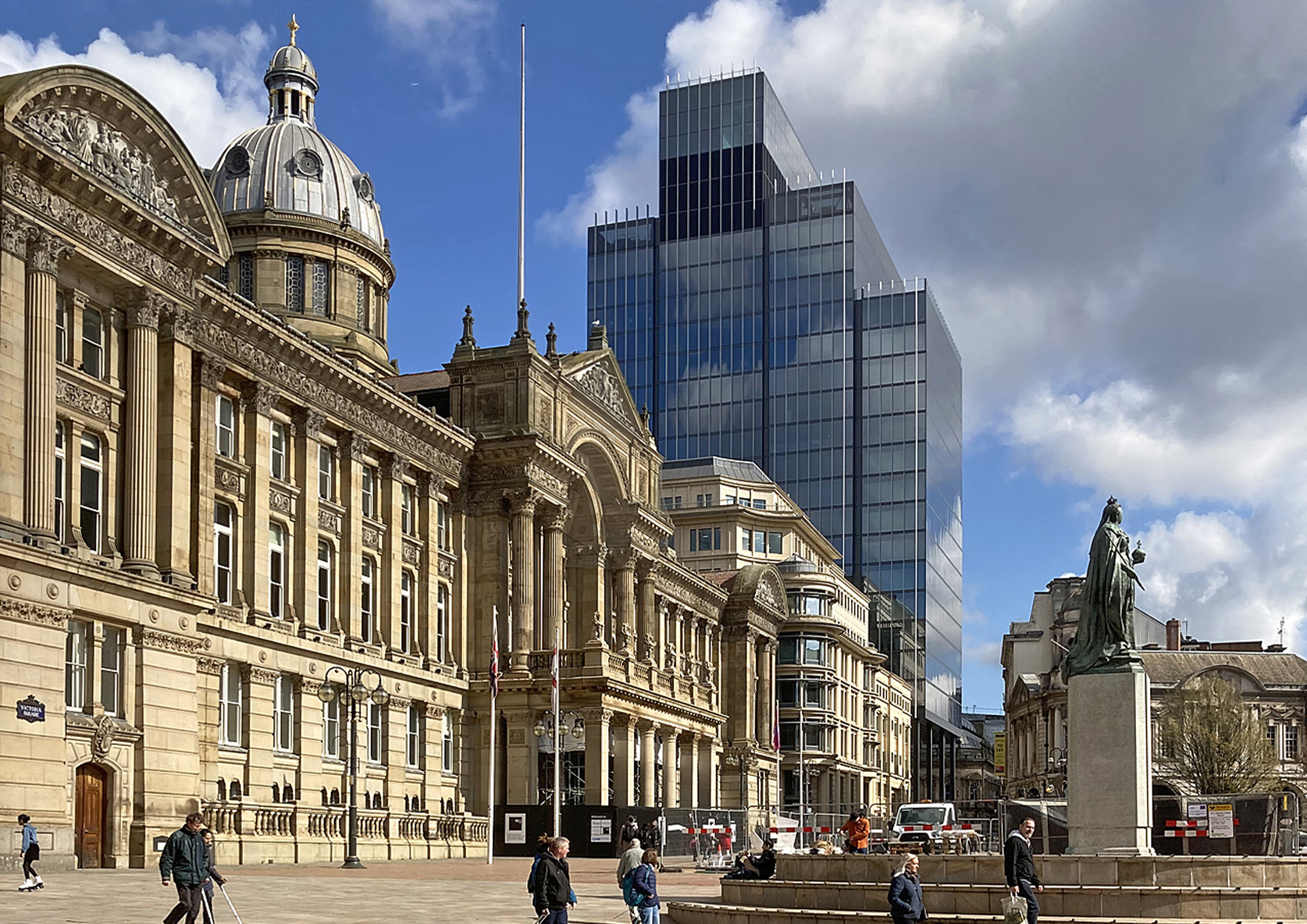
Birmingham (/ˈbɜːrmɪŋəm/ ⓘ BUR-ming-əm) is a city and metropolitan borough in the metropolitan county of West Midlands, within the wider West Midlands region, in England. It is the largest local authority district in England by population and the second-largest city in Britain – commonly referred to as the second city of the United Kingdom – with a population of 1.2 million people in the city proper in 2024. Birmingham borders the Black Country to its west and, together with the city of Wolverhampton and towns including Dudley and Solihull, forms the West Midlands conurbation. The royal town of Sutton Coldfield is incorporated within the city limits to the northeast. The urban area has a population of 2.7 million and the wider metropolitan area has a population of 4.3 million.
Located in the West Midlands region of England, Birmingham is considered to be the social, cultural, financial and commercial centre of the Midlands. It is just west of the traditional centre point of England at Meriden, and is the most inland major city in the country, lying north of the Cotswolds and east of the Shropshire Hills. Distinctively, Birmingham only has small rivers flowing through it, mainly the River Tame and its tributaries River Rea and River Cole – one of the closest main rivers is the Severn, approximately 20 miles (32 km) west of the city centre. The city does however have numerous canals, collectively named the Birmingham Canal Navigations.
Historically a market town in Warwickshire in the medieval period, Birmingham grew during the 18th century during the Midlands Enlightenment and during the Industrial Revolution, which saw advances in science, technology and economic development, producing a series of innovations that laid many of the foundations of modern industrial society. By 1791, it was being hailed as "the first manufacturing town in the world". Birmingham's distinctive economic profile, with thousands of small workshops practising a wide variety of specialised and highly skilled trades, encouraged exceptional levels of creativity and innovation; this provided an economic base for prosperity that was to last into the final quarter of the 20th century. The Watt steam engine was invented in Birmingham.
The resulting high level of social mobility also fostered a culture of political radicalism which, under leaders from Thomas Attwood to Joseph Chamberlain, was to give it a political influence unparalleled in Britain outside London and a pivotal role in the development of British democracy. From the summer of 1940 to the spring of 1943, Birmingham was bombed heavily by the German Luftwaffe in what is known as the Birmingham Blitz. The damage done to the city's infrastructure, in addition to a deliberate policy of demolition and new building by planners, led to extensive urban regeneration in subsequent decades.
Birmingham's economy is now dominated by the service sector. The city is a major international commercial centre and an important transport, retail, events and conference hub. Its metropolitan economy is the second-largest in the United Kingdom with a GDP of £95.94bn (2014[update]). Its five universities, including the University of Birmingham, make it the largest centre of higher education in the country outside London. Birmingham's major cultural institutions – the City of Birmingham Symphony Orchestra, Birmingham Royal Ballet, Birmingham Repertory Theatre, Library of Birmingham and Barber Institute of Fine Arts – enjoy international reputations, and the city has vibrant and influential grassroots art, music, literary and culinary scenes. Birmingham was the host city for the 2022 Commonwealth Games. In 2021, Birmingham was the third most visited city in the UK by people from foreign nations.
The name Birmingham comes from the Old English Beormingahām, meaning the home or settlement of the Beormingas – a tribe or clan whose name means 'Beorma's people' and which may have formed an early unit of Anglo-Saxon administration. Beorma, after whom the tribe was named, could have been its leader at the time of the Anglo-Saxon settlement, a shared ancestor, or a mythical tribal figurehead. Place names ending in -ingahām are characteristic of primary settlements established during the early phases of Anglo-Saxon colonisation of an area, suggesting that Birmingham was probably in existence by the early 7th century at the latest. Surrounding settlements with names ending in -tūn ('farm'), -lēah ('woodland clearing'), -worð ('enclosure') and -field ('open ground') are likely to be secondary settlements created by the later expansion of the Anglo-Saxon population, in some cases possibly on earlier British sites.
There is evidence of early human activity in the Birmingham area dating back to around 8000 BC, with Stone Age artefacts suggesting seasonal settlements, overnight hunting parties and woodland activities such as tree felling. The many burnt mounds that can still be seen around the city indicate that modern humans first intensively settled and cultivated the area during the Bronze Age, when a substantial but short-lived influx of population occurred between 1700 BC and 1000 BC, possibly caused by conflict or immigration in the surrounding area. During the 1st-century Roman conquest of Britain, the forested country of the Birmingham Plateau formed a barrier to the advancing Roman legions, who built the large Metchley Fort in the area of modern-day Edgbaston in AD 48, and made it the focus of a network of Roman roads. Birmingham was then later established by the Beormingas around the 6th or 7th century as a small settlement in the then heavily forested Arden region in Mercia.
The development of Birmingham into a significant urban and commercial centre began in 1166, when the Lord of the Manor Peter de Bermingham obtained a charter to hold a market at his castle, and followed this with the creation of a planned market town and seigneurial borough within his demesne or manorial estate, around the site that became the Bull Ring. This established Birmingham as the primary commercial centre for the Birmingham Plateau at a time when the area's economy was expanding rapidly, with population growth nationally leading to the clearance, cultivation and settlement of previously marginal land. Within a century of the charter Birmingham had grown into a prosperous urban centre of merchants and craftsmen. By 1327 it was the third-largest town in Warwickshire, a position it would retain for the next 200 years.
Hub AI
Birmingham AI simulator
(@Birmingham_simulator)
Birmingham
Birmingham (/ˈbɜːrmɪŋəm/ ⓘ BUR-ming-əm) is a city and metropolitan borough in the metropolitan county of West Midlands, within the wider West Midlands region, in England. It is the largest local authority district in England by population and the second-largest city in Britain – commonly referred to as the second city of the United Kingdom – with a population of 1.2 million people in the city proper in 2024. Birmingham borders the Black Country to its west and, together with the city of Wolverhampton and towns including Dudley and Solihull, forms the West Midlands conurbation. The royal town of Sutton Coldfield is incorporated within the city limits to the northeast. The urban area has a population of 2.7 million and the wider metropolitan area has a population of 4.3 million.
Located in the West Midlands region of England, Birmingham is considered to be the social, cultural, financial and commercial centre of the Midlands. It is just west of the traditional centre point of England at Meriden, and is the most inland major city in the country, lying north of the Cotswolds and east of the Shropshire Hills. Distinctively, Birmingham only has small rivers flowing through it, mainly the River Tame and its tributaries River Rea and River Cole – one of the closest main rivers is the Severn, approximately 20 miles (32 km) west of the city centre. The city does however have numerous canals, collectively named the Birmingham Canal Navigations.
Historically a market town in Warwickshire in the medieval period, Birmingham grew during the 18th century during the Midlands Enlightenment and during the Industrial Revolution, which saw advances in science, technology and economic development, producing a series of innovations that laid many of the foundations of modern industrial society. By 1791, it was being hailed as "the first manufacturing town in the world". Birmingham's distinctive economic profile, with thousands of small workshops practising a wide variety of specialised and highly skilled trades, encouraged exceptional levels of creativity and innovation; this provided an economic base for prosperity that was to last into the final quarter of the 20th century. The Watt steam engine was invented in Birmingham.
The resulting high level of social mobility also fostered a culture of political radicalism which, under leaders from Thomas Attwood to Joseph Chamberlain, was to give it a political influence unparalleled in Britain outside London and a pivotal role in the development of British democracy. From the summer of 1940 to the spring of 1943, Birmingham was bombed heavily by the German Luftwaffe in what is known as the Birmingham Blitz. The damage done to the city's infrastructure, in addition to a deliberate policy of demolition and new building by planners, led to extensive urban regeneration in subsequent decades.
Birmingham's economy is now dominated by the service sector. The city is a major international commercial centre and an important transport, retail, events and conference hub. Its metropolitan economy is the second-largest in the United Kingdom with a GDP of £95.94bn (2014[update]). Its five universities, including the University of Birmingham, make it the largest centre of higher education in the country outside London. Birmingham's major cultural institutions – the City of Birmingham Symphony Orchestra, Birmingham Royal Ballet, Birmingham Repertory Theatre, Library of Birmingham and Barber Institute of Fine Arts – enjoy international reputations, and the city has vibrant and influential grassroots art, music, literary and culinary scenes. Birmingham was the host city for the 2022 Commonwealth Games. In 2021, Birmingham was the third most visited city in the UK by people from foreign nations.
The name Birmingham comes from the Old English Beormingahām, meaning the home or settlement of the Beormingas – a tribe or clan whose name means 'Beorma's people' and which may have formed an early unit of Anglo-Saxon administration. Beorma, after whom the tribe was named, could have been its leader at the time of the Anglo-Saxon settlement, a shared ancestor, or a mythical tribal figurehead. Place names ending in -ingahām are characteristic of primary settlements established during the early phases of Anglo-Saxon colonisation of an area, suggesting that Birmingham was probably in existence by the early 7th century at the latest. Surrounding settlements with names ending in -tūn ('farm'), -lēah ('woodland clearing'), -worð ('enclosure') and -field ('open ground') are likely to be secondary settlements created by the later expansion of the Anglo-Saxon population, in some cases possibly on earlier British sites.
There is evidence of early human activity in the Birmingham area dating back to around 8000 BC, with Stone Age artefacts suggesting seasonal settlements, overnight hunting parties and woodland activities such as tree felling. The many burnt mounds that can still be seen around the city indicate that modern humans first intensively settled and cultivated the area during the Bronze Age, when a substantial but short-lived influx of population occurred between 1700 BC and 1000 BC, possibly caused by conflict or immigration in the surrounding area. During the 1st-century Roman conquest of Britain, the forested country of the Birmingham Plateau formed a barrier to the advancing Roman legions, who built the large Metchley Fort in the area of modern-day Edgbaston in AD 48, and made it the focus of a network of Roman roads. Birmingham was then later established by the Beormingas around the 6th or 7th century as a small settlement in the then heavily forested Arden region in Mercia.
The development of Birmingham into a significant urban and commercial centre began in 1166, when the Lord of the Manor Peter de Bermingham obtained a charter to hold a market at his castle, and followed this with the creation of a planned market town and seigneurial borough within his demesne or manorial estate, around the site that became the Bull Ring. This established Birmingham as the primary commercial centre for the Birmingham Plateau at a time when the area's economy was expanding rapidly, with population growth nationally leading to the clearance, cultivation and settlement of previously marginal land. Within a century of the charter Birmingham had grown into a prosperous urban centre of merchants and craftsmen. By 1327 it was the third-largest town in Warwickshire, a position it would retain for the next 200 years.
Recent media