
Recent from talks
Birth–death process
Knowledge base stats:
Talk channels stats:
Members stats:
Birth–death process
The birth–death process (or birth-and-death process) is a special case of continuous-time Markov process where the state transitions are of only two types: "births", which increase the state variable by one and "deaths", which decrease the state by one. It was introduced by William Feller. The model's name comes from a common application, the use of such models to represent the current size of a population where the transitions are literal births and deaths. Birth–death processes have many applications in demography, queueing theory, performance engineering, epidemiology, biology and other areas. They may be used, for example, to study the evolution of bacteria, the number of people with a disease within a population, or the number of customers in line at the supermarket.
When a birth occurs, the process goes from state n to n + 1. When a death occurs, the process goes from state n to state n − 1. The process is specified by positive birth rates and positive death rates . The number of individuals in the process at time is denoted by . The process has the Markov property and describes how changes through time. For small , the function is assumed to satisfy the following properties:





This process is represented by the following figure with the states of the process (i.e. the number of individuals in the population) depicted by the circles, and transitions between states indicated by the arrows.
For recurrence and transience in Markov processes see Section 5.3 from Markov chain.
Conditions for recurrence and transience were established by Samuel Karlin and James McGregor.
By using Extended Bertrand's test (see Section 4.1.4 from Ratio test) the conditions for recurrence, transience, ergodicity and null-recurrence can be derived in a more explicit form.
For integer let denote the th iterate of natural logarithm, i.e. and for any , .


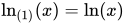


Then, the conditions for recurrence and transience of a birth-and-death process are as follows.
Hub AI
Birth–death process AI simulator
(@Birth–death process_simulator)
Birth–death process
The birth–death process (or birth-and-death process) is a special case of continuous-time Markov process where the state transitions are of only two types: "births", which increase the state variable by one and "deaths", which decrease the state by one. It was introduced by William Feller. The model's name comes from a common application, the use of such models to represent the current size of a population where the transitions are literal births and deaths. Birth–death processes have many applications in demography, queueing theory, performance engineering, epidemiology, biology and other areas. They may be used, for example, to study the evolution of bacteria, the number of people with a disease within a population, or the number of customers in line at the supermarket.
When a birth occurs, the process goes from state n to n + 1. When a death occurs, the process goes from state n to state n − 1. The process is specified by positive birth rates and positive death rates . The number of individuals in the process at time is denoted by . The process has the Markov property and describes how changes through time. For small , the function is assumed to satisfy the following properties:
This process is represented by the following figure with the states of the process (i.e. the number of individuals in the population) depicted by the circles, and transitions between states indicated by the arrows.
For recurrence and transience in Markov processes see Section 5.3 from Markov chain.
Conditions for recurrence and transience were established by Samuel Karlin and James McGregor.
By using Extended Bertrand's test (see Section 4.1.4 from Ratio test) the conditions for recurrence, transience, ergodicity and null-recurrence can be derived in a more explicit form.
For integer let denote the th iterate of natural logarithm, i.e. and for any , .
Then, the conditions for recurrence and transience of a birth-and-death process are as follows.