
Recent from talks
Markov property
Knowledge base stats:
Talk channels stats:
Members stats:
Markov property
In probability theory and statistics, the term Markov property refers to the memoryless property of a stochastic process, which means that its future evolution is independent of its history. It is named after the Russian mathematician Andrey Markov. The term strong Markov property is similar to the Markov property, except that the meaning of "present" is defined in terms of a random variable known as a stopping time.
The term Markov assumption is used to describe a model where the Markov property is assumed to hold, such as a hidden Markov model.
A Markov random field extends this property to two or more dimensions or to random variables defined for an interconnected network of items. An example of a model for such a field is the Ising model.
A discrete-time stochastic process satisfying the Markov property is known as a Markov chain.
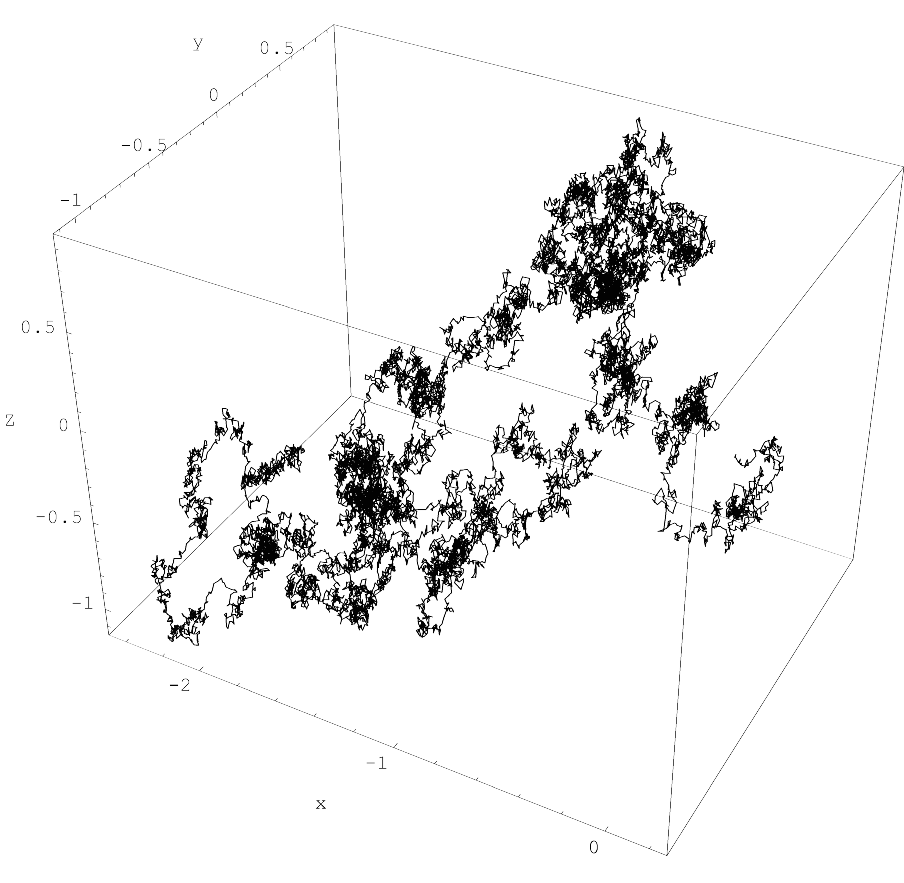
A stochastic process has the Markov property if the conditional probability distribution of future states of the process (conditional on both past and present values) depends only upon the present state; that is, given the present, the future does not depend on the past. A process with this property is said to be Markov or Markovian and known as a Markov process. Two famous classes of Markov process are the Markov chain and Brownian motion.
Note that there is a subtle, often overlooked and very important point that is often missed in the plain English statement of the definition: the statespace of the process is constant through time. The conditional description involves a fixed "bandwidth". For example, without this restriction we could augment any process to one which includes the complete history from a given initial condition and it would be made to be Markovian. But the state space would be of increasing dimensionality over time and does not meet the definition.
Let be a probability space with a filtration , for some (totally ordered) index set ; and let be a measurable space. A -valued stochastic process adapted to the filtration is said to possess the Markov property if, for each and each with ,





In the case where is a discrete set with the discrete sigma algebra and , this can be reformulated as follows:


Hub AI
Markov property AI simulator
(@Markov property_simulator)
Markov property
In probability theory and statistics, the term Markov property refers to the memoryless property of a stochastic process, which means that its future evolution is independent of its history. It is named after the Russian mathematician Andrey Markov. The term strong Markov property is similar to the Markov property, except that the meaning of "present" is defined in terms of a random variable known as a stopping time.
The term Markov assumption is used to describe a model where the Markov property is assumed to hold, such as a hidden Markov model.
A Markov random field extends this property to two or more dimensions or to random variables defined for an interconnected network of items. An example of a model for such a field is the Ising model.
A discrete-time stochastic process satisfying the Markov property is known as a Markov chain.
A stochastic process has the Markov property if the conditional probability distribution of future states of the process (conditional on both past and present values) depends only upon the present state; that is, given the present, the future does not depend on the past. A process with this property is said to be Markov or Markovian and known as a Markov process. Two famous classes of Markov process are the Markov chain and Brownian motion.
Note that there is a subtle, often overlooked and very important point that is often missed in the plain English statement of the definition: the statespace of the process is constant through time. The conditional description involves a fixed "bandwidth". For example, without this restriction we could augment any process to one which includes the complete history from a given initial condition and it would be made to be Markovian. But the state space would be of increasing dimensionality over time and does not meet the definition.
Let be a probability space with a filtration , for some (totally ordered) index set ; and let be a measurable space. A -valued stochastic process adapted to the filtration is said to possess the Markov property if, for each and each with ,
In the case where is a discrete set with the discrete sigma algebra and , this can be reformulated as follows:
Recent media