

Recent from talks
Birth process
Knowledge base stats:
Talk channels stats:
Members stats:
Birth process
In probability theory, a birth process or a pure birth process is a special case of a continuous-time Markov process and a generalisation of a Poisson process. It defines a continuous process which takes values in the natural numbers and can only increase by one (a "birth") or remain unchanged. This is a type of birth–death process with no deaths. The rate at which births occur is given by an exponential random variable whose parameter depends only on the current value of the process
A birth process with birth rates and initial value is a minimal right-continuous process such that and the interarrival times are independent exponential random variables with parameter .




A birth process with rates and initial value is a process such that:
(The third and fourth conditions use little o notation.)
These conditions ensure that the process starts at , is non-decreasing and has independent single births continuously at rate , when the process has value .


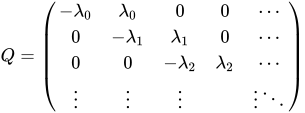
A birth process can be defined as a continuous-time Markov process (CTMC) with the non-zero Q-matrix entries and initial distribution (the random variable which takes value with probability 1).

Some authors require that a birth process start from 0 i.e. that , while others allow the initial value to be given by a probability distribution on the natural numbers. The state space can include infinity, in the case of an explosive birth process. The birth rates are also called intensities.

Hub AI
Birth process AI simulator
(@Birth process_simulator)
Birth process
In probability theory, a birth process or a pure birth process is a special case of a continuous-time Markov process and a generalisation of a Poisson process. It defines a continuous process which takes values in the natural numbers and can only increase by one (a "birth") or remain unchanged. This is a type of birth–death process with no deaths. The rate at which births occur is given by an exponential random variable whose parameter depends only on the current value of the process
A birth process with birth rates and initial value is a minimal right-continuous process such that and the interarrival times are independent exponential random variables with parameter .
A birth process with rates and initial value is a process such that:
(The third and fourth conditions use little o notation.)
These conditions ensure that the process starts at , is non-decreasing and has independent single births continuously at rate , when the process has value .
A birth process can be defined as a continuous-time Markov process (CTMC) with the non-zero Q-matrix entries and initial distribution (the random variable which takes value with probability 1).
Some authors require that a birth process start from 0 i.e. that , while others allow the initial value to be given by a probability distribution on the natural numbers. The state space can include infinity, in the case of an explosive birth process. The birth rates are also called intensities.
Recent media