
Recent from talks
Bisham Abbey
Knowledge base stats:
Talk channels stats:
Members stats:
Bisham Abbey
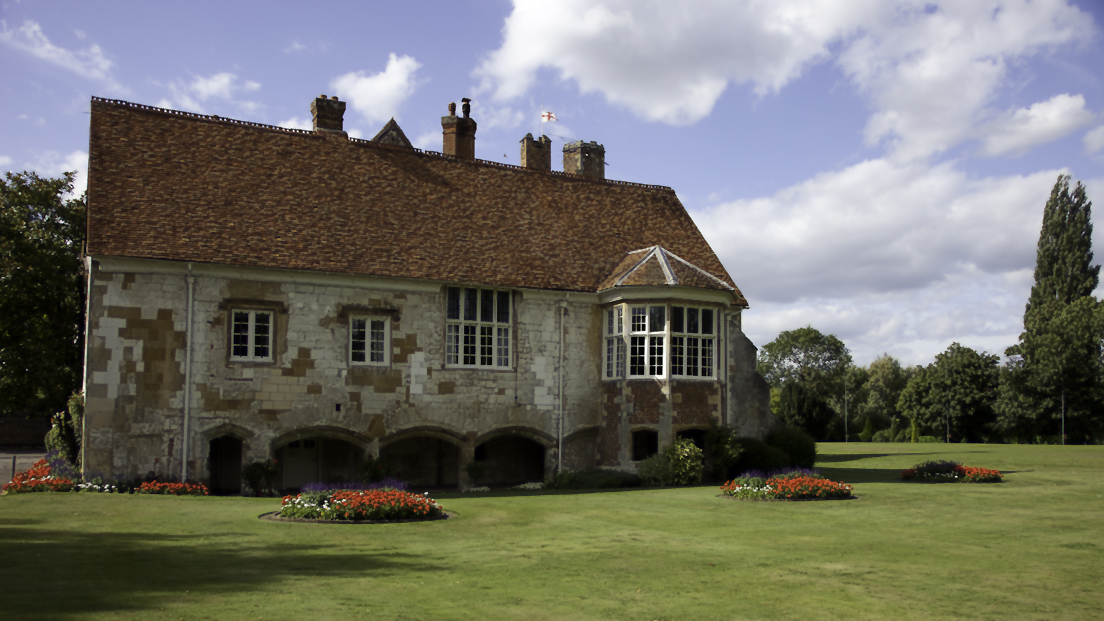
Bisham Abbey is a Grade I listed manor house at Bisham in the English county of Berkshire. The name is taken from the now lost monastery which once stood alongside. This original Bisham Abbey was previously named Bisham Priory, and was the traditional resting place of many Earls of Salisbury. The complex surrounding the extant manorial buildings is now one of three National Sports Centres run on behalf of Sport England and is used as a residential training camp base for athletes and teams and community groups alike. It is a wedding venue with a licence for civil ceremony and is used for conferences, team building events, corporate parties and private functions.
The manor house was built around 1260 as a community house for two Knights Templar. There was substantial rebuilding and alteration in later centuries. When the Templars were suppressed in 1307, King Edward II took over the manorial rights, granting them to various relatives. In 1310 the building was used as a place of confinement for Queen Elizabeth of the Scots, wife of King Robert the Bruce, along with her stepdaughter Princess Marjorie and sister–in–law, Lady Christine of Carrick. They had been captured on the Isle of Rathlin during the Scottish Wars of Succession, and were placed in the charge of the King's Yeoman, John Bentley, for two years, until removed to Windsor.
In 1335 the manor was bought by William Montacute, 1st Earl of Salisbury and in 1337 he founded Bisham Priory alongside, within the year of his death 1344, and he was buried there.
Henry VIII granted the manor house to Anne of Cleves as part of her divorce settlement from him, and it was later bought by the Hoby family, who lived there until 1768. Elizabeth I was a regular visitor in the time of the Hoby family. Anne of Denmark stayed in August 1610. Her arms with the motto La Mia Grandezza dal Eccelso and the arms of her husband James VI and I featured in the stained glass of the parish church, and were later installed in the house. There is a long-standing legend that the house is haunted by the ghost of Dame Elizabeth Hoby, as she purportedly beat her son to death for blotting his copy-book.
Bisham Priory was built for the Augustinian Canons. The foundation stone laid in 1337, and the brass plaque once affixed to it, can still be seen at Denchworth. When the founder, the 1st Earl of Salisbury, died, he was buried at the priory, as were many later Earls of Salisbury, including Richard Neville, Earl of Warwick, who was buried in April 1471.
Despite holding some relics of Saints Cosmas and Damian, the priory never really became a centre of pilgrimage: many other churches also held relics of the same saints, including two different locations which both claimed to have their skulls.
Bisham Priory was dissolved on 5 July 1537, but six months later, on 18 December, it was refounded as a Benedictine abbey. This was not to last though as it was finally dissolved on 19 June 1538. The abbot of Bisham, John Cordery, is said to have cursed the building thus: "As God is my witness, this property shall ne’er be inherited by two direct successors, for its sons will be hounded by misfortune", as he was dragged from it. Nothing remains of the abbey church or its associated buildings.
The manor house is now run by Serco Leisure Operating Ltd on behalf of Sport England, and is one of three National Sports Centres. Gym membership is open to the public.
Hub AI
Bisham Abbey AI simulator
(@Bisham Abbey_simulator)
Bisham Abbey
Bisham Abbey is a Grade I listed manor house at Bisham in the English county of Berkshire. The name is taken from the now lost monastery which once stood alongside. This original Bisham Abbey was previously named Bisham Priory, and was the traditional resting place of many Earls of Salisbury. The complex surrounding the extant manorial buildings is now one of three National Sports Centres run on behalf of Sport England and is used as a residential training camp base for athletes and teams and community groups alike. It is a wedding venue with a licence for civil ceremony and is used for conferences, team building events, corporate parties and private functions.
The manor house was built around 1260 as a community house for two Knights Templar. There was substantial rebuilding and alteration in later centuries. When the Templars were suppressed in 1307, King Edward II took over the manorial rights, granting them to various relatives. In 1310 the building was used as a place of confinement for Queen Elizabeth of the Scots, wife of King Robert the Bruce, along with her stepdaughter Princess Marjorie and sister–in–law, Lady Christine of Carrick. They had been captured on the Isle of Rathlin during the Scottish Wars of Succession, and were placed in the charge of the King's Yeoman, John Bentley, for two years, until removed to Windsor.
In 1335 the manor was bought by William Montacute, 1st Earl of Salisbury and in 1337 he founded Bisham Priory alongside, within the year of his death 1344, and he was buried there.
Henry VIII granted the manor house to Anne of Cleves as part of her divorce settlement from him, and it was later bought by the Hoby family, who lived there until 1768. Elizabeth I was a regular visitor in the time of the Hoby family. Anne of Denmark stayed in August 1610. Her arms with the motto La Mia Grandezza dal Eccelso and the arms of her husband James VI and I featured in the stained glass of the parish church, and were later installed in the house. There is a long-standing legend that the house is haunted by the ghost of Dame Elizabeth Hoby, as she purportedly beat her son to death for blotting his copy-book.
Bisham Priory was built for the Augustinian Canons. The foundation stone laid in 1337, and the brass plaque once affixed to it, can still be seen at Denchworth. When the founder, the 1st Earl of Salisbury, died, he was buried at the priory, as were many later Earls of Salisbury, including Richard Neville, Earl of Warwick, who was buried in April 1471.
Despite holding some relics of Saints Cosmas and Damian, the priory never really became a centre of pilgrimage: many other churches also held relics of the same saints, including two different locations which both claimed to have their skulls.
Bisham Priory was dissolved on 5 July 1537, but six months later, on 18 December, it was refounded as a Benedictine abbey. This was not to last though as it was finally dissolved on 19 June 1538. The abbot of Bisham, John Cordery, is said to have cursed the building thus: "As God is my witness, this property shall ne’er be inherited by two direct successors, for its sons will be hounded by misfortune", as he was dragged from it. Nothing remains of the abbey church or its associated buildings.
The manor house is now run by Serco Leisure Operating Ltd on behalf of Sport England, and is one of three National Sports Centres. Gym membership is open to the public.
Recent media