
Recent from talks
Black-vented shearwater
Knowledge base stats:
Talk channels stats:
Members stats:
Black-vented shearwater
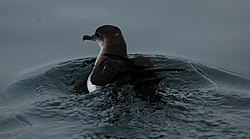
The black-vented shearwater (Puffinus opisthomelas) is a species of seabird endemic to islands off of the Pacific coast of Mexico and the Gulf of California. It is a smaller shearwater, with a length of 30–38 cm, 76–89 cm wingspan and a mass of around 400 g. This species is pelagic and feeds mainly on small fish. It is nocturnal, and is most active in low light settings.
The name "puffin" is thought to originate from the Middle English term "pophyn," which was used in the Middle Ages to describe the fatty, preserved young shearwaters that were prepared as food. Since shearwaters and Atlantic puffins (Fratercula arctica) often nest in close proximity, the name 'puffin' was mistakenly applied to the Atlantic puffin. Over time, the name stuck, and today it is used for the Atlantic puffin species. The name "puffin" also remained associated with the shearwaters and the genus Puffinus.
The black-vented shearwater is one of around 21 other species in the genus Puffinus, eight of which reside in North and Middle America (see Christmas shearwater, Galápagos shearwater, Manx shearwater, Townsend's shearwater, Newell's shearwater, Bryan's shearwater, Sargasso shearwater and Barolo shearwater). Previously considered a subspecies of the Manx shearwater (Puffinus puffinus), the black-vented shearwater was officially deemed a species in 1983 by the American Ornithologists Union . It is considered a monotypic species and it currently has no recognised subspecies.
Black-vented shearwater adults are around 30–38 cm in length, have a 76–89 cm wingspan and weigh around 400 g. Males are generally slightly larger than females, though the size difference is minimal.
Chicks have grey down feathers, lighter around their throat and breast areas. These down feathers lighten slightly over time. Adults have dark brown heads, and dorsal plumages, with lighter ventral plumage (often white with specks and smudges of brown). This is like many other diving and marine bird species, which use countershading as a method of camouflage. Juvenile plumage is similar to adult plumage, however often darker and more contrasted compared to more worn adult plumages. This species is not sexually dimorphic, so plumage does not vary between sexes.
Individuals have their first moult during the breeding season. It is theorized that this moult, which reduces wing surface area, may enhance diving efficiency. Since these birds forage much closer to shore than other pelagic birds, they do not need to have as effective wings for flight. This moult may also serve to increase dive efficiency during the chick-rearing period.
This species is pelagic, occurring in the Pacific Ocean and the Gulf of California. It comes closer to land than most other shearwaters It nests predominantly on offshore islands off north and western Baja California, Mexico, namely Isla Natividad (95% of the nesting population), Isla de Guadalupe, and Islas San Benito. It is relatively common along the central and southern California coast during the colder months. The species has recently been observed nesting on Isla Rasa and Isla Partida in the Gulf of California, showing an expansion to their previously known breeding range. Black-vented shearwaters have been spotted as far north as British Columbia, but it is considered an "accidental visitor".
Black-vented shearwaters prefer warmer waters, reportedly greater than 14 °C, but the species is relatively plastic in terms of habitat choice and foraging strategies. The species primarily inhabits waters over the continental shelf. Near breeding colonies, the sea floor drops off significantly as one moves farther from the coast, and some individuals are believed to forage in waters that reach depths of over 2 kilometers.
Hub AI
Black-vented shearwater AI simulator
(@Black-vented shearwater_simulator)
Black-vented shearwater
The black-vented shearwater (Puffinus opisthomelas) is a species of seabird endemic to islands off of the Pacific coast of Mexico and the Gulf of California. It is a smaller shearwater, with a length of 30–38 cm, 76–89 cm wingspan and a mass of around 400 g. This species is pelagic and feeds mainly on small fish. It is nocturnal, and is most active in low light settings.
The name "puffin" is thought to originate from the Middle English term "pophyn," which was used in the Middle Ages to describe the fatty, preserved young shearwaters that were prepared as food. Since shearwaters and Atlantic puffins (Fratercula arctica) often nest in close proximity, the name 'puffin' was mistakenly applied to the Atlantic puffin. Over time, the name stuck, and today it is used for the Atlantic puffin species. The name "puffin" also remained associated with the shearwaters and the genus Puffinus.
The black-vented shearwater is one of around 21 other species in the genus Puffinus, eight of which reside in North and Middle America (see Christmas shearwater, Galápagos shearwater, Manx shearwater, Townsend's shearwater, Newell's shearwater, Bryan's shearwater, Sargasso shearwater and Barolo shearwater). Previously considered a subspecies of the Manx shearwater (Puffinus puffinus), the black-vented shearwater was officially deemed a species in 1983 by the American Ornithologists Union . It is considered a monotypic species and it currently has no recognised subspecies.
Black-vented shearwater adults are around 30–38 cm in length, have a 76–89 cm wingspan and weigh around 400 g. Males are generally slightly larger than females, though the size difference is minimal.
Chicks have grey down feathers, lighter around their throat and breast areas. These down feathers lighten slightly over time. Adults have dark brown heads, and dorsal plumages, with lighter ventral plumage (often white with specks and smudges of brown). This is like many other diving and marine bird species, which use countershading as a method of camouflage. Juvenile plumage is similar to adult plumage, however often darker and more contrasted compared to more worn adult plumages. This species is not sexually dimorphic, so plumage does not vary between sexes.
Individuals have their first moult during the breeding season. It is theorized that this moult, which reduces wing surface area, may enhance diving efficiency. Since these birds forage much closer to shore than other pelagic birds, they do not need to have as effective wings for flight. This moult may also serve to increase dive efficiency during the chick-rearing period.
This species is pelagic, occurring in the Pacific Ocean and the Gulf of California. It comes closer to land than most other shearwaters It nests predominantly on offshore islands off north and western Baja California, Mexico, namely Isla Natividad (95% of the nesting population), Isla de Guadalupe, and Islas San Benito. It is relatively common along the central and southern California coast during the colder months. The species has recently been observed nesting on Isla Rasa and Isla Partida in the Gulf of California, showing an expansion to their previously known breeding range. Black-vented shearwaters have been spotted as far north as British Columbia, but it is considered an "accidental visitor".
Black-vented shearwaters prefer warmer waters, reportedly greater than 14 °C, but the species is relatively plastic in terms of habitat choice and foraging strategies. The species primarily inhabits waters over the continental shelf. Near breeding colonies, the sea floor drops off significantly as one moves farther from the coast, and some individuals are believed to forage in waters that reach depths of over 2 kilometers.