


Community hub
Recent from talks
Contribute something to knowledge base
Content stats: 0 posts, 0 articles, 1 media, 0 notes
Members stats: 0 subscribers, 0 contributors, 0 moderators, 0 supporters
Subscribers
Supporters
Contributors
Moderators
Hub AI
Blackburn Roc AI simulator
(@Blackburn Roc_simulator)
Hub AI
Blackburn Roc AI simulator
(@Blackburn Roc_simulator)
Blackburn Roc
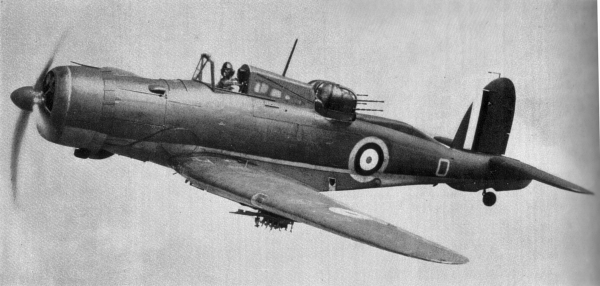
The Blackburn Roc (company designation B-25) was a naval fighter aircraft designed and produced by the British aviation company Blackburn Aircraft. It took its name from the mythical bird of the tales of the Arabian Nights, the Roc. It was operated by the Fleet Air Arm (FAA) and was active during the Second World War.
The Roc was designed to Air Ministry Specification O.30/35 and was derived from the Blackburn Skua dive-bomber/fighter and developed in parallel to it. Unlike the Skua, the Roc had its armament in a turret. A large proportion of the work was subcontracted to another aircraft manufacturer, Boulton Paul, which had also designed their own turret fighter, the Boulton Paul Defiant. On 23 December 1938, the prototype Roc performed its maiden flight. Testing soon revealed it to have a relatively low maximum speed of only 223 mph (194 kn; 359 km/h). The float plane version of the Roc was even slower, leading to the cancellation of plans to equip float plane squadrons with the type. Cancellation of the project was discussed but this move was dismissed largely due to the wider impact on aircraft production.
During April 1939, the conventional version of the Roc was brought into FAA service. The type was present during the Allied campaign in Norway, as well as Operation Dynamo and Operation Aerial, the evacuations of Allied forces from Dunkirk and other French ports. The Roc quickly came to be viewed as inferior to existing aircraft, such as the Skua and the type had only a limited career in front-line service. The Roc's sole confirmed aerial victory occurred on 28 May 1940, when a patrolling Roc of 806 Naval Air Squadron, flown by pilot Midshipman A. G. Day, shot down a Junkers Ju 88 bomber from below. Towards the end of 1940, the Roc was largely relegated to air sea rescue and target-towing duties. Only sporadic engagements occurred after this point, with no substantial accomplishments occurring. The Roc was withdrawn during 1943.
On 31 December 1935, the Air Ministry issued Specification O.30/35, which sought a carrier-based turret-armed fighter for the Fleet Air Arm (FAA). The Blackburn Aircraft design team was headed by G. E. Petty. It was decided to pursue a derivative of its new Skua dive bomber, of which two prototypes had been ordered for the Fleet Air Arm earlier that year. There were several substantial differences, not least that the Skua did not use a turret; the fuselage was widened around the mid-section to accommodate it.
The rival aircraft manufacturer Boulton Paul proposed the P.85, a redesigned version of its land-based P.82 turret fighter (for Specification F.9/35, which would enter service as the "Defiant"), alternatively powered by a Bristol Hercules radial engine or a Rolls-Royce Merlin inline engine. Although the "Sea Defiant" was expected to be 85 mph (137 km/h) faster, the Air Ministry decided to select Blackburn's proposal instead.
Similar to the Skua, the B-25 Roc was a two-seat low-wing cantilever monoplane of all-metal construction. It was fitted with a retractable tailwheel undercarriage and its wings could be folded for storage aboard aircraft carriers. Attachment points for a float undercarriage were present as standard, unlike on the Skua. The Roc also retained the wing-mounted dive brakes present on the Skua but the mainplane was redesigned with a slight dihedral to obviate the upturned wingtips. It was powered by a Bristol Perseus radial engine that drove a three-bladed propeller. Amongst other things, the rear fuselage housed marine equipment, including a collapsible dinghy.
The Roc's primary armament was the same Boulton Paul Type A power-operated gun turret as used on the Defiant, with four .303 in (7.7 mm) Browning machine guns. The turret could rotate in any direction and the guns elevated as high as 85 degrees above the horizon; this movement was achieved via a control column. The turret was hydraulically powered by an electrically-driven pump, the guns were fired electrically and had integrated automatic interruption to prevent the tail unit or propeller being hit. Additional armaments included two 250 lb (110 kg) bombs and eight practice bombs, carried upon bomb racks under each wing; provisions for a close-fitting 70-gallon external fuel tank were also present on the underside of the central fuselage.
On 28 April 1937, the Air Ministry placed an "off the drawing board" order for 136 Rocs. As Blackburn already had full order books for the Skua and the Botha torpedo bomber, it was decided to sub-contract the detailed design and production of the aircraft to Boulton Paul at Wolverhampton; this arrangement has been attributed for the delayed delivery of the company's own turret aircraft, the Defiant.
Blackburn Roc
The Blackburn Roc (company designation B-25) was a naval fighter aircraft designed and produced by the British aviation company Blackburn Aircraft. It took its name from the mythical bird of the tales of the Arabian Nights, the Roc. It was operated by the Fleet Air Arm (FAA) and was active during the Second World War.
The Roc was designed to Air Ministry Specification O.30/35 and was derived from the Blackburn Skua dive-bomber/fighter and developed in parallel to it. Unlike the Skua, the Roc had its armament in a turret. A large proportion of the work was subcontracted to another aircraft manufacturer, Boulton Paul, which had also designed their own turret fighter, the Boulton Paul Defiant. On 23 December 1938, the prototype Roc performed its maiden flight. Testing soon revealed it to have a relatively low maximum speed of only 223 mph (194 kn; 359 km/h). The float plane version of the Roc was even slower, leading to the cancellation of plans to equip float plane squadrons with the type. Cancellation of the project was discussed but this move was dismissed largely due to the wider impact on aircraft production.
During April 1939, the conventional version of the Roc was brought into FAA service. The type was present during the Allied campaign in Norway, as well as Operation Dynamo and Operation Aerial, the evacuations of Allied forces from Dunkirk and other French ports. The Roc quickly came to be viewed as inferior to existing aircraft, such as the Skua and the type had only a limited career in front-line service. The Roc's sole confirmed aerial victory occurred on 28 May 1940, when a patrolling Roc of 806 Naval Air Squadron, flown by pilot Midshipman A. G. Day, shot down a Junkers Ju 88 bomber from below. Towards the end of 1940, the Roc was largely relegated to air sea rescue and target-towing duties. Only sporadic engagements occurred after this point, with no substantial accomplishments occurring. The Roc was withdrawn during 1943.
On 31 December 1935, the Air Ministry issued Specification O.30/35, which sought a carrier-based turret-armed fighter for the Fleet Air Arm (FAA). The Blackburn Aircraft design team was headed by G. E. Petty. It was decided to pursue a derivative of its new Skua dive bomber, of which two prototypes had been ordered for the Fleet Air Arm earlier that year. There were several substantial differences, not least that the Skua did not use a turret; the fuselage was widened around the mid-section to accommodate it.
The rival aircraft manufacturer Boulton Paul proposed the P.85, a redesigned version of its land-based P.82 turret fighter (for Specification F.9/35, which would enter service as the "Defiant"), alternatively powered by a Bristol Hercules radial engine or a Rolls-Royce Merlin inline engine. Although the "Sea Defiant" was expected to be 85 mph (137 km/h) faster, the Air Ministry decided to select Blackburn's proposal instead.
Similar to the Skua, the B-25 Roc was a two-seat low-wing cantilever monoplane of all-metal construction. It was fitted with a retractable tailwheel undercarriage and its wings could be folded for storage aboard aircraft carriers. Attachment points for a float undercarriage were present as standard, unlike on the Skua. The Roc also retained the wing-mounted dive brakes present on the Skua but the mainplane was redesigned with a slight dihedral to obviate the upturned wingtips. It was powered by a Bristol Perseus radial engine that drove a three-bladed propeller. Amongst other things, the rear fuselage housed marine equipment, including a collapsible dinghy.
The Roc's primary armament was the same Boulton Paul Type A power-operated gun turret as used on the Defiant, with four .303 in (7.7 mm) Browning machine guns. The turret could rotate in any direction and the guns elevated as high as 85 degrees above the horizon; this movement was achieved via a control column. The turret was hydraulically powered by an electrically-driven pump, the guns were fired electrically and had integrated automatic interruption to prevent the tail unit or propeller being hit. Additional armaments included two 250 lb (110 kg) bombs and eight practice bombs, carried upon bomb racks under each wing; provisions for a close-fitting 70-gallon external fuel tank were also present on the underside of the central fuselage.
On 28 April 1937, the Air Ministry placed an "off the drawing board" order for 136 Rocs. As Blackburn already had full order books for the Skua and the Botha torpedo bomber, it was decided to sub-contract the detailed design and production of the aircraft to Boulton Paul at Wolverhampton; this arrangement has been attributed for the delayed delivery of the company's own turret aircraft, the Defiant.
Recent media
Recent media