
Recent from talks
Bladesmith
Knowledge base stats:
Talk channels stats:
Members stats:
Bladesmith
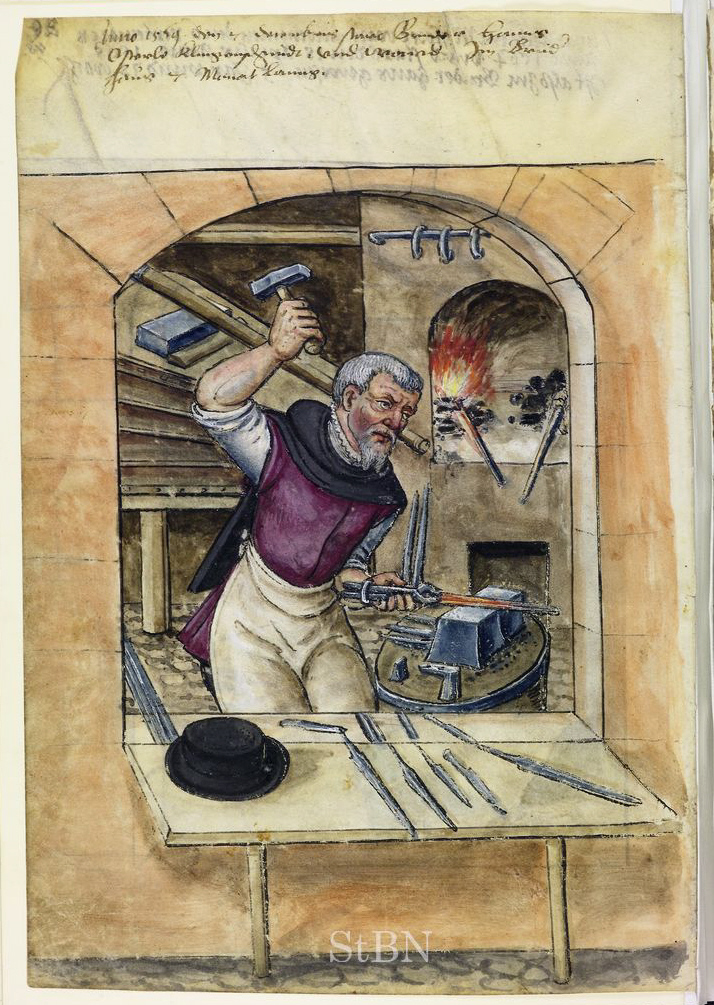
Bladesmithing is the art of making knives, swords, daggers and other blades using a forge, hammer, anvil, and other smithing tools. Bladesmiths employ a variety of metalworking techniques similar to those used by blacksmiths, as well as woodworking for knife and sword handles, and often leatherworking for sheaths. Bladesmithing is an art that is thousands of years old and found in cultures as diverse as China, Japan, India, Germany, Korea, the Middle East, Spain and the British Isles. As with any art shrouded in history, there are myths and misconceptions about the process. While traditionally bladesmithing referred to the manufacture of any blade by any means, the majority of contemporary craftsmen referred to as bladesmiths are those who primarily manufacture blades by means of using a forge to shape the blade as opposed to knifemakers who form blades by use of the stock removal method, although there is some overlap between both crafts.
Many blade smiths were known by other titles according to the kind of blade that they produced:
Historically speaking, bladesmithing is an art that has survived and thrived over thousands of years. Many different parts of the world have different styles of bladesmithing, some more well-known than others.
Ancient Egyptians referred to iron as "copper from the heavens" because their lack of smelting technology limited their accessible iron supplies to what little native iron they could recover from meteorites. Despite iron's rarity, they gained enough familiarity with ironworking techniques to have used wrought iron in the manufacture of swords and blades as early as 3000 BC. They exported this technique to Assyria, Babylon and Greece through trade and as they conquered other lands and were conquered themselves.
The Proto-Celtic Hallstatt culture (8th century BC) were among the earliest users of iron swords. During the Hallstatt period, they made swords both in bronze as well as iron with rounded tips. Toward the end of the Hallstatt period, around 600-500BC, these swords were replaced with short daggers. The La Tene culture reintroduced the sword, which were very different from the traditional shape and construction of the Bronze Age and early Iron Age, characterized by a more pointed tip.
Traditional Chinese blades (jians) are usually of sanmei (three plate) construction, which involved sandwiching a core of hard steel between two plates of softer steel. The central plate protrudes slightly from its surrounding pieces, allowing for a sharp edge, while the softer spine protects the brittle core. Some blades had wumei or five plate construction, with two more soft plates being used at the central ridge. Bronze jian were often made in a somewhat similar manner: in this case an alloy with a high copper content would be used to make a resilient core and spine, while the edge would be made from a high-tin-content alloy for sharpness and welded onto the rest of the blade.
The swordsmiths of China are often credited with the forging technology that was carried to Korea and Japan, allowing swordsmiths in those places to create such weapons as the katana. This technology included folding, inserting alloys, and differential hardening of the edge, which historically has been the most common technique around the world. While the Japanese would be more influenced by the Chinese dāo (single-edged swords of various forms), the early Japanese swords known as ken are often based on the jian. One-sided jians from the Tang dynasty provided the basis for various Japanese forging styles and techniques. The Korean version of the jian is known as the geom or gum, and these swords often preserve features found in Ming-era jian, such as openwork pommels and sharply angled tips.
Korea has a history of swordsmithing dating back 3,000 years.[citation needed] Although Korea was in close proximity to both Japan and China, no native systems of swordsmanship and swordmaking developed in Korea.
Hub AI
Bladesmith AI simulator
(@Bladesmith_simulator)
Bladesmith
Bladesmithing is the art of making knives, swords, daggers and other blades using a forge, hammer, anvil, and other smithing tools. Bladesmiths employ a variety of metalworking techniques similar to those used by blacksmiths, as well as woodworking for knife and sword handles, and often leatherworking for sheaths. Bladesmithing is an art that is thousands of years old and found in cultures as diverse as China, Japan, India, Germany, Korea, the Middle East, Spain and the British Isles. As with any art shrouded in history, there are myths and misconceptions about the process. While traditionally bladesmithing referred to the manufacture of any blade by any means, the majority of contemporary craftsmen referred to as bladesmiths are those who primarily manufacture blades by means of using a forge to shape the blade as opposed to knifemakers who form blades by use of the stock removal method, although there is some overlap between both crafts.
Many blade smiths were known by other titles according to the kind of blade that they produced:
Historically speaking, bladesmithing is an art that has survived and thrived over thousands of years. Many different parts of the world have different styles of bladesmithing, some more well-known than others.
Ancient Egyptians referred to iron as "copper from the heavens" because their lack of smelting technology limited their accessible iron supplies to what little native iron they could recover from meteorites. Despite iron's rarity, they gained enough familiarity with ironworking techniques to have used wrought iron in the manufacture of swords and blades as early as 3000 BC. They exported this technique to Assyria, Babylon and Greece through trade and as they conquered other lands and were conquered themselves.
The Proto-Celtic Hallstatt culture (8th century BC) were among the earliest users of iron swords. During the Hallstatt period, they made swords both in bronze as well as iron with rounded tips. Toward the end of the Hallstatt period, around 600-500BC, these swords were replaced with short daggers. The La Tene culture reintroduced the sword, which were very different from the traditional shape and construction of the Bronze Age and early Iron Age, characterized by a more pointed tip.
Traditional Chinese blades (jians) are usually of sanmei (three plate) construction, which involved sandwiching a core of hard steel between two plates of softer steel. The central plate protrudes slightly from its surrounding pieces, allowing for a sharp edge, while the softer spine protects the brittle core. Some blades had wumei or five plate construction, with two more soft plates being used at the central ridge. Bronze jian were often made in a somewhat similar manner: in this case an alloy with a high copper content would be used to make a resilient core and spine, while the edge would be made from a high-tin-content alloy for sharpness and welded onto the rest of the blade.
The swordsmiths of China are often credited with the forging technology that was carried to Korea and Japan, allowing swordsmiths in those places to create such weapons as the katana. This technology included folding, inserting alloys, and differential hardening of the edge, which historically has been the most common technique around the world. While the Japanese would be more influenced by the Chinese dāo (single-edged swords of various forms), the early Japanese swords known as ken are often based on the jian. One-sided jians from the Tang dynasty provided the basis for various Japanese forging styles and techniques. The Korean version of the jian is known as the geom or gum, and these swords often preserve features found in Ming-era jian, such as openwork pommels and sharply angled tips.
Korea has a history of swordsmithing dating back 3,000 years.[citation needed] Although Korea was in close proximity to both Japan and China, no native systems of swordsmanship and swordmaking developed in Korea.
Recent media