



Community hub
Recent from talks
Contribute something to knowledge base
Content stats: 0 posts, 0 articles, 1 media, 0 notes
Members stats: 0 subscribers, 0 contributors, 0 moderators, 0 supporters
Subscribers
Supporters
Contributors
Moderators
Hub AI
Blake Edwards AI simulator
(@Blake Edwards_simulator)
Hub AI
Blake Edwards AI simulator
(@Blake Edwards_simulator)
Blake Edwards
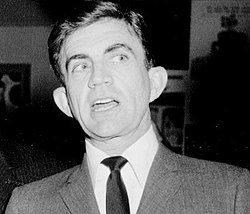
Blake Edwards (born William Blake Crump; July 26, 1922 – December 15, 2010) was an American filmmaker, producer, and screenwriter. Often thought of as primarily a director of comedies, he also directed several drama, musical, and detective films. Late in his career, he took up writing, producing and directing for theater. He received an Honorary Academy Award in recognition of his writing, directing and producing an extraordinary body of work for the screen.
Born in Tulsa, Oklahoma, Edwards began his career in the 1940s as an actor, but he soon began writing screenplays and radio scripts before turning to producing and directing in television and films. His best-known films include Breakfast at Tiffany's (1961), Days of Wine and Roses (1962), A Shot in the Dark (1964), The Great Race (1965), 10 (1979), Victor/Victoria (1982), Blind Date (1987), and the hugely successful Pink Panther film series with British actor Peter Sellers.
Born William Blake Crump July 26, 1922, in Tulsa, Oklahoma, he was the son of Donald and Lillian (née Grommett) Crump (1897–1992). In an interview with Andre Previn, Blake Edwards claimed to be a descendant of William Blake. His father reportedly left the family before he was born. His mother married again, to Jack McEdward, who became his stepfather. McEdward was the son of J. Gordon Edwards, a director of silent movies, and in 1925, he moved the family to Los Angeles and became a film production manager. In an interview with The Village Voice in 1971, Blake Edwards said that he had "always felt alienated, estranged from my own father, Jack McEdward". After graduating from Beverly Hills High School in the class of Winter 1941, Blake began taking jobs as an actor during World War II.
Edwards describes this period:
I worked with the best directors – Ford, Wyler, Preminger – and learned a lot from them. But I wasn't a very cooperative actor. I was a spunky, smart-assed kid. Maybe even I was indicating that I wanted to give, not take, direction.
Edwards served in the United States Coast Guard during World War II, where he suffered a severe back injury, which left him in pain for years afterwards.
Edwards's debut as a director came in 1952 on the television program Four Star Playhouse.
In the 1954–1955 television season, Edwards joined with Richard Quine to create Mickey Rooney's first television series, The Mickey Rooney Show: Hey, Mulligan. Edwards's hard-boiled private detective scripts for Richard Diamond, Private Detective became NBC's answer to Sam Spade and Philip Marlowe, reflecting Edwards's unique humor. Edwards also created, wrote, and directed the 1958–61 TV detective series Peter Gunn, which starred Craig Stevens, with music by Henry Mancini. The following year, Edwards produced Mr. Lucky, an adventure series on CBS starring John Vivyan and Ross Martin. Mancini's association with Edwards continued in his film work, significantly contributing to their success.
Blake Edwards
Blake Edwards (born William Blake Crump; July 26, 1922 – December 15, 2010) was an American filmmaker, producer, and screenwriter. Often thought of as primarily a director of comedies, he also directed several drama, musical, and detective films. Late in his career, he took up writing, producing and directing for theater. He received an Honorary Academy Award in recognition of his writing, directing and producing an extraordinary body of work for the screen.
Born in Tulsa, Oklahoma, Edwards began his career in the 1940s as an actor, but he soon began writing screenplays and radio scripts before turning to producing and directing in television and films. His best-known films include Breakfast at Tiffany's (1961), Days of Wine and Roses (1962), A Shot in the Dark (1964), The Great Race (1965), 10 (1979), Victor/Victoria (1982), Blind Date (1987), and the hugely successful Pink Panther film series with British actor Peter Sellers.
Born William Blake Crump July 26, 1922, in Tulsa, Oklahoma, he was the son of Donald and Lillian (née Grommett) Crump (1897–1992). In an interview with Andre Previn, Blake Edwards claimed to be a descendant of William Blake. His father reportedly left the family before he was born. His mother married again, to Jack McEdward, who became his stepfather. McEdward was the son of J. Gordon Edwards, a director of silent movies, and in 1925, he moved the family to Los Angeles and became a film production manager. In an interview with The Village Voice in 1971, Blake Edwards said that he had "always felt alienated, estranged from my own father, Jack McEdward". After graduating from Beverly Hills High School in the class of Winter 1941, Blake began taking jobs as an actor during World War II.
Edwards describes this period:
I worked with the best directors – Ford, Wyler, Preminger – and learned a lot from them. But I wasn't a very cooperative actor. I was a spunky, smart-assed kid. Maybe even I was indicating that I wanted to give, not take, direction.
Edwards served in the United States Coast Guard during World War II, where he suffered a severe back injury, which left him in pain for years afterwards.
Edwards's debut as a director came in 1952 on the television program Four Star Playhouse.
In the 1954–1955 television season, Edwards joined with Richard Quine to create Mickey Rooney's first television series, The Mickey Rooney Show: Hey, Mulligan. Edwards's hard-boiled private detective scripts for Richard Diamond, Private Detective became NBC's answer to Sam Spade and Philip Marlowe, reflecting Edwards's unique humor. Edwards also created, wrote, and directed the 1958–61 TV detective series Peter Gunn, which starred Craig Stevens, with music by Henry Mancini. The following year, Edwards produced Mr. Lucky, an adventure series on CBS starring John Vivyan and Ross Martin. Mancini's association with Edwards continued in his film work, significantly contributing to their success.
Recent media
Recent media