



Community hub
Recent from talks
Contribute something to knowledge base
Content stats: 0 posts, 0 articles, 1 media, 0 notes
Members stats: 0 subscribers, 0 contributors, 0 moderators, 0 supporters
Subscribers
Supporters
Contributors
Moderators
Hub AI
Coagulation AI simulator
(@Coagulation_simulator)
Hub AI
Coagulation AI simulator
(@Coagulation_simulator)
Coagulation
Coagulation, also known as clotting, is the process by which blood changes from a liquid to a gel, forming a blood clot. It results in hemostasis, the cessation of blood loss from a damaged vessel, followed by repair. The process of coagulation involves activation, adhesion and aggregation of platelets, as well as deposition and maturation of fibrin.
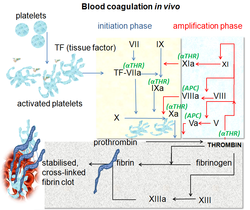
Coagulation begins almost instantly after an injury to the endothelium that lines a blood vessel. Exposure of blood to the subendothelial space initiates two processes: changes in platelets, and the exposure of subendothelial platelet tissue factor to coagulation factor VII, which ultimately leads to cross-linked fibrin formation. Platelets immediately form a plug at the site of injury; this is called primary hemostasis. Secondary hemostasis occurs simultaneously: additional coagulation factors beyond factor VII (listed below) respond in a cascade to form fibrin strands, which strengthen the platelet plug.
Coagulation is highly conserved throughout biology. In all mammals, coagulation involves both cellular components (platelets) and proteinaceous components (coagulation or clotting factors). The pathway in humans has been the most extensively researched and is the best understood. Disorders of coagulation can result in problems with hemorrhage, bruising, or thrombosis.
There are 13 traditional clotting factors, as named below, and other substances necessary for coagulation:
Physiology of blood coagulation is based on hemostasis, the normal bodily process that stops bleeding. Coagulation is a part of an integrated series of haemostatic reactions, involving plasma, platelet, and vascular components.
Hemostasis consists of four main stages:
After the fibrin clot is formed, clot retraction occurs and then clot resolution starts, and these two process are together called "tertiary hemostasis". Activated platelets contract their internal actin and myosin fibrils in their cytoskeleton, which leads to shrinkage of the clot volume. Plasminogen activators, such as tissue plasminogen activator (t-PA), activate plasminogen into plasmin, which promotes lysis of the fibrin clot; this restores the flow of blood in the damaged/obstructed blood vessels.
When there is an injury to a blood vessel, the endothelial cells can release various vasoconstrictor substances, such as endothelin and thromboxane, to induce the constriction of the smooth muscles in the vessel wall. This helps reduce blood flow to the site of injury and limits bleeding.
Coagulation
Coagulation, also known as clotting, is the process by which blood changes from a liquid to a gel, forming a blood clot. It results in hemostasis, the cessation of blood loss from a damaged vessel, followed by repair. The process of coagulation involves activation, adhesion and aggregation of platelets, as well as deposition and maturation of fibrin.
Coagulation begins almost instantly after an injury to the endothelium that lines a blood vessel. Exposure of blood to the subendothelial space initiates two processes: changes in platelets, and the exposure of subendothelial platelet tissue factor to coagulation factor VII, which ultimately leads to cross-linked fibrin formation. Platelets immediately form a plug at the site of injury; this is called primary hemostasis. Secondary hemostasis occurs simultaneously: additional coagulation factors beyond factor VII (listed below) respond in a cascade to form fibrin strands, which strengthen the platelet plug.
Coagulation is highly conserved throughout biology. In all mammals, coagulation involves both cellular components (platelets) and proteinaceous components (coagulation or clotting factors). The pathway in humans has been the most extensively researched and is the best understood. Disorders of coagulation can result in problems with hemorrhage, bruising, or thrombosis.
There are 13 traditional clotting factors, as named below, and other substances necessary for coagulation:
Physiology of blood coagulation is based on hemostasis, the normal bodily process that stops bleeding. Coagulation is a part of an integrated series of haemostatic reactions, involving plasma, platelet, and vascular components.
Hemostasis consists of four main stages:
After the fibrin clot is formed, clot retraction occurs and then clot resolution starts, and these two process are together called "tertiary hemostasis". Activated platelets contract their internal actin and myosin fibrils in their cytoskeleton, which leads to shrinkage of the clot volume. Plasminogen activators, such as tissue plasminogen activator (t-PA), activate plasminogen into plasmin, which promotes lysis of the fibrin clot; this restores the flow of blood in the damaged/obstructed blood vessels.
When there is an injury to a blood vessel, the endothelial cells can release various vasoconstrictor substances, such as endothelin and thromboxane, to induce the constriction of the smooth muscles in the vessel wall. This helps reduce blood flow to the site of injury and limits bleeding.
Recent media
Recent media