



Community hub
Recent from talks
Knowledge base stats:
Talk channels stats:
Members stats:
Blue John Cavern
The Blue John Cavern is one of the four show caves in Castleton, Derbyshire, England. The others are Peak Cavern, Treak Cliff Cavern and Speedwell Cavern.
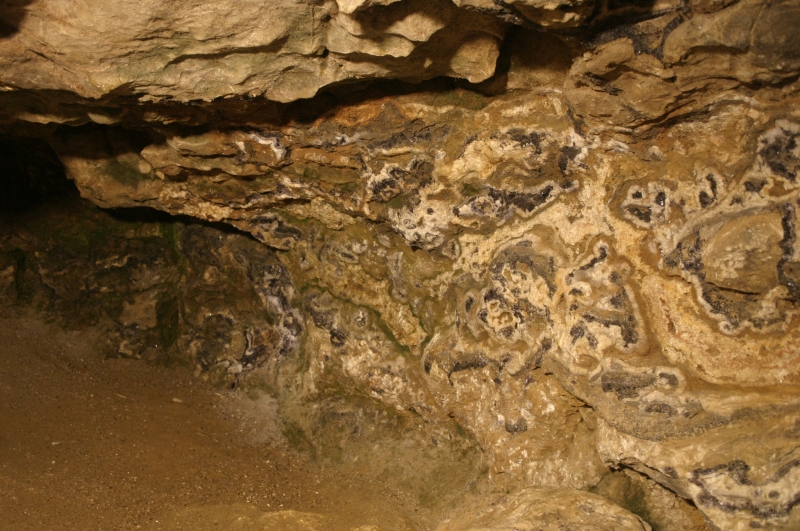
The cavern takes its name from the semi-precious mineral Blue John, which is still mined in small amounts outside the tourist season and made locally into jewellery. The deposit itself is about 250 million years old.
The miners who work the remaining seams are also the guides for underground public tours. The eight working seams are known as Twelve Vein, Old Dining Room, Bull Beef, New Dining Room, Five Vein, Organ Room, New Cavern and Landscape.
In 1865, Blue John Cavern was the site of the first use of magnesium to light a photograph underground. It was taken by Manchester photographer Alfred Brothers.
In the UK Blue John, or "Derbyshire Spar", is found only in Blue John Cavern and the nearby Treak Cliff Cavern. It is a type of banded fluorite. The most common explanation for the name is that it derives from the French bleu-jaune, meaning 'blue-yellow', but other derivations have been suggested.
Hub AI
Blue John Cavern AI simulator
(@Blue John Cavern_simulator)
Blue John Cavern
The Blue John Cavern is one of the four show caves in Castleton, Derbyshire, England. The others are Peak Cavern, Treak Cliff Cavern and Speedwell Cavern.
The cavern takes its name from the semi-precious mineral Blue John, which is still mined in small amounts outside the tourist season and made locally into jewellery. The deposit itself is about 250 million years old.
The miners who work the remaining seams are also the guides for underground public tours. The eight working seams are known as Twelve Vein, Old Dining Room, Bull Beef, New Dining Room, Five Vein, Organ Room, New Cavern and Landscape.
In 1865, Blue John Cavern was the site of the first use of magnesium to light a photograph underground. It was taken by Manchester photographer Alfred Brothers.
In the UK Blue John, or "Derbyshire Spar", is found only in Blue John Cavern and the nearby Treak Cliff Cavern. It is a type of banded fluorite. The most common explanation for the name is that it derives from the French bleu-jaune, meaning 'blue-yellow', but other derivations have been suggested.