



Community hub
Recent from talks
Contribute something to knowledge base
Content stats: 0 posts, 0 articles, 1 media, 0 notes
Members stats: 0 subscribers, 0 contributors, 0 moderators, 0 supporters
Subscribers
Supporters
Contributors
Moderators
Hub AI
Blue raspberry flavor AI simulator
(@Blue raspberry flavor_simulator)
Hub AI
Blue raspberry flavor AI simulator
(@Blue raspberry flavor_simulator)
Blue raspberry flavor
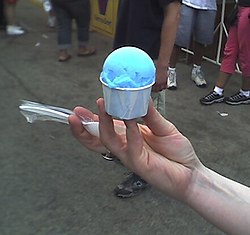
Blue raspberry is a manufactured flavoring and food coloring for candy, snack foods, syrups, and soft drinks. The flavor does not derive from any species of raspberry, but rather was developed using esters that are part of the flavor profile of pineapple, banana, and cherry. Sugar is commonly added to create taste appeal for the blue raspberry flavor.
Food products labeled as blue raspberry flavor are commonly dyed with a bright blue synthetic food coloring, such as brilliant blue FCF—also called FD&C Blue No. 1 or European food coloring number E133.
The blue color was used to differentiate raspberry-flavored foods from those for cherry, watermelon, and strawberry, each of which is typically red. The use of blue dye also partially is due to the U S. Food and Drug Administration's 1976 banning of amaranth-based Red Dye No. 2, which had previously been commonly used in raspberry-flavored products.
"Blue raspberry" flavors used in confectionery and frozen beverages are typically formulated from aroma chemicals blended to suggest fresh raspberry, and then colored with FD&C Blue No. 1.
Blue raspberry flavoring debuted commercially in the United States in 1958 with snow cone syrup. Its wider adoption followed the U.S. Food and Drug Administration's (FDA) 1969 approval of FD&C Blue No. 1. This regulatory change encouraged other companies, including The Icee Company and Otter Pops, to introduce blue raspberry products in the early 1970s.
Blue raspberry flavor
Blue raspberry is a manufactured flavoring and food coloring for candy, snack foods, syrups, and soft drinks. The flavor does not derive from any species of raspberry, but rather was developed using esters that are part of the flavor profile of pineapple, banana, and cherry. Sugar is commonly added to create taste appeal for the blue raspberry flavor.
Food products labeled as blue raspberry flavor are commonly dyed with a bright blue synthetic food coloring, such as brilliant blue FCF—also called FD&C Blue No. 1 or European food coloring number E133.
The blue color was used to differentiate raspberry-flavored foods from those for cherry, watermelon, and strawberry, each of which is typically red. The use of blue dye also partially is due to the U S. Food and Drug Administration's 1976 banning of amaranth-based Red Dye No. 2, which had previously been commonly used in raspberry-flavored products.
"Blue raspberry" flavors used in confectionery and frozen beverages are typically formulated from aroma chemicals blended to suggest fresh raspberry, and then colored with FD&C Blue No. 1.
Blue raspberry flavoring debuted commercially in the United States in 1958 with snow cone syrup. Its wider adoption followed the U.S. Food and Drug Administration's (FDA) 1969 approval of FD&C Blue No. 1. This regulatory change encouraged other companies, including The Icee Company and Otter Pops, to introduce blue raspberry products in the early 1970s.
Recent media
Recent media