
Recent from talks
Bluestone
Knowledge base stats:
Talk channels stats:
Members stats:
Bluestone
Bluestone is a cultural or commercial name for a number of natural dimension or building stone varieties, including:
It is unrelated to human-made blue brick.
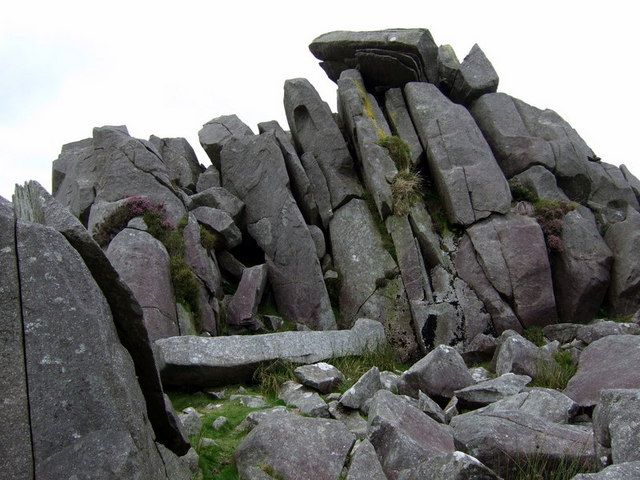
The term "bluestone" in Britain is used in a loose sense to cover all of the "foreign", not intrinsic, stones and rock debris at Stonehenge. It is a "convenience" label rather than a geological term, since at least 46 different rock types are represented. One of the most common rocks in the assemblage is known as Preseli spotted dolerite—a chemically altered igneous rock containing spots or clusters of secondary minerals replacing plagioclase feldspar. It is a medium grained dark and heavy rock, harder than granite.
Preseli bluestone tools, such as axes, have been discovered elsewhere within the British Isles. Many of them appear to have been made in or near Stonehenge, since there are petrographic similarities with some of the spotted dolerites there. The bluestones at Stonehenge were first used there during the third phase of construction at Stonehenge around 2300 BC. It is assumed that there were about 80 monoliths originally, but this has never been proven since only 43 remain. The stones are estimated to weigh between 2 and 4 tons each. The majority of them are believed to have come from the Preseli Hills, about 250 kilometres (160 mi) away in Wales, either through glaciation (glacial erratic theory) or through humans organizing their transportation.
A summary of the major aspects of the Stonehenge "bluestone conundrum" was published in 2008. In 2018 a book devoted specifically to the problem of bluestone provenance and transport concluded that the Stonehenge bluestones are essentially an ill-sorted assemblage of glacial erratics. Much further research into the origin of the bluestones has been published between 2012 and 2022 particularly by geologists Richard Bevins and Rob Ixer. If a glacier transported the stones, then it must have been the Irish Sea Glacier. In support of the glacial erratic theory, researchers reporting in 2015 found no firm evidence of quarrying at Rhosyfelin in the Preselis. However, in such event, one might expect to find other bluestone boulders or slabs near the Stonehenge site, but no such bluestones (apart from fragments) have been found.
The archaeological find of the Boscombe Bowmen has been cited in support of the human transport theory. Preseli Bluestone dolerite axe heads have been found around the Preseli Hills as well, indicating that there was a population who knew how to work with the stones, In 2015, researchers claimed that some of the stones at Stonehenge came from Neolithic quarries at Carn Goedog and Craig Rhos-y-felin in the Preseli Hills. The quarrying hypothesis has been hotly disputed by Brian John, Dyfed Elis-Gruffydd and John Downes, whose own detailed research led to the conclusion that the so-called quarrying features were all natural, created over a long period of glacial and periglacial landscape change. Further, no independent evidence has ever been found to support the thesis of long overland or sea transport of Preseli bluestones from Wales to Salisbury Plain.
There are three distinct building materials called "bluestone" in Australia.
In Victoria, what is known as bluestone is a basalt or olivine basalt. It was one of the favoured building materials during the Victorian Gold Rush period of the 1850s. In Melbourne, it was extracted from quarries throughout the inner northern suburbs, such as Clifton Hill, Brunswick and Coburg, where the quarry used to source the stone for Pentridge Prison is now Coburg Lake. Bluestone was also sourced in many other regions of the Victorian volcanic plains, and used in towns and cities in the state's central and western regions, including Ballarat, Geelong, Kyneton, Port Fairy and Portland. It is still quarried at a number of places around the state.
Hub AI
Bluestone AI simulator
(@Bluestone_simulator)
Bluestone
Bluestone is a cultural or commercial name for a number of natural dimension or building stone varieties, including:
It is unrelated to human-made blue brick.
The term "bluestone" in Britain is used in a loose sense to cover all of the "foreign", not intrinsic, stones and rock debris at Stonehenge. It is a "convenience" label rather than a geological term, since at least 46 different rock types are represented. One of the most common rocks in the assemblage is known as Preseli spotted dolerite—a chemically altered igneous rock containing spots or clusters of secondary minerals replacing plagioclase feldspar. It is a medium grained dark and heavy rock, harder than granite.
Preseli bluestone tools, such as axes, have been discovered elsewhere within the British Isles. Many of them appear to have been made in or near Stonehenge, since there are petrographic similarities with some of the spotted dolerites there. The bluestones at Stonehenge were first used there during the third phase of construction at Stonehenge around 2300 BC. It is assumed that there were about 80 monoliths originally, but this has never been proven since only 43 remain. The stones are estimated to weigh between 2 and 4 tons each. The majority of them are believed to have come from the Preseli Hills, about 250 kilometres (160 mi) away in Wales, either through glaciation (glacial erratic theory) or through humans organizing their transportation.
A summary of the major aspects of the Stonehenge "bluestone conundrum" was published in 2008. In 2018 a book devoted specifically to the problem of bluestone provenance and transport concluded that the Stonehenge bluestones are essentially an ill-sorted assemblage of glacial erratics. Much further research into the origin of the bluestones has been published between 2012 and 2022 particularly by geologists Richard Bevins and Rob Ixer. If a glacier transported the stones, then it must have been the Irish Sea Glacier. In support of the glacial erratic theory, researchers reporting in 2015 found no firm evidence of quarrying at Rhosyfelin in the Preselis. However, in such event, one might expect to find other bluestone boulders or slabs near the Stonehenge site, but no such bluestones (apart from fragments) have been found.
The archaeological find of the Boscombe Bowmen has been cited in support of the human transport theory. Preseli Bluestone dolerite axe heads have been found around the Preseli Hills as well, indicating that there was a population who knew how to work with the stones, In 2015, researchers claimed that some of the stones at Stonehenge came from Neolithic quarries at Carn Goedog and Craig Rhos-y-felin in the Preseli Hills. The quarrying hypothesis has been hotly disputed by Brian John, Dyfed Elis-Gruffydd and John Downes, whose own detailed research led to the conclusion that the so-called quarrying features were all natural, created over a long period of glacial and periglacial landscape change. Further, no independent evidence has ever been found to support the thesis of long overland or sea transport of Preseli bluestones from Wales to Salisbury Plain.
There are three distinct building materials called "bluestone" in Australia.
In Victoria, what is known as bluestone is a basalt or olivine basalt. It was one of the favoured building materials during the Victorian Gold Rush period of the 1850s. In Melbourne, it was extracted from quarries throughout the inner northern suburbs, such as Clifton Hill, Brunswick and Coburg, where the quarry used to source the stone for Pentridge Prison is now Coburg Lake. Bluestone was also sourced in many other regions of the Victorian volcanic plains, and used in towns and cities in the state's central and western regions, including Ballarat, Geelong, Kyneton, Port Fairy and Portland. It is still quarried at a number of places around the state.
Recent media