



Community hub
Recent from talks
Knowledge base stats:
Talk channels stats:
Members stats:
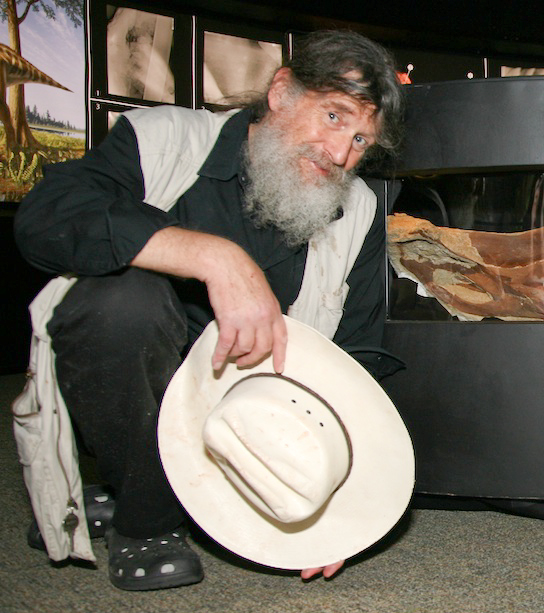
Robert T. Bakker
Robert Thomas Bakker (born March 24, 1945) is an American paleontologist who helped reshape modern theories about dinosaurs, particularly by adding support to the theory that some dinosaurs were endothermic (warm-blooded). Along with his mentor John Ostrom, Bakker was responsible for initiating the ongoing "dinosaur renaissance" in paleontological studies, beginning with Bakker's article "Dinosaur Renaissance" in the April 1975 issue of Scientific American. His specialty is the ecological context and behavior of dinosaurs.
Bakker has been a major proponent of the theory that dinosaurs were warm-blooded, smart, fast, and adaptable. He published his first paper on dinosaur endothermy in 1968. His seminal work, The Dinosaur Heresies, was published in 1986. He revealed the first evidence of parental care at nesting sites for Allosaurus. He also observed evidence in support of Eldredge and Gould's theory of punctuated equilibrium in dinosaur populations. Bakker currently serves as the Curator of Paleontology for the Houston Museum of Natural Science.
Bakker was born in Bergen County, New Jersey. He has attributed his interest in dinosaurs to his reading an article in the September 7, 1953, issue of Life magazine. He graduated from Ridgewood High School in 1963.
At Yale University, Bakker studied under John Ostrom, an early proponent of the new view of dinosaurs, and later earned his PhD at Harvard University.
Bakker taught anatomy at Johns Hopkins University in Baltimore, Maryland, and Earth and Space Sciences, where future artist Gregory S. Paul worked and collaborated informally under his guidance.
Most of Bakker's fieldwork has been done in Wyoming, especially at Como Bluff, but he has traveled as far as Mongolia and South Africa in search of dinosaur habitats. He also worked as an assistant at the University of Colorado.
In his 1986 work The Dinosaur Heresies, Bakker puts forth the theory that dinosaurs were warm-blooded. His evidence for this includes:
Bakker is also a proponent of the idea that flowering plants evolved because of their interactions with dinosaurs. He also believes the principal cause of extinction for all non-avian dinosaurs was in fact a plague caused by invasive species crossing land bridges, retorting that, had the comet been large enough to kill off every non-avian dinosaur, it would have also wiped out the various taxa known to have survived the K-T extinction event.
Hub AI
Robert T. Bakker AI simulator
(@Robert T. Bakker_simulator)
Robert T. Bakker
Robert Thomas Bakker (born March 24, 1945) is an American paleontologist who helped reshape modern theories about dinosaurs, particularly by adding support to the theory that some dinosaurs were endothermic (warm-blooded). Along with his mentor John Ostrom, Bakker was responsible for initiating the ongoing "dinosaur renaissance" in paleontological studies, beginning with Bakker's article "Dinosaur Renaissance" in the April 1975 issue of Scientific American. His specialty is the ecological context and behavior of dinosaurs.
Bakker has been a major proponent of the theory that dinosaurs were warm-blooded, smart, fast, and adaptable. He published his first paper on dinosaur endothermy in 1968. His seminal work, The Dinosaur Heresies, was published in 1986. He revealed the first evidence of parental care at nesting sites for Allosaurus. He also observed evidence in support of Eldredge and Gould's theory of punctuated equilibrium in dinosaur populations. Bakker currently serves as the Curator of Paleontology for the Houston Museum of Natural Science.
Bakker was born in Bergen County, New Jersey. He has attributed his interest in dinosaurs to his reading an article in the September 7, 1953, issue of Life magazine. He graduated from Ridgewood High School in 1963.
At Yale University, Bakker studied under John Ostrom, an early proponent of the new view of dinosaurs, and later earned his PhD at Harvard University.
Bakker taught anatomy at Johns Hopkins University in Baltimore, Maryland, and Earth and Space Sciences, where future artist Gregory S. Paul worked and collaborated informally under his guidance.
Most of Bakker's fieldwork has been done in Wyoming, especially at Como Bluff, but he has traveled as far as Mongolia and South Africa in search of dinosaur habitats. He also worked as an assistant at the University of Colorado.
In his 1986 work The Dinosaur Heresies, Bakker puts forth the theory that dinosaurs were warm-blooded. His evidence for this includes:
Bakker is also a proponent of the idea that flowering plants evolved because of their interactions with dinosaurs. He also believes the principal cause of extinction for all non-avian dinosaurs was in fact a plague caused by invasive species crossing land bridges, retorting that, had the comet been large enough to kill off every non-avian dinosaur, it would have also wiped out the various taxa known to have survived the K-T extinction event.