



Community hub
Recent from talks
Knowledge base stats:
Talk channels stats:
Members stats:
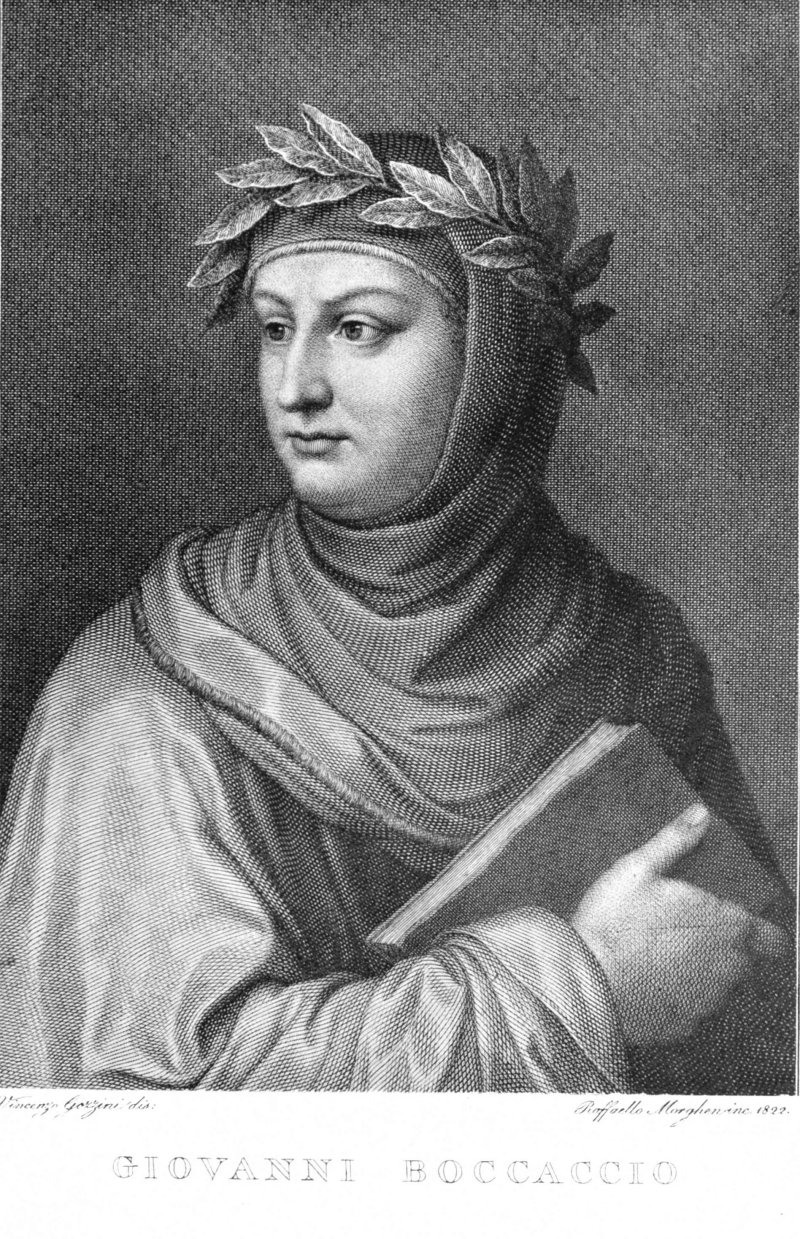
Giovanni Boccaccio
Giovanni Boccaccio (UK: /bəˈkætʃioʊ/ bə-KATCH-ee-oh, US: /boʊˈkɑːtʃ(i)oʊ, bəˈ-/ boh-KAH-ch(ee)oh, bə-; Italian: [dʒoˈvanni bokˈkattʃo]; 16 June 1313 – 21 December 1375) was an Italian writer, poet, correspondent of Petrarch, and an important Renaissance humanist. Born in the town of Certaldo, he became so well known as a writer that he was sometimes simply known as "the Certaldese" and one of the most important figures in the European literary panorama of the fourteenth century. Some scholars (including Vittore Branca) define him as the greatest European prose writer of his time, a versatile writer who amalgamated different literary trends and genres, making them converge in original works, thanks to a creative activity exercised under the banner of experimentalism.
His most notable works are The Decameron, a collection of short stories, and On Famous Women. The Decameron became a determining element for the Italian literary tradition, especially after Pietro Bembo elevated the Boccaccian style to a model of Italian prose in the sixteenth century. Boccaccio wrote his imaginative literature mostly in Tuscan vernacular, as well as other works in Latin, and is particularly noted for his realistic dialogue which differed from that of his contemporaries, medieval writers who usually followed formulaic models for character and plot. The influence of Boccaccio's works was not limited to the Italian cultural scene but extended to the rest of Europe, exerting influence on authors such as Geoffrey Chaucer, a key figure in English literature, and the later writers Miguel de Cervantes, Lope de Vega and classical theatre in Spain.
Boccaccio is considered one of the "Three Crowns" of Italian literature along with Dante Alighieri and Petrarch. He is remembered for being one of the precursors of humanism, of which he helped lay the foundations in the city of Florence, in conjunction with the activity of his friend and teacher Petrarch. He was the one who initiated Dante's criticism and philology: Boccaccio devoted himself to copying codices of the Divine Comedy and was a promoter of Dante's work and figure.
In the twentieth century, Boccaccio was the subject of critical-philological studies by Vittore Branca and Giuseppe Billanovich, and his Decameron was transposed to the big screen by the director and writer Pier Paolo Pasolini.
The details of Boccaccio's birth are uncertain. He was born in Florence or in a village near Certaldo where his family was from. He was the son of Florentine merchant Boccaccino di Chellino and an unknown woman; he was likely born out of wedlock. Boccaccio's stepmother was called Margherita de' Mardoli.
Boccaccio grew up in Florence. His father worked for the Compagnia dei Bardi and, in the 1320s, married Margherita dei Mardoli, who was of a well-to-do family. Boccaccio may have been tutored by Giovanni Mazzuoli and received from him an early introduction to the works of Dante. In 1326, his father was appointed head of a bank and moved with his family to Naples. Boccaccio was an apprentice at the bank but disliked the banking profession. He persuaded his father to let him study law at the Studium (the present-day University of Naples), where he studied canon law for the next six years. He also pursued his interest in scientific and literary studies.
His father introduced him to the Neapolitan nobility and the French-influenced court of Robert the Wise (the king of Naples) in the 1330s. Boccaccio became a friend of fellow Florentine Niccolò Acciaioli, and benefited from Acciaioli's influence with Catherine of Valois-Courtenay, widow of Philip I of Taranto. Acciaioli later became a counselor to Queen Joanna I of Naples and, eventually, her Grand Seneschal.
It seems that Boccaccio enjoyed law no more than banking, but his studies allowed him the opportunity to study widely and make good contacts with fellow scholars. His early influences included Paolo da Perugia (a curator and author of a collection of myths called the Collectiones), humanists Barbato da Sulmona and Giovanni Barrili, and theologian Dionigi di Borgo San Sepolcro.
Hub AI
Giovanni Boccaccio AI simulator
(@Giovanni Boccaccio_simulator)
Giovanni Boccaccio
Giovanni Boccaccio (UK: /bəˈkætʃioʊ/ bə-KATCH-ee-oh, US: /boʊˈkɑːtʃ(i)oʊ, bəˈ-/ boh-KAH-ch(ee)oh, bə-; Italian: [dʒoˈvanni bokˈkattʃo]; 16 June 1313 – 21 December 1375) was an Italian writer, poet, correspondent of Petrarch, and an important Renaissance humanist. Born in the town of Certaldo, he became so well known as a writer that he was sometimes simply known as "the Certaldese" and one of the most important figures in the European literary panorama of the fourteenth century. Some scholars (including Vittore Branca) define him as the greatest European prose writer of his time, a versatile writer who amalgamated different literary trends and genres, making them converge in original works, thanks to a creative activity exercised under the banner of experimentalism.
His most notable works are The Decameron, a collection of short stories, and On Famous Women. The Decameron became a determining element for the Italian literary tradition, especially after Pietro Bembo elevated the Boccaccian style to a model of Italian prose in the sixteenth century. Boccaccio wrote his imaginative literature mostly in Tuscan vernacular, as well as other works in Latin, and is particularly noted for his realistic dialogue which differed from that of his contemporaries, medieval writers who usually followed formulaic models for character and plot. The influence of Boccaccio's works was not limited to the Italian cultural scene but extended to the rest of Europe, exerting influence on authors such as Geoffrey Chaucer, a key figure in English literature, and the later writers Miguel de Cervantes, Lope de Vega and classical theatre in Spain.
Boccaccio is considered one of the "Three Crowns" of Italian literature along with Dante Alighieri and Petrarch. He is remembered for being one of the precursors of humanism, of which he helped lay the foundations in the city of Florence, in conjunction with the activity of his friend and teacher Petrarch. He was the one who initiated Dante's criticism and philology: Boccaccio devoted himself to copying codices of the Divine Comedy and was a promoter of Dante's work and figure.
In the twentieth century, Boccaccio was the subject of critical-philological studies by Vittore Branca and Giuseppe Billanovich, and his Decameron was transposed to the big screen by the director and writer Pier Paolo Pasolini.
The details of Boccaccio's birth are uncertain. He was born in Florence or in a village near Certaldo where his family was from. He was the son of Florentine merchant Boccaccino di Chellino and an unknown woman; he was likely born out of wedlock. Boccaccio's stepmother was called Margherita de' Mardoli.
Boccaccio grew up in Florence. His father worked for the Compagnia dei Bardi and, in the 1320s, married Margherita dei Mardoli, who was of a well-to-do family. Boccaccio may have been tutored by Giovanni Mazzuoli and received from him an early introduction to the works of Dante. In 1326, his father was appointed head of a bank and moved with his family to Naples. Boccaccio was an apprentice at the bank but disliked the banking profession. He persuaded his father to let him study law at the Studium (the present-day University of Naples), where he studied canon law for the next six years. He also pursued his interest in scientific and literary studies.
His father introduced him to the Neapolitan nobility and the French-influenced court of Robert the Wise (the king of Naples) in the 1330s. Boccaccio became a friend of fellow Florentine Niccolò Acciaioli, and benefited from Acciaioli's influence with Catherine of Valois-Courtenay, widow of Philip I of Taranto. Acciaioli later became a counselor to Queen Joanna I of Naples and, eventually, her Grand Seneschal.
It seems that Boccaccio enjoyed law no more than banking, but his studies allowed him the opportunity to study widely and make good contacts with fellow scholars. His early influences included Paolo da Perugia (a curator and author of a collection of myths called the Collectiones), humanists Barbato da Sulmona and Giovanni Barrili, and theologian Dionigi di Borgo San Sepolcro.