



Community hub
Recent from talks
Knowledge base stats:
Talk channels stats:
Members stats:
Bockscar
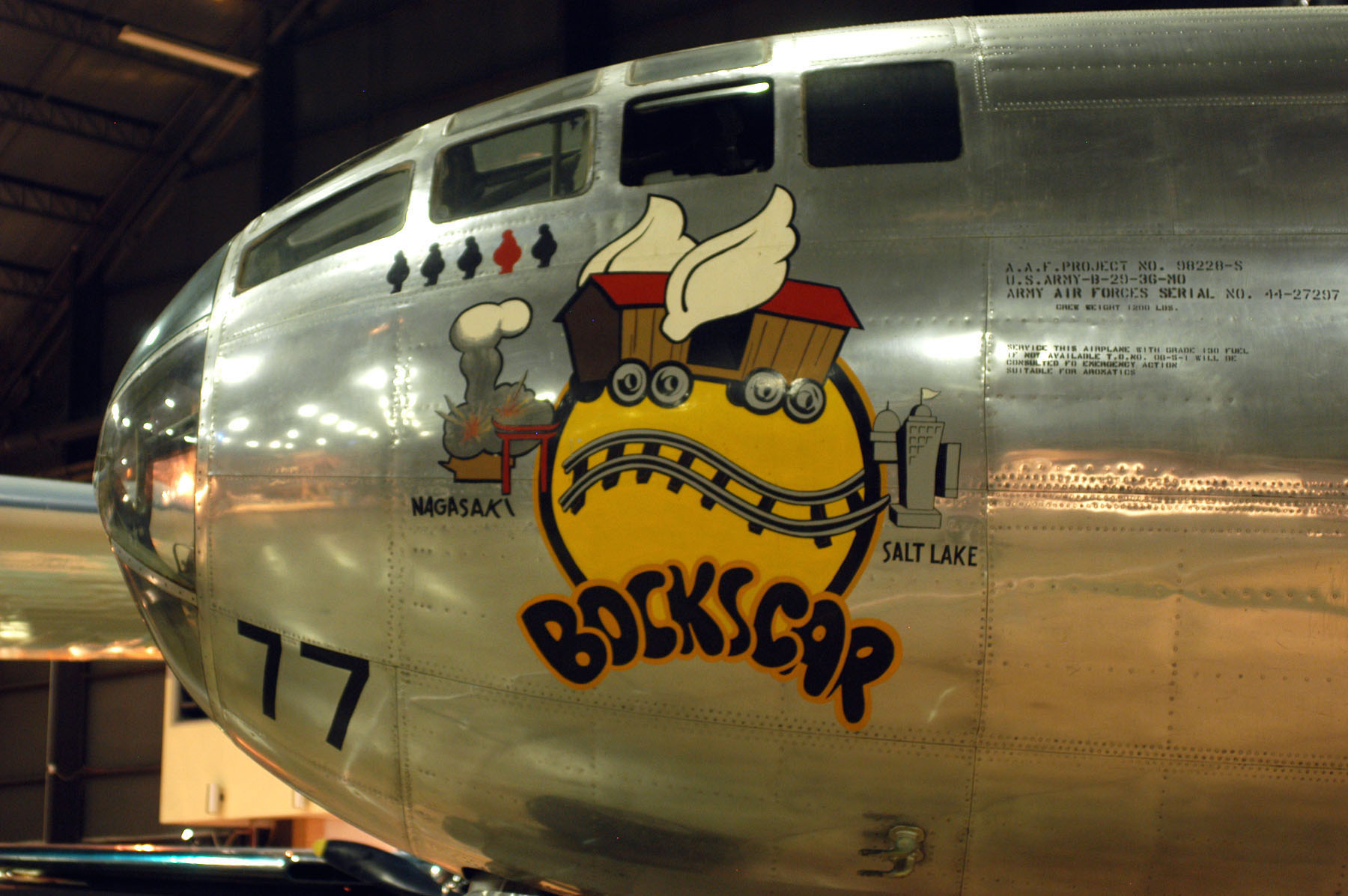
Bockscar, sometimes called Bock's Car, is the United States Army Air Forces Boeing B-29 Superfortress bomber that dropped a Fat Man atomic bomb over the Japanese city of Nagasaki during World War II in the second – and most recent – nuclear attack in history. One of 15 Silverplate B-29s used by the 509th, Bockscar was built at the Glenn L. Martin Bomber Plant at Bellevue, Nebraska, at what is now Offutt Air Force Base, and delivered to the United States Army Air Forces on 19 March 1945. It was assigned to the 393rd Bombardment Squadron, 509th Composite Group to Wendover Army Air Field, Utah, in April and was named after captain Frederick C. Bock.
Bockscar was used in 13 training and practice missions from Tinian, and three combat missions in which it dropped pumpkin bombs on industrial targets in Japan. On 9 August 1945, Bockscar, piloted by the 393rd Bombardment Squadron's commander, Major Charles W. Sweeney, dropped a Fat Man nuclear bomb with a blast yield equivalent to 21 kilotonnes of TNT (88 TJ) over the city of Nagasaki. The explosion destroyed about 44% of the city, killed 35,000 people, and injured 60,000 people.
After the war, Bockscar returned to the United States in November 1945. In September 1946, it was given to the National Museum of the United States Air Force at Wright-Patterson Air Force Base, Ohio. The aircraft was flown to the museum on 26 September 1961, and its original markings were restored. Bockscar is now on permanent display at the National Museum of the United States Air Force, Dayton, Ohio, next to a replica of the Fat Man bomb.
Bockscar, B-29-36-MO 44-27297, Victor number 77, was one of 15 Silverplate B-29s used by the 393d Bombardment Squadron of the 509th Composite Group. Bockscar was built by the Glenn L. Martin Company (later part of Lockheed Martin) at its bomber plant in Bellevue, Nebraska, located at Offutt Field, now Offutt Air Force Base. A Block 35 aircraft, it was one of ten modified as a Silverplate and re-designated "Block 36".
Silverplate involved extensive modifications to the B-29 to carry nuclear weapons. The bomb bay doors and the fuselage section between the bomb bays were removed to create a single 33-foot (10 m) bomb bay. British suspensions and bracing were attached for both shape types, with the gun-type suspension anchored in the aft bomb bay and the implosion type mounted in the forward bay. Weight reduction was also accomplished by removal of gun turrets and armor plating. These B-29s also had an improved engine, the R-3350-41. The Silverplate aircraft represented a significant increase in performance over the standard variants.
Delivered to the U.S. Army Air Forces on 19 March 1945, Bockscar was assigned to Captain Frederick C. Bock and crew C-13, and flown to Wendover Army Air Field, Utah, in April. The name chosen for the aircraft, and painted on it after the mission, was a pun on the name of the aircraft commander. It left Wendover on 11 June 1945 for Tinian, where it arrived 16 June. It was originally given the Victor (unit-assigned identification) number 7 but on 1 August was given the triangle N tail markings of the 444th Bombardment Group as a security measure, and had its Victor changed to 77 to avoid misidentification with an actual 444th aircraft.
Bockscar was used in 13 training and practice missions from Tinian, and three combat missions in which it dropped pumpkin bombs on industrial targets in Japan, in which Bock's crew bombed Niihama and Musashino, and First Lieutenant Charles Donald Albury and crew C-15 bombed Koromo.
The mission included three B-29 bombers and their crews: Bockscar, The Great Artiste, and The Big Stink. Bockscar was flown on 9 August 1945 by Crew C-15, which usually manned The Great Artiste; piloted by Major Charles W. Sweeney, commander of the 393d Bombardment Squadron; and co-piloted by First Lieutenant Charles Donald Albury, C-15's aircraft commander. The Great Artiste was designated as an observation and instrumentation support plane for the second mission, while The Big Stink – flown by group operations officer Major James I. Hopkins Jr. – as a photographic aircraft. The primary target was the city of Kokura, where the Kokura Arsenal was located, and the secondary target was Nagasaki, where two large Mitsubishi armament plants were located.
Hub AI
Bockscar AI simulator
(@Bockscar_simulator)
Bockscar
Bockscar, sometimes called Bock's Car, is the United States Army Air Forces Boeing B-29 Superfortress bomber that dropped a Fat Man atomic bomb over the Japanese city of Nagasaki during World War II in the second – and most recent – nuclear attack in history. One of 15 Silverplate B-29s used by the 509th, Bockscar was built at the Glenn L. Martin Bomber Plant at Bellevue, Nebraska, at what is now Offutt Air Force Base, and delivered to the United States Army Air Forces on 19 March 1945. It was assigned to the 393rd Bombardment Squadron, 509th Composite Group to Wendover Army Air Field, Utah, in April and was named after captain Frederick C. Bock.
Bockscar was used in 13 training and practice missions from Tinian, and three combat missions in which it dropped pumpkin bombs on industrial targets in Japan. On 9 August 1945, Bockscar, piloted by the 393rd Bombardment Squadron's commander, Major Charles W. Sweeney, dropped a Fat Man nuclear bomb with a blast yield equivalent to 21 kilotonnes of TNT (88 TJ) over the city of Nagasaki. The explosion destroyed about 44% of the city, killed 35,000 people, and injured 60,000 people.
After the war, Bockscar returned to the United States in November 1945. In September 1946, it was given to the National Museum of the United States Air Force at Wright-Patterson Air Force Base, Ohio. The aircraft was flown to the museum on 26 September 1961, and its original markings were restored. Bockscar is now on permanent display at the National Museum of the United States Air Force, Dayton, Ohio, next to a replica of the Fat Man bomb.
Bockscar, B-29-36-MO 44-27297, Victor number 77, was one of 15 Silverplate B-29s used by the 393d Bombardment Squadron of the 509th Composite Group. Bockscar was built by the Glenn L. Martin Company (later part of Lockheed Martin) at its bomber plant in Bellevue, Nebraska, located at Offutt Field, now Offutt Air Force Base. A Block 35 aircraft, it was one of ten modified as a Silverplate and re-designated "Block 36".
Silverplate involved extensive modifications to the B-29 to carry nuclear weapons. The bomb bay doors and the fuselage section between the bomb bays were removed to create a single 33-foot (10 m) bomb bay. British suspensions and bracing were attached for both shape types, with the gun-type suspension anchored in the aft bomb bay and the implosion type mounted in the forward bay. Weight reduction was also accomplished by removal of gun turrets and armor plating. These B-29s also had an improved engine, the R-3350-41. The Silverplate aircraft represented a significant increase in performance over the standard variants.
Delivered to the U.S. Army Air Forces on 19 March 1945, Bockscar was assigned to Captain Frederick C. Bock and crew C-13, and flown to Wendover Army Air Field, Utah, in April. The name chosen for the aircraft, and painted on it after the mission, was a pun on the name of the aircraft commander. It left Wendover on 11 June 1945 for Tinian, where it arrived 16 June. It was originally given the Victor (unit-assigned identification) number 7 but on 1 August was given the triangle N tail markings of the 444th Bombardment Group as a security measure, and had its Victor changed to 77 to avoid misidentification with an actual 444th aircraft.
Bockscar was used in 13 training and practice missions from Tinian, and three combat missions in which it dropped pumpkin bombs on industrial targets in Japan, in which Bock's crew bombed Niihama and Musashino, and First Lieutenant Charles Donald Albury and crew C-15 bombed Koromo.
The mission included three B-29 bombers and their crews: Bockscar, The Great Artiste, and The Big Stink. Bockscar was flown on 9 August 1945 by Crew C-15, which usually manned The Great Artiste; piloted by Major Charles W. Sweeney, commander of the 393d Bombardment Squadron; and co-piloted by First Lieutenant Charles Donald Albury, C-15's aircraft commander. The Great Artiste was designated as an observation and instrumentation support plane for the second mission, while The Big Stink – flown by group operations officer Major James I. Hopkins Jr. – as a photographic aircraft. The primary target was the city of Kokura, where the Kokura Arsenal was located, and the secondary target was Nagasaki, where two large Mitsubishi armament plants were located.