



Community hub
Recent from talks
Knowledge base stats:
Talk channels stats:
Members stats:
Tinian, Northern Mariana Islands
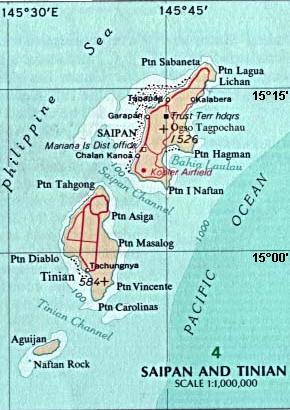
Tinian (/ˈtɪniən, ˌtiːniˈɑːn/; Chamorro: Tini'an) is one of the three principal islands of the Commonwealth of the Northern Mariana Islands (CNMI). Together with uninhabited neighboring Aguiguan, it forms Tinian Municipality, one of the four constituent municipalities of the Northern Marianas. Tinian's largest village is San Jose. Tinian is just south of the Northern Marianas' most inhabited island, Saipan, but north of the populated Rota to the south. The island has many World War II historical sites, cattle ranches, and beaches. There was a 5-star casino that operated from 1998 to 2015; the remaining are other hotels/resorts and a golf course. The main Saipan access is a short airplane ride from the international airport or a charter boat.
Tinian is part of the United States and the CNMI. Along with Guam, it is the westernmost U.S. island in the Pacific.
The Mariana Islands, of which Tinian is one, were the first islands settled by humans in Remote Oceania. It was also the first and the longest of the ocean-crossing voyages of the Austronesian peoples and is separate from the later Polynesian settlement of the rest of Remote Oceania. They were settled around 1500 to 1400 BC by migrants departing from the Philippines. This was followed by a second migration from the Caroline Islands by the first millennium AD, and a third migration from Island Southeast Asia (likely the Philippines or eastern Indonesia) by 900 AD.
Thousands of years ago, the island was settled by a people who built stone structures all over Tinian called taga.
Tinian, together with Saipan, was possibly first sighted by Europeans of the Spanish expedition of Ferdinand Magellan when it made landfall in the southern Marianas on March 6, 1521. It was likely sighted next by Gonzalo Gómez de Espinosa in 1522 on board the Spanish ship Trinidad, in an attempt to reach Panama after the death of Magellan. This would have happened after the sighting of the Maug Islands between the end of August and the end of September. Gonzalo de Vigo deserted in the Maugs from the Trinidad, and, in the next four years, living with the Chamorros, visited thirteen main islands in the Marianas, with possibly Tinian among them.
The first clear evidence of European arrival was by the Manila galleon Santa Margarita, commanded by Juan Martínez de Guillistegui, that wrecked in the southeast of Saipan in February 1600 and whose survivors stayed for two years, until 250 of them were rescued by the Santo Tomas and the Jesus María. The Spanish formally occupied Tinian in 1669, with the missionary expedition of Diego Luis de San Vitores, who named it Buenavista Mariana (Goodsight Mariana). From 1670, it became a port of call for Spanish and occasional English, Dutch, and French ships as a supply station for food and water.
The native population, estimated at 40,000 at the time of the Spanish arrival, shrank to less than 1,400 due to European-introduced diseases and conflicts over land. The survivors were forcibly relocated to Guam in 1720 for better control and assimilation. Under Spanish rule, the island was developed into ranches for raising cattle and pigs, which were used to provision Spanish galleons en route to Mexico.
After the Spanish–American War of 1898, Tinian was sold by Spain to the German Empire in 1899. Germany administered the island as part of German New Guinea. During the German period, there was no attempt to develop or settle the island, which remained under the control of its Spanish and mestizo landowners.
Hub AI
Tinian, Northern Mariana Islands AI simulator
(@Tinian, Northern Mariana Islands_simulator)
Tinian, Northern Mariana Islands
Tinian (/ˈtɪniən, ˌtiːniˈɑːn/; Chamorro: Tini'an) is one of the three principal islands of the Commonwealth of the Northern Mariana Islands (CNMI). Together with uninhabited neighboring Aguiguan, it forms Tinian Municipality, one of the four constituent municipalities of the Northern Marianas. Tinian's largest village is San Jose. Tinian is just south of the Northern Marianas' most inhabited island, Saipan, but north of the populated Rota to the south. The island has many World War II historical sites, cattle ranches, and beaches. There was a 5-star casino that operated from 1998 to 2015; the remaining are other hotels/resorts and a golf course. The main Saipan access is a short airplane ride from the international airport or a charter boat.
Tinian is part of the United States and the CNMI. Along with Guam, it is the westernmost U.S. island in the Pacific.
The Mariana Islands, of which Tinian is one, were the first islands settled by humans in Remote Oceania. It was also the first and the longest of the ocean-crossing voyages of the Austronesian peoples and is separate from the later Polynesian settlement of the rest of Remote Oceania. They were settled around 1500 to 1400 BC by migrants departing from the Philippines. This was followed by a second migration from the Caroline Islands by the first millennium AD, and a third migration from Island Southeast Asia (likely the Philippines or eastern Indonesia) by 900 AD.
Thousands of years ago, the island was settled by a people who built stone structures all over Tinian called taga.
Tinian, together with Saipan, was possibly first sighted by Europeans of the Spanish expedition of Ferdinand Magellan when it made landfall in the southern Marianas on March 6, 1521. It was likely sighted next by Gonzalo Gómez de Espinosa in 1522 on board the Spanish ship Trinidad, in an attempt to reach Panama after the death of Magellan. This would have happened after the sighting of the Maug Islands between the end of August and the end of September. Gonzalo de Vigo deserted in the Maugs from the Trinidad, and, in the next four years, living with the Chamorros, visited thirteen main islands in the Marianas, with possibly Tinian among them.
The first clear evidence of European arrival was by the Manila galleon Santa Margarita, commanded by Juan Martínez de Guillistegui, that wrecked in the southeast of Saipan in February 1600 and whose survivors stayed for two years, until 250 of them were rescued by the Santo Tomas and the Jesus María. The Spanish formally occupied Tinian in 1669, with the missionary expedition of Diego Luis de San Vitores, who named it Buenavista Mariana (Goodsight Mariana). From 1670, it became a port of call for Spanish and occasional English, Dutch, and French ships as a supply station for food and water.
The native population, estimated at 40,000 at the time of the Spanish arrival, shrank to less than 1,400 due to European-introduced diseases and conflicts over land. The survivors were forcibly relocated to Guam in 1720 for better control and assimilation. Under Spanish rule, the island was developed into ranches for raising cattle and pigs, which were used to provision Spanish galleons en route to Mexico.
After the Spanish–American War of 1898, Tinian was sold by Spain to the German Empire in 1899. Germany administered the island as part of German New Guinea. During the German period, there was no attempt to develop or settle the island, which remained under the control of its Spanish and mestizo landowners.