
Recent from talks
Boeing P-12
Knowledge base stats:
Talk channels stats:
Members stats:
Boeing P-12
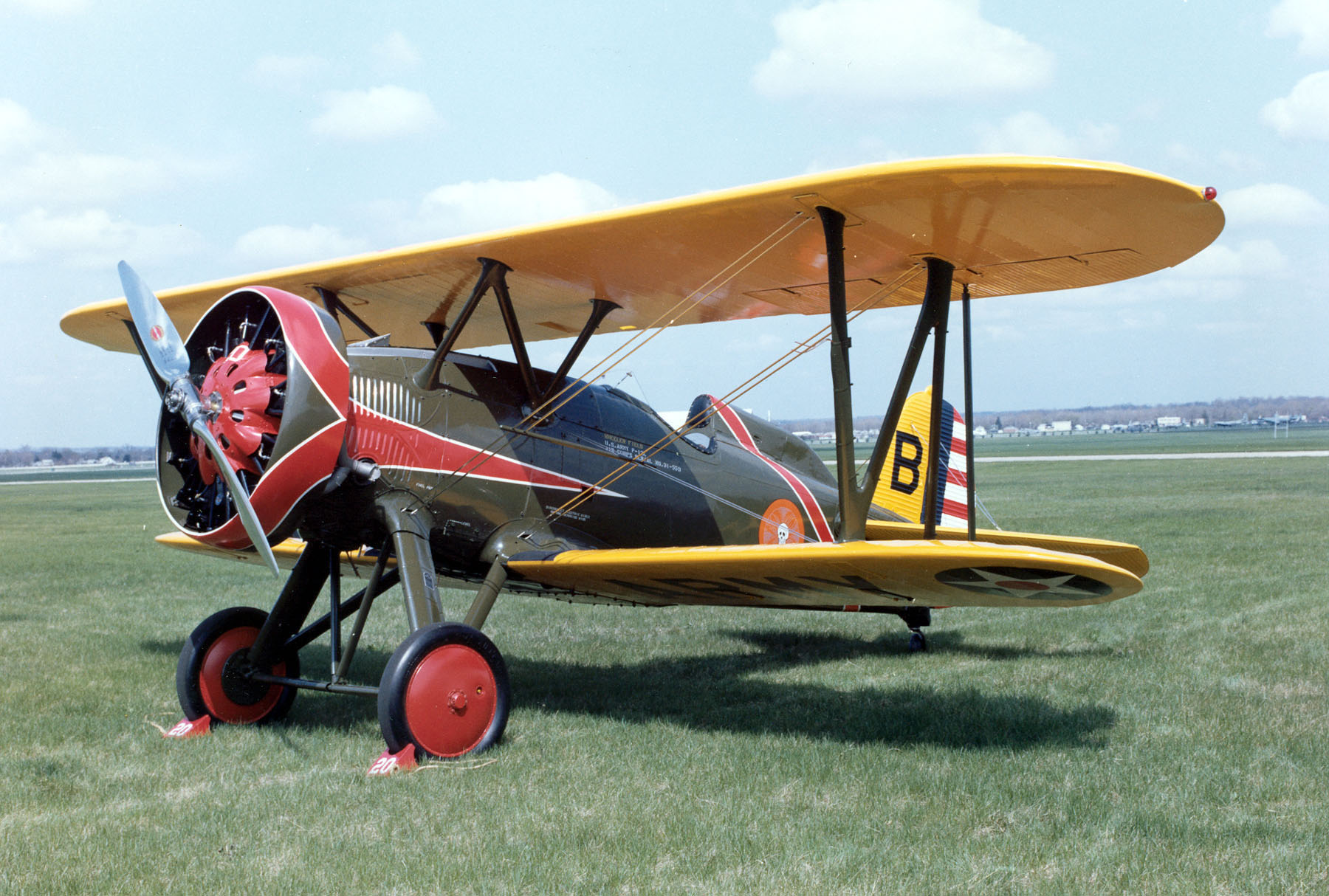
The Boeing P-12 or Boeing F4B is an American pursuit aircraft that was operated by the United States Army Air Corps, United States Marine Corps, and United States Navy. It was the chief fighter aircraft in American service during the early 1930s but also used internationally. By the late 1930s it was replaced in front-line duty by newer designs, but it was still used for training into the early 1940s. Many variants of the aircraft were developed. In the 21st century a handful of surviving air frames are on display in museums.
Developed as a private venture to replace the Boeing F2B and F3B with the United States Navy, the Boeing Model 99 first flew on 25 June 1928. The new aircraft was smaller, lighter and more agile than the ones it replaced but still used the Wasp engine of the F3B. This resulted in a higher top speed and overall better performance. As result of Navy evaluation 27 were ordered as the F4B-1; later evaluation by the United States Army Air Corps resulted in orders with the designation P-12. Boeing supplied the USAAC with 366 P-12s between 1929 and 1932. Production of all variants totaled 586.
F4B-1 (Boeing Model 99)
The F4B-1 was built using typical construction techniques of the day with a welded truss fuselage with formers and longerons to define the aerodynamic shape. Wings were of wood construction and covered by fabric. Ailerons were tapered, with corrugated aluminum covering. The Pratt & Whitney R-1340 nine-cylinder radial engine was uncowled and sported prominent cooling fairings behind each cylinder which were later removed in service.
F4B-2 (Boeing Model 223)
The F4B-2 was similar to the F4B-1 but incorporated a Townend ring cowling around the engine. The prominent cooling fairings behind each cylinder were not incorporated on this model. A spreader bar was incorporated between the landing wheels and the tail skid was replaced by a castoring tailwheel. Finally, the tapered ailerons were replaced by constant chord Frise ailerons. A total of 46 production F4B-2s were built. Bureau numbers included A-6813 through A8639 and A-8791 through A-8809. Some F4B-2s received F4B-4 style vertical fins and rudders to address poor directional stability.
F4B-3 (Boeing Model 235)
The F4B-3 represented a significant departure in design from the earlier versions of the F4B. While the F4B-1 and F4B-2 had fuselages constructed of welded steel tube truss, the F4B-3 used a combination of welded truss and semi-monocoque construction. From the engine mount aft to the rear of the fuel tank bay, the structure was welded steel truss, while the fuselage aft of the fuel tank bay was constructed of stressed skin, semi-monocoque aluminum alloy. Wings were constructed primarily of wood and covered in fabric. The F4B-3 was powered by a single-row, nine-cylinder Pratt & Whitney R-1340-D engine generating 500 hp. It had an internal supercharger and turned a 9 ft. two-blade Hamilton Standard propeller. The original configuration of the F4B-3 has a headrest fairing similar to the P-12E, but most were retrofitted with a headrest fairing capable of storing a liferaft. This later headrest fairing design was carried over to the F4B-4.
Hub AI
Boeing P-12 AI simulator
(@Boeing P-12_simulator)
Boeing P-12
The Boeing P-12 or Boeing F4B is an American pursuit aircraft that was operated by the United States Army Air Corps, United States Marine Corps, and United States Navy. It was the chief fighter aircraft in American service during the early 1930s but also used internationally. By the late 1930s it was replaced in front-line duty by newer designs, but it was still used for training into the early 1940s. Many variants of the aircraft were developed. In the 21st century a handful of surviving air frames are on display in museums.
Developed as a private venture to replace the Boeing F2B and F3B with the United States Navy, the Boeing Model 99 first flew on 25 June 1928. The new aircraft was smaller, lighter and more agile than the ones it replaced but still used the Wasp engine of the F3B. This resulted in a higher top speed and overall better performance. As result of Navy evaluation 27 were ordered as the F4B-1; later evaluation by the United States Army Air Corps resulted in orders with the designation P-12. Boeing supplied the USAAC with 366 P-12s between 1929 and 1932. Production of all variants totaled 586.
F4B-1 (Boeing Model 99)
The F4B-1 was built using typical construction techniques of the day with a welded truss fuselage with formers and longerons to define the aerodynamic shape. Wings were of wood construction and covered by fabric. Ailerons were tapered, with corrugated aluminum covering. The Pratt & Whitney R-1340 nine-cylinder radial engine was uncowled and sported prominent cooling fairings behind each cylinder which were later removed in service.
F4B-2 (Boeing Model 223)
The F4B-2 was similar to the F4B-1 but incorporated a Townend ring cowling around the engine. The prominent cooling fairings behind each cylinder were not incorporated on this model. A spreader bar was incorporated between the landing wheels and the tail skid was replaced by a castoring tailwheel. Finally, the tapered ailerons were replaced by constant chord Frise ailerons. A total of 46 production F4B-2s were built. Bureau numbers included A-6813 through A8639 and A-8791 through A-8809. Some F4B-2s received F4B-4 style vertical fins and rudders to address poor directional stability.
F4B-3 (Boeing Model 235)
The F4B-3 represented a significant departure in design from the earlier versions of the F4B. While the F4B-1 and F4B-2 had fuselages constructed of welded steel tube truss, the F4B-3 used a combination of welded truss and semi-monocoque construction. From the engine mount aft to the rear of the fuel tank bay, the structure was welded steel truss, while the fuselage aft of the fuel tank bay was constructed of stressed skin, semi-monocoque aluminum alloy. Wings were constructed primarily of wood and covered in fabric. The F4B-3 was powered by a single-row, nine-cylinder Pratt & Whitney R-1340-D engine generating 500 hp. It had an internal supercharger and turned a 9 ft. two-blade Hamilton Standard propeller. The original configuration of the F4B-3 has a headrest fairing similar to the P-12E, but most were retrofitted with a headrest fairing capable of storing a liferaft. This later headrest fairing design was carried over to the F4B-4.
Recent media