


Community hub
Recent from talks
Contribute something to knowledge base
Content stats: 0 posts, 0 articles, 1 media, 0 notes
Members stats: 0 subscribers, 0 contributors, 0 moderators, 0 supporters
Subscribers
Supporters
Contributors
Moderators
Hub AI
Boeing Skyfox AI simulator
(@Boeing Skyfox_simulator)
Hub AI
Boeing Skyfox AI simulator
(@Boeing Skyfox_simulator)
Boeing Skyfox
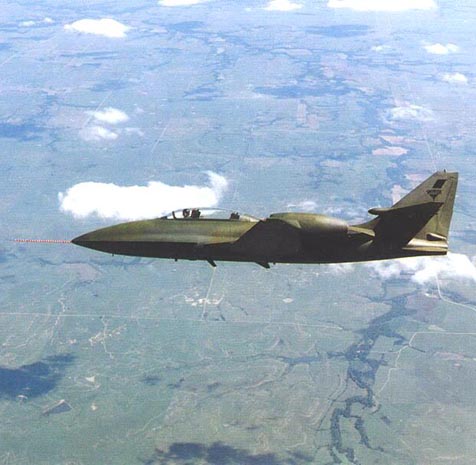
The Boeing Skyfox is an American twin-engined jet trainer aircraft, a highly upgraded development of the Lockheed T-33. It was designed as a primary trainer to compete with and replace the Cessna T-37 Tweet. Besides its primary role as a trainer, the aircraft was envisioned to have other roles as well, including ground attack. The program was started by the Skyfox Corporation in 1983, and was acquired by Boeing in 1986.
The program included the replacement of the Allison J33-A-35 turbojet by two Garrett TFE731-3A turbofans. It also included an extensive redesign of the airframe. Only one prototype aircraft was built, and the program was later canceled due to lack of customers.
Over 6,500 Lockheed T-33 trainers were built, making it one of the most successful jet trainer programs in history. However, technology passed the "T-Bird" by, and by the 1980s, it was clear that the world's air forces needed a more modern training aircraft. The "Skyfox" was conceived and developed by Russell O'Quinn. The modification designs were led by T-33 designer Irvin Culver and a number of other former Lockheed employees formed Flight Concepts Incorporated in 1982, with the intent of modernizing the T-33 design. The company's name was later changed to Skyfox Corporation.
The highly modified and modernized aircraft was expected to cost about half of a new comparable trainer, such as the BAE Hawk and Dassault/Dornier Alpha Jet. With the design work done, Skyfox purchased 80 surplus T-33s.
The Skyfox was marketed either as a complete converted aircraft from Boeing, or as a conversion kit, with the customer providing the T-33 airframe. The conversion incorporated about 70% of the existing T-33 airframe, but replaced the existing internal single Allison J33 turbojet engine with two Garrett TFE731-3A turbofan engines mounted externally. Together, the two TFE731s weighed 17% less than the single original engine, while providing 60% more thrust on 45% less fuel.[citation needed]
The engine change provided a large internal volume for fuel storage, eliminating the need for the T-33's wingtip tanks, but tip mountings were retained to accommodate optional auxiliary fuel tanks if desired.
Other modifications included inboard wing leading-edge extensions, the replacement of the tip tanks with winglets, a new canopy with one-piece windshield, revised nose geometry to improve visibility from the cockpit and to fair into the T-33's lateral intakes, new tail surfaces with a mid-set tailplane (although the original wings were retained), and new avionics.
The Skyfox was designed to be produced entirely from kits of components. The conversion involved the disassembly, the inspection, and the refurbishment of the T-33 airframe as necessary; the installation of the kits; and reassembly of the airframe in the Skyfox configuration.
Boeing Skyfox
The Boeing Skyfox is an American twin-engined jet trainer aircraft, a highly upgraded development of the Lockheed T-33. It was designed as a primary trainer to compete with and replace the Cessna T-37 Tweet. Besides its primary role as a trainer, the aircraft was envisioned to have other roles as well, including ground attack. The program was started by the Skyfox Corporation in 1983, and was acquired by Boeing in 1986.
The program included the replacement of the Allison J33-A-35 turbojet by two Garrett TFE731-3A turbofans. It also included an extensive redesign of the airframe. Only one prototype aircraft was built, and the program was later canceled due to lack of customers.
Over 6,500 Lockheed T-33 trainers were built, making it one of the most successful jet trainer programs in history. However, technology passed the "T-Bird" by, and by the 1980s, it was clear that the world's air forces needed a more modern training aircraft. The "Skyfox" was conceived and developed by Russell O'Quinn. The modification designs were led by T-33 designer Irvin Culver and a number of other former Lockheed employees formed Flight Concepts Incorporated in 1982, with the intent of modernizing the T-33 design. The company's name was later changed to Skyfox Corporation.
The highly modified and modernized aircraft was expected to cost about half of a new comparable trainer, such as the BAE Hawk and Dassault/Dornier Alpha Jet. With the design work done, Skyfox purchased 80 surplus T-33s.
The Skyfox was marketed either as a complete converted aircraft from Boeing, or as a conversion kit, with the customer providing the T-33 airframe. The conversion incorporated about 70% of the existing T-33 airframe, but replaced the existing internal single Allison J33 turbojet engine with two Garrett TFE731-3A turbofan engines mounted externally. Together, the two TFE731s weighed 17% less than the single original engine, while providing 60% more thrust on 45% less fuel.[citation needed]
The engine change provided a large internal volume for fuel storage, eliminating the need for the T-33's wingtip tanks, but tip mountings were retained to accommodate optional auxiliary fuel tanks if desired.
Other modifications included inboard wing leading-edge extensions, the replacement of the tip tanks with winglets, a new canopy with one-piece windshield, revised nose geometry to improve visibility from the cockpit and to fair into the T-33's lateral intakes, new tail surfaces with a mid-set tailplane (although the original wings were retained), and new avionics.
The Skyfox was designed to be produced entirely from kits of components. The conversion involved the disassembly, the inspection, and the refurbishment of the T-33 airframe as necessary; the installation of the kits; and reassembly of the airframe in the Skyfox configuration.
Recent media
Recent media