



Community hub
Recent from talks
Knowledge base stats:
Talk channels stats:
Members stats:
Boeing XB-15
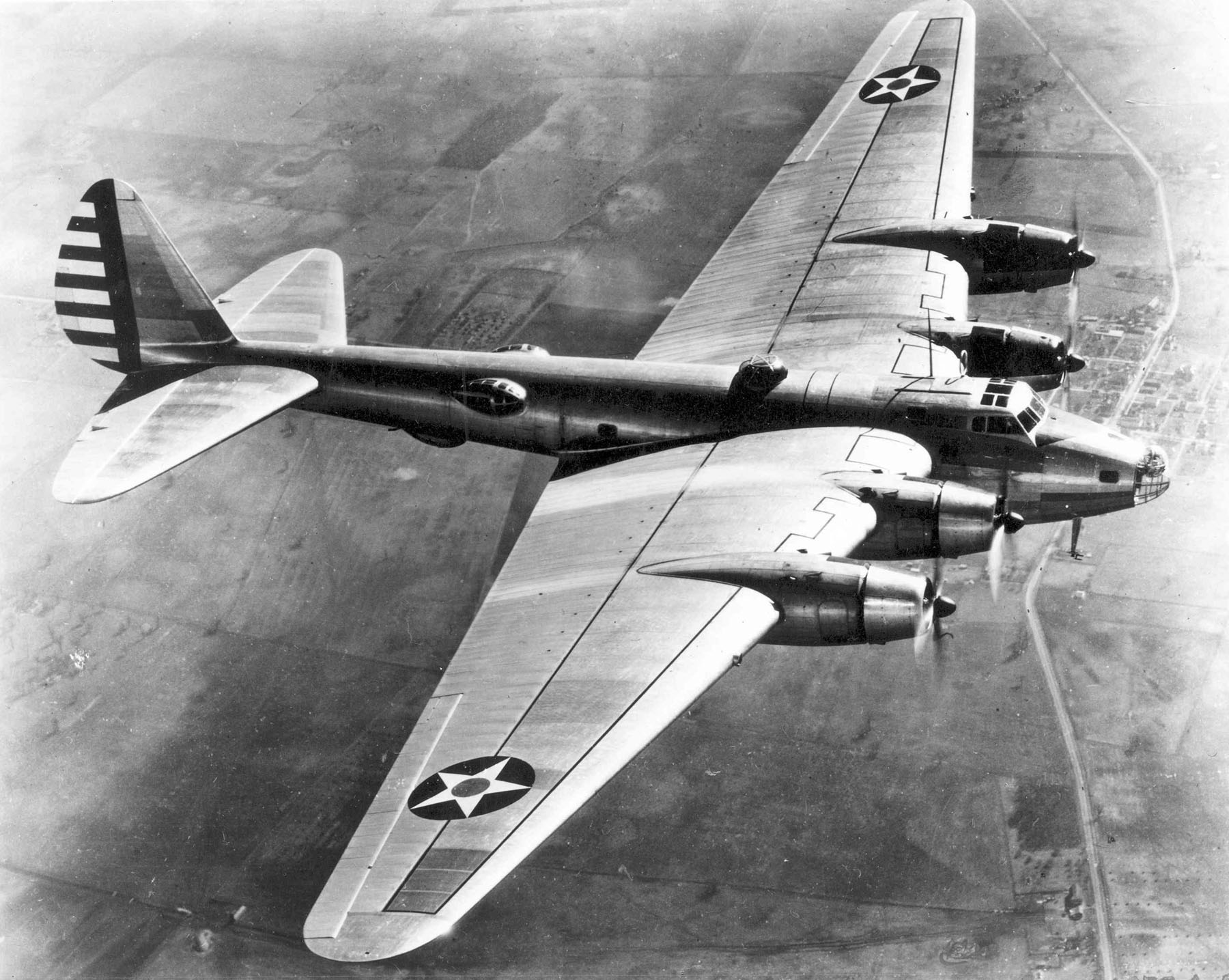
The Boeing XB-15 (Boeing 294) was a United States bomber aircraft designed in 1934 as a test for the United States Army Air Corps (USAAC) to see if it would be possible to build a heavy bomber with a 5,000 mi (8,000 km) range. For a year beginning in mid-1935 it was designated the XBLR-1. When it first flew in 1937, it was the most massive and voluminous airplane ever built in the US. It set a number of load-to-altitude records for land-based aircraft, including carrying a 31,205 lb (14,154 kg) payload to 8,200 ft (2,500 m) on 30 July 1939.
The aircraft's immense size allowed flight engineers to enter the wing through a crawlway and make minor repairs in flight. A 5,000 mi (8,000 km) flight took 33 hours at its 152 mph (245 km/h) cruising speed; the crew was made up of several shifts, and bunks allowed them to sleep when off duty.
The specification that produced the XB-15 began in mid-1933 as "Project A", USAAC discussions regarding the possibility of flying a very large bomber with a range of 5,000 mi (8,000 km). In April 1934, the USAAC contracted with Boeing and Martin to design a bomber capable of carrying 2,000 lb (910 kg) at 200 mph (320 km/h) over a distance of 5,000 miles. Boeing gave the project the internal name of Model 294, while the USAAC called it the XB-15. Martin's design, the XB-16, was judged inferior by the USAAC before a prototype was built, and was canceled.
The Boeing design team, headed by Jack Kylstra, initially intended the aircraft to use 2,600 hp (1,900 kW) Allison V-3420 liquid-cooled W engines; since these were not ready, 850 hp (630 kW) Pratt & Whitney R-1830 Twin Wasp air-cooled radial engines were used instead.
Starting in August 1934, Boeing began designing the Model 299 in answer to a proposal by the USAAC to replace the Martin B-10 bomber. The Model 299 design team incorporated elements of the Boeing 247 and the Model 294, especially its use of four engines. The Model 299 design team worked alongside Klystra's team, but difficulties in fabricating such a large aircraft slowed progress on the 294. The Model 299 flew first, on 28 July 1935.
In mid-1935, the USAAC combined Project A with Project D; a proposal asking for "the maximum feasible range into the future." The combined program was designated BLR for "Bomber, Long Range". The XB-15 was renamed the XBLR-1; it was joined under the BLR program by two other projects: one from Douglas Aircraft, the XBLR-2 which later became the XB-19; and one from Sikorsky Aircraft called the XBLR-3, later canceled. The next year, the XBLR designation was dropped and the Boeing prototype was once again the XB-15.
Unusual features that the XB-15 pioneered included an autopilot, deicing equipment, and two gasoline generators used as auxiliary power units (independent of the main engines) to power the 110-volt electrical system. The main engines were serviceable in flight using an access tunnel inside the wing. The aircraft contained a sizable crew compartment with bunkbeds, a galley and a lavatory. Finally, in September 1937, construction was finished, and it first flew on 15 October. Its double-wheel main landing gear remained down from takeoff to landing. On 2 December 1937, the XB-15 flew from Seattle to Wright Field in Ohio to be accepted by the USAAC for testing.
With the Twin Wasp radial engines installed — the same number and type of engines fitted to the later Consolidated B-24 Liberator, with individual turbochargers added on the Liberators' Twin Wasp powerplants — the specified speed of 200 mph (320 km/h) for the Twin Wasp-powered XB-15 was not quite reached even when the aircraft was empty; the best speed attained in level flight was 197 mph (317 km/h). Loaded with the specified 2,000 pounds (910 kg), the maximum speed was a disappointing 145 mph (233 km/h). This was considered too slow for a combat aircraft, and the project was abandoned. However, Boeing engineers projected that the prototype would be capable of carrying the heaviest air cargo to date: a load of 8,000 lb (3,600 kg).
Hub AI
Boeing XB-15 AI simulator
(@Boeing XB-15_simulator)
Boeing XB-15
The Boeing XB-15 (Boeing 294) was a United States bomber aircraft designed in 1934 as a test for the United States Army Air Corps (USAAC) to see if it would be possible to build a heavy bomber with a 5,000 mi (8,000 km) range. For a year beginning in mid-1935 it was designated the XBLR-1. When it first flew in 1937, it was the most massive and voluminous airplane ever built in the US. It set a number of load-to-altitude records for land-based aircraft, including carrying a 31,205 lb (14,154 kg) payload to 8,200 ft (2,500 m) on 30 July 1939.
The aircraft's immense size allowed flight engineers to enter the wing through a crawlway and make minor repairs in flight. A 5,000 mi (8,000 km) flight took 33 hours at its 152 mph (245 km/h) cruising speed; the crew was made up of several shifts, and bunks allowed them to sleep when off duty.
The specification that produced the XB-15 began in mid-1933 as "Project A", USAAC discussions regarding the possibility of flying a very large bomber with a range of 5,000 mi (8,000 km). In April 1934, the USAAC contracted with Boeing and Martin to design a bomber capable of carrying 2,000 lb (910 kg) at 200 mph (320 km/h) over a distance of 5,000 miles. Boeing gave the project the internal name of Model 294, while the USAAC called it the XB-15. Martin's design, the XB-16, was judged inferior by the USAAC before a prototype was built, and was canceled.
The Boeing design team, headed by Jack Kylstra, initially intended the aircraft to use 2,600 hp (1,900 kW) Allison V-3420 liquid-cooled W engines; since these were not ready, 850 hp (630 kW) Pratt & Whitney R-1830 Twin Wasp air-cooled radial engines were used instead.
Starting in August 1934, Boeing began designing the Model 299 in answer to a proposal by the USAAC to replace the Martin B-10 bomber. The Model 299 design team incorporated elements of the Boeing 247 and the Model 294, especially its use of four engines. The Model 299 design team worked alongside Klystra's team, but difficulties in fabricating such a large aircraft slowed progress on the 294. The Model 299 flew first, on 28 July 1935.
In mid-1935, the USAAC combined Project A with Project D; a proposal asking for "the maximum feasible range into the future." The combined program was designated BLR for "Bomber, Long Range". The XB-15 was renamed the XBLR-1; it was joined under the BLR program by two other projects: one from Douglas Aircraft, the XBLR-2 which later became the XB-19; and one from Sikorsky Aircraft called the XBLR-3, later canceled. The next year, the XBLR designation was dropped and the Boeing prototype was once again the XB-15.
Unusual features that the XB-15 pioneered included an autopilot, deicing equipment, and two gasoline generators used as auxiliary power units (independent of the main engines) to power the 110-volt electrical system. The main engines were serviceable in flight using an access tunnel inside the wing. The aircraft contained a sizable crew compartment with bunkbeds, a galley and a lavatory. Finally, in September 1937, construction was finished, and it first flew on 15 October. Its double-wheel main landing gear remained down from takeoff to landing. On 2 December 1937, the XB-15 flew from Seattle to Wright Field in Ohio to be accepted by the USAAC for testing.
With the Twin Wasp radial engines installed — the same number and type of engines fitted to the later Consolidated B-24 Liberator, with individual turbochargers added on the Liberators' Twin Wasp powerplants — the specified speed of 200 mph (320 km/h) for the Twin Wasp-powered XB-15 was not quite reached even when the aircraft was empty; the best speed attained in level flight was 197 mph (317 km/h). Loaded with the specified 2,000 pounds (910 kg), the maximum speed was a disappointing 145 mph (233 km/h). This was considered too slow for a combat aircraft, and the project was abandoned. However, Boeing engineers projected that the prototype would be capable of carrying the heaviest air cargo to date: a load of 8,000 lb (3,600 kg).