Hubbry Logo
BoletoBoletoMain
Open search
Boleto
Community hub
Boleto
logo
8 pages, 0 posts
0 subscribers
Be the first to start a discussion here.
Boleto
Boleto
from Wikipedia

Boleto bancário, simply referred to as boleto (English: bank ticket) is a payment method in Brazil regulated by Febraban (Brazilian Banks Federation).

A boleto, which can be considered a proforma invoice, can be paid at ATMs, branch facilities, and internet banking of any bank, post office, lottery agent and some supermarkets until its due date. After the due date it can only be paid at the issuer bank facilities.[1] A boleto can only be collected by an authorized collector agent in the Brazilian territory.[citation needed]

Open source projects like BoletoPHP allow the merchandisers to generate unregistered boletos bancários without communicating with a bank.[2]

Initially, boletos could only be paid at bank branches, but nowadays it is possible to pay them through ATMs, lottery shops, supermarkets, or with the help of a computer or smartphone via internet banking. Some boletos may contain instructions from the issuer that allow payment even after the set due date, with possible penalty or interest charges for late payment, but these conditions are specific to each issued boleto.

See also

[edit]

References

[edit]
[edit]
Revisions and contributorsEdit on WikipediaRead on Wikipedia
from Grokipedia
Boleto bancário, commonly referred to as boleto, is a standardized payment voucher system in that enables consumers to settle bills, invoices, and online purchases using cash or electronic transfers at banks, ATMs, or authorized retail locations such as supermarkets and lottery outlets. Regulated by the Brazilian Federation of Banks (FEBRABAN) and the , boleto was introduced in 1993 as a secure, push-payment method to facilitate transactions without requiring a or . It generates several billion transactions annually, accounting for approximately 9% of payments in the country (as of 2024). The system operates through a pre-filled voucher featuring a unique barcode or serial number, which merchants generate for each transaction and send to customers via email, download, or print. Payments must typically be made within 3 to 15 days of issuance, after which the voucher expires unless extended, and confirmation of payment reaches the merchant within 1 to 3 business days via bank processing. Since 2017, all boletos must be registered with the Central Bank at issuance to enhance security and prevent fraud, a measure that has standardized the process across over 40,000 payment points nationwide. Boleto's enduring popularity stems from Brazil's financial landscape, where approximately 60 million adults (around 40%) lack credit cards and fewer than 5% have no (as of 2024), making it an essential tool for reaching or underbanked populations, including corporate and clients. It offers merchants benefits such as low fraud risk, no chargebacks, and no credit limits, while providing customers with flexible, accessible payment options that build trust in . Recent updates, including integration with the instant payment system Pix under the 2025 Boleto 2.0 framework, aim to further modernize and accelerate settlements.

Overview

Definition and Purpose

Boleto Bancário is a standardized payment slip issued by Brazilian financial institutions on behalf of creditors, serving as a key instrument for collecting payments related to bills, taxes, services, and other obligations. Regulated by the and standardized by the Brazilian Federation of Banks (Febraban), it functions as a non-card, cash-based that can be paid at banks, automated teller machines (ATMs), or authorized agents without requiring a personal . The primary purpose of Boleto Bancário is to facilitate accessible payments in a with historical banking fragmentation, enabling individuals—who represent about 14% of Brazilian adults as of 2025—to participate in financial transactions through simple, offline methods. It supports both business-to-consumer (B2C) transactions, such as utility bills or purchases, and (B2B) payments, like supplier invoices, thereby bridging gaps in for populations without credit cards or access. Originating in the late as a response to Brazil's diverse and uneven banking landscape, it emerged in 1993 to streamline collections in a system where traditional banking was not universally available. Economically, Boleto Bancário handles around 4 billion transactions annually in recent years, accounting for a substantial portion of Brazil's retail payments and underscoring its role in the national despite the rise of digital alternatives like Pix.

Key Features

Boleto features a 44-digit machine-readable (código de barras) and a corresponding 47-digit human-readable "linha digitável" formatted with dots and dashes for manual entry. The structure includes: (positions 1-3), code 9 for BRL (position 4), free field (positions 5-29), expiration factor (positions 30-33, representing days from October 7, 1997), value (positions 34-43, 10 digits), and general verifier digit (position 44). The linha digitável inserts three local verifier digits (using Modulo 10/11) into the free field segments to facilitate readability and error checking without scanning. Once processed, Boleto payments are non-reversible, meaning they are final with no option for chargebacks similar to those available in transactions, which enhances for merchants by eliminating disputes after settlement. The system incorporates an expiration mechanism, typically set to 3 to 15 days from issuance, after which the boleto becomes invalid and requires reissuance by the issuer to enable payment. Boleto integrates seamlessly with Brazil's banking infrastructure through standardized protocols established by the Brazilian Federation of Banks (FEBRABAN), ensuring across all participating financial institutions via a uniform layout for generation and processing. These FEBRABAN standards, including verification digits using Modulo 10 and 11, support nationwide compatibility and reduce errors in transaction handling. Accessibility is a core feature, allowing payments at physical locations such as bank branches, automated teller machines (ATMs), lottery outlets, and even supermarkets or post offices, alongside digital options through online bank portals for those with internet access. This multi-channel approach broadens usability, particularly for individuals who can complete transactions in cash without needing a personal .

History

Origins and Development

In the 1980s, grappled with , where annual rates often surpassed 1,000%, eroding the value of money and complicating financial transactions. This economic turmoil, combined with limited electronic banking infrastructure, resulted in heavy reliance on and as primary methods, as delays in processing could lead to significant value loss. Traditional were particularly vulnerable, often requiring immediate clearance to mitigate inflation's impact, while dominated everyday and bill payments due to the scarcity of automated systems. To address these challenges and standardize bill collection amid ongoing instability, the Boleto Bancário system was introduced in 1993 through the Central Bank's Circular Letter No. 2414, dated , which took effect on January 3, 1994. Regulated by the Brazilian Federation of Banks (FEBRABAN), the initiative aimed to create a more reliable mechanism for payments, replacing fragmented manual processes with a uniform, bank-issued system. Early adoption was driven by the urgent need for secure, traceable transactions in Brazil's high-inflation environment, where unverified payments risked or ; the system initially targeted bills, such as , , and services, to streamline collections for utilities. FEBRABAN coordinated the rollout, emphasizing standardization across institutions, while major banks like provided essential infrastructure for issuance and processing during the pilot phase. This collaboration enabled rapid integration into existing banking networks, fostering trust and efficiency in an otherwise chaotic financial landscape.

Major Milestones

In 1997, FEBRABAN enforced a uniform format for boletos across all Brazilian banks, establishing October 7 as the reference date for the fator de vencimento—a numerical code calculating days from issuance to due date—to standardize processing and reduce errors in electronic clearing. This milestone built on the system's initial 1993 launch, enabling more efficient nationwide adoption by unifying technical specifications for reading and validation. During the 2000s, boleto expanded significantly into and online payments, integrating with emerging digital platforms as Brazil's penetration grew from under 5% in 2000 to over 25% by 2009. This period marked boleto's shift from primarily physical bill payments to a key method for remote transactions, with banks incorporating it into online apps and portals to facilitate purchases without requiring credit cards, thereby supporting the nascent sector's annual growth rates exceeding 30%. The 2010s brought major reforms, culminating in the introduction of "Boleto Registrado" in by FEBRABAN, which mandated registration of all boletos with banks to enhance fraud prevention and enable better tracking. Effective January 1, , this system required issuers to include payer details like full name, CPF/, and address, allowing automatic notifications to buyers' accounts and formal objection filing for unpaid items, thereby reducing losses estimated at hundreds of millions annually prior to implementation. Full mandatory adoption followed by November 2018, processing high-value boletos (over R$50,000) first from July . In the 2020s, the accelerated boleto's digital evolution, boosting contactless and online usage as consumers avoided physical locations, with adoption surging over 50% in alone. This trend aligned with broader shifts, including FEBRABAN's 2023 updates to the CNAB240 layout standard, which integrated QR codes for Pix compatibility, enabling instant scanning and via mobile apps to streamline processing. In 2025, FEBRABAN introduced the Boleto 2.0 framework, effective February 3, integrating deeper with Pix for same-day settlements (for payments before 1:30 PM), dynamic slips, and a new governance structure to modernize the system further. Additionally, to address the fator de vencimento limit reached on February 21, 2025 (after 9999 days from 1997), FEBRABAN updated the standard to reset or extend the code starting February 22, preventing disruptions in boleto issuance. Overall, boleto volumes have scaled dramatically, reaching approximately 3.7 billion transactions annually as of 2022, though growth has moderated with Pix's rise, maintaining its role in Brazil's ecosystem.

Issuance Process

Generation by Issuers

Creditors issuing boletos must first register with a participating or authorized (PSP), such as a , to comply with Brazilian banking regulations. This registration enables access to the necessary infrastructure for generation, often through dedicated software, APIs, or integrated platforms provided by the or PSP. The generation process begins with the issuer inputting key details, including the debtor's information (such as name, CPF or , and address), the payment amount, and the due date (typically 3 to 15 days from issuance). The bank or PSP then assigns a unique 47-digit linha digitável (readable line) and generates a based on these inputs, ensuring the boleto's . Following this, the boleto is automatically registered in the Centralized Issuance Platform (CIP), a system managed by FEBRABAN, which centralizes validation and processing to prevent fraud. A FEBRABAN initiated mandatory registration in the CIP at issuance, with phased implementation from 2017 to 2019 based on boleto value thresholds; effective November 2019, all boletos—regardless of value—must undergo this registration to ensure security, accurate tracking, and compliance with oversight. Unregistered boletos are no longer valid for processing. Once generated, issuers distribute the boleto as a PDF or image file via , postal mail, or secure download for the . Unlike methods, boletos require manual payment by the and do not authorize automatic withdrawals from bank accounts. Under the Boleto 2.0 framework, effective February 3, 2025 (per Resolution No. 443/2024), issuers can generate dynamic payment slips for tradable financial assets, allowing post-issuance changes to the recipient and beneficiary upon asset negotiation. These dynamic boletos integrate with the Pix system via QR codes, requiring registration synchronization between the SILOC (Nuclea) and SPI systems to record payments and prevent duplicates; they are limited to beneficiaries with contractual relationships with bookkeepers or registrars.

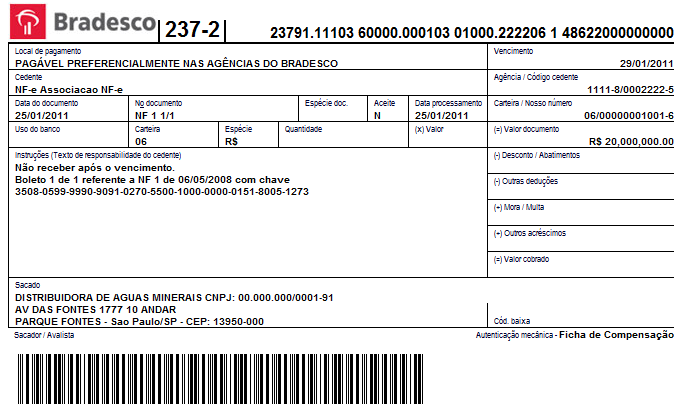
Format and Components

A Boleto document follows a standardized layout on A4-sized , divided into sections for clarity and ease of processing. The upper portion typically includes the beneficiary's details (such as name, tax ID, and address), followed by key information: the payer's name and address, the document value, due date, and any instructions for the payer (e.g., penalties for late or discount conditions). Below this, a non-removable "ficha de compensação" (clearance slip) contains essential data like the bank agency, account number, and for bank processing. This structure ensures all parties have access to necessary details while complying with FEBRABAN standards for and uniformity. The core visual and coded element is the , printed in format and encoding a 44-digit string for readability. This is structured as follows: positions 1–3 represent the (e.g., 001 for ); position 4 indicates the currency (typically 9 for ); position 5 is the general , calculated using modulus 11 for validation; positions 6–9 denote the due date factor (number of days since October 7, 1997); positions 10–19 specify the value in cents (with two decimal places); and positions 20–44 comprise the 25-digit free field (campo livre), which includes bank-specific details like the issuer's code, agency, account number, and transaction identifiers. The free field structure varies by issuing bank but enables unique identification and processing. Above the , the "linha digitável" (readable line) displays a 47-digit version of this information, incorporating three additional check digits for manual entry verification. For security, printed Boleto versions often incorporate watermarks or special paper to deter counterfeiting, while digital formats, typically distributed as PDFs, may include electronic signatures to verify authenticity and prevent alterations during transmission. These elements, combined with the 's built-in check digits, help ensure the document's integrity throughout handling. In Boleto 2.0, dynamic payment slips add Pix QR codes alongside the traditional to enable options. Boleto documents exist in two primary variations: simple (unregistered) and registered. Simple boletos lack mandatory registration in the Centralized Payments System (CIP), omitting detailed payer information and a unique transaction ID, which limits real-time tracking and increases fraud risk; they were phased out by FEBRABAN starting in , with full prohibition effective December 10, 2019. Registered boletos, now the standard, include a transaction ID within the free field for comprehensive tracking, enabling features like payment confirmation updates and duplicate detection, and require pre-registration of all details with the issuing bank or CIP.

Payment and Processing

Payment Methods

Boleto payments can be made through a variety of traditional in-person channels, providing accessibility for or cash-preferring individuals in . These include bank branches, automated teller machines (ATMs), lottery houses such as those operated by Caixa Econômica Federal, post offices, supermarkets, and convenience stores, where the barcode on the Boleto is scanned for processing. Online payment options have expanded Boleto's convenience, allowing payers to settle via internet banking portals, applications that scan the Boleto's barcode or input the , and third-party digital platforms like . Payers generally face no fees when using their own bank's channels, but non-bank payers settling at lottery houses or third-party locations may incur a small service commission, typically ranging from 1% to 2% of the transaction value or a fixed amount around R$1-5. While partial payments are not standard for standard Boletos, certain registered systems and platforms enable installment options, where the total amount is divided into multiple over time. Upon successful , payers receive an instant at in-person locations or through the app for transactions, with digital proof often sent via or accessible in the banking application for verification.

Validation and Settlement

Upon payment presentation, the receiving bank scans the Boleto's and validates it against the Plataforma Centralizada de Recebíveis (PCR), managed by the Brazilian Federation of Banks (FEBRABAN). This process confirms the Boleto's registration status, verifies the payer and issuer details (such as CPF/, due date, and value), and checks for expiration, duplicates, or alterations to prevent . Settlement occurs after validation, with funds typically credited to the issuer's account within 1 business day, with same-day settlement possible for payments made before 1:30 p.m. (as of March 2024). For payments made through digital channels, integration with the Pix instant payment system enables near-instant confirmation and settlement (under 60 seconds) for supported Boletos as of 2025. As of March 2024, FEBRABAN accelerated processing, allowing same-day compensation for boletos paid by 1:30 p.m. The 2025 Boleto 2.0 framework further integrates dynamic payment slips with Pix for enhanced speed. Issuers access reconciliation reports through secure bank portals, which detail paid Boletos, including transaction IDs, amounts, and dates, allowing for automated matching against issued invoices. Errors such as overpayments or invalid codes are handled via these portals, with s issuing credits or adjustments as needed. rates in Boleto processing remain low, primarily due to embedded check digits in the barcode that follow FEBRABAN's standard validation algorithm, ensuring during scanning. Disputes arising from processing issues are resolved through FEBRABAN's regulatory oversight and mechanisms.

Usage and Economic Impact

Common Applications

Boleto Bancário is extensively used for settling utility and service bills in Brazil, including , , and charges. For instance, electricity provider Light S.A. issues boletos for monthly consumer accounts, allowing payments at banks, ATMs, or lottery outlets. Similarly, telecom operator Vivo employs boletos for mobile, fixed-line, and internet service invoices, facilitating accessible cash-based settlements for subscribers. Water utilities, such as Sabesp in , also rely on boletos for residential and commercial billing, ensuring broad coverage across urban and rural areas. In the realm of taxes and government payments, Boleto serves as a primary mechanism for fulfilling fiscal obligations. The IPVA (Imposto sobre a Propriedade de Veículos Automotores), a state-level vehicle ownership , is commonly paid via boleto generated through state department portals, with options for single or installment payments at authorized financial institutions. The IPTU (Imposto Predial e Territorial Urbano), a municipal , follows a similar process; for example, São Paulo's city hall issues boletos for annual assessments, offering discounts for early payment. Federal collections, including income taxes and contributions, are handled through the DARF (Documento de Arrecadação de Receitas Federais), which operates analogously to a boleto and can be settled at banks or via electronic means. Within , Boleto is favored for high-value or international transactions, particularly where buyers seek to bypass credit card fees and processing delays. Retailers like integrate Boleto as a option on their platform, enabling customers to purchase , appliances, and other goods without a , which appeals to approximately 35-40% of lacking cards as of 2025. This method supports secure, upfront payments, reducing merchant risk for larger orders. Boleto also finds application in education and health sectors for fee collections and medical billing. Private schools and universities issue boletos for tuition and enrollment fees, accommodating parents or students who prefer non-card options. In healthcare, hospitals and clinics generate boletos for consultation fees, treatments, and insurance copayments, as seen in platforms like HSaúde for streamlined bill access. Additionally, in B2B contexts, suppliers utilize Boleto for invoicing goods and services, minimizing chargeback risks and supporting cash flow for small to medium enterprises. Geographically, Boleto's dominance is pronounced in Brazil's Northeast region and among lower-income demographics, where banking access remains limited—about 3% of adults were as of 2024. This prevalence stems from the method's cash compatibility at over 40,000 physical locations, including supermarkets and pharmacies, which aligns with the socioeconomic realities of these areas.

Adoption Statistics

In 2024, Brazilian financial institutions issued over 4.3 billion boletos bancários in the first half of the year, processing a total value of R$ 6.67 trillion during that period, according to data from the Federação Brasileira de Bancos (Febraban). Boleto's in overall payment transactions has declined steadily amid the rapid adoption of systems like Pix, falling from 7% in 2022 to 5% in 2023 and stabilizing at around 4% in 2024, as reported by the (Banco Central do Brasil, or BCB). This represents a drop from approximately 10-15% in earlier years like 2019, when digital alternatives were less prevalent. In specifically, merchant acceptance of Boleto fell to 32% as of July 2025. Demographically, Boleto continues to serve as a primary option for the remaining population in , estimated at about 3% of adults as of , enabling cash-based transactions without requiring a . Usage remains higher in rural areas compared to urban centers, though exact figures vary by region. Regionally, the highest issuance volumes occur in economically active states like and Rio de Janeiro, while reliance is greater in poorer northern and northeastern states with limited banking infrastructure.

Advantages and Challenges

Benefits for Users and Businesses

Boleto offers significant advantages for users in , particularly those without access to traditional banking services. Unlike payments, Boleto does not require a or a personal , allowing individuals to make purchases or pay bills using at banks, ATMs, lotteries, or apps. This accessibility enables widespread participation in and utility payments, with Boleto accepted by nearly all major retailers and service providers across the country. For businesses, Boleto minimizes financial risks by eliminating chargebacks, as payments are prepaid and verified through the banking system before settlement, reducing exposure to disputes common in card transactions. Its straightforward integration into platforms supports recurring billing for subscriptions and installments, streamlining operations for services like utilities and without the need for complex authorization processes. Furthermore, Boleto expands market reach to 60% of the adult population who lack credit cards, enabling businesses to tap into underserved segments and boost conversion rates. Boleto plays a key role in promoting by providing a reliable mechanism for Brazil's approximately 27 million adults (as of 2023), allowing them to engage in formal economic activities without traditional banking infrastructure. This inclusivity is enhanced by the system's regulation under the , which ensures secure processing and high reliability in settlements. Issuance fees for Boleto, typically ranging from R$3 to R$5 per transaction, are notably lower than those for international credit cards, which can exceed 5% of the transaction value, offering cost efficiency for both small merchants and large enterprises. Overall, the oversight by Brazil's banking network contributes to a low fraud incidence, fostering trust and operational stability for all stakeholders.

Criticisms and Limitations

One significant criticism of the Boleto system is its reliance on manual processes, which can lead to errors during entry. Users often need to manually input a 47-digit or code when paying online or at banks, increasing the risk of transcription mistakes that invalidate the transaction and require retries. Additionally, not all channels provide instant confirmation, as settlement typically takes 1 to 3 days, though it can be instant when paid via Pix integration under the 2025 Boleto 2.0 framework, contrasting with real-time alternatives like Pix and potentially lowering e-commerce conversion rates. This delay in confirmation can frustrate users and merchants, who must wait for bank validation before proceeding. Fraud risks further undermine Boleto's reliability, particularly through schemes involving fake boletos. Criminals exploit the system's format by distributing altered documents that redirect payments to fraudulent accounts, with recent reports indicating that scams using fake boletos contributed to losses of R$25.5 billion in the 12 months prior to mid-2025. Boletos also have fixed expiration dates, usually 3 to 15 days, after which they become invalid; this necessitates reissuance by the merchant, adding administrative burden and opportunities for scammers to pose as issuers for "new" boletos. The paper-based nature of traditional Boletos contributes to environmental concerns, as payments often require printing vouchers for in-person settlement at banks or lottery houses, perpetuating unnecessary paper consumption in an era of digital alternatives. Despite efforts to digitize, Boleto's declining relevance stems from legacy systems that hinder faster adoption of electronic formats, as noted in Central Bank initiatives to modernize the infrastructure, such as approving dynamic boletos payable via Pix QR codes in late 2024. This slower transition has led to Boleto's market share stagnating after years of decline, exacerbated by competition from instant payment systems. Additionally, boleto's fixed issuance fees (around R$3) are higher than Pix's low percentage-based costs (about 0.3%), contributing to its stagnating market share as of August 2025.

Regulatory Framework

Governing Laws

The Brazilian Federation of Banks (FEBRABAN) establishes mandatory standards for Boleto Bancário operations, with the system originating in the early 1990s through the introduction of bar codes on collection slips to enable electronic clearing. These standards have been updated through resolutions, including the implementation of the New Payment Collection Platform, which requires registration of boletos to enhance and prevent . The platform, managed by FEBRABAN, ensures standardized processing across banks. The (BCB) oversees the Boleto system as part of the Brazilian (SPB), particularly through the Central de Identificação de Pagamentos (CIP) platform for boleto registration. Under Law No. 12.865/2013, the BCB regulates payment arrangements and institutions, authorizing the CIP to centralize boleto data for validation and settlement, thereby promoting efficiency and in non-card payment methods. This oversight ensures interoperability and compliance within the national financial infrastructure. In December 2024, the BCB issued Resolução BCB nº 443, effective February 2025, establishing the Boleto 2.0 framework. This regulation modernizes boleto operations by allowing payments via Pix (including QR codes for immediate settlement if paid before 1:30 PM), introducing dynamic boletos linked to financial assets like duplicatas and receivables, and creating a shared structure involving representative associations and BCB supervision to enhance , , and efficiency. Consumer protections for Boleto transactions are governed by the Consumer Defense Code (Law No. 8.078/1990), which grants rights to address disputes, including undue charges, defective services, and refund requests. Consumers can seek compensation, such as double repayment for overcharges plus corrections and interest, through mechanisms like the Procon agencies or judicial channels, applying to payment-related issues in commercial transactions. This framework holds suppliers and financial institutions jointly liable for damages arising from Boleto processing errors or misleading practices. For government payments, Boletos are regulated by fiscal codes, including the National Tax Code (CTN, Law No. 5.172/1966), which defines tax obligations, collection procedures, and enforcement rules. This applies to payments like federal taxes (e.g., IRPF) or state levies (e.g., IPVA), where Boletos serve as official instruments, ensuring compliance with computation bases, due dates, and penalties for non-payment as outlined in the CTN. Tax authorities integrate Boletos into their systems for secure revenue collection. International aspects of Boleto are limited due to its domestic focus, but high-value transactions must comply with (FATF) standards through Brazil's anti-money laundering (AML) regime under Law No. 9.613/1998. Financial institutions processing Boletos monitor for suspicious activities as part of FATF Recommendation 10 on customer , aligning with Brazil's evaluated compliance in FATF mutual assessments. This integration prevents misuse in cross-border contexts while maintaining Boleto's primarily local utility.

Security and Fraud Prevention

Boleto transactions incorporate a based on 10 and 11 verification within the barcode and linha digitável to detect any alterations or errors during processing. This mechanism calculates the digit by applying weighted sums to the preceding fields and ensures integrity when the boleto is scanned or manually entered, preventing invalid or tampered payments from proceeding. The Centralized Identification of Payers (CIP), operated by the Câmara Interbancária de Pagamentos, serves as the central registration system for all boletos since the implementation of the Nova Plataforma de Cobrança in 2017. Under this mandatory framework, issuers must register each boleto in the CIP database prior to issuance, including details such as the payer's CPF or , due date, value, and beneficiary information, which are validated against requirements. The system blocks payments on unregistered boletos, duplicates, or those with unauthorized modifications by cross-checking data in real-time during redemption, thereby mitigating risks of fraudulent issuance or alteration. By August 2022, the platform had registered 30.6 billion boletos, processing over 234.9 billion transactions and preventing an estimated R$450 million in annual fraud losses through centralized validation. Brazilian banks employ AI-driven monitoring for fraud detection in Boleto transactions, analyzing patterns such as unusual payment volumes, geographic discrepancies, or rapid successive attempts to identify anomalies. This includes real-time scrutiny of redemption requests against historical data and issuer profiles, with mandatory authentication of the issuer via the CIP registration to confirm legitimacy before approval. Solutions like TIVIT Decisions, deployed by financial institutions, leverage AI to cover 97% of transactional data and flag potential bolware infections— that alters boleto details—reducing successful incidents. FEBRABAN conducts ongoing user education campaigns to enhance Boleto , emphasizing verification of issuer details such as the beneficiary's CPF/CNPJ and name against official records, and ensuring the first three digits of the barcode match the issuing bank's . These initiatives also advise against opening attachments purportedly containing boletos, recommending instead the use of secure PDF requests or the Débito Direto Autorizado (DDA) system to receive electronic versions directly from the centralized platform, thereby avoiding virus-induced alterations. The campaigns promote antivirus updates and direct contact with issuers for any discrepancies, contributing to broader adoption of fraud-resistant practices. Incident response measures, bolstered by the Nova Plataforma de Cobrança updates, have led to measurable reductions; for instance, the platform's validation protocols eliminated an estimated R$450 million in annual Boleto-related by 2022, with continued enhancements supporting a decline in successful tampering attempts amid rising overall reports.

Modern Developments

Digital Integration

Digital integration efforts have transformed Boleto from a primarily paper-based instrument into a more electronic and accessible option, enhancing user convenience through mobile technologies and standardized APIs. Since the mid-2010s, major banks like have enabled mobile scanning of QR codes and barcodes on Boleto slips via their apps, allowing customers to capture details directly from physical or digital vouchers for quick processing without manual entry. This feature, now widespread across banking apps, has streamlined in-person and remote payments, particularly for users who can scan at ATMs or lotteries. The rollout of in , particularly Phase 3 in 2022, has facilitated API integrations that embed Boleto functionality into platforms, enabling seamless issuance and payment initiation without traditional banking intermediaries. Regulated by the (BCB), this phase introduced standardized APIs for payment services, allowing like to incorporate registered Boletos into their ecosystems for automated processing and shared features, such as collaborative bill splitting. These integrations promote , reducing friction in digital wallets and e-commerce checkouts. E-Boleto, or fully digital Boleto variants, has gained traction with features like push notifications for due dates and automated reminders, shifting from printed slips to app-based or delivery. By mid-2024, Boletos exhibited increasing digital adoption, with over 80% of overall banking transactions occurring via digital channels, including a significant portion of Boleto payments processed electronically to support real-time status updates and e-invoicing. This evolution has made Boletos more user-friendly, particularly in mobile environments, where 66% of Brazilians handle payments through digital account apps. Interoperability advancements link Boleto with Pix, Brazil's instant payment system, through hybrid models that combine traditional slips with QR codes for dual payment options, thereby reducing reliance on paper and accelerating settlement. Under Boleto 2.0 rules announced in 2024 and effective from early 2025, integrations allow dynamic QR codes on Boletos to trigger Pix transfers, enabling paperless hybrid payments that cut processing times and environmental impact. Platforms like FitBank exemplify this by offering APIs for Boleto-Pix hybrids, where users scan a single code to choose between deferred Boleto or instant Pix execution. As of late 2025, Boleto 2.0 has seen widespread adoption, with hybrid Pix-Boleto payments processing millions of transactions monthly via QR code scans, further integrating the systems and boosting efficiency as per BCB reports. To address validation challenges like and delays in traditional processing, pilots have emerged in Brazil's payment ecosystem during 2023-2024, testing distributed ledger technology for faster, tamper-proof authentication in broader . These initiatives, aligned with BCB's digital real (Drex) CBDC pilots, explore tokenized assets and smart contracts to verify transactions in real-time, though full-scale remains in testing phases focused on wholesale applications. Boleto faces significant competitive pressure from Pix, the instant payment system launched by 's Central Bank (Banco Central do Brasil, or BCB) in November 2020, which enables 24/7 real-time transfers at low cost. By 2024, Pix accounted for 76.4% of all payment transactions in , surpassing traditional methods including boletos and contributing to their declining usage. This shift has particularly impacted boleto in , where merchant acceptance dropped from 79.6% in July 2021 to 32% in July 2025, as consumers increasingly prefer Pix's speed and convenience over boleto's processing delays. New Pix features, such as Pix Automático for recurring payments (launched June 2025) and Pix Parcelado for installments (September 2025), have accelerated this trend by offering instant, flexible alternatives to deferred boleto payments. Beyond Pix, boleto competes with established credit cards, which remain prevalent despite Pix's growth, holding a substantial share of online payments through networks like Visa and . Digital wallets such as Mercado Pago have also gained traction, integrating Pix and offering seamless options to over 55 million users in by 2022, further fragmenting boleto's market. Emerging pilots, including Ripio's 2022 launch of a prepaid allowing crypto payments in , represent nascent competition, though adoption remains limited compared to traditional methods. To adapt, the Brazilian Federation of Banks (FEBRABAN) is driving sector-wide strategies focused on and , with banks planning a 61% increase in AI and investments to R$1.8 billion in 2025 for enhanced personalization and . These efforts aim to modernize legacy systems like boleto, integrating them with digital tools to maintain relevance amid faster alternatives. FEBRABAN Tech 2025 emphasized AI's role in customer-centric experiences, signaling a push toward full in payments. Looking ahead, boleto's is projected to continue eroding, with Pix expected to capture 44% of online payments by 2025; as of mid-2025, Pix has already reached approximately 40% of transactions and is on track to surpass this projection amid 28% year-over-year growth in transaction volumes. Globally, boleto parallels the role of in the United States for bill payments among or cash-preferring users, but Brazil's payment is evolving toward efficient, instant standards similar to Europe's SEPA through Pix's widespread .

References

Add your contribution
Related Hubs
User Avatar
No comments yet.