


Community hub
Recent from talks
Contribute something to knowledge base
Content stats: 0 posts, 0 articles, 1 media, 0 notes
Members stats: 0 subscribers, 0 contributors, 0 moderators, 0 supporters
Subscribers
Supporters
Contributors
Moderators
Hub AI
Bollington AI simulator
(@Bollington_simulator)
Hub AI
Bollington AI simulator
(@Bollington_simulator)
Bollington
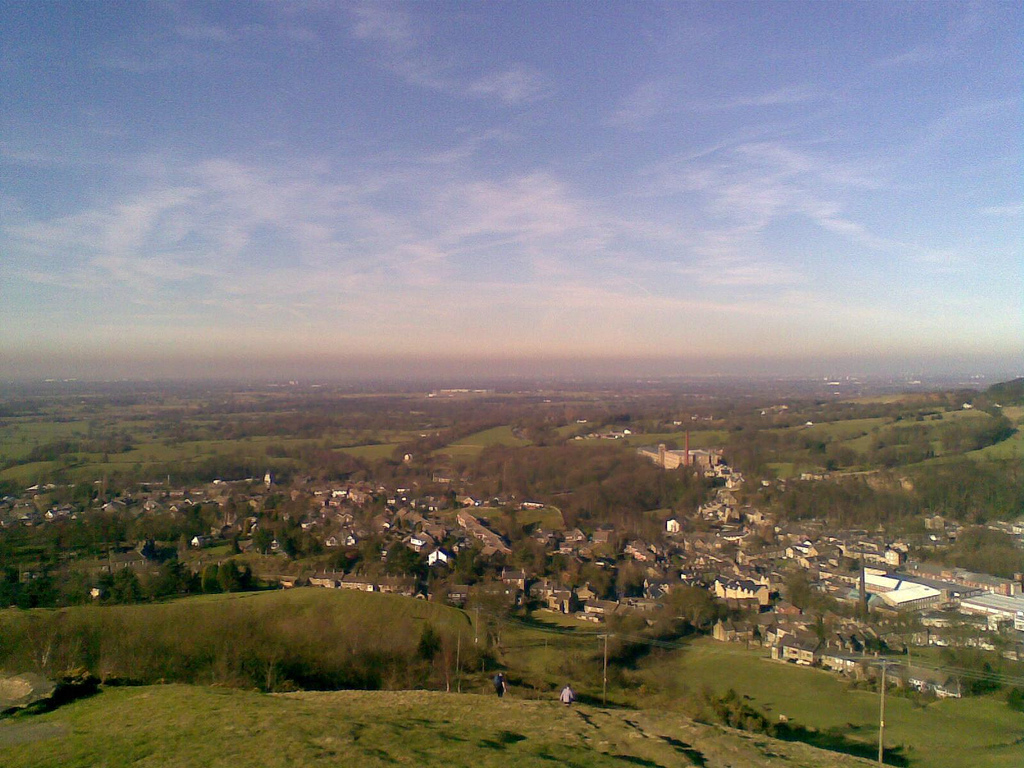
Bollington is a town and civil parish in Cheshire, England, to the east of Prestbury. In the Middle Ages, it was part of the Earl of Chester's manor of Macclesfield and the ancient parish of Prestbury. At the 2021 census, the parish had a population of 7,944 and the built up area had a population of 7,235.
Bollington is on the River Dean and the Macclesfield Canal, on the south-western edge of the Peak District. Rising above the town on Kerridge Hill is White Nancy, a structure built to commemorate the victory at the Battle of Waterloo.
From the late 18th through to the mid-20th centuries, Bollington was a major centre for cotton-spinning. Waterhouse Mill, now demolished, off Wellington Road, once spun the finest cotton in the world, and was sought after by lace makers in Nottingham and in Brussels, Belgium.
Clarence Mill still stands on Clarence Road. The lower floors remain commercial but the upper floors have been converted into apartments. One of the oldest surviving mills in Bollington is the very small Defiance Mill, built on Queen Street about 1800 and now restored for residential occupation.
There is a large paper coating mill on the site of Lower Mills. The original mill was built by George Antrobus in 1792, but very little of those buildings remain. A stone-built traditional mill still survives amongst the 20th century brick and 21st century steel developments. In the 1830s and 1840s, this mill was rented to Thomas Oliver and Martin Swindells for the production of fine cotton thread for the lace-making industry. Lowerhouse Mill (Antrobus, 1819, later occupied by Samuel Greg Junior) also produced coated papers and remained as an industrial mill until it closed in 2025.
The other remaining mill is Adelphi Mill (Swindells, 1856), which is today entirely commercial.
In 1801, the population was 1,231; by 1851, the population was 4,655; and in 1901, it had grown to 5,245. Population growth slowed during the mid-20th century, such that by 1951 the population was 5,644. By 2001 the population had reached 7,095; in 2011 it was 8,310.
There are two tiers of local government covering Bollington, at civil parish (town) and unitary authority level: Bollington Town Council and Cheshire East Council. The town council is based at the Town Hall on Wellington Road.
Bollington
Bollington is a town and civil parish in Cheshire, England, to the east of Prestbury. In the Middle Ages, it was part of the Earl of Chester's manor of Macclesfield and the ancient parish of Prestbury. At the 2021 census, the parish had a population of 7,944 and the built up area had a population of 7,235.
Bollington is on the River Dean and the Macclesfield Canal, on the south-western edge of the Peak District. Rising above the town on Kerridge Hill is White Nancy, a structure built to commemorate the victory at the Battle of Waterloo.
From the late 18th through to the mid-20th centuries, Bollington was a major centre for cotton-spinning. Waterhouse Mill, now demolished, off Wellington Road, once spun the finest cotton in the world, and was sought after by lace makers in Nottingham and in Brussels, Belgium.
Clarence Mill still stands on Clarence Road. The lower floors remain commercial but the upper floors have been converted into apartments. One of the oldest surviving mills in Bollington is the very small Defiance Mill, built on Queen Street about 1800 and now restored for residential occupation.
There is a large paper coating mill on the site of Lower Mills. The original mill was built by George Antrobus in 1792, but very little of those buildings remain. A stone-built traditional mill still survives amongst the 20th century brick and 21st century steel developments. In the 1830s and 1840s, this mill was rented to Thomas Oliver and Martin Swindells for the production of fine cotton thread for the lace-making industry. Lowerhouse Mill (Antrobus, 1819, later occupied by Samuel Greg Junior) also produced coated papers and remained as an industrial mill until it closed in 2025.
The other remaining mill is Adelphi Mill (Swindells, 1856), which is today entirely commercial.
In 1801, the population was 1,231; by 1851, the population was 4,655; and in 1901, it had grown to 5,245. Population growth slowed during the mid-20th century, such that by 1951 the population was 5,644. By 2001 the population had reached 7,095; in 2011 it was 8,310.
There are two tiers of local government covering Bollington, at civil parish (town) and unitary authority level: Bollington Town Council and Cheshire East Council. The town council is based at the Town Hall on Wellington Road.
Recent media
Recent media