



Community hub
Recent from talks
Contribute something to knowledge base
Content stats: 0 posts, 0 articles, 0 media, 0 notes
Members stats: 0 subscribers, 0 contributors, 0 moderators, 0 supporters
Subscribers
Supporters
Contributors
Moderators
Hub AI
Absolute magnitude AI simulator
(@Absolute magnitude_simulator)
Hub AI
Absolute magnitude AI simulator
(@Absolute magnitude_simulator)
Absolute magnitude
In astronomy, absolute magnitude (M) is a measure of the luminosity of a celestial object on an inverse logarithmic astronomical magnitude scale; the more luminous (intrinsically bright) an object, the lower its magnitude number. An object's absolute magnitude is defined to be equal to the apparent magnitude that the object would have if it were viewed from a distance of exactly 10 parsecs (32.6 light-years), without extinction (or dimming) of its light due to absorption by interstellar matter and cosmic dust. By hypothetically placing all objects at a standard reference distance from the observer, their luminosities can be directly compared among each other on a magnitude scale. For Solar System bodies that shine in reflected light, a different definition of absolute magnitude (H) is used, based on a standard reference distance of one astronomical unit.
Absolute magnitudes of stars generally range from approximately −10 to +20. The absolute magnitudes of galaxies can be much lower (brighter).
The more luminous an object, the smaller the numerical value of its absolute magnitude. A difference of 5 magnitudes between the absolute magnitudes of two objects corresponds to a ratio of 100 in their luminosities, and a difference of n magnitudes in absolute magnitude corresponds to a luminosity ratio of 100n/5. For example, a star of absolute magnitude MV = 3.0 would be 100 times as luminous as a star of absolute magnitude MV = 8.0 as measured in the V filter band. The Sun has absolute magnitude MV = +4.83. Highly luminous objects can have negative absolute magnitudes: for example, the Milky Way galaxy has an absolute B magnitude of about −20.8.
As with all astronomical magnitudes, the absolute magnitude can be specified for different wavelength ranges corresponding to specified filter bands or passbands; for stars a commonly quoted absolute magnitude is the absolute visual magnitude, which uses the visual (V) band of the spectrum (in the UBV photometric system). Absolute magnitudes are denoted by a capital M, with a subscript representing the filter band used for measurement, such as MV for absolute magnitude in the V band.
An object's absolute bolometric magnitude (Mbol) represents its total luminosity over all wavelengths, rather than in a single filter band, as expressed on a logarithmic magnitude scale. To convert from an absolute magnitude in a specific filter band to absolute bolometric magnitude, a bolometric correction (BC) is applied.
In stellar and galactic astronomy, the standard distance is 10 parsecs (about 32.616 light-years, 308.57 petameters or 308.57 trillion kilometres). A star at 10 parsecs has a parallax of 0.1″ (100 milliarcseconds). Galaxies (and other extended objects) are much larger than 10 parsecs; their light is radiated over an extended patch of sky, and their overall brightness cannot be directly observed from relatively short distances, but the same convention is used. A galaxy's magnitude is defined by measuring all the light radiated over the entire object, treating that integrated brightness as the brightness of a single point-like or star-like source, and computing the magnitude of that point-like source as it would appear if observed at the standard 10 parsecs distance. Consequently, the absolute magnitude of any object equals the apparent magnitude it would have if it were 10 parsecs away.
Some stars visible to the naked eye have such a low absolute magnitude that they would appear bright enough to outshine the planets and cast shadows if they were at 10 parsecs from the Earth. Examples include Rigel (−7.8), Deneb (−8.4), Naos (−6.2), and Betelgeuse (−5.8). For comparison, Sirius has an absolute magnitude of only 1.4, which is still brighter than the Sun, whose absolute visual magnitude is 4.83. The Sun's absolute bolometric magnitude is set arbitrarily, usually at 4.75. Absolute magnitudes of stars generally range from approximately −10 to +20. The absolute magnitudes of galaxies can be much lower (brighter). For example, the giant elliptical galaxy M87 has an absolute magnitude of −22 (i.e. as bright as about 60,000 stars of magnitude −10). Some active galactic nuclei (quasars like CTA-102) can reach absolute magnitudes in excess of −32, making them the most luminous persistent objects in the observable universe, although these objects can vary in brightness over astronomically short timescales. At the extreme end, the optical afterglow of the gamma ray burst GRB 080319B reached, according to one paper, an absolute r magnitude brighter than −38 for a few tens of seconds.
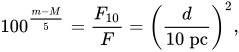
The Greek astronomer Hipparchus established a numerical scale to describe the brightness of each star appearing in the sky. The brightest stars in the sky were assigned an apparent magnitude m = 1, and the dimmest stars visible to the naked eye are assigned m = 6. The difference between them corresponds to a factor of 100 in brightness. For objects within the immediate neighborhood of the Sun, the absolute magnitude M and apparent magnitude m from any distance d (in parsecs, with 1 pc = 3.2616 light-years) are related by where F is the radiant flux measured at distance d (in parsecs), F10 the radiant flux measured at distance 10 pc. Using the common logarithm, the equation can be written as where it is assumed that extinction from gas and dust is negligible. Typical extinction rates within the Milky Way galaxy are 1 to 2 magnitudes per kiloparsec, when dark clouds are taken into account.

Absolute magnitude
In astronomy, absolute magnitude (M) is a measure of the luminosity of a celestial object on an inverse logarithmic astronomical magnitude scale; the more luminous (intrinsically bright) an object, the lower its magnitude number. An object's absolute magnitude is defined to be equal to the apparent magnitude that the object would have if it were viewed from a distance of exactly 10 parsecs (32.6 light-years), without extinction (or dimming) of its light due to absorption by interstellar matter and cosmic dust. By hypothetically placing all objects at a standard reference distance from the observer, their luminosities can be directly compared among each other on a magnitude scale. For Solar System bodies that shine in reflected light, a different definition of absolute magnitude (H) is used, based on a standard reference distance of one astronomical unit.
Absolute magnitudes of stars generally range from approximately −10 to +20. The absolute magnitudes of galaxies can be much lower (brighter).
The more luminous an object, the smaller the numerical value of its absolute magnitude. A difference of 5 magnitudes between the absolute magnitudes of two objects corresponds to a ratio of 100 in their luminosities, and a difference of n magnitudes in absolute magnitude corresponds to a luminosity ratio of 100n/5. For example, a star of absolute magnitude MV = 3.0 would be 100 times as luminous as a star of absolute magnitude MV = 8.0 as measured in the V filter band. The Sun has absolute magnitude MV = +4.83. Highly luminous objects can have negative absolute magnitudes: for example, the Milky Way galaxy has an absolute B magnitude of about −20.8.
As with all astronomical magnitudes, the absolute magnitude can be specified for different wavelength ranges corresponding to specified filter bands or passbands; for stars a commonly quoted absolute magnitude is the absolute visual magnitude, which uses the visual (V) band of the spectrum (in the UBV photometric system). Absolute magnitudes are denoted by a capital M, with a subscript representing the filter band used for measurement, such as MV for absolute magnitude in the V band.
An object's absolute bolometric magnitude (Mbol) represents its total luminosity over all wavelengths, rather than in a single filter band, as expressed on a logarithmic magnitude scale. To convert from an absolute magnitude in a specific filter band to absolute bolometric magnitude, a bolometric correction (BC) is applied.
In stellar and galactic astronomy, the standard distance is 10 parsecs (about 32.616 light-years, 308.57 petameters or 308.57 trillion kilometres). A star at 10 parsecs has a parallax of 0.1″ (100 milliarcseconds). Galaxies (and other extended objects) are much larger than 10 parsecs; their light is radiated over an extended patch of sky, and their overall brightness cannot be directly observed from relatively short distances, but the same convention is used. A galaxy's magnitude is defined by measuring all the light radiated over the entire object, treating that integrated brightness as the brightness of a single point-like or star-like source, and computing the magnitude of that point-like source as it would appear if observed at the standard 10 parsecs distance. Consequently, the absolute magnitude of any object equals the apparent magnitude it would have if it were 10 parsecs away.
Some stars visible to the naked eye have such a low absolute magnitude that they would appear bright enough to outshine the planets and cast shadows if they were at 10 parsecs from the Earth. Examples include Rigel (−7.8), Deneb (−8.4), Naos (−6.2), and Betelgeuse (−5.8). For comparison, Sirius has an absolute magnitude of only 1.4, which is still brighter than the Sun, whose absolute visual magnitude is 4.83. The Sun's absolute bolometric magnitude is set arbitrarily, usually at 4.75. Absolute magnitudes of stars generally range from approximately −10 to +20. The absolute magnitudes of galaxies can be much lower (brighter). For example, the giant elliptical galaxy M87 has an absolute magnitude of −22 (i.e. as bright as about 60,000 stars of magnitude −10). Some active galactic nuclei (quasars like CTA-102) can reach absolute magnitudes in excess of −32, making them the most luminous persistent objects in the observable universe, although these objects can vary in brightness over astronomically short timescales. At the extreme end, the optical afterglow of the gamma ray burst GRB 080319B reached, according to one paper, an absolute r magnitude brighter than −38 for a few tens of seconds.
The Greek astronomer Hipparchus established a numerical scale to describe the brightness of each star appearing in the sky. The brightest stars in the sky were assigned an apparent magnitude m = 1, and the dimmest stars visible to the naked eye are assigned m = 6. The difference between them corresponds to a factor of 100 in brightness. For objects within the immediate neighborhood of the Sun, the absolute magnitude M and apparent magnitude m from any distance d (in parsecs, with 1 pc = 3.2616 light-years) are related by where F is the radiant flux measured at distance d (in parsecs), F10 the radiant flux measured at distance 10 pc. Using the common logarithm, the equation can be written as where it is assumed that extinction from gas and dust is negligible. Typical extinction rates within the Milky Way galaxy are 1 to 2 magnitudes per kiloparsec, when dark clouds are taken into account.