Hubbry Logo
Light-yearLight-yearMain
Open search
Light-year
Community hub
Light-year
logo
8 pages, 0 posts
0 subscribers
Be the first to start a discussion here.
Contribute something
Light-year
Light-year
from Wikipedia

Light-year
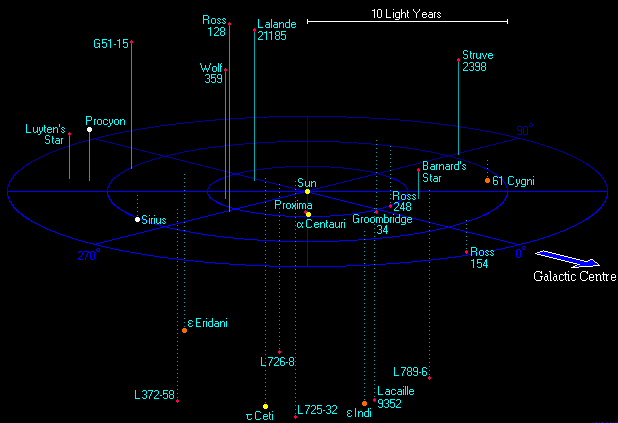
Map showing stars and star systems lying within 12.5 light-years of the Sun[1]
General information
Unit systemastronomy units
Unit oflength
Symbolly[2]
Conversions
1 ly[2] in ...... is equal to ...
   metric (SI) units   
  • 9.4607×10¹⁵ m
  • 9.46073 Pm
   imperial and US units   
  • 5.8786×10¹² mi
   astronomical units   

A light-year, alternatively spelled light year (ly or lyr[3]), is a unit of length used to express astronomical distances and is equal to exactly 9460730472580.8 km, which is approximately 9.46 trillion km or 5.88 trillion mi. As defined by the International Astronomical Union (IAU), a light-year is the distance that light travels in vacuum in one Julian year (365.25 days).[2] Despite its inclusion of the word "year", the term should not be misinterpreted as a unit of time.[4]

The light-year is most often used when expressing distances to stars and other distances on a galactic scale, especially in non-specialist contexts and popular science publications.[4] The unit most commonly used in professional astronomy is the parsec (symbol: pc, about 3.26 light-years).[2]

Definitions

[edit]

As defined by the International Astronomical Union (IAU), the light-year is the product of the Julian year[note 1] (365.25 days, as opposed to the 365.2425-day Gregorian year or the 365.24219-day Tropical year that both approximate) and the speed of light (299792458 m/s).[note 2] Both of these values are included in the IAU (1976) System of Astronomical Constants, used since 1984.[6] From this, the following conversions can be derived:

1 light-year   = 9460730472580800 metres (exactly)
c. 9.461 petametres
c. 9.461 trillion (short scale) kilometres (5.879 trillion miles)
c. 63241.077 astronomical units
c. 0.306601 parsec

The abbreviation used by the IAU for light-year is "ly",[2] International standards like ISO 80000:2006 (now superseded) have used "l.y."[7][8] and localized abbreviations are frequent, such as "al" in French, Spanish, and Italian (from année-lumière, año luz and anno luce, respectively), "Lj" in German (from Lichtjahr), etc.

Before 1984, the tropical year (not the Julian year) and a measured (not defined) speed of light were included in the IAU (1964) System of Astronomical Constants, used from 1968 to 1983.[9] The product of Simon Newcomb's J1900.0 mean tropical year of 31556925.9747 ephemeris seconds and a speed of light of 299792.5 km/s produced a light-year of 9.460530×10¹⁵ m (rounded to the seven significant digits in the speed of light) found in several modern sources[10][11][12] was probably derived from an old source such as C. W. Allen's 1973 Astrophysical Quantities reference work,[13] which was updated in 2000, including the IAU (1976) value cited above (truncated to 10 significant digits).[14]

Other high-precision values are not derived from a coherent IAU system. A value of 9.460536207×10¹⁵ m found in some modern sources[15][16] is the product of a mean Gregorian year (365.2425 days or 31556952 s) and the defined speed of light (299792458 m/s). Another value, 9.460528405×10¹⁵ m,[17] is the product of the J1900.0 mean tropical year and the defined speed of light.

Abbreviations used for light-years and multiples of light-years are:

  • "ly" for one light-year[2]
  • "kly" [18] or "klyr"[19] for a kilolight-year (1,000 light-years)
  • "Mly" for a megalight-year (1,000,000 light-years)[20]
  • "Gly"[21] or "Glyr"[22] for a gigalight-year (1000000000 light-years)

History

[edit]

The light-year unit appeared a few years after the first successful measurement of the distance to a star other than the Sun, by Friedrich Bessel in 1838. The star was 61 Cygni, and he used a 160-millimetre (6.2 in) heliometre designed by Joseph von Fraunhofer. The largest unit for expressing distances across space at that time was the astronomical unit, equal to the radius of the Earth's orbit at 150 million kilometres (93 million miles). In those terms, trigonometric calculations based on 61 Cygni's parallax of 0.314 arcseconds, showed the distance to the star to be 660000 astronomical units (9.9×10¹³ km; 6.1×10¹³ mi). Bessel added that light takes 10.3 years to traverse this distance.[23] He recognized that his readers would enjoy the mental picture of the approximate transit time for light, but he refrained from using the light-year as a unit. He may have resisted expressing distances in light-years because it would reduce the accuracy of his parallax data due to multiplying with the uncertain parameter of the speed of light.

The speed of light was not yet precisely known in 1838; the estimate of its value changed in 1849 (Fizeau) and 1862 (Foucault). It was not yet considered to be a fundamental constant of nature, and the propagation of light through the aether or space was still enigmatic.

The light-year unit appeared in 1851 in a German popular astronomical article by Otto Ule.[24] Ule explained the oddity of a distance unit name ending in "year" by comparing it to a walking hour (Wegstunde).

A contemporary German popular astronomical book also noticed that light-year is an odd name.[25] In 1868 an English journal labelled the light-year as a unit used by the Germans.[26] Eddington called the light-year an inconvenient and irrelevant unit, which had sometimes crept from popular use into technical investigations.[27]

Although modern astronomers often prefer to use the parsec, light-years are also popularly used to gauge the expanses of interstellar and intergalactic space.

Usage of term

[edit]

Distances expressed in light-years include those between stars in the same general area, such as those belonging to the same spiral arm or globular cluster. Galaxies themselves span from a few thousand to a few hundred thousand light-years in diameter, and are separated from neighbouring galaxies and galaxy clusters by millions of light-years. Distances to objects such as quasars and the Sloan Great Wall run into the billions of light-years.

List of orders of magnitude for length
Scale (ly) Value Item
10−9 4.04×10⁻⁸ ly Reflected sunlight from the Moon's surface takes 1.2–1.3 seconds to travel the distance to the Earth's surface (travelling roughly 350000 to 400000 kilometres).
10−6 1.58×10⁻⁵ ly One astronomical unit (the distance from the Sun to the Earth). It takes approximately 499 seconds (8.32 minutes) for light to travel this distance.[28]
1.27×10⁻⁴ ly The Huygens probe lands on Titan off Saturn and transmits images from its surface, 1.2 billion kilometres from Earth.
5.04×10⁻⁴ ly New Horizons encounters Pluto at a distance of 4.7 billion kilometres, and the communication takes 4 hours 25 minutes to reach Earth.
10−3 2.04×10⁻³ ly The most distant space probe, Voyager 1, was about 18 light-hours (130 au,19.4 billion km, 12.1 billion mi) away from the Earth as of October 2014.[29] It will take about 17500 years to reach one light-year at its current speed of about 17 km/s (38000 mph, 61 200 km/h) relative to the Sun. On 12 September 2013, NASA scientists announced that Voyager 1 had entered the interstellar medium of space on 25 August 2012, becoming the first manmade object to leave the Solar System.[30]
2.28×10⁻³ ly Voyager 1 as of October 2018, nearly 20 light-hours (144 au, 21.6 billion km, 13.4 billion mi) from the Earth.
100 1.6×100 ly The Oort cloud is approximately two light-years in diameter. Its inner boundary is speculated to be at 50000 au ≈ 0.8 ly, with its outer edge at 100000 au ≈ 1.6 ly.
2.0×100 ly Approximate maximum distance at which an object can orbit the Sun (Hill sphere/Roche sphere, 125000 au). Beyond this is the deep ex-solar gravitational interstellar medium.
4.24×100 ly The nearest known star (other than the Sun), Proxima Centauri, is about 4.24 light-years away.[31][32]
8.6×100 ly Sirius, the brightest star of the night sky. Twice as massive and 25 times more luminous than the Sun, it outshines more luminous stars due to its relative proximity.
1.19×101 ly Tau Ceti e, an extrasolar candidate for a habitable planet. 6.6 times as massive as the earth, it is in the middle of the habitable zone of star Tau Ceti.[33][34]
2.05×101 ly Gliese 581, a red-dwarf star with several detectable exoplanets.
3.1×10² ly Canopus, second in brightness in the terrestrial sky only to Sirius, a type A9 bright giant 10700 times more luminous than the Sun.
103 1.56×10³ ly Gaia BH1, the nearest known black hole, is about 1560 light-years away.
3.3×10³ ly A0620-00, the fifth-nearest known black hole, is about 3300 light-years away.
2.6×10⁴ ly The centre of the Milky Way is about 26000 light-years away.[35][36]
1×10⁵ ly The Milky Way is about 100000 light-years across.
1.65×10⁵ ly R136a1, in the Large Magellanic Cloud, the most luminous star known at 8.7 million times the luminosity of the Sun, has an apparent magnitude 12.77, just brighter than 3C 273.
106 2.5×10⁶ ly The Andromeda Galaxy is approximately 2.5 million light-years away.
3×10⁶ ly The Triangulum Galaxy (M33), at about 3 million light-years away, is the most distant object visible to the naked eye.
5.9×10⁷ ly The nearest large galaxy cluster, the Virgo Cluster, is about 59 million light-years away.
1.5×1082.5×108 ly The Great Attractor lies at a distance of somewhere between 150 and 250 million light-years (the latter being the most recent estimate).
109 1.2×10⁹ ly The Sloan Great Wall (not to be confused with Great Wall and Her–CrB GW) has been measured to be approximately one billion light-years distant.
2.4×10⁹ ly 3C 273, optically the brightest quasar, of apparent magnitude 12.9, just dimmer than R136a1. 3C 273 is about 2.4 billion light-years away.
1.353×10¹⁰ ly - 3.38×10¹⁰ ly MoM-z14, is the farthest confirmed galaxy discovered as of 2025, with an apparent magnitude of 20.2. It is about 13.53 billion light-years away in light travel distance, and 33.8 billion light-years away in proper distance.
4.57×10¹⁰ ly The comoving distance from the Earth to the edge of the visible universe is about 45.7 billion light-years in any direction; this is the comoving radius of the observable universe. This is larger than the age of the universe dictated by the cosmic background radiation; see here for why this is possible.
[edit]

Distances between objects within a star system tend to be small fractions of a light-year, and are usually expressed in astronomical units. However, smaller units of length can similarly be formed usefully by multiplying units of time by the speed of light. For example, the light-second, useful in astronomy, telecommunications and relativistic physics, is exactly 299792458 metres or 1/31557600 of a light-year. Units such as the light-minute, light-hour and light-day are sometimes used in popular science publications. The light-month, roughly one-twelfth of a light-year, is also used occasionally for approximate measures.[37][38] The Hayden Planetarium specifies the light month more precisely as 30 days of light travel time.[39]

Light travels approximately one foot in a nanosecond; the term "light-foot" is sometimes used as an informal measure of time.[40]

See also

[edit]

Notes

[edit]

References

[edit]
[edit]
Revisions and contributorsEdit on WikipediaRead on Wikipedia
from Grokipedia
A light-year (symbol: ) is a used in astronomy to measure vast interstellar and intergalactic distances, defined as the distance that travels in a during one Julian year of 365.25 days, or exactly 31,557,600 seconds. This definition stems from the (IAU) standard, leveraging the constant in , which is exactly 299,792,458 meters per second. The exact value of one light-year is 9.46073 × 10¹⁵ , equivalent to approximately 9.46073 × 10¹² kilometers or 5.87863 × 10¹² miles. Despite its name, a light-year measures rather than time, representing how far has traveled rather than the duration of a year. It provides a convenient scale for cosmic measurements, as the limits how quickly information from distant objects can reach ; for instance, from the nearest star beyond the Sun takes over four years to arrive. In practice, light-years are essential for describing the scale of the universe, from nearby stars like at 4.24 light-years to distant galaxies billions of light-years away. The unit complements smaller measures like the (AU), which spans about 149.6 million kilometers from to the Sun, with one light-year equaling roughly 63,241 AU. Although not part of the (SI), it remains a standard in due to its intuitive relation to the finite and the immense sizes involved in .

Definition and Fundamentals

Precise Definition

A light-year is a defined by the (IAU) as the distance traveled by in a vacuum during one Julian year, consisting of exactly 365.25 days or 31,557,600 seconds. This definition leverages the exact value of the in vacuum, established as a fundamental constant, to provide a precise and invariant measure for astronomical scales. Although the name includes the word "year," the light-year quantifies distance rather than time, serving as an essential tool for conveying the immense separations between , galaxies, and other celestial objects that would otherwise require cumbersome numerical expressions in meters or kilometers. In interstellar contexts, where distances span trillions of kilometers, the light-year facilitates intuitive comprehension of scales that exceed everyday human experience, such as the proximity of nearby measured in tens or hundreds of light-years.

Calculation and Numerical Value

The light-year is defined as the distance light travels in vacuum during one Julian year, given by the formula 1ly=c×t1\,\text{ly} = c \times t, where cc is the in and tt is the duration of the Julian year. The cc has been exactly 299,792,458 m/s since its definition by the 17th General Conference on Weights and Measures in 1983. The Julian year tt is exactly 365.25 mean solar days, equivalent to 31,557,600 seconds, as recommended by the for astronomical timekeeping. To compute the value in meters, multiply these constants: 1ly=299,792,458m/s×31,557,600s=9.4607304725808×1015m.\begin{align*} 1\,\text{ly} &= 299{,}792{,}458\,\text{m/s} \times 31{,}557{,}600\,\text{s} \\ &= 9.4607304725808 \times 10^{15}\,\text{m}. \end{align*} This result is exact, as both cc and tt are defined precisely. The primary conversions from this value are as follows: in kilometers, 1ly=9.4607304725808×10121\,\text{ly} = 9.4607304725808 \times 10^{12} km (dividing by 1,000); in astronomical units, 1ly=63,241.0771\,\text{ly} = 63{,}241.077 AU, using the defined AU of exactly 149,597,870,700 m; and in parsecs, 1ly=0.3066011\,\text{ly} = 0.306601 pc. Larger multiples of the light-year are used for vast cosmic scales, including the kilolight-year (kly = 10310^3 ly), megalight-year (Mly = 10610^6 ly), and gigalight-year (Gly = 10910^9 ly). Prior to 1983, when cc was measured rather than defined, the light-year was approximated as 9.46053×10159.46053 \times 10^{15} m based on the then-accepted value of c299,792.458c \approx 299{,}792.458 km/s.

Historical Development

Origins of the Concept

The measurement of stellar distances in the early underscored the limitations of existing units like the (AU), which is the average distance from to the Sun. In 1838, German astronomer Friedrich Wilhelm Bessel successfully determined the of , the first reliable stellar distance beyond the Solar System, calculating it at approximately 10.3 light-travel years or about 660,000 AU. This vast scale highlighted the need for a more intuitive unit to convey the immense separations in , as expressing such distances in millions of miles or AU became cumbersome for conceptual understanding. The concept of the light-year emerged amid advancing knowledge of light's speed and improving stellar parallax techniques during the mid-19th century. Accurate terrestrial measurements of the , such as Hippolyte Fizeau's 1849 experiment using a toothed over an 8.6 km baseline, provided a precise value of about 313,000 km/s, enabling astronomers to relate time-of-flight to distance more reliably. Combined with estimates from observations, this facilitated the framing of stellar distances in terms of how long takes to traverse them, bridging the gap between time and spatial scales in astronomy. The growing body of such estimates for nearby stars further emphasized the utility of a standardized, light-based beyond traditional units. The English equivalent "light-year" first appeared in in the Monthly Notices of the Royal Astronomical Society. The first recorded use of the term "light-year" (Lichtjahr in German) appeared in 1851 in a popular astronomy article by German science writer Otto Ule, titled "Was wir in den Sternen lesen" ("What We Read in the Stars"). Ule defined it as the distance light travels in one Julian year, approximately 63,000 AU, and analogized it to familiar units like the "hour's walk" to make cosmic scales accessible to the public. This introduction marked the light-year's entry into scientific discourse, initially as a communicative tool rather than a formal metric. Despite its intuitive appeal, the light-year faced early skepticism from professional astronomers. In 1914, British astrophysicist criticized it as an "inconvenient and irrelevant unit" that had "crept from popular use into technical investigations," preferring metric-based alternatives like the due to its alignment with measurements. This reflected broader tensions between popularization and precision in astronomical units during the era.

Standardization and Adoption

During the mid-20th century, the light-year underwent significant refinements as part of broader efforts to standardize astronomical constants. In the 1950s and 1960s, astronomers increasingly favored the Julian year—defined as exactly 365.25 days—for calculations involving large-scale distances, moving away from the variable to ensure consistency in ephemerides and reference systems. This shift culminated in the International Astronomical Union's (IAU) adoption of the 1976 System of Astronomical Constants, which incorporated the Julian year as the basis for units like the light-year, facilitating precise computations in professional astronomy. The IAU's endorsement emphasized the light-year's utility for conveying vast distances, though it recommended the for formal catalogs and data reduction. The 1983 redefinition of the by the General Conference on Weights and Measures (CGPM) marked a pivotal update, fixing c at exactly 299792458 m/s and redefining the meter as the light travels in during 1/299792458 of a second. This exact value directly impacted the light-year's numerical computation, as it is the product of c and the Julian year's duration (31,557,600 seconds), prompting the IAU to refine its standards in 1984 for observations and ephemerides starting that year. The IAU's 1984 resolutions clarified the use of the Julian year length across astronomical units, ensuring alignment with the new SI definitions while maintaining continuity in legacy data. The light-year's adoption evolved from a niche term in early 20th-century literature to a staple in mid-century astronomical texts, particularly following the Space Age's onset in the 1950s and 1960s. Initially rare in professional works before , its usage surged with public interest in space exploration, exemplified by NASA's , which popularized concepts of interstellar scales in educational materials and media. By the 1970s, it had become a standard for introductory astronomy, bridging technical precision with accessible communication, as endorsed by the IAU for non-specialist audiences.

Applications in Astronomy

Measuring Stellar and Galactic Distances

The light-year serves as a fundamental unit for measuring distances to nearby stars, where methods provide precise determinations. For instance, , the closest known star to the Sun, lies at 4.24 light-years away, as measured through astrometric observations. Similarly, Sirius is situated 8.6 light-years from Earth, and is approximately 25 light-years distant; these values derive from data collected by the mission, which measured angular shifts in star positions to calculate distances up to about 500 light-years with high accuracy. Such measurements enable astronomers to map the local stellar neighborhood effectively. On galactic scales, light-years quantify the vast extent of the , which has a diameter of roughly 100,000 light-years, encompassing billions of stars in a barred spiral structure. The solar system resides about 26,000 light-years from the , allowing researchers to position our location within the disk. Light-years are applied in mapping spiral arms through observations of star-forming regions and dust distributions; for example, infrared surveys identify nurseries of young stars that trace arm structures spanning thousands of light-years. Distances in this context are often derived using stars, whose pulsation periods correlate with intrinsic brightness, enabling calibration of farther objects, while provides luminosity classes for main-sequence stars to estimate proper distances via fitting to known stellar models. The light-year's expression of light-travel time offers intuitive insights into exploration and studies. As of 2025, has traveled approximately 0.002 light-years from the Sun, highlighting the immense scales even for human-made probes. In research, the unit conveys the time delay for signals from distant systems, such as the system at 39 light-years, where seven Earth-sized planets orbit a cool , aiding assessments of and transit timing. This temporal perspective underscores the light-year's advantage in conceptualizing interstellar voyages and light propagation in galactic contexts.

Cosmological and Intergalactic Scales

On intergalactic scales, the light-year unit facilitates the measurement of distances between galaxies within the and beyond. The (M31), the nearest major spiral galaxy to the , lies approximately 2.5 million light-years away, making it a key example of nearby intergalactic structure. Similarly, the (M33), another member, is situated about 3 million light-years from , providing insights into the dynamics of satellite galaxies. The light-year also plays a central role in , which describes the by relating a galaxy's recession to its : more distant galaxies recede faster, with velocity v=H0dv = H_0 d, where dd is often expressed in millions or billions of light-years and H0H_0 is the Hubble constant. This proportionality allows astronomers to estimate recession speeds for galaxies millions of light-years away, revealing the universe's overall expansion rate. At cosmological scales, the light-year quantifies the immense size of the , whose comoving radius—the distance to the accounting for expansion—is approximately 46.5 billion light-years. The light-travel distance to the edge of this observable region, representing the path length light has traversed since emission, is about 45.7 billion light-years, though the actual proper distance today exceeds this due to ongoing expansion. Recent observations from the (JWST) have extended these measurements to the 's earliest epochs. For instance, the galaxy JADES-GS-z14-0, confirmed at a of 14.32, existed roughly 290 million years after the , corresponding to a light-travel distance of about 13.5 billion light-years and a current proper distance of up to 33.8 billion light-years. Such discoveries, including similarly distant objects like those observed in 2025 JWST surveys, illuminate galaxy formation in the nascent . These vast light-year distances tie directly to the timeline, with light from the observable 's edge originating approximately 13.8 billion years ago, shortly after the 's inception. In an expanding , the light-year primarily measures lookback time—the duration light has traveled—while the proper between objects increases over time due to cosmic expansion, distinguishing historical emission sites from current positions without altering the unit's fundamental definition.

Astronomical Distance Units

In astronomy, the (pc) serves as a fundamental unit for measuring distances to stars and galaxies, defined as the distance at which one subtends an angle of one arcsecond. This corresponds exactly to 3.08568 × 10^{16} meters or approximately 3.26 light-years. The is preferred in professional astronomical catalogs and surveys, such as the European Space Agency's mission, which measures stellar positions and distances using in parsecs for high-precision data on billions of stars. The (AU) provides a scale suited to the solar system, defined exactly as 1.496 × 10^{11} —the mean from to the Sun. One light-year equals approximately 63,240 AU, making the AU useful for describing planetary orbits and spacecraft trajectories within our solar system. Other specialized units complement the light-year for particular scales. The light-day, the distance light travels in one day (about 2.59 × 10^{10} kilometers), is employed for tracking solar system probes like , which is expected to reach roughly one light-day from in 2026. For cosmological distances, the megaparsec (Mpc), equivalent to one million parsecs or 3.26 million light-years, measures structures like galaxy clusters and the universe's expansion. Astronomers select units based on context: the light-year's intuitive link to time and aids public outreach and conceptual understanding of interstellar scales, while the excels in precision for angular parallax measurements in research.

Comparisons to Other Scales

To grasp the immense scale of a light-year, consider its equivalents in familiar metric and . One light-year equals approximately 9.461 × 10^{12} kilometers (5.879 × 10^{12} miles), a distance that dwarfs everyday measures. In astronomical units (AU), where one AU is the average Earth-Sun distance of about 149.6 million kilometers, a light-year spans roughly 63,240 AU. Relative to scales, this equates to traversing the Earth's equatorial (40,030 kilometers) approximately 236 million times, illustrating how a light-year compresses cosmic vastness into a single, manageable unit for interstellar contexts. Everyday analogies further highlight its enormity. For instance, sunlight takes about 8.3 minutes to reach , covering just 1 AU, while a light-year encompasses the light-travel time across the entire Solar System and far beyond. Humanity's fastest spacecraft, such as NASA's probe, travels at around 14 kilometers per second post-Pluto flyby, covering only about 0.000047 light-years per year—meaning it would take over 21,000 years to traverse one light-year at that pace. Even the , which achieved a record close approach to the Sun in December 2024 at roughly 6.1 million kilometers from the solar surface (equivalent to about 0.0000007 light-years from the Sun's center), underscores how minuscule human-engineered distances remain compared to this unit. At extreme scales, the light-year stands in stark contrast to both the minuscule and the cosmic. The Planck length, the smallest meaningful distance in quantum physics at 1.616 × 10^{-35} meters, is so tiny that about 5.85 × 10^{50} such lengths fit into one light-year (where 1 light-year ≈ 9.461 × 10^{15} meters). This disparity shows why the light-year is ill-suited for quantum or subatomic descriptions, which require units like meters or femtometers. Conversely, the has a diameter of approximately 93 billion light-years, making the light-year practical for interstellar and intergalactic measurements but inadequate for the full expanse of cosmic structure without multiples like gigalight-years. These comparisons emphasize the light-year's niche: bridging human intuition with the vastness of space beyond our Solar System. Note that precise values post-1983 reflect the exact definition of the speed of light (299,792,458 m/s) and the meter, avoiding outdated approximations from earlier eras when the meter was artifact-based.

Misconceptions and Broader Usage

Common Misunderstandings

One of the most prevalent misconceptions about the light-year is that it represents a unit of time rather than a unit of distance. In reality, a light-year is defined as the distance that light travels in a vacuum over one Julian year, approximately 9.461 × 10^12 kilometers, serving as a measure of spatial extent in astronomy. This confusion often arises from the term's inclusion of "year," leading some to interpret it as a duration, but it fundamentally quantifies how far light propagates in that period, not the passage of time itself. Another common error involves underestimating the immense scale of light-year distances, such as perceiving the 4.24 light-years to —the nearest star to the Sun—as relatively "close" in the context of . Studies of student conceptions reveal that a significant majority dramatically underestimate stellar distances; for instance, 93% of surveyed undergraduates placed the nearest star much closer than its actual separation, failing to grasp that even this proximity equates to over 40 trillion kilometers, far beyond current human technological reach. This misjudgment overlooks the light-year's role in highlighting the vast emptiness of , where even nearby stars are separated by distances equivalent to billions of Earth-Sun separations. In cosmological contexts, a frequent misunderstanding equates the light-year distance to an object's age or the exact time light has traveled, ignoring the universe's expansion. For example, while the universe is approximately 13.8 billion years old, the spans about 93 billion light-years in diameter because space itself has expanded during the light's journey, stretching the effective beyond a simple multiplication of the by time. This effect, known as , means the light we receive from distant galaxies has taken longer to arrive than a static model would suggest, but the light-year remains a fixed distance unit unaffected by such dynamics in its definition. In educational contexts, the light-year serves as a fundamental unit for conveying the immense scales of the to students and the public. For instance, textbooks and museum exhibits often describe exoplanets like , located approximately 1,800 light-years from , to illustrate the challenges of interstellar exploration and the habitable zones around distant stars. The (IAU) has supported this through its educational resources, including that define the light-year as the distance light travels in a over one year—about 9.46 trillion kilometers—to aid in teaching astronomical distances since the organization's early outreach efforts in the late . In popular media, the light-year frequently appears in science fiction and documentaries to dramatize cosmic voyages. The franchise, for example, incorporates light-years into its warp speed mechanics, where ships like the USS Voyager are depicted traveling 70,000 light-years across the over 75 years at near-maximum warp, emphasizing the unit's role in narrative scales of exploration. Similarly, Carl Sagan's 1980 documentary series Cosmos: A Personal Voyage uses light-years to explain galactic structures, such as the Andromeda Galaxy's 2.5 million light-year distance, making abstract concepts accessible through visual analogies of light's journey through space and time. Recent space missions in 2025 have further integrated the light-year into public communications to highlight technological feats against vast distances. NASA's spacecraft, en route to , captured images of stars 150 to 300 light-years away during its early flight phase, demonstrating how even nearby cosmic objects dwarf mission trajectories that span mere fractions of a light-year, such as the approximately 8 × 10^{-5} light-year path to the Jovian system. The (JWST) press releases routinely quote distances in gigalight-years for early universe observations, like galaxy groups over 12 billion light-years away, to convey the telescope's ability to peer into cosmic history. The cultural impact of the light-year has grown through influential works and heightened public engagement with astronomy. Carl Sagan's 1994 book , inspired by Voyager 1's 1990 image of Earth from 6 billion kilometers (about 0.00063 light-years) away, popularized the unit by framing humanity's place in a spanning billions of light-years, fostering a sense of wonder and humility. Post-2020s discoveries from telescopes like JWST have amplified this interest, with reports of ancient galaxies over 12 billion light-years distant sparking widespread media coverage and public discussions on cosmic evolution.

References

  1. https://science.[nasa](/page/NASA).gov/learn/basics-of-space-flight/units/
  2. https://science.[nasa](/page/NASA).gov/mission/voyager/where-are-voyager-1-and-voyager-2-now/
Add your contribution
Related Hubs
Contribute something
User Avatar
No comments yet.