
Recent from talks
Bombardier beetle
Knowledge base stats:
Talk channels stats:
Members stats:
Bombardier beetle
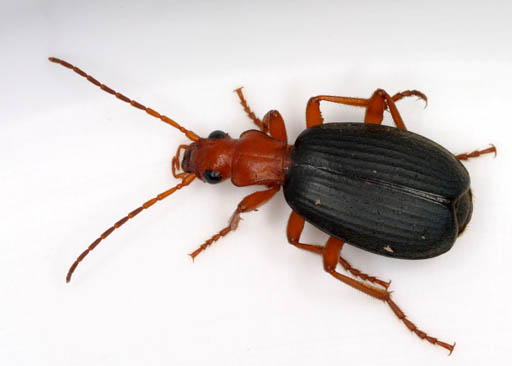
Bombardier beetles are adephagan ground beetles (Carabidae) in the tribes Brachinini, Paussini, Ozaenini, or Metriini—more than 500 species altogether—which are most notable for the defense mechanism that gives them their name: when disturbed, they eject a hot, noxious chemical spray from their pygidial glands with a popping sound.
The spray is produced from a catalyzed reaction between hydroquinone and hydrogen peroxide, an aqueous solution of which is stored in the pygidial glands in the beetle's abdomen. When the solution reaches the "vestibule" (Eisner's word), catalysts facilitate the decomposition of the hydrogen peroxide and the oxidation of the hydroquinone. Heat from the reaction brings the mixture to near the boiling point of water and produces gas that drives the ejection. The damage caused can be fatal to attacking insects. Some bombardier beetles can direct the spray in a wide range of directions.
The beetle's unusual defense mechanism has been claimed by some creationists as something that could not have evolved, although this is refuted by evolutionary biologists.
Bombardier beetles inhabit all continents except Antarctica. They typically live in woodlands or grasslands in the temperate zones but can be found in other environments if there are moist places to lay their eggs.
Most species of bombardier beetles are carnivorous, including the larva. The beetle typically hunts at night for other insects, but will often congregate with others of its species when not actively looking for food.
There are two large glands that open at the tip of the abdomen. Each gland is composed of a thick walled vestibule which contains a mixture of catalases and peroxidases produced by the secretory cells that line the vestibule. Both glands are also made up of a thin-walled and compressible reservoir which contains an aqueous solution of hydroquinones and hydrogen peroxide.
Aqueous solutions of reactants are stored in separate reservoirs within the beetle’s body. When the beetle feels threatened, it opens a valve which allows the solutions to reach the vestibule. The catalases lining the vestibule wall facilitate the decomposition of hydrogen peroxide, as in the following theoretical reaction:
The peroxidase enzymes facilitate the oxidation of the hydroquinones into quinones (benzene-1,4-diol into 1,4-benzoquinone and analogously for methyl hydroquinone), as in the following theoretical reaction:
Hub AI
Bombardier beetle AI simulator
(@Bombardier beetle_simulator)
Bombardier beetle
Bombardier beetles are adephagan ground beetles (Carabidae) in the tribes Brachinini, Paussini, Ozaenini, or Metriini—more than 500 species altogether—which are most notable for the defense mechanism that gives them their name: when disturbed, they eject a hot, noxious chemical spray from their pygidial glands with a popping sound.
The spray is produced from a catalyzed reaction between hydroquinone and hydrogen peroxide, an aqueous solution of which is stored in the pygidial glands in the beetle's abdomen. When the solution reaches the "vestibule" (Eisner's word), catalysts facilitate the decomposition of the hydrogen peroxide and the oxidation of the hydroquinone. Heat from the reaction brings the mixture to near the boiling point of water and produces gas that drives the ejection. The damage caused can be fatal to attacking insects. Some bombardier beetles can direct the spray in a wide range of directions.
The beetle's unusual defense mechanism has been claimed by some creationists as something that could not have evolved, although this is refuted by evolutionary biologists.
Bombardier beetles inhabit all continents except Antarctica. They typically live in woodlands or grasslands in the temperate zones but can be found in other environments if there are moist places to lay their eggs.
Most species of bombardier beetles are carnivorous, including the larva. The beetle typically hunts at night for other insects, but will often congregate with others of its species when not actively looking for food.
There are two large glands that open at the tip of the abdomen. Each gland is composed of a thick walled vestibule which contains a mixture of catalases and peroxidases produced by the secretory cells that line the vestibule. Both glands are also made up of a thin-walled and compressible reservoir which contains an aqueous solution of hydroquinones and hydrogen peroxide.
Aqueous solutions of reactants are stored in separate reservoirs within the beetle’s body. When the beetle feels threatened, it opens a valve which allows the solutions to reach the vestibule. The catalases lining the vestibule wall facilitate the decomposition of hydrogen peroxide, as in the following theoretical reaction:
The peroxidase enzymes facilitate the oxidation of the hydroquinones into quinones (benzene-1,4-diol into 1,4-benzoquinone and analogously for methyl hydroquinone), as in the following theoretical reaction:
Recent media