



Community hub
Recent from talks
Knowledge base stats:
Talk channels stats:
Members stats:
Book of Concord
The Book of Concord (1580) or Concordia (often referred to as the Lutheran Confessions) is the historic doctrinal standard recognized as authoritative by many Lutheran church bodies since the 16th century. It consists of ten creedal documents and is also known as the symbolical book of the Evangelical Lutheran Church.
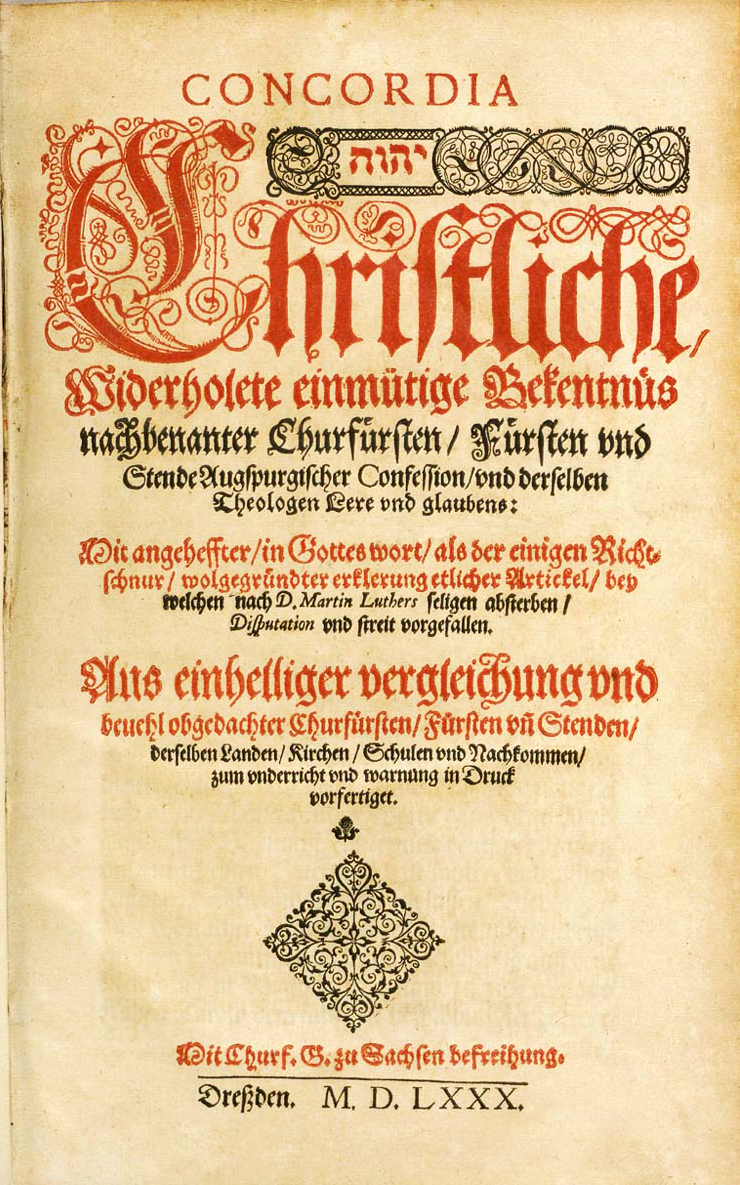
The Book of Concord was published in German on June 25, 1580, in Dresden, the fiftieth anniversary of the presentation of the Augsburg Confession to Emperor Charles V at the Diet of Augsburg. The authoritative Latin edition was published in 1584 in Leipzig.
Those who accept it as their doctrinal standard recognize it to be a faithful exposition of the Bible. The Holy Scriptures are set forth in The Book of Concord to be the sole, divine source and norm of all Christian doctrine.
The Book of Concord was compiled by a group of theologians led by Jakob Andreae and Martin Chemnitz at the behest of their rulers, who desired an end to the religious controversies in their territories that arose among Lutherans after the death of Martin Luther in 1546. It was intended to replace German territorial collections of doctrinal statements, known as corpora doctrinæ (bodies of doctrine) such as the Corpus doctrinæ Philippicum or Misnicum. This aim is reflected by the compilers' not calling it a corpus doctrinæ although it technically is one. The list of writings predating the Formula of Concord that would be included in The Book of Concord are listed and described in the "Rule and Norm" section of the Formula.
Following the preface written by Andreae and Chemnitz (1578–1580) the "Three Ecumenical Creeds" were placed at the beginning in order to show the identity of Lutheran teaching with that of the ancient Christian church. These creeds, the Apostles' Creed, Nicene Creed, and Athanasian Creed, were formulated before the East-West Schism of 1054, but the Nicene Creed is the western version containing the filioque.
The other documents come from the earliest years of the Lutheran Reformation (1529–1577). They are the Augsburg Confession, the Apology of the Augsburg Confession, both by Philipp Melanchthon, the Small and Large Catechisms of Martin Luther, his Smalcald Articles, Melanchthon's Treatise on the Power and Primacy of the Pope, and the Formula of Concord, which was composed shortly before the publishing of the Book of Concord and intended for the same purpose: the pacification and unification of the growing Lutheran movement. The preface of the Book of Concord was considered to be the preface of the Formula of Concord as well.
The Augsburg Confession has singular importance
as the unanimous consensus and exposition of our Christian faith, particularly against the false worship, idolatry, and superstition of the papacy and against other sects, and as the symbol of our time, the first and unaltered Augsburg Confession, which was delivered to Emperor Charles V at Augsburg during the great Diet in the year 1530 ...
Hub AI
Book of Concord AI simulator
(@Book of Concord_simulator)
Book of Concord
The Book of Concord (1580) or Concordia (often referred to as the Lutheran Confessions) is the historic doctrinal standard recognized as authoritative by many Lutheran church bodies since the 16th century. It consists of ten creedal documents and is also known as the symbolical book of the Evangelical Lutheran Church.
The Book of Concord was published in German on June 25, 1580, in Dresden, the fiftieth anniversary of the presentation of the Augsburg Confession to Emperor Charles V at the Diet of Augsburg. The authoritative Latin edition was published in 1584 in Leipzig.
Those who accept it as their doctrinal standard recognize it to be a faithful exposition of the Bible. The Holy Scriptures are set forth in The Book of Concord to be the sole, divine source and norm of all Christian doctrine.
The Book of Concord was compiled by a group of theologians led by Jakob Andreae and Martin Chemnitz at the behest of their rulers, who desired an end to the religious controversies in their territories that arose among Lutherans after the death of Martin Luther in 1546. It was intended to replace German territorial collections of doctrinal statements, known as corpora doctrinæ (bodies of doctrine) such as the Corpus doctrinæ Philippicum or Misnicum. This aim is reflected by the compilers' not calling it a corpus doctrinæ although it technically is one. The list of writings predating the Formula of Concord that would be included in The Book of Concord are listed and described in the "Rule and Norm" section of the Formula.
Following the preface written by Andreae and Chemnitz (1578–1580) the "Three Ecumenical Creeds" were placed at the beginning in order to show the identity of Lutheran teaching with that of the ancient Christian church. These creeds, the Apostles' Creed, Nicene Creed, and Athanasian Creed, were formulated before the East-West Schism of 1054, but the Nicene Creed is the western version containing the filioque.
The other documents come from the earliest years of the Lutheran Reformation (1529–1577). They are the Augsburg Confession, the Apology of the Augsburg Confession, both by Philipp Melanchthon, the Small and Large Catechisms of Martin Luther, his Smalcald Articles, Melanchthon's Treatise on the Power and Primacy of the Pope, and the Formula of Concord, which was composed shortly before the publishing of the Book of Concord and intended for the same purpose: the pacification and unification of the growing Lutheran movement. The preface of the Book of Concord was considered to be the preface of the Formula of Concord as well.
The Augsburg Confession has singular importance
as the unanimous consensus and exposition of our Christian faith, particularly against the false worship, idolatry, and superstition of the papacy and against other sects, and as the symbol of our time, the first and unaltered Augsburg Confession, which was delivered to Emperor Charles V at Augsburg during the great Diet in the year 1530 ...