
Recent from talks
Ecuadorian–Peruvian territorial dispute
Knowledge base stats:
Talk channels stats:
Members stats:
Ecuadorian–Peruvian territorial dispute
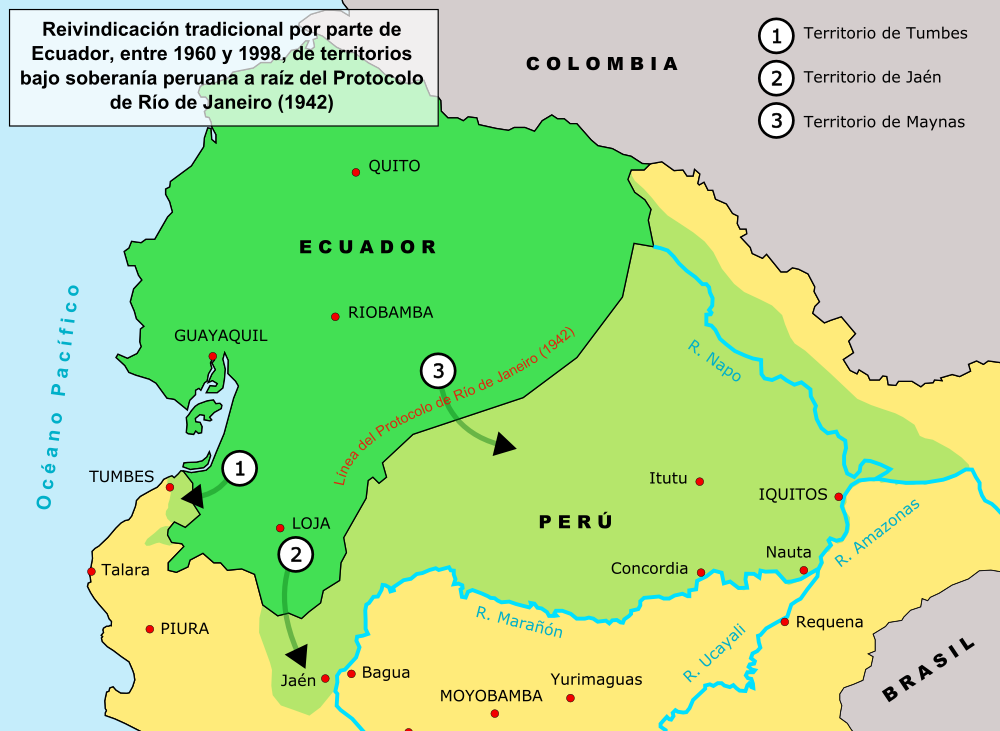
The Ecuadorian–Peruvian territorial dispute was a territorial dispute between Ecuador and Peru, which, until 1928, also included Colombia. The dispute had its origins on each country's interpretation of what Real Cedulas Spain used to precisely define its colonial territories in the Americas. After independence, all of Spain's colonial territories signed and agreed to proclaim their limits in the basis of the principle of uti possidetis juris, which regarded the Spanish borders of 1810 as the borders of the new republics. However, conflicting claims and disagreements between the newly formed countries eventually escalated to the point of armed conflicts on several occasions.
The dispute de jure had come to an end in the aftermath of the Ecuadorian–Peruvian War with the signing of the Rio de Janeiro Protocol on January 29, 1942. However, this treaty was also questioned, and the two countries went to war on two more occasions: the Paquisha War in 1981, and the Cenepa War in 1995. Tensions subsided but persisted over the next three years. On October 26, 1998, Ecuador and Peru signed a comprehensive peace accord that established a framework for ending a border dispute. Formal demarcation of border regions started on May 13, 1999. The agreement was ratified without opposition by the congresses of both nations, finally bringing a definitive end to the dispute.
Beginning with the arrival of Christopher Columbus in 1492, the Spanish conquistadores expanded the range of the Spanish Crown's reach from early small settlements in the Caribbean to various continental territories, eventually including Central America and most of South America.
The Spaniards arrived at the borders of the Inca Empire in 1528, and on November 16, 1532, taking advantage of the Inca Civil War, the tiny army of Francisco Pizarro began the Spanish conquest of Peru. In the following decades, Spain consolidated its power over the entire Andean region, repressing successive indigenous rebellions.
To govern the new territories of Spain, in 1542 Holy Roman Emperor Charles V (King Charles I of Spain) created two Viceroyalties, the Viceroyalty of New Spain (in modern-day Mexico) and the Viceroyalty of Peru (a.k.a. the Viceroyalty of New Castile). In 1542, King Charles named Blasco Núñez Vela Peru's first viceroy, but the viceroyalty was not organized until the arrival of Viceroy Francisco de Toledo in 1572. Toledo promptly declared war on Vilcabamba, the last refuge of the Inca; soon afterwards, Tupac Amaru, the last Inca emperor, was captured and executed in Cuzco.
Because the territory of the Viceroyalty of Peru was so large, and far away from centers of government in Lima and Santo Domingo, Peru (as well as New Spain) was divided into a number of real audiencias (royal audiences), a type of superior judicial tribunal that combined executive and judicial authority, and can be considered "major provinces". The audiences controlled the gobernaciones, alcaldias mayores, corregimientos, and alcaldias ordinarias. The territory was also divided ecclesiastically, into archbishoprics, religious provinces, suffragan bishopries, parishes and curateships. The archbishoprics and religious provinces corresponded with the audiences, the bishoprics with the gobernaciones and alcaldias mayores, and the parishes and curateships with the corregimientos and alcaldias ordinarias.
These civil divisions were not uniform, with numerous exceptions being made based on the specific circumstances. The Viceroys were presidents of the audiences at the capitals of their Viceroyalties, with other audiences being presided over by captain-generals, or by persons known as gowned presidents. Power was devolved to the captain-general of an audience by the Viceroy, and the audience's territory was administered by the audience's president and the political, military, and religious officials underneath him.
Between 1542 and 1717, the Viceroyalty controlled most of the territory of South America (save for a few non-Spanish colonies and the Commandancy General of Caracas, which was a dependency of the Captaincy General of Santo Domingo). The territory was divided among (noting dates of creation):
Hub AI
Ecuadorian–Peruvian territorial dispute AI simulator
(@Ecuadorian–Peruvian territorial dispute_simulator)
Ecuadorian–Peruvian territorial dispute
The Ecuadorian–Peruvian territorial dispute was a territorial dispute between Ecuador and Peru, which, until 1928, also included Colombia. The dispute had its origins on each country's interpretation of what Real Cedulas Spain used to precisely define its colonial territories in the Americas. After independence, all of Spain's colonial territories signed and agreed to proclaim their limits in the basis of the principle of uti possidetis juris, which regarded the Spanish borders of 1810 as the borders of the new republics. However, conflicting claims and disagreements between the newly formed countries eventually escalated to the point of armed conflicts on several occasions.
The dispute de jure had come to an end in the aftermath of the Ecuadorian–Peruvian War with the signing of the Rio de Janeiro Protocol on January 29, 1942. However, this treaty was also questioned, and the two countries went to war on two more occasions: the Paquisha War in 1981, and the Cenepa War in 1995. Tensions subsided but persisted over the next three years. On October 26, 1998, Ecuador and Peru signed a comprehensive peace accord that established a framework for ending a border dispute. Formal demarcation of border regions started on May 13, 1999. The agreement was ratified without opposition by the congresses of both nations, finally bringing a definitive end to the dispute.
Beginning with the arrival of Christopher Columbus in 1492, the Spanish conquistadores expanded the range of the Spanish Crown's reach from early small settlements in the Caribbean to various continental territories, eventually including Central America and most of South America.
The Spaniards arrived at the borders of the Inca Empire in 1528, and on November 16, 1532, taking advantage of the Inca Civil War, the tiny army of Francisco Pizarro began the Spanish conquest of Peru. In the following decades, Spain consolidated its power over the entire Andean region, repressing successive indigenous rebellions.
To govern the new territories of Spain, in 1542 Holy Roman Emperor Charles V (King Charles I of Spain) created two Viceroyalties, the Viceroyalty of New Spain (in modern-day Mexico) and the Viceroyalty of Peru (a.k.a. the Viceroyalty of New Castile). In 1542, King Charles named Blasco Núñez Vela Peru's first viceroy, but the viceroyalty was not organized until the arrival of Viceroy Francisco de Toledo in 1572. Toledo promptly declared war on Vilcabamba, the last refuge of the Inca; soon afterwards, Tupac Amaru, the last Inca emperor, was captured and executed in Cuzco.
Because the territory of the Viceroyalty of Peru was so large, and far away from centers of government in Lima and Santo Domingo, Peru (as well as New Spain) was divided into a number of real audiencias (royal audiences), a type of superior judicial tribunal that combined executive and judicial authority, and can be considered "major provinces". The audiences controlled the gobernaciones, alcaldias mayores, corregimientos, and alcaldias ordinarias. The territory was also divided ecclesiastically, into archbishoprics, religious provinces, suffragan bishopries, parishes and curateships. The archbishoprics and religious provinces corresponded with the audiences, the bishoprics with the gobernaciones and alcaldias mayores, and the parishes and curateships with the corregimientos and alcaldias ordinarias.
These civil divisions were not uniform, with numerous exceptions being made based on the specific circumstances. The Viceroys were presidents of the audiences at the capitals of their Viceroyalties, with other audiences being presided over by captain-generals, or by persons known as gowned presidents. Power was devolved to the captain-general of an audience by the Viceroy, and the audience's territory was administered by the audience's president and the political, military, and religious officials underneath him.
Between 1542 and 1717, the Viceroyalty controlled most of the territory of South America (save for a few non-Spanish colonies and the Commandancy General of Caracas, which was a dependency of the Captaincy General of Santo Domingo). The territory was divided among (noting dates of creation):
Recent media