



Community hub
Recent from talks
Contribute something
Nothing was collected or created yet.
Born equation
View on WikipediaThe Born equation can be used for estimating the electrostatic component of Gibbs free energy of solvation of an ion. It is an electrostatic model that treats the solvent as a continuous dielectric medium (it is thus one member of a class of methods known as continuum solvation methods).
The equation was derived by Max Born.[1][2] where:

- NA = Avogadro constant
- z = charge of ion
- e = elementary charge, 1.6022×10⁻¹⁹ C
- ε0 = permittivity of free space
- r0 = effective radius of ion
- εr = dielectric constant of the solvent
Derivation
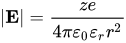
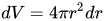
[edit]The energy U stored in an electrostatic field distribution is:Knowing the magnitude of the electric field of an ion in a medium of dielectric constant εr is and the volume element can be expressed as , the energy can be written as: Thus, the energy of solvation of the ion from gas phase (εr = 1) to a medium of dielectric constant εr is:




References
[edit]- ^ Born, M. (1920-02-01). "Volumen und Hydratationswärme der Ionen". Zeitschrift für Physik (in German). 1 (1): 45–48. Bibcode:1920ZPhy....1...45B. doi:10.1007/BF01881023. ISSN 0044-3328. S2CID 92547891.
- ^ Atkins; De Paula (2006). Physical Chemistry (8th ed.). Oxford university press. p. 102. ISBN 0-7167-8759-8.
External links
[edit] | This physical chemistry-related article is a stub. You can help Wikipedia by expanding it. |
Born equation
View on GrokipediaBackground
Ion Solvation
Solvation refers to the process by which solvent molecules surround and stabilize solute ions in solution through intermolecular interactions, primarily electrostatic attractions between the ion's charge and the solvent's dipoles, as well as van der Waals forces that contribute to the overall binding energy.[7][8] This surrounding layer, known as the solvation shell, effectively screens the ion's charge and influences its behavior in the bulk solvent. In aqueous environments, water molecules orient their oxygen atoms toward cations and hydrogen atoms toward anions, forming structured hydration shells that can extend to multiple layers depending on the ion's charge density.[9] The solvation process is essential for the physical and chemical properties of electrolyte solutions. It determines solubility by balancing the energy gained from ion-solvent interactions against the lattice energy required to separate ions from the solid phase; for instance, highly charged ions like Li⁺ form strong solvation bonds that promote dissolution in polar solvents.[10] Solvation also governs electrical conductivity, as the size and stability of the solvation shell affect ion mobility—strongly solvated ions move more slowly, reducing solution conductance at higher concentrations where ion association increases.[10] Additionally, solvation modulates reactivity by altering the ion's effective charge and accessibility, impacting reaction rates in processes like electron transfer or ligand exchange.[11] Early recognition of solvation effects emerged in the late 19th century with Svante Arrhenius's 1887 theory of electrolytic dissociation, which explained the enhanced colligative properties and conductivity of electrolyte solutions by positing that dissolved salts partially dissociate into hydrated ions stabilized by water. This laid groundwork for understanding ion behavior beyond simple dissociation, highlighting hydration's role in solution thermodynamics. Max Born's 1920 contribution advanced electrolyte theory by quantifying electrostatic solvation contributions, building on these foundations to address discrepancies in observed solution properties.[6] Experimental measurement of solvation energies relies on techniques that capture the thermodynamic changes accompanying ion-solvent interactions. Calorimetry, particularly solution calorimetry, quantifies the enthalpy of solvation by measuring the heat evolved or absorbed when ions dissolve in a solvent, allowing isolation of solvation contributions from lattice energies via thermochemical cycles.[12] Electrochemical methods, such as potentiometric cells, probe solvation free energies by recording open-circuit potentials in cells where ion transfer between phases reveals solvation differences, often using reference electrodes to establish absolute scales.[13] These approaches provide empirical data essential for validating theoretical models of ion behavior in solution.Continuum Solvation Models
In continuum solvation models, the solvent is treated as a homogeneous dielectric medium with a constant relative permittivity , effectively ignoring its molecular-scale structure and fluctuations to focus on average electrostatic properties. This approximation represents the solvent as a continuous polarizable environment surrounding the solute, which is typically placed within a cavity to mimic the exclusion of solvent molecules from the solute's volume. Such models emerged from early electrostatic theories and have been widely adopted in computational chemistry for their ability to incorporate solvent effects without the need for explicit molecular representations.[14] Compared to discrete solvation approaches, like explicit solvent simulations in molecular dynamics or Monte Carlo methods, continuum models drastically reduce computational cost by avoiding the simulation of thousands of solvent molecules and their dynamic interactions. Explicit models capture specific hydrogen bonding, hydrophobic effects, and solvent structuring at the molecular level but require extensive sampling and resources, making them impractical for large systems or high-throughput calculations. In contrast, continuum models excel in efficiency for quantum mechanical treatments of solute electronic structure, enabling rapid assessments of solvation influences on molecular properties. The physical foundation of these models lies in Maxwell's equations adapted for dielectric media, which govern the electrostatic potential through Poisson's equation inside the dielectric, where and is the charge density. The solvent responds to the solute's electric field by developing a polarization , with susceptibility , leading to bound charges that screen the field; these induced charges predominantly appear as surface charges at the cavity boundary, where is the outward normal. This linear dielectric response assumes the polarization is directly proportional to the field, valid for weak fields and non-saturating media.[14] For applications like the Born model, continuum solvation relies on key assumptions, including the representation of ions as spherical charge distributions to simplify boundary conditions and the validity of the linear response regime, ensuring the dielectric constant remains field-independent. These prerequisites allow the model to treat the solvent as an infinite, uniform medium outside the spherical cavity, providing a baseline for electrostatic solvation contributions.[14]Formulation
The Equation
The Born equation expresses the electrostatic contribution to the Gibbs free energy of solvation, , for the transfer of a charged ion from vacuum to a dielectric solvent modeled as a continuum.[1] This is given by where the parameters are defined as follows:- : electrostatic Gibbs free energy of solvation, in J/mol;
- : Avogadro's number, mol;
- : charge number of the ion, dimensionless;
- : elementary charge, C;
- : vacuum permittivity, F/m (or C N m);
- : effective ion radius, in m;
- : relative permittivity of the solvent, dimensionless.[15]