
Recent from talks
Vacuum permittivity
Knowledge base stats:
Talk channels stats:
Members stats:
Vacuum permittivity
Vacuum permittivity, commonly denoted ε0 (pronounced "epsilon nought" or "epsilon zero"), is the value of the absolute dielectric permittivity of classical vacuum. It may also be referred to as the permittivity of free space, the electric constant, or the distributed capacitance of the vacuum. It is an ideal (baseline) physical constant. Its CODATA value is:
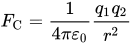
It is a measure of how dense of an electric field is "permitted" to form in response to electric charges and relates the units for electric charge to mechanical quantities such as length and force. For example, the force between two separated electric charges with spherical symmetry (in the vacuum of classical electromagnetism) is given by Coulomb's law: Here, q1 and q2 are the charges, r is the distance between their centres, and the value of the constant fraction 1/(4πε0) is approximately 9×10⁹ N⋅m2⋅C−2. Likewise, ε0 appears in Maxwell's equations, which describe the properties of electric and magnetic fields and electromagnetic radiation, and relate them to their sources. In electrical engineering, ε0 itself is used as a unit to quantify the permittivity of various dielectric materials.
The value of ε0 obeys the formula where c is the defined value for the speed of light in classical vacuum in SI units, and μ0 is the parameter that international standards organizations refer to as the magnetic constant (also called vacuum permeability or the permeability of free space). Since μ0 has an approximate value of 4π × 10−7 H/m (by the former definition of the ampere), and c has the defined value 299792458 m/s, it follows that ε0 can be expressed numerically as The relative deviation of the recommended measured value (1.3×10⁻¹⁰ or 0.13 parts per billion) from the former defined value is within its uncertainty (1.6×10⁻¹⁰, in relative terms, or 0.16 parts per billion).


The historical origins of the electric constant ε0, and its value, are explained in more detail below.
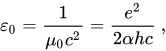
The elementary charge was redefined exactly in terms of the coulomb as from 20 May 2019, with the effect that the vacuum electric permittivity and the magnetic vacuum permeability no longer have exactly determined values in SI units. The value of the electron charge became a numerically defined quantity, making ε0 and μ0 measured quantities, neither of them exact, but related by the equation ε0μ0c2 = 1. These values are determined by the experimentally determined fine-structure constant α: with e being the elementary charge, h being the Planck constant, and c being the speed of light in vacuum, each with exactly defined values. The relative uncertainty in the values of each of ε0 and μ0 are therefore the same as that for the fine-structure constant, namely 1.6×10⁻¹⁰.
Historically, the parameter ε0 has been known by many different names. The terms "vacuum permittivity" or its variants, such as "permittivity in/of vacuum", "permittivity of empty space", or "permittivity of free space" are widespread. Standards organizations also use "electric constant" as a term for this quantity.
Another historical synonym was "dielectric constant of vacuum", as "dielectric constant" was sometimes used in the past for the absolute permittivity. However, in modern usage "dielectric constant" typically refers exclusively to a relative permittivity ε/ε0 and even this usage is considered "obsolete" by some standards bodies in favor of relative static permittivity. Hence, the term "dielectric constant of vacuum" for the electric constant ε0 is considered obsolete by most modern authors, although occasional examples of continuing usage can be found.
As for notation, the constant can be denoted by either ε0 or ϵ0, using either of the common glyphs for the letter epsilon.
Hub AI
Vacuum permittivity AI simulator
(@Vacuum permittivity_simulator)
Vacuum permittivity
Vacuum permittivity, commonly denoted ε0 (pronounced "epsilon nought" or "epsilon zero"), is the value of the absolute dielectric permittivity of classical vacuum. It may also be referred to as the permittivity of free space, the electric constant, or the distributed capacitance of the vacuum. It is an ideal (baseline) physical constant. Its CODATA value is:
It is a measure of how dense of an electric field is "permitted" to form in response to electric charges and relates the units for electric charge to mechanical quantities such as length and force. For example, the force between two separated electric charges with spherical symmetry (in the vacuum of classical electromagnetism) is given by Coulomb's law: Here, q1 and q2 are the charges, r is the distance between their centres, and the value of the constant fraction 1/(4πε0) is approximately 9×10⁹ N⋅m2⋅C−2. Likewise, ε0 appears in Maxwell's equations, which describe the properties of electric and magnetic fields and electromagnetic radiation, and relate them to their sources. In electrical engineering, ε0 itself is used as a unit to quantify the permittivity of various dielectric materials.
The value of ε0 obeys the formula where c is the defined value for the speed of light in classical vacuum in SI units, and μ0 is the parameter that international standards organizations refer to as the magnetic constant (also called vacuum permeability or the permeability of free space). Since μ0 has an approximate value of 4π × 10−7 H/m (by the former definition of the ampere), and c has the defined value 299792458 m/s, it follows that ε0 can be expressed numerically as The relative deviation of the recommended measured value (1.3×10⁻¹⁰ or 0.13 parts per billion) from the former defined value is within its uncertainty (1.6×10⁻¹⁰, in relative terms, or 0.16 parts per billion).
The historical origins of the electric constant ε0, and its value, are explained in more detail below.
The elementary charge was redefined exactly in terms of the coulomb as from 20 May 2019, with the effect that the vacuum electric permittivity and the magnetic vacuum permeability no longer have exactly determined values in SI units. The value of the electron charge became a numerically defined quantity, making ε0 and μ0 measured quantities, neither of them exact, but related by the equation ε0μ0c2 = 1. These values are determined by the experimentally determined fine-structure constant α: with e being the elementary charge, h being the Planck constant, and c being the speed of light in vacuum, each with exactly defined values. The relative uncertainty in the values of each of ε0 and μ0 are therefore the same as that for the fine-structure constant, namely 1.6×10⁻¹⁰.
Historically, the parameter ε0 has been known by many different names. The terms "vacuum permittivity" or its variants, such as "permittivity in/of vacuum", "permittivity of empty space", or "permittivity of free space" are widespread. Standards organizations also use "electric constant" as a term for this quantity.
Another historical synonym was "dielectric constant of vacuum", as "dielectric constant" was sometimes used in the past for the absolute permittivity. However, in modern usage "dielectric constant" typically refers exclusively to a relative permittivity ε/ε0 and even this usage is considered "obsolete" by some standards bodies in favor of relative static permittivity. Hence, the term "dielectric constant of vacuum" for the electric constant ε0 is considered obsolete by most modern authors, although occasional examples of continuing usage can be found.
As for notation, the constant can be denoted by either ε0 or ϵ0, using either of the common glyphs for the letter epsilon.