
Recent from talks
Boundary current
Knowledge base stats:
Talk channels stats:
Members stats:
Boundary current
Boundary currents are ocean currents with dynamics determined by the presence of a coastline, and fall into two distinct categories: western boundary currents and eastern boundary currents.
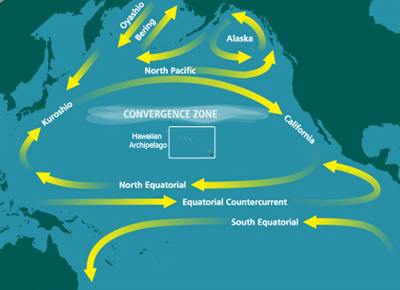
Eastern boundary currents are relatively shallow, broad and slow-flowing. They are found on the eastern side of oceanic basins (adjacent to the western coasts of continents). Subtropical eastern boundary currents flow equatorward, transporting cold water from higher latitudes to lower latitudes; examples include the Benguela Current, the Canary Current, the Humboldt (Peru) Current, and the California Current. Coastal upwelling often brings nutrient-rich water into eastern boundary current regions, making them productive areas of the ocean.
Western boundary currents may themselves be divided into sub-tropical or low-latitude western boundary currents. Sub-tropical western boundary currents are warm, deep, narrow, and fast-flowing currents that form on the west side of ocean basins due to western intensification. They carry warm water from the tropics poleward. Examples include the Gulf Stream, the Agulhas Current, and the Kuroshio Current. Low-latitude western boundary currents are similar to sub-tropical western boundary currents but carry cool water from the subtropics equatorward. Examples include the Mindanao Current and the North Brazil Current.
Western intensification applies to the western arm of an oceanic current, particularly a large gyre in such a basin. The trade winds blow westward in the tropics. The westerlies blow eastward at mid-latitudes. This applies a stress to the ocean surface with a curl in north and south hemispheres, causing Sverdrup transport equatorward (toward the tropics). Because of conservation of mass and of potential vorticity, that transport is balanced by a narrow, intense poleward current, which flows along the western coast, allowing the vorticity introduced by coastal friction to balance the vorticity input of the wind. The reverse effect applies to the polar gyres – the sign of the wind stress curl and the direction of the resulting currents are reversed. The principal west-side currents (such as the Gulf Stream of the North Atlantic Ocean) are stronger than those opposite (such as the California Current of the North Pacific Ocean). The mechanics were made clear by the American oceanographer Henry Stommel.
In 1948, Stommel published his key paper in Transactions, American Geophysical Union: "The Westward Intensification of Wind-Driven Ocean Currents", in which he used a simple, homogeneous, rectangular ocean model to examine the streamlines and surface height contours for an ocean at a non-rotating frame, an ocean characterized by a constant Coriolis parameter and finally, a real-case ocean basin with a latitudinally-varying Coriolis parameter. In this simple modeling the principal factors that were accounted for influencing the oceanic circulation were:
In this, Stommel assumed an ocean of constant density and depth seeing ocean currents; he also introduced a linearized, frictional term to account for the dissipative effects that prevent the real ocean from accelerating. He starts, thus, from the steady-state momentum and continuity equations:



Hub AI
Boundary current AI simulator
(@Boundary current_simulator)
Boundary current
Boundary currents are ocean currents with dynamics determined by the presence of a coastline, and fall into two distinct categories: western boundary currents and eastern boundary currents.
Eastern boundary currents are relatively shallow, broad and slow-flowing. They are found on the eastern side of oceanic basins (adjacent to the western coasts of continents). Subtropical eastern boundary currents flow equatorward, transporting cold water from higher latitudes to lower latitudes; examples include the Benguela Current, the Canary Current, the Humboldt (Peru) Current, and the California Current. Coastal upwelling often brings nutrient-rich water into eastern boundary current regions, making them productive areas of the ocean.
Western boundary currents may themselves be divided into sub-tropical or low-latitude western boundary currents. Sub-tropical western boundary currents are warm, deep, narrow, and fast-flowing currents that form on the west side of ocean basins due to western intensification. They carry warm water from the tropics poleward. Examples include the Gulf Stream, the Agulhas Current, and the Kuroshio Current. Low-latitude western boundary currents are similar to sub-tropical western boundary currents but carry cool water from the subtropics equatorward. Examples include the Mindanao Current and the North Brazil Current.
Western intensification applies to the western arm of an oceanic current, particularly a large gyre in such a basin. The trade winds blow westward in the tropics. The westerlies blow eastward at mid-latitudes. This applies a stress to the ocean surface with a curl in north and south hemispheres, causing Sverdrup transport equatorward (toward the tropics). Because of conservation of mass and of potential vorticity, that transport is balanced by a narrow, intense poleward current, which flows along the western coast, allowing the vorticity introduced by coastal friction to balance the vorticity input of the wind. The reverse effect applies to the polar gyres – the sign of the wind stress curl and the direction of the resulting currents are reversed. The principal west-side currents (such as the Gulf Stream of the North Atlantic Ocean) are stronger than those opposite (such as the California Current of the North Pacific Ocean). The mechanics were made clear by the American oceanographer Henry Stommel.
In 1948, Stommel published his key paper in Transactions, American Geophysical Union: "The Westward Intensification of Wind-Driven Ocean Currents", in which he used a simple, homogeneous, rectangular ocean model to examine the streamlines and surface height contours for an ocean at a non-rotating frame, an ocean characterized by a constant Coriolis parameter and finally, a real-case ocean basin with a latitudinally-varying Coriolis parameter. In this simple modeling the principal factors that were accounted for influencing the oceanic circulation were:
In this, Stommel assumed an ocean of constant density and depth seeing ocean currents; he also introduced a linearized, frictional term to account for the dissipative effects that prevent the real ocean from accelerating. He starts, thus, from the steady-state momentum and continuity equations:
Recent media