


Community hub
Recent from talks
Contribute something to knowledge base
Content stats: 0 posts, 0 articles, 1 media, 0 notes
Members stats: 0 subscribers, 0 contributors, 0 moderators, 0 supporters
Subscribers
Supporters
Contributors
Moderators
Hub AI
Ocean current AI simulator
(@Ocean current_simulator)
Hub AI
Ocean current AI simulator
(@Ocean current_simulator)
Ocean current
An ocean current is a continuous, directed movement of seawater generated by a number of forces acting upon the water, including wind, the Coriolis effect, breaking waves, cabbeling, and temperature and salinity differences. Depth contours, shoreline configurations, and interactions with other currents influence a current's direction and strength. Ocean currents move both horizontally, on scales that can span entire oceans, as well as vertically, with vertical currents (upwelling and downwelling) playing an important role in the movement of nutrients and gases, such as carbon dioxide, between the surface and the deep ocean.
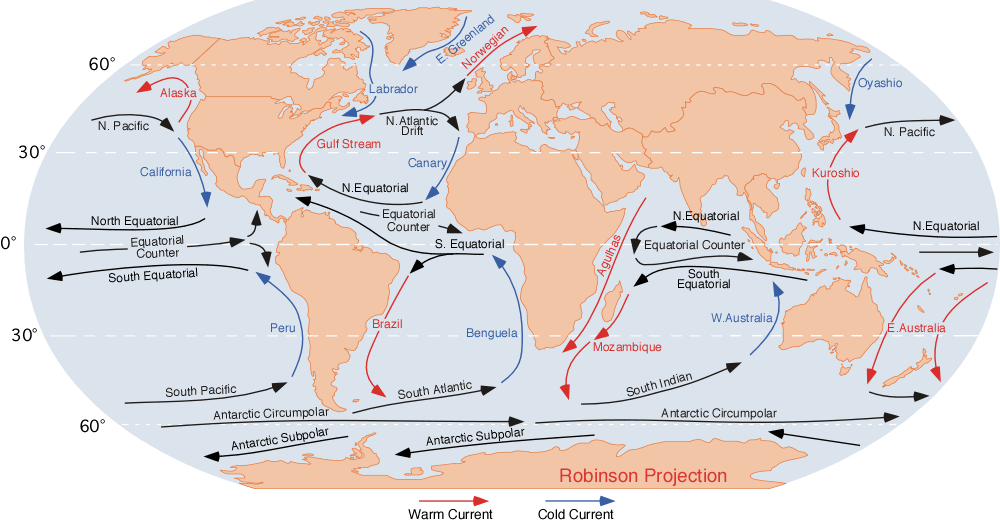
Ocean currents are classified by temperature as either warm currents or cold currents. They are also classified by their velocity, dimension, and direction as either drifts, currents, or streams. Drifts, such as the North Atlantic Drift Current, involve the forward movement of surface ocean water under the influence of the prevailing wind. Currents, such as the Labrador Current, involve the movement of oceanic water in a more definite direction at a greater velocity than drifts. Streams, such as the Gulf Stream, involve movement of larger masses of ocean water with greater velocity than drifts or currents.
Ocean currents are patterns of water movement that influence climate zones and weather patterns around the world. They are primarily driven by winds and by seawater density, although many other factors influence them, including the shape and configuration of the oceanic basin they flow through. The two basic types of currents – surface and deep-water currents – help define the character and flow of ocean waters across the planet.
Ocean currents flow for great distances, and together they create the global conveyor belt, which plays a dominant role in determining the climate of many of Earth's regions. More specifically, ocean currents influence the temperature of the regions through which they travel. For example, warm currents traveling along more temperate coasts increase the temperature of the area by warming the sea breezes that blow over them. Perhaps the most striking example is the Gulf Stream, which, together with its extension the North Atlantic Drift, makes northwest Europe much more temperate for its high latitude than other areas at the same latitude. Another example is Lima, Peru, whose cooler subtropical climate contrasts with that of its surrounding tropical latitudes because of the Humboldt Current.
The largest ocean current is the Antarctic Circumpolar Current (ACC), a wind-driven current which flows clockwise uninterrupted around Antarctica. The ACC connects all the oceanic basins together, and also provides a link between the atmosphere and the deep ocean due to the way water upwells and downwells on either side of it.
Ocean currents are driven by the wind, by the gravitational pull of the Moon in the form of tides, and by the effects of variations in water density. Ocean dynamics define and describe the motion of water within the oceans.
Ocean temperature and motion fields can be separated into three distinct layers: mixed (surface) layer, upper ocean (above the thermocline), and deep ocean. Ocean currents are measured in units of sverdrup (Sv), where 1 Sv is equivalent to a volume flow rate of 1,000,000 m3 (35,000,000 cu ft) per second.
There are two main types of currents, surface currents and deep-water currents. Generally surface currents are driven by wind systems and deep-water currents are driven by differences in water density due to variations in water temperature and salinity.
Ocean current
An ocean current is a continuous, directed movement of seawater generated by a number of forces acting upon the water, including wind, the Coriolis effect, breaking waves, cabbeling, and temperature and salinity differences. Depth contours, shoreline configurations, and interactions with other currents influence a current's direction and strength. Ocean currents move both horizontally, on scales that can span entire oceans, as well as vertically, with vertical currents (upwelling and downwelling) playing an important role in the movement of nutrients and gases, such as carbon dioxide, between the surface and the deep ocean.
Ocean currents are classified by temperature as either warm currents or cold currents. They are also classified by their velocity, dimension, and direction as either drifts, currents, or streams. Drifts, such as the North Atlantic Drift Current, involve the forward movement of surface ocean water under the influence of the prevailing wind. Currents, such as the Labrador Current, involve the movement of oceanic water in a more definite direction at a greater velocity than drifts. Streams, such as the Gulf Stream, involve movement of larger masses of ocean water with greater velocity than drifts or currents.
Ocean currents are patterns of water movement that influence climate zones and weather patterns around the world. They are primarily driven by winds and by seawater density, although many other factors influence them, including the shape and configuration of the oceanic basin they flow through. The two basic types of currents – surface and deep-water currents – help define the character and flow of ocean waters across the planet.
Ocean currents flow for great distances, and together they create the global conveyor belt, which plays a dominant role in determining the climate of many of Earth's regions. More specifically, ocean currents influence the temperature of the regions through which they travel. For example, warm currents traveling along more temperate coasts increase the temperature of the area by warming the sea breezes that blow over them. Perhaps the most striking example is the Gulf Stream, which, together with its extension the North Atlantic Drift, makes northwest Europe much more temperate for its high latitude than other areas at the same latitude. Another example is Lima, Peru, whose cooler subtropical climate contrasts with that of its surrounding tropical latitudes because of the Humboldt Current.
The largest ocean current is the Antarctic Circumpolar Current (ACC), a wind-driven current which flows clockwise uninterrupted around Antarctica. The ACC connects all the oceanic basins together, and also provides a link between the atmosphere and the deep ocean due to the way water upwells and downwells on either side of it.
Ocean currents are driven by the wind, by the gravitational pull of the Moon in the form of tides, and by the effects of variations in water density. Ocean dynamics define and describe the motion of water within the oceans.
Ocean temperature and motion fields can be separated into three distinct layers: mixed (surface) layer, upper ocean (above the thermocline), and deep ocean. Ocean currents are measured in units of sverdrup (Sv), where 1 Sv is equivalent to a volume flow rate of 1,000,000 m3 (35,000,000 cu ft) per second.
There are two main types of currents, surface currents and deep-water currents. Generally surface currents are driven by wind systems and deep-water currents are driven by differences in water density due to variations in water temperature and salinity.
Recent media
Recent media