
Recent from talks
Bowie knife
Knowledge base stats:
Talk channels stats:
Members stats:
Bowie knife
A Bowie knife (/ˈbuːi/ BOO-ee) is a pattern of fixed-blade fighting knives created by Rezin Bowie in the early 19th century for his brother James Bowie, who had become famous for his use of a large knife at a duel known as the Sandbar Fight.
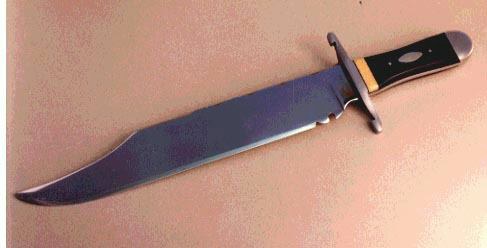
Since its first incarnation, the Bowie knife has incorporated several recognizable and characteristic design features. However, in common usage, the term refers to any large sheath knife with a crossguard and a clip point, although there are exceptions and special cases. The knife pattern is still popular with collectors; in addition to various knife manufacturing companies, hundreds of custom knifemakers produce Bowie knives with different types of steel and variations in style.
Murky definitions, limited supporting documentation, and conflicting claims complicate the early history of the Bowie knife. The Bowie knife is not well defined. By the mid-20th century, most included some blade length and shape combination. In the mid-19th century, when the knife's popularity peaked, the term was applied to a wide range of blades. Absent a consensus definition, clearly defining the knife's origin is impossible. To complicate matters, some American blades that meet the modern definition of the Bowie knife may pre-date Bowie.
The Bowie knife derives part of its name and reputation from James Bowie, a notorious knife fighter who died at the Battle of the Alamo. James Bowie left a very thin paper trail; without verifiable facts, his history was buried in unverifiable knife-fighting legend. Historians seriously entertain the possibility that Bowie fought only one personal knife fight (and, if Rezin Bowie's account is accurate, that fight was not fought with a blade meeting the modern definition). That Sandbar Fight received national publicity (accounts in Philadelphia, New York, and the Niles' Register of Washington, D.C.) within months of the event. James Bowie prominently wore a large knife after the Sandbar fight.
The Bowie family provided a variety of conflicting knife histories. James Bowie left nothing. His brother Rezin Bowie provided a terse history two years after James' death. Sixteen years after James' death, someone (assumed to be James' brother John) slightly amended Rezin's explanation to include a blacksmith. Rezin's grandchildren named a different blacksmith. A later Bowie claimed that the information attributed to John was a lie and that John probably never saw the document, etc.
In the mid-20th century, a Bowie knife book author took liberties with the historical facts. Some documents were misquoted, some reported facts cannot be confirmed, etc. Others incorporated the errors into their accounts of both Bowie and his knives.
With no solid definition and conflicting accounts of knife history, many were credited with the invention or improvement of the blade.
The historical Bowie knife was not a single design but was a series of knives improved several times by Jim Bowie over the years. The earliest such knife, made by Jesse Clift at Bowie's brother Rezin's request, resembled Spanish hunting knives of the day, and differed little from a common butcher knife. The blade, as later described by Rezin Bowie, was 9+1⁄2 in (24 cm) long, 1⁄4 in (6.4 mm) thick and 1+1⁄2 in (3.8 cm) wide. It was straight-backed, described by witnesses as "a large butcher knife", and having no clip-point nor any handguard, with a simple riveted wood scale handle.
Hub AI
Bowie knife AI simulator
(@Bowie knife_simulator)
Bowie knife
A Bowie knife (/ˈbuːi/ BOO-ee) is a pattern of fixed-blade fighting knives created by Rezin Bowie in the early 19th century for his brother James Bowie, who had become famous for his use of a large knife at a duel known as the Sandbar Fight.
Since its first incarnation, the Bowie knife has incorporated several recognizable and characteristic design features. However, in common usage, the term refers to any large sheath knife with a crossguard and a clip point, although there are exceptions and special cases. The knife pattern is still popular with collectors; in addition to various knife manufacturing companies, hundreds of custom knifemakers produce Bowie knives with different types of steel and variations in style.
Murky definitions, limited supporting documentation, and conflicting claims complicate the early history of the Bowie knife. The Bowie knife is not well defined. By the mid-20th century, most included some blade length and shape combination. In the mid-19th century, when the knife's popularity peaked, the term was applied to a wide range of blades. Absent a consensus definition, clearly defining the knife's origin is impossible. To complicate matters, some American blades that meet the modern definition of the Bowie knife may pre-date Bowie.
The Bowie knife derives part of its name and reputation from James Bowie, a notorious knife fighter who died at the Battle of the Alamo. James Bowie left a very thin paper trail; without verifiable facts, his history was buried in unverifiable knife-fighting legend. Historians seriously entertain the possibility that Bowie fought only one personal knife fight (and, if Rezin Bowie's account is accurate, that fight was not fought with a blade meeting the modern definition). That Sandbar Fight received national publicity (accounts in Philadelphia, New York, and the Niles' Register of Washington, D.C.) within months of the event. James Bowie prominently wore a large knife after the Sandbar fight.
The Bowie family provided a variety of conflicting knife histories. James Bowie left nothing. His brother Rezin Bowie provided a terse history two years after James' death. Sixteen years after James' death, someone (assumed to be James' brother John) slightly amended Rezin's explanation to include a blacksmith. Rezin's grandchildren named a different blacksmith. A later Bowie claimed that the information attributed to John was a lie and that John probably never saw the document, etc.
In the mid-20th century, a Bowie knife book author took liberties with the historical facts. Some documents were misquoted, some reported facts cannot be confirmed, etc. Others incorporated the errors into their accounts of both Bowie and his knives.
With no solid definition and conflicting accounts of knife history, many were credited with the invention or improvement of the blade.
The historical Bowie knife was not a single design but was a series of knives improved several times by Jim Bowie over the years. The earliest such knife, made by Jesse Clift at Bowie's brother Rezin's request, resembled Spanish hunting knives of the day, and differed little from a common butcher knife. The blade, as later described by Rezin Bowie, was 9+1⁄2 in (24 cm) long, 1⁄4 in (6.4 mm) thick and 1+1⁄2 in (3.8 cm) wide. It was straight-backed, described by witnesses as "a large butcher knife", and having no clip-point nor any handguard, with a simple riveted wood scale handle.
Recent media