


Community hub
Recent from talks
Contribute something to knowledge base
Content stats: 0 posts, 0 articles, 1 media, 0 notes
Members stats: 0 subscribers, 0 contributors, 0 moderators, 0 supporters
Subscribers
Supporters
Contributors
Moderators
Hub AI
Hilt AI simulator
(@Hilt_simulator)
Hub AI
Hilt AI simulator
(@Hilt_simulator)
Hilt
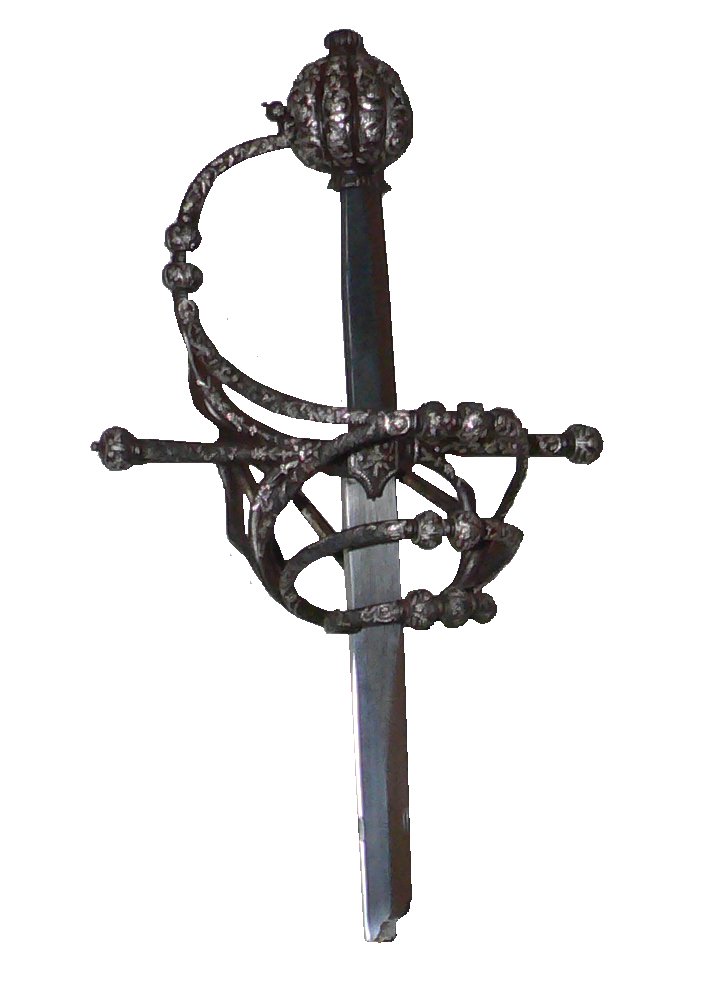
The hilt (rarely called a haft or shaft) is the handle of a knife, dagger, sword, or bayonet, consisting of a guard, grip, and pommel. The guard may contain a crossguard or quillons. A tassel or sword knot may be attached to the guard or pommel.
The pommel (Anglo-Norman pomel "little apple") is an enlarged fitting at the top of the handle. They were originally developed to prevent the sword from slipping from the hand. From around the 11th century in Europe, they became heavy enough to be a counterweight to the blade. This gave the sword a point of balance not too far from the hilt, allowing a more fluid fighting style. Depending on sword design and swordsmanship style, the pommel may also be used to strike the opponent (e.g. using the Mordhau technique).
Pommels have appeared in a wide variety of shapes, including oblate spheroids, crescents, disks, wheels, and animal or bird heads. They are often engraved or inlayed with various designs and occasionally gilt and mounted with jewels. Ewart Oakeshott introduced a system of classification of medieval pommel forms in his The Sword in the Age of Chivalry (1964) to stand alongside his blade typology. Oakeshott pommel types are enumerated with capital letters A–Z, with subtypes indicated by numerals.
The grip is the handle of the sword. It is usually made of wood or metal and often covered with shagreen (untanned tough leather or shark skin). Shark skin proved to be the most durable in temperate climates but deteriorates in hot climates. Consequently, rubber became popular in the latter half of the 19th century. Many sword types alternatively opt for ray skin, referred to in katana construction as same. Whatever material covers the grip, it is usually both glued on and wrapped with wire in a helix.
The guard is just above the grip. It is a common misconception that the cross-guard protects the wielder's entire hand from the opposing sword; only with the abandonment of the shield and then the armoured gauntlet did a full hand guard become necessary. The crossguard still protected the user from a blade that was deliberately slid down the length of the blade to cut off or injure the hand.
Early swords do not have true guards but simply a form of stop to prevent the hand slipping up the blade when thrusting, as they were invariably used in conjunction with a shield.
From the 11th century, European sword guards took the form of a straight crossbar (later called "quillon") perpendicular to the blade.
Beginning in the 16th century in Europe, guards became more and more elaborate, with additional loops and curved bars or branches to protect the hand. A single curved piece alongside the fingers (roughly parallel with the handle/blade and perpendicular to any crossguards) was referred to as a knuckle-bow.
Hilt
The hilt (rarely called a haft or shaft) is the handle of a knife, dagger, sword, or bayonet, consisting of a guard, grip, and pommel. The guard may contain a crossguard or quillons. A tassel or sword knot may be attached to the guard or pommel.
The pommel (Anglo-Norman pomel "little apple") is an enlarged fitting at the top of the handle. They were originally developed to prevent the sword from slipping from the hand. From around the 11th century in Europe, they became heavy enough to be a counterweight to the blade. This gave the sword a point of balance not too far from the hilt, allowing a more fluid fighting style. Depending on sword design and swordsmanship style, the pommel may also be used to strike the opponent (e.g. using the Mordhau technique).
Pommels have appeared in a wide variety of shapes, including oblate spheroids, crescents, disks, wheels, and animal or bird heads. They are often engraved or inlayed with various designs and occasionally gilt and mounted with jewels. Ewart Oakeshott introduced a system of classification of medieval pommel forms in his The Sword in the Age of Chivalry (1964) to stand alongside his blade typology. Oakeshott pommel types are enumerated with capital letters A–Z, with subtypes indicated by numerals.
The grip is the handle of the sword. It is usually made of wood or metal and often covered with shagreen (untanned tough leather or shark skin). Shark skin proved to be the most durable in temperate climates but deteriorates in hot climates. Consequently, rubber became popular in the latter half of the 19th century. Many sword types alternatively opt for ray skin, referred to in katana construction as same. Whatever material covers the grip, it is usually both glued on and wrapped with wire in a helix.
The guard is just above the grip. It is a common misconception that the cross-guard protects the wielder's entire hand from the opposing sword; only with the abandonment of the shield and then the armoured gauntlet did a full hand guard become necessary. The crossguard still protected the user from a blade that was deliberately slid down the length of the blade to cut off or injure the hand.
Early swords do not have true guards but simply a form of stop to prevent the hand slipping up the blade when thrusting, as they were invariably used in conjunction with a shield.
From the 11th century, European sword guards took the form of a straight crossbar (later called "quillon") perpendicular to the blade.
Beginning in the 16th century in Europe, guards became more and more elaborate, with additional loops and curved bars or branches to protect the hand. A single curved piece alongside the fingers (roughly parallel with the handle/blade and perpendicular to any crossguards) was referred to as a knuckle-bow.
Recent media
Recent media