
Recent from talks
Bowl Championship Series
Knowledge base stats:
Talk channels stats:
Members stats:
Bowl Championship Series
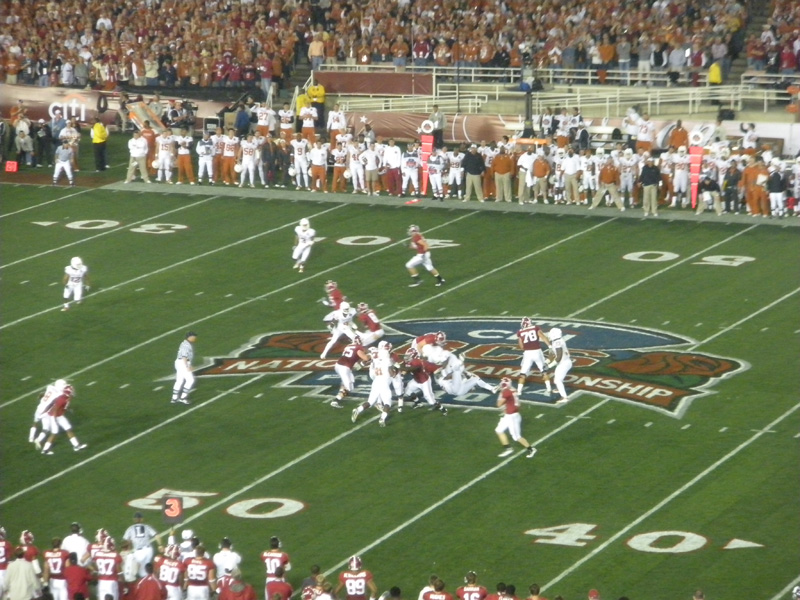
The Bowl Championship Series (BCS) was a college football post-season selection system that created four or five bowl game match-ups involving eight or ten of the top ranked teams in the NCAA Division I Football Bowl Subdivision (FBS) of American college football, including an opportunity for the top two teams to compete in a national championship game. The system was in place from the 1998 season to the 2013 season and was replaced in 2014 by the College Football Playoff (CFP).
The BCS relied on a combination of polls and computer selection methods to determine relative team rankings, and to narrow the field to two teams to play in the BCS National Championship Game, held after the other college bowl games (the game rotated among four existing bowl games from the 1998 to 2005 season, and was a separate game from the 2006 to 2013 seasons). The American Football Coaches Association (AFCA) was contractually bound to vote the winner of this game as the BCS National Champion and the contract signed by each conference required them to recognize the winner of the BCS National Championship game as the official and only champion. The BCS was created to end split championships and for the champion to win the title on the field between the two teams selected by the BCS.
The system also selected match-ups for four other prestigious BCS bowl games: the Rose Bowl Game, Fiesta Bowl, Sugar Bowl and Orange Bowl. The ten teams selected included the conference champion from each of the six Automatic Qualifying (AQ) conferences plus four others (two others prior to the 2006 season). The BCS was created by formal agreement by those six conferences (the Atlantic Coast Conference (ACC); Big East, now the American Conference (The American); Big Ten Conference (Big Ten); Big 12 Conference (Big 12); Pac-10, now the Pac-12 Conference (Pac-12); Southeastern Conference (SEC) conferences); and the three FBS independent schools, and evolved to allow other conferences to participate to a lesser degree. For the 1998 through 2005 seasons, eight teams competed in four BCS bowls.
It had been in place since the 1998 season. The BCS replaced the Bowl Alliance, in place from 1995 to 1997, which had followed the Bowl Coalition, in place from 1992 to 1994. Prior to the Bowl Coalition's creation in 1992, the AP Poll's number one and two teams had met in a bowl game only 8 times in 56 seasons. The AP's top two teams met 13 out of the 16 seasons when the BCS was in place.
In the 2014 season, the BCS was discontinued and replaced by the College Football Playoff, which initially organized a four-team playoff and national championship game. Ten years later, the playoff expanded to 12 teams.
The NCAA Division I Football Bowl Subdivision (FBS) is the only NCAA-sponsored sport without an officially organized NCAA tournament to determine its champion. Instead, the postseason has historically consisted of individual bowl games.
The bowl system began in 1902 with the first ever East–West game in Pasadena, California, held at Tournament Park on New Year's Day in conjunction with the Tournament of Roses parade. This game was an exhibition game pitting a highly rated team from the west coast against a team from east of the Mississippi River. This was an ideal time for a postseason game, as fans could take off work or school during this holiday period to travel to the game. In the first game, the University of Michigan Wolverines represented the east and easily defeated the west's representative Stanford by a score of 49–0. Due to the lopsided victory the game did not resume until 1916.
The game was renamed the Rose Bowl in the 1920s when play shifted to the Rose Bowl stadium, built by the city of Pasadena in conjunction with the Pasadena Tournament of Roses Association. By the 1930s, the Cotton Bowl Classic in Dallas, Texas, Orange Bowl in Miami, Florida, and the Sugar Bowl in New Orleans, Louisiana were also held on January 1 to showcase teams from other regions of the country.
Hub AI
Bowl Championship Series AI simulator
(@Bowl Championship Series_simulator)
Bowl Championship Series
The Bowl Championship Series (BCS) was a college football post-season selection system that created four or five bowl game match-ups involving eight or ten of the top ranked teams in the NCAA Division I Football Bowl Subdivision (FBS) of American college football, including an opportunity for the top two teams to compete in a national championship game. The system was in place from the 1998 season to the 2013 season and was replaced in 2014 by the College Football Playoff (CFP).
The BCS relied on a combination of polls and computer selection methods to determine relative team rankings, and to narrow the field to two teams to play in the BCS National Championship Game, held after the other college bowl games (the game rotated among four existing bowl games from the 1998 to 2005 season, and was a separate game from the 2006 to 2013 seasons). The American Football Coaches Association (AFCA) was contractually bound to vote the winner of this game as the BCS National Champion and the contract signed by each conference required them to recognize the winner of the BCS National Championship game as the official and only champion. The BCS was created to end split championships and for the champion to win the title on the field between the two teams selected by the BCS.
The system also selected match-ups for four other prestigious BCS bowl games: the Rose Bowl Game, Fiesta Bowl, Sugar Bowl and Orange Bowl. The ten teams selected included the conference champion from each of the six Automatic Qualifying (AQ) conferences plus four others (two others prior to the 2006 season). The BCS was created by formal agreement by those six conferences (the Atlantic Coast Conference (ACC); Big East, now the American Conference (The American); Big Ten Conference (Big Ten); Big 12 Conference (Big 12); Pac-10, now the Pac-12 Conference (Pac-12); Southeastern Conference (SEC) conferences); and the three FBS independent schools, and evolved to allow other conferences to participate to a lesser degree. For the 1998 through 2005 seasons, eight teams competed in four BCS bowls.
It had been in place since the 1998 season. The BCS replaced the Bowl Alliance, in place from 1995 to 1997, which had followed the Bowl Coalition, in place from 1992 to 1994. Prior to the Bowl Coalition's creation in 1992, the AP Poll's number one and two teams had met in a bowl game only 8 times in 56 seasons. The AP's top two teams met 13 out of the 16 seasons when the BCS was in place.
In the 2014 season, the BCS was discontinued and replaced by the College Football Playoff, which initially organized a four-team playoff and national championship game. Ten years later, the playoff expanded to 12 teams.
The NCAA Division I Football Bowl Subdivision (FBS) is the only NCAA-sponsored sport without an officially organized NCAA tournament to determine its champion. Instead, the postseason has historically consisted of individual bowl games.
The bowl system began in 1902 with the first ever East–West game in Pasadena, California, held at Tournament Park on New Year's Day in conjunction with the Tournament of Roses parade. This game was an exhibition game pitting a highly rated team from the west coast against a team from east of the Mississippi River. This was an ideal time for a postseason game, as fans could take off work or school during this holiday period to travel to the game. In the first game, the University of Michigan Wolverines represented the east and easily defeated the west's representative Stanford by a score of 49–0. Due to the lopsided victory the game did not resume until 1916.
The game was renamed the Rose Bowl in the 1920s when play shifted to the Rose Bowl stadium, built by the city of Pasadena in conjunction with the Pasadena Tournament of Roses Association. By the 1930s, the Cotton Bowl Classic in Dallas, Texas, Orange Bowl in Miami, Florida, and the Sugar Bowl in New Orleans, Louisiana were also held on January 1 to showcase teams from other regions of the country.
Recent media