


Community hub
Recent from talks
Contribute something to knowledge base
Content stats: 0 posts, 0 articles, 1 media, 0 notes
Members stats: 0 subscribers, 0 contributors, 0 moderators, 0 supporters
Subscribers
Supporters
Contributors
Moderators
Hub AI
Bowls AI simulator
(@Bowls_simulator)
Hub AI
Bowls AI simulator
(@Bowls_simulator)
Bowls
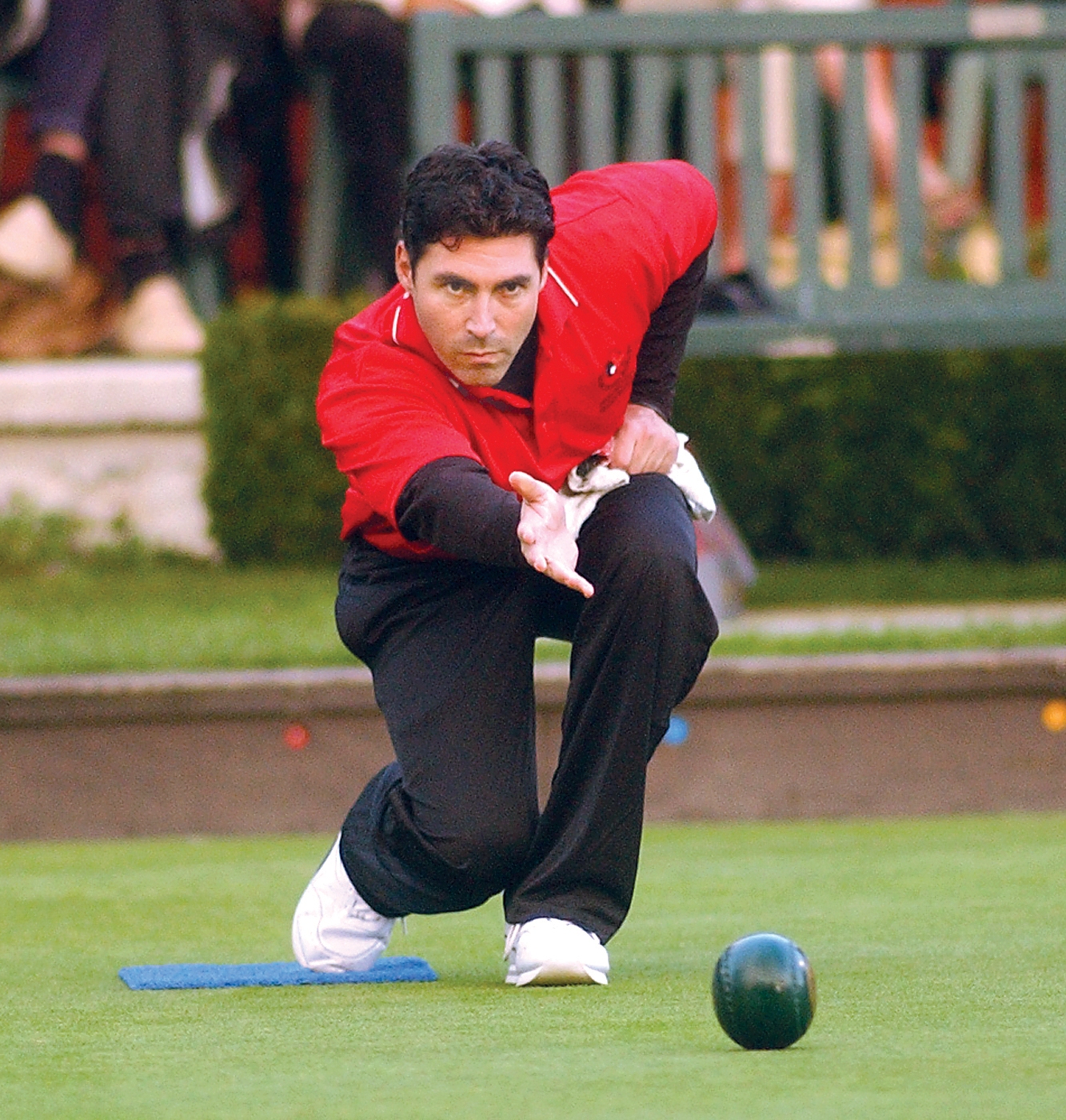
Bowls, also known as lawn bowls or lawn bowling, is a sport in which players try to roll their ball (called a bowl) closest to a smaller ball (known as a "jack" or sometimes a "kitty"). The bowls are shaped (biased), so that they follow a curved path when being rolled. The game is played either in teams or one against one.
The game was first played in the 13th century. The game is played on grass, although other surfaces are sometimes used. Matches are held either until one player gets to a score, or when a number of ends are played.
The game is mostly played on a bowling green, which can vary by the type of bowls being played. Whilst the game is often played outdoors, there are indoor bowling venues, and can also be played on rollable carpets. For outdoor games, this is usually on grass; however, it can also be played on cotula in New Zealand.
Bowls is a variant of the boules games (Italian: bocce), which, in their general form, are of ancient or prehistoric origin. Ancient Greek variants are recorded that involved throwing light objects (such as flat stones, coins, or later also stone balls) as far as possible. The aspect of tossing the balls to approach a target as closely as possible is recorded in ancient Rome. This game was spread to Roman Gaul by soldiers or sailors. A Roman sepulchre in Florence shows people playing this game, stooping down to measure the points.
Bowls in England has been traced certainly to the 13th century, and conjecturally to the 12th century. William Fitzstephen (d. about 1190), in his biography of Thomas Becket, gives a graphic sketch of the London of his day and, writing of the summer amusements of young men, says that on holidays they were "exercised in Leaping, Shooting, Wrestling, Casting of Stones [in jactu lapidum], and Throwing of Javelins fitted with Loops for the Purpose, which they strive to fling before the Mark; they also use Bucklers, like fighting Men." It is commonly supposed that by jactus lapidum, Fitzstephen refers to an early variety of bowls, possibly played using round stone; there is a record of iron bowls being used, though at a much later date, on festive occasions at Nairn.[year needed]. On the other hand, the jactus lapidum of which he speaks may have been more akin to shot put.
It is clear, at any rate, that a rudimentary form of the game was played in England in the 13th century. A manuscript of that period in the royal library, Windsor (No. 20, E iv.), contains a drawing representing two players aiming at a small cone instead of an earthenware ball or jack. The world's oldest surviving bowling green is the Southampton Old Bowling Green, which was first used in 1299.
Another manuscript of the same century has a crude but spirited picture which brings us into close touch with the existing game. Three figures are introduced and a jack. The first player's bowl has come to rest just in front of the jack; the second has delivered his bowl and is following after it with one of those eccentric contortions still not unusual on modern greens, the first player meanwhile making a repressive gesture with his hand, as if to urge the bowl to stop short of his own; the third player is depicted as in the act of delivering his bowl. A 14th-century manuscript, Book of Prayers, in the Francis Douce collection in the Bodleian Library at Oxford, contains a drawing in which two persons are shown, but they bowl to no mark. Strutt (Sports and Pastimes) suggests that the first player's bowl may have been regarded by the second player as a species of jack; but in that case it is not clear what was the first player's target. In these three earliest illustrations of the pastime each player has one bowl only, and that the attitude in delivering it was as various five or six hundred years ago as it is today. In the third, he stands almost upright; in the first, he kneels; in the second, he stoops, halfway between the upright and the kneeling position.
The game eventually came under the ban of king and Parliament, both fearing it might jeopardise the practice of archery, then so important in battle. Statutes forbidding it and other sports were enacted in the reigns of Edward III, Richard II and other monarchs. Even when, on the invention of gunpowder and firearms, the bow had fallen into disuse as a weapon of war, the prohibition was continued. The discredit attaching to bowling alleys, first established in London in 1455, probably encouraged subsequent repressive legislation, for many of the alleys were connected with taverns frequented by the dissolute and gamesters.
Bowls
Bowls, also known as lawn bowls or lawn bowling, is a sport in which players try to roll their ball (called a bowl) closest to a smaller ball (known as a "jack" or sometimes a "kitty"). The bowls are shaped (biased), so that they follow a curved path when being rolled. The game is played either in teams or one against one.
The game was first played in the 13th century. The game is played on grass, although other surfaces are sometimes used. Matches are held either until one player gets to a score, or when a number of ends are played.
The game is mostly played on a bowling green, which can vary by the type of bowls being played. Whilst the game is often played outdoors, there are indoor bowling venues, and can also be played on rollable carpets. For outdoor games, this is usually on grass; however, it can also be played on cotula in New Zealand.
Bowls is a variant of the boules games (Italian: bocce), which, in their general form, are of ancient or prehistoric origin. Ancient Greek variants are recorded that involved throwing light objects (such as flat stones, coins, or later also stone balls) as far as possible. The aspect of tossing the balls to approach a target as closely as possible is recorded in ancient Rome. This game was spread to Roman Gaul by soldiers or sailors. A Roman sepulchre in Florence shows people playing this game, stooping down to measure the points.
Bowls in England has been traced certainly to the 13th century, and conjecturally to the 12th century. William Fitzstephen (d. about 1190), in his biography of Thomas Becket, gives a graphic sketch of the London of his day and, writing of the summer amusements of young men, says that on holidays they were "exercised in Leaping, Shooting, Wrestling, Casting of Stones [in jactu lapidum], and Throwing of Javelins fitted with Loops for the Purpose, which they strive to fling before the Mark; they also use Bucklers, like fighting Men." It is commonly supposed that by jactus lapidum, Fitzstephen refers to an early variety of bowls, possibly played using round stone; there is a record of iron bowls being used, though at a much later date, on festive occasions at Nairn.[year needed]. On the other hand, the jactus lapidum of which he speaks may have been more akin to shot put.
It is clear, at any rate, that a rudimentary form of the game was played in England in the 13th century. A manuscript of that period in the royal library, Windsor (No. 20, E iv.), contains a drawing representing two players aiming at a small cone instead of an earthenware ball or jack. The world's oldest surviving bowling green is the Southampton Old Bowling Green, which was first used in 1299.
Another manuscript of the same century has a crude but spirited picture which brings us into close touch with the existing game. Three figures are introduced and a jack. The first player's bowl has come to rest just in front of the jack; the second has delivered his bowl and is following after it with one of those eccentric contortions still not unusual on modern greens, the first player meanwhile making a repressive gesture with his hand, as if to urge the bowl to stop short of his own; the third player is depicted as in the act of delivering his bowl. A 14th-century manuscript, Book of Prayers, in the Francis Douce collection in the Bodleian Library at Oxford, contains a drawing in which two persons are shown, but they bowl to no mark. Strutt (Sports and Pastimes) suggests that the first player's bowl may have been regarded by the second player as a species of jack; but in that case it is not clear what was the first player's target. In these three earliest illustrations of the pastime each player has one bowl only, and that the attitude in delivering it was as various five or six hundred years ago as it is today. In the third, he stands almost upright; in the first, he kneels; in the second, he stoops, halfway between the upright and the kneeling position.
The game eventually came under the ban of king and Parliament, both fearing it might jeopardise the practice of archery, then so important in battle. Statutes forbidding it and other sports were enacted in the reigns of Edward III, Richard II and other monarchs. Even when, on the invention of gunpowder and firearms, the bow had fallen into disuse as a weapon of war, the prohibition was continued. The discredit attaching to bowling alleys, first established in London in 1455, probably encouraged subsequent repressive legislation, for many of the alleys were connected with taverns frequented by the dissolute and gamesters.
Recent media
Recent media