
.jpg/250px-Museum_of_Oxford_(5652685943).jpg)


.jpg/2000px-Museum_of_Oxford_(5652685943).jpg)
Community hub
Recent from talks
Contribute something
Nothing was collected or created yet.
Oxford
View on Wikipedia
Oxford (/ˈɒksfərd/ ⓘ)[5][6] is a cathedral city and non-metropolitan district in Oxfordshire, England, of which it is the county town.
Key Information


The city is home to the University of Oxford, the oldest university in the English-speaking world;[7] it has buildings in every style of English architecture since late Anglo-Saxon. Oxford's industries include motor manufacturing, education, publishing, science, and information technologies.
Founded in the 8th century, it was granted city status in 1542. The city is located at the confluence of the rivers Thames (locally known as the Isis) and Cherwell. It had a population of 166,034 in 2024.[3] It is 56 miles (90 km) north-west of London, 64 miles (103 km) south-east of Birmingham and 61 miles (98 km) north-east of Bristol.
History
[edit]The history of Oxford in England dates back to its original settlement in the Saxon period. The name “Oxford” comes from the Old English Oxenaforda, meaning “ford of the oxen,” referring to a shallow crossing in the river where oxen could pass.[8] The town was of strategic significance, because of the ford and the town's controlling location on the upper reaches of the River Thames at its confluence with the River Cherwell.
After the Norman Conquest in 1066, Norman lord Robert D’Oyly built Oxford Castle in 1071 to secure control of the area.[8] The town grew in national importance during the early Norman period.

Teaching began in the 11th century and by the late 12th century the town was home to the fledgling University of Oxford.[9] Tensions sometimes erupted between the scholastic community and the town: in 1209, after a townsperson hanged two scholars for an alleged murder, a number of Oxford academics fled and founded Cambridge University. Town-and-gown conflicts continued, culminating in the St. Scholastica Day Riot of 1355 – a feuding that lasted days and left around 93 students and townspeople dead.
Oxford was besieged during The Anarchy in 1142.[10] During the Middle Ages, Oxford had an important Jewish community, of which David of Oxford and his wife Licoricia of Winchester were prominent members.[11] The university rose to dominate the town.
A heavily ecclesiastical town, Oxford was greatly affected by the changes of the English Reformation. Oxford’s ecclesiastical institutions were dismantled — the city’s monasteries were closed in the 1530s.[12] Religious strife touched Oxford directly during the Marian persecution: the Oxford Martyrs were tried for heresy here. Bishops Hugh Latimer and Nicholas Ridley were burned at the stake in Oxford in October 1555, and the former Archbishop Thomas Cranmer was executed in March 1556. A Victorian-era monument, the Martyrs’ Memorial in St Giles’, now commemorates these events.
Oxford was elevated from town to city status in 1542 when the Diocese of Oxford was created – Christ Church college chapel was made a cathedral, officially granting Oxford its city privileges.
During the English Civil War Charles I made Oxford his de facto capital (1642–1646): he moved his court to Oxford, using the city as his headquarters after being expelled from London.[13]

The city began to grow industrially during the 19th century, and had an industrial boom in the early 20th century. Traditional industries included brewing and publishing – Oxford University Press and other print houses were major employers by the 19th century. In 1910 entrepreneur William Morris (later Lord Nuffield) founded a motor car business in Oxford, opening an assembly plant at Cowley.
The city’s population and economy grew with this industrial boom, diversifying beyond the university.
Geography
[edit]Physical
[edit]Location
[edit]Oxford's latitude and longitude are 51°45′07″N 1°15′28″W / 51.75194°N 1.25778°W, with Ordnance Survey grid reference SP513061 (at Carfax Tower, which is usually considered the centre). Oxford is 24 miles (39 km) north-west of Reading, 26 miles (42 km) north-east of Swindon, 36 miles (58 km) east of Cheltenham, 43 miles (69 km) east of Gloucester, 29 miles (47 km) south-west of Milton Keynes, 38 miles (61 km) south-east of Evesham, 54 miles (87 km) south-east of Worcester, 43 miles (69 km) south of Rugby and 51 miles (82 km) west-north-west of London. The rivers Cherwell and Thames (also sometimes known as the Isis locally, supposedly from the Latinised name Thamesis) run through Oxford and meet south of the city centre. These rivers and their flood plains constrain the size of the city centre.
Climate
[edit]Oxford has a maritime temperate climate (Köppen: Cfb). Precipitation is uniformly distributed throughout the year and is provided mostly by weather systems that arrive from the Atlantic. The lowest temperature ever recorded in Oxford was −17.8 °C (0.0 °F) on 24 December 1860. The highest temperature ever recorded in Oxford is 38.1 °C (101 °F) on 19 July 2022.[14] The average conditions below are from the Radcliffe Meteorological Station. It has the longest series of temperature and rainfall records for one site in Britain. These records are continuous from January 1815. Irregular observations of rainfall, cloud cover, and temperature exist since 1767.[15]
The driest year on record was 1788, with 336.7 mm (13.26 in) of rainfall. The wettest year was 2012, with 979.5 mm (38.56 in). The wettest month on record was September 1774, with a total fall of 223.9 mm (8.81 in). The warmest month on record is July 1983, with an average of 21.1 °C (70 °F) and the coldest is January 1963, with an average of −3.0 °C (27 °F). The warmest year on record is 2014, with an average of 11.8 °C (53 °F) and the coldest is 1879, with a mean temperature of 7.7 °C (46 °F). The sunniest month on record is May 2020, with 331.7 hours and December 1890 is the least sunny, with 5.0 hours. The greatest one-day rainfall occurred on 10 July 1968, with a total of 87.9 mm (3.46 in). The greatest known snow depth was 61.0 cm (24.0 in) in February 1888.[16]
| Climate data for Oxford (RMS),[a] elevation: 200 ft (61 m), 1991–2020 normals, extremes 1815–2020 | |||||||||||||
|---|---|---|---|---|---|---|---|---|---|---|---|---|---|
| Month | Jan | Feb | Mar | Apr | May | Jun | Jul | Aug | Sep | Oct | Nov | Dec | Year |
| Record high °C (°F) | 15.9 (60.6) |
18.8 (65.8) |
22.1 (71.8) |
27.6 (81.7) |
30.6 (87.1) |
34.3 (93.7) |
38.1 (100.6) |
35.1 (95.2) |
33.4 (92.1) |
29.1 (84.4) |
18.9 (66.0) |
15.9 (60.6) |
38.1 (100.6) |
| Mean daily maximum °C (°F) | 8.0 (46.4) |
8.6 (47.5) |
11.3 (52.3) |
14.4 (57.9) |
17.7 (63.9) |
20.7 (69.3) |
23.1 (73.6) |
22.5 (72.5) |
19.4 (66.9) |
15.1 (59.2) |
10.9 (51.6) |
8.2 (46.8) |
15.0 (59.0) |
| Daily mean °C (°F) | 5.2 (41.4) |
5.5 (41.9) |
7.5 (45.5) |
9.9 (49.8) |
12.9 (55.2) |
15.9 (60.6) |
18.1 (64.6) |
17.8 (64.0) |
15.0 (59.0) |
11.5 (52.7) |
7.9 (46.2) |
5.4 (41.7) |
11.1 (52.0) |
| Mean daily minimum °C (°F) | 2.4 (36.3) |
2.3 (36.1) |
3.6 (38.5) |
5.3 (41.5) |
8.2 (46.8) |
11.1 (52.0) |
13.1 (55.6) |
13.0 (55.4) |
10.7 (51.3) |
8.0 (46.4) |
4.9 (40.8) |
2.6 (36.7) |
7.1 (44.8) |
| Record low °C (°F) | −16.6 (2.1) |
−16.2 (2.8) |
−12.0 (10.4) |
−5.6 (21.9) |
−3.4 (25.9) |
0.4 (32.7) |
2.4 (36.3) |
0.2 (32.4) |
−3.3 (26.1) |
−5.7 (21.7) |
−10.1 (13.8) |
−17.8 (0.0) |
−17.8 (0.0) |
| Average precipitation mm (inches) | 59.6 (2.35) |
46.8 (1.84) |
43.2 (1.70) |
48.7 (1.92) |
56.9 (2.24) |
49.7 (1.96) |
52.5 (2.07) |
61.7 (2.43) |
51.9 (2.04) |
73.2 (2.88) |
71.5 (2.81) |
66.1 (2.60) |
681.6 (26.83) |
| Average precipitation days (≥ 1.0 mm) | 12.1 | 9.4 | 9.1 | 8.9 | 9.6 | 8.0 | 8.3 | 9.0 | 8.6 | 10.9 | 11.3 | 12.2 | 117.7 |
| Mean monthly sunshine hours | 63.4 | 81.9 | 118.2 | 165.6 | 200.3 | 197.1 | 212.0 | 193.3 | 145.3 | 110.2 | 70.8 | 57.6 | 1,615.5 |
| Source 1: Met Office[17] | |||||||||||||
| Source 2: University of Oxford[18] | |||||||||||||
- ^ Weather station is located 0.7 miles (1.1 km) from the Oxford city centre.

Districts
[edit]The city centre
[edit]The city centre is relatively small and is centred on Carfax, a crossroads which forms the junction of Cornmarket Street (pedestrianised), Queen Street (mainly pedestrianised), St Aldate's and the High Street ("the High"; blocked for through traffic). Cornmarket Street and Queen Street are home to Oxford's chain stores, as well as a small number of independent retailers, one of the longest established of which was Boswell's, founded in 1738.[19] The store closed in 2020.[20] St Aldate's has few shops but several local government buildings, including the town hall, the city police station and local council offices. The High (the word street is traditionally omitted) is the longest of the four streets and has a number of independent and high-end chain stores, but mostly university and college buildings. The historic buildings mean the area is often used by film and TV crews.
Suburbs
[edit]Aside from the city centre, there are several suburbs and neighbourhoods within the borders of the city of Oxford, including:
Green belt
[edit]
Oxford is at the centre of the Oxford Green Belt, which is an environmental and planning policy that regulates the rural space in Oxfordshire surrounding the city, aiming to prevent urban sprawl and minimize convergence with nearby settlements.[21] The policy has been blamed for the large rise in house prices in Oxford, making it the least affordable city in the United Kingdom outside of London, with some estate agents calling for brownfield land inside the green belt to be released for new housing.[22][23][24]
The vast majority of the area covered is outside of the city, but there are some green spaces within that which are covered by the designation, such as much of the Thames and river Cherwell flood-meadows, and the village of Binsey, along with several smaller portions on the fringes. Other landscape features and places of interest covered include Cutteslowe Park and the mini railway attraction, the University Parks, Hogacre Common Eco Park, numerous sports grounds, Aston's Eyot, St Margaret's Church and well, and Wolvercote Common and community orchard.[25]


Governance
[edit].jpg)
There are two tiers of local government covering Oxford, at district and county level: Oxford City Council and Oxfordshire County Council. From 1889 to 1974 the city of Oxford was a county borough, independent from the county council.[26] Oxford City Council meets at the Town Hall on the street called St Aldate's in the city centre. The current building was completed in 1897, on a site which had been occupied by Oxford's guildhall since the 13th century.[27]
Most of Oxford is an unparished area, but there are four civil parishes within the city's boundaries: Blackbird Leys, Littlemore, Old Marston, and Risinghurst and Sandhills.[28]
Economy
[edit]Oxford's economy includes manufacturing, publishing and science-based industries as well as education, sports, entertainment, breweries, research and tourism.[29]
Car production
[edit]Oxford has been an important centre of motor manufacturing since Morris Motors was established in the city in 1910. The principal production site for Mini cars, owned by BMW since 2000, is in the Oxford suburb of Cowley. The plant, which survived the turbulent years of British Leyland in the 1970s and was threatened with closure in the early 1990s, also produced cars under the Austin and Rover brands following the demise of the Morris brand in 1984, although the last Morris-badged car was produced there in 1982.[citation needed]
Publishing
[edit]Oxford University Press, a department of the University of Oxford, is based in the city, although it no longer operates its own paper mill and printing house. The city is also home to the UK operations of Wiley-Blackwell, Elsevier[30] and several smaller publishing houses.
Science and technology
[edit]The presence of the university has given rise to many science and technology based businesses, including Oxford Instruments, Research Machines and Sophos. The university established Isis Innovation in 1987 to promote technology transfer. The Oxford Science Park was established in 1990, and the Begbroke Science Park, owned by the university, lies north of the city. Oxford increasingly has a reputation for being a centre of digital innovation, as epitomized by Digital Oxford.[31] Several startups including Passle,[32] Brainomix,[33] Labstep,[34] and more, are based in Oxford.
Education
[edit]
The presence of the university has also led to Oxford becoming a centre for the education industry. Companies often draw their teaching staff from the pool of Oxford University students and graduates, and, especially for EFL education, use their Oxford location as a selling point.[35]
Tourism
[edit]Oxford has numerous major tourist attractions, many belonging to the university and colleges. As well as several famous institutions, the town centre is home to Carfax Tower and the University Church of St Mary the Virgin, both of which offer views over the spires of the city. Many tourists shop at the historic Covered Market. In the summer, punting on the Thames/Isis and the Cherwell is a common practice. As well as being a major draw for tourists (9.1 million in 2008, similar in 2009)[needs update],[36] Oxford city centre has many shops, several theatres and an ice rink.
-
 Carfax Tower at Carfax, the junction of the High Street, Queen Street, Cornmarket and St Aldate's streets, considered by many to be the centre of the city
 -
 Night view of High Street with Christmas lights – one of Oxford's main streets


Retail
[edit]There are two small shopping malls in the city centre: the Clarendon Centre[37] and the Westgate Oxford.[38] The Westgate Centre is named for the original West Gate in the city wall, and is at the west end of Queen Street. A major redevelopment and expansion to 750,000 sq ft (70,000 m2), with a new 230,000 sq ft (21,000 m2) John Lewis department store and a number of new homes, was completed in October 2017. Blackwell's Bookshop is a bookshop which claims the largest single room devoted to book sales in the whole of Europe, the Norrington Room (10,000 sq ft).[39]
Brewing
[edit]There is a long history of brewing in Oxford. Several of the colleges had private breweries, one of which, at Brasenose, survived until 1889. In the 16th century brewing and malting appear to have been the most popular trades in the city. There were breweries in Brewer Street and Paradise Street, near the Castle Mill Stream. The rapid expansion of Oxford and the development of its railway links after the 1840s facilitated expansion of the brewing trade.[40] As well as expanding the market for Oxford's brewers, railways enabled brewers further from the city to compete for a share of its market.[40] By 1874 there were nine breweries in Oxford and 13 brewers' agents in Oxford shipping beer in from elsewhere.[40] The nine breweries were: Flowers & Co in Cowley Road, Hall's St Giles Brewery, Hall's Swan Brewery (see below), Hanley's City Brewery in Queen Street, Le Mills's Brewery in St. Ebbes, Morrell's Lion Brewery in St Thomas Street (see below), Simonds's Brewery in Queen Street, Weaving's Eagle Brewery (by 1869 the Eagle Steam Brewery) in Park End Street and Wootten and Cole's St. Clement's Brewery.[40]
The Swan's Nest Brewery, later the Swan Brewery, was established by the early 18th century in Paradise Street, and in 1795 was acquired by William Hall.[41] The brewery became known as Hall's Oxford Brewery, which acquired other local breweries. Hall's Brewery was acquired by Samuel Allsopp & Sons in 1926, after which it ceased brewing in Oxford.[42] Morrell's was founded in 1743 by Richard Tawney. He formed a partnership in 1782 with Mark and James Morrell, who eventually became the owners.[43] After an acrimonious family dispute the brewery was closed in 1998.[44] The beer brand names were taken over by the Thomas Hardy Burtonwood brewery,[45] while the 132 tied pubs were bought by Michael Cannon, owner of the American hamburger chain Fuddruckers, through a new company, Morrells of Oxford.[46] The new owners sold most of the pubs on to Greene King in 2002.[47] The Lion Brewery was converted into luxury apartments in 2002.[48] Oxford's first legal distillery, the Oxford Artisan Distillery, was established in 2017 in historic farm buildings at the top of South Park.[49]
Bellfounding
[edit]The Taylor family of Loughborough had a bell-foundry in Oxford between 1786 and 1854.[50]

Buildings
[edit]-
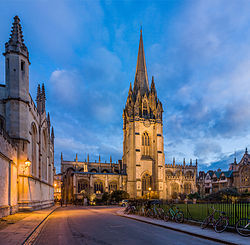 The University Church of St Mary the Virgin
 -
 Sheldonian Theatre in 2009
 -
 Interior of Christ Church Cathedral, Oxford
 -
 Oxford Botanic Garden


This is a small selection of the many notable buildings in Oxford.
- Christ Church Cathedral, Oxford
- The Headington Shark
- Oxford University Press
- Oxford Botanic Garden
- Sheldonian Theatre
- St. Mary the Virgin Church
- Radcliffe Camera
- Radcliffe Observatory
- Oxford Oratory
- Malmaison Hotel, in a converted prison in part of the medieval Oxford Castle
Parks and nature walks
[edit]Oxford is a very green city, with several parks and nature walks within the ring road, as well as several sites just outside the ring road. In total, 28 nature reserves exist within or just outside the ring road, including:
Demographics
[edit]
As of 2023, Oxford’s population was approximately 165,200.[51] More than a third (35%) of Oxford's residents were born outside of the United Kingdom.[51]
Oxford’s population is notably young and diverse. About 30% of residents are ages 18–29, roughly double the national average for that age bracket. This is largely because of the substantial student population: about 35,000 students are enrolled for full-time studies in the city's two universities.[51]
Ethnicity
[edit]| Ethnic Group | 1981 estimates[52] | 1991[53] | 2001[54] | 2011[55] | 2021[56] | |||||
|---|---|---|---|---|---|---|---|---|---|---|
| Number | % | Number | % | Number | % | Number | % | Number | % | |
| White: Total | 83,762 | 93% | 99,935 | 90.8% | 116,948 | 87.1% | 117,957 | 77.7% | 120,509 | 70.7% |
| White: British | – | – | – | – | 103,041 | 76.8% | 96,633 | 63.6% | 86,672 | 53.5% |
| White: Irish | – | – | – | – | 2,898 | 2,431 | 2,351 | |||
| White: Gypsy or Irish Traveller | – | – | – | – | – | – | 92 | 62 | ||
| White: Roma | – | – | – | – | – | – | – | – | 501 | |
| White: Other | – | – | – | – | 11,009 | 8.2% | 18,801 | 12.4% | 24,975 | 15.4% |
| Asian or Asian British: Total | – | – | 5,808 | 5.3% | 8,931 | 6.7% | 18,827 | 12.4% | 24,991 | 15.4% |
| Asian or Asian British: Indian | – | – | 1,560 | 1.4% | 2,323 | 1.7% | 4,449 | 2.9% | 6,005 | 3.7% |
| Asian or Asian British: Pakistani | – | – | 2042 | 1.9% | 2,625 | 2.0% | 4,825 | 3.2% | 6,619 | 4.1% |
| Asian or Asian British: Bangladeshi | – | – | 510 | 0.5% | 878 | 0.7% | 1,791 | 1.2% | 2,025 | 1.3% |
| Asian or Asian British: Chinese | – | – | 859 | 0.8% | 2,460 | 1.8% | 3,559 | 2.3% | 4,479 | 2.8% |
| Asian or Asian British: Other Asian | – | – | 837 | 0.8% | 645 | 0.5% | 4,203 | 2.8% | 5,863 | 3.6% |
| Black or Black British: Total | – | – | 3,055 | 2.8% | 3,368 | 2.5% | 7,028 | 4.6% | 7,535 | 4.7% |
| Black or Black British: Caribbean | – | – | 1745 | 1,664 | 1,874 | 1,629 | ||||
| Black or Black British: African | – | – | 593 | 1,408 | 4,456 | 5,060 | ||||
| Black or Black British: Other Black | – | – | 717 | 296 | 698 | 846 | ||||
| Mixed or British Mixed: Total | – | – | – | – | 3,239 | 2.4% | 6,035 | 4% | 9,005 | 5.6% |
| Mixed: White and Black Caribbean | – | – | – | – | 1,030 | 1,721 | 1,916 | |||
| Mixed: White and Black African | – | – | – | – | 380 | 703 | 1,072 | |||
| Mixed: White and Asian | – | – | – | – | 974 | 2,008 | 3,197 | |||
| Mixed: Other Mixed | – | – | – | – | 855 | 1,603 | 2,820 | |||
| Other: Total | – | – | 1,305 | 1.2% | 1,762 | 1.3% | 2,059 | 1.4% | 5,948 | 3.7% |
| Other: Arab | – | – | – | – | – | – | 922 | 0.6% | 1,449 | 0.9% |
| Other: Any other ethnic group | – | – | 1,305 | 1.2% | 1,762 | 1.3% | 1,137 | 0.7% | 4,499 | 2.8% |
| Ethnic minority: Total | 6,265 | 7% | 10,168 | 9.2% | 17,300 | 12.9% | 33,949 | 22.3% | 47,479 | 29.3% |
| Total | 90,027 | 100% | 110,103 | 100% | 134,248 | 100% | 151,906 | 100% | 162,040 | 100% |
Religion
[edit]| Religion | 2001[57] | 2011[58] | 2021[59] | |||
|---|---|---|---|---|---|---|
| Number | % | Number | % | Number | % | |
| No religion | 32,075 | 23.9 | 50,274 | 33.1 | 63,201 | 39.0 |
| Christian | 81,100 | 60.4 | 72,924 | 48.0 | 61,750 | 38.1 |
| Religion not stated | 11,725 | 8.7 | 12,611 | 8.3 | 16,110 | 9.9 |
| Muslim | 5,165 | 3.8 | 10,320 | 6.8 | 14,093 | 8.7 |
| Hindu | 1,041 | 0.8 | 2,044 | 1.3 | 2,523 | 1.6 |
| Other religion | 656 | 0.5 | 796 | 0.5 | 1,447 | 0.9 |
| Buddhism | 1,080 | 0.8 | 1,431 | 0.9 | 1,195 | 0.7 |
| Jewish | 1,091 | 0.8 | 1,072 | 0.7 | 1,120 | 0.7 |
| Sikh | 315 | 0.2 | 434 | 0.3 | 599 | 0.4 |
| Total | 134,248 | 100.0% | 151,906 | 100.0% | 162,040 | 100.0% |
Transport
[edit]Air
[edit]In addition to the larger airports in the region, Oxford is served by nearby Oxford Airport, in Kidlington. The airport is also home to CAE Oxford Aviation Academy and Airways Aviation[60] airline pilot flight training centres, and several private jet companies. The airport is also home to Airbus Helicopters UK headquarters.[61]
Rail–airport links
[edit]Direct trains run from Oxford railway station to London Paddington where there is an interchange with the Heathrow Express. Passengers can change at Reading for connecting trains to Gatwick Airport or the RailAir coach link to Heathrow. CrossCountry runs direct services to Birmingham International, as well as to Southampton Airport Parkway further afield.
Buses
[edit]
.jpg)
Bus services in Oxford and its suburbs are run by the Oxford Bus Company and Stagecoach West as well as other operators including Arriva Shires & Essex and Thames Travel. Oxford has one of the largest urban park and ride networks in the United Kingdom. Its five sites, at Pear Tree, Redbridge, Seacourt, Thornhill, Water Eaton and Oxford Parkway have a combined capacity of 4,930 car parking spaces,[62] served by 20 Oxford Bus Company double decker buses with a combined capacity of 1,695 seats.[63] Hybrid buses began to be used in Oxford in 2010, and their usage has been expanded.[64] In 2014 Oxford Bus introduced a fleet of 20 new buses with flywheel energy storage on the services it operates under contract for Oxford Brookes University.[65] Most buses in the city now use a smartcard to pay for journeys[66] and have free WiFi installed.[67][68][69]
Coach
[edit]The Oxford to London coach route offers a frequent coach service to London. The Oxford Tube is operated by Stagecoach West and the Oxford Bus Company runs the Airline services to Heathrow and Gatwick airports. There is a bus station at Gloucester Green, used mainly by the London and airport buses, National Express coaches and other long-distance buses including route X5 to Milton Keynes and Bedford and Stagecoach Gold route S6.
Cycling
[edit]Among cities in England and Wales, Oxford has the second highest percentage of people cycling to work.[70]
Rail
[edit]

Oxford railway station is half a mile (about 1 km) west of the city centre. The station is served by trains from three train operating companies. Great Western Railway (GWR) manage the station and run direct services to London Paddington and Worcester, Malvern and Hereford. CrossCountry trains call at Oxford on their Bournemouth—Manchester route via Southampton, Reading and Birmingham. Chiltern Railways operates a service to London Marylebone and will operate the East West Rail trains to Milton Keynes when these start running in 2025.
Oxford has had three main railway stations. The first was opened at Grandpont in 1844,[71] but this was a terminus, inconvenient for routes to the north;[72] it was replaced by the present station on Park End Street in 1852 with the opening of the Birmingham route.[73] Another terminus, at Rewley Road, was opened in 1851 to serve the Bletchley route;[74] this station closed in 1951.[75] There have also been a number of local railway stations, all of which are now closed. A fourth station, Oxford Parkway, is just outside the city, at the park and ride site near Kidlington. The present railway station opened in 1852.
Oxford is the junction for a short branch line to Bicester, a remnant of the former Varsity line to Cambridge. This Oxford–Bicester line was upgraded to 100 mph (161 km/h) running during an 18-month closure in 2014/2015 – and is scheduled to be extended to form the planned East West Rail line to Milton Keynes.[76] East West Rail is proposed to continue through Bletchley (for Milton Keynes Central) to Bedford,[77] Cambridge,[78] and ultimately Ipswich and Norwich,[79] thus providing alternative route to East Anglia without needing to travel via, and connect between, the London mainline terminals.
Chiltern Railways operates from Oxford to London Marylebone via Bicester Village, having sponsored the building of about 400 metres of new track between Bicester Village and the Chiltern Main Line southwards in 2014. The route serves High Wycombe and London Marylebone, avoiding London Paddington and Didcot Parkway.
In 1844, the Great Western Railway linked Oxford with London Paddington via Didcot and Reading;[80][81] in 1851, the London & North Western Railway opened its own route from Oxford to London Euston, via Bicester, Bletchley and Watford;[82] and in 1864 a third route, also to Paddington, running via Thame, High Wycombe and Maidenhead, was provided;[83] this was shortened in 1906 by the opening of a direct route between High Wycombe and London Paddington by way of Denham.[84] The distance from Oxford to London was 78 miles (125.5 km) via Bletchley; 63.5 miles (102.2 km) via Didcot and Reading; 63.25 miles (101.8 km) via Thame and Maidenhead;[85] and 55.75 miles (89.7 km) via Denham.[84]
Only the original (Didcot) route is still in use for its full length, portions of the others remain. There were also routes to the north and west. The line to Banbury was opened in 1850,[72] and was extended to Birmingham Snow Hill in 1852;[73] a route to Worcester opened in 1853.[86] A branch to Witney was opened in 1862,[87] which was extended to Fairford in 1873.[88] The line to Witney and Fairford closed in 1962, but the others remain open.
River and canal
[edit]Oxford was historically an important port on the River Thames, with this section of the river being called the Isis; the Oxford-Burcot Commission in the 17th century attempted to improve navigation to Oxford.[89] Iffley Lock and Osney Lock lie within the bounds of the city. In the 18th century the Oxford Canal was built to connect Oxford with the Midlands.[90] Commercial traffic has given way to recreational use of the river and canal. Oxford was the original base of Salters Steamers (founded in 1858), which was a leading racing-boatbuilder that played an important role in popularising pleasure boating on the Upper Thames. The firm runs a regular service from Folly Bridge downstream to Abingdon and beyond.
Roads
[edit]
Oxford's central location on several transport routes means that it has long been a crossroads city with many coaching inns, although road traffic is now strongly discouraged, and largely prevented, from using the city centre. The Oxford Ring Road or A4142 (southern part) surrounds the city centre and close suburbs Marston, Iffley, Cowley and Headington; it consists of the A34 to the west, a 330-yard section of the A44, the A40 north and north-east, A4142/A423 to the east. It is a dual carriageway, except for a 330-yard section of the A40 where two residential service roads adjoin, and was completed in 1966.
A roads
[edit]The main roads to/from Oxford are:
- A34 – a trunk route connecting the North and Midlands to the port of Southampton. It leaves J9 of the M40 north of Oxford, passes west of Oxford to Newbury and Winchester to the south and joins the M3 12.7 miles (20.4 km) north of Southampton. Since the completion of the Newbury bypass in 1998, this section of the A34 has been an entirely grade separated dual carriageway. Historically the A34 led to Bicester, Banbury, Stratford-upon-Avon, Birmingham and Manchester, but since the completion of the M40 it disappears at J9 and re-emerges 50 miles (80 km) north at Solihull.
- A40 – leading east dualled to J8 of the M40 motorway, then an alternative route to High Wycombe and London; leading west part-dualled to Witney then bisecting Cheltenham, Gloucester, Monmouth, Abergavenny, passing Brecon, Llandovery, Carmarthen and Haverfordwest to reach Fishguard.
- A44 – which begins in Oxford, leading past Evesham to Worcester, Hereford and Aberystwyth.
- A420 – which also begins in Oxford and leads to Bristol, passing Swindon and Chippenham.
Zero emission zone
[edit]On 28 February 2022 a zero-emission pilot area became operational in Oxford city centre. Zero-emission vehicles can be used without incurring a charge but all petrol and diesel vehicles (including hybrids) incur a daily charge if they are driven in the zone between 7am and 7pm.[91]
A consultation on the introduction of a wider zero-emission zone is expected in the future, at a date to be confirmed.
Bus gates
[edit]Oxford has eight bus gates, short sections of road where only buses and other authorised vehicles can pass.[92]
Six further bus gates are currently proposed. A council-led consultation on the traffic filters ended on 13 October 2022. On 29 November 2022, Oxfordshire County Council cabinet approved the introduction on a trial basis, for a minimum period of six months.[93] The trial will begin after improvement works to Oxford railway station are complete, which is expected to be by October 2024.[94] The additional bus gates have been controversial; Oxford University and Oxford Bus Company support the proposals but more than 3,700 people have signed an online petition opposing the new traffic filters for Marston Ferry Road and Hollow Way, and hotelier Jeremy Mogford has argued they would be a mistake.[95][96] In November 2022, Mogford announced that his hospitality group The Oxford Collection had joined up with Oxford Business Action Group (OBAG), Oxford High Street Association (OHSA), ROX (Backing Oxford Business), Reconnecting Oxford, Jericho Traders, and Summertown traders to launch a legal challenge to the new bus gates.[97]
Motorway
[edit]The city is served by the M40 motorway, which connects London to Birmingham. The M40 approached Oxford in 1974, leading from London to Waterstock, where the A40 continued to Oxford. When the M40 extension to Birmingham was completed in January 1991, it curved sharply north, and a mile of the old motorway became a spur. The M40 comes no closer than 6 miles (10 km) away from the city centre, curving to pass to the east of Otmoor. The M40 meets the A34 to the north of Oxford.
Education
[edit]Schools
[edit]Universities and colleges
[edit]
There are two universities in Oxford, the University of Oxford and Oxford Brookes University, as well as the specialist further and higher education institution Ruskin College that is part of the University of West London in Oxford. The Islamic Azad University also has a campus near Oxford. The University of Oxford is the oldest university in the English-speaking world,[98] and one of the most prestigious higher education institutions of the world, averaging nine applications to every available place, and attracting 40% of its academic staff and 17% of undergraduates from overseas.[99] In September 2016, it was ranked as the world's number one university, according to the Times Higher Education World University Rankings.[100] Oxford is renowned for its tutorial-based method of teaching.
The Bodleian Library
[edit]
The University of Oxford maintains the largest university library system in the United Kingdom,[101] and, with over 11 million volumes housed on 120 miles (190 km) of shelving, the Bodleian group is the second-largest library in the United Kingdom, after the British Library. The Bodleian Library is a legal deposit library, which means that it is entitled to request a free copy of every book published in the United Kingdom. As such, its collection is growing at a rate of over three miles (five kilometres) of shelving every year.[102]
Media
[edit]As well as the BBC national radio stations, Oxford and the surrounding area has several local stations, including BBC Radio Oxford, Heart South, First FM (formerly Destiny 105), Greatest Hits Radio and Hits Radio Oxfordshire, along with Oxide: Oxford Student Radio[103] (which went on terrestrial radio at 87.7 MHz FM in late May 2005). A local TV station, Six TV: The Oxford Channel, was also available[104] but closed in April 2009; a service operated by That's TV, originally called That's Oxford (now That's Oxfordshire), took to the airwaves in 2015.[105] The city is home to a BBC Television newsroom which produces an opt-out from the main South Today programme broadcast from Southampton.
Local papers include The Oxford Times (compact; weekly), its sister papers the Oxford Mail (tabloid; daily) and the Oxford Star (tabloid; free and delivered), and Oxford Journal (tabloid; weekly free pick-up). Oxford is also home to several advertising agencies. Daily Information (known locally as "Daily Info") is an event information and advertising news sheet which has been published since 1964 and now provides a connected website. Nightshift is a monthly local free magazine that has covered the Oxford music scene since 1991.[106]
Culture
[edit]Museums and galleries
[edit]Oxford is home to many museums, galleries, and collections, most of which are free of admission charges and are major tourist attractions. The majority are departments of the University of Oxford. The first of these to be established was the Ashmolean Museum, the world's first university museum,[107] and the oldest museum in the UK.[108] Its first building was erected in 1678–1683 to house a cabinet of curiosities given to the University of Oxford in 1677. The museum reopened in 2009 after a major redevelopment. It holds significant collections of art and archaeology, including works by Michelangelo, Leonardo da Vinci, Turner, and Picasso, as well as treasures such as the Scorpion Macehead, the Parian Marble and the Alfred Jewel. It also contains "The Messiah", a pristine Stradivarius violin, regarded by some as one of the finest examples in existence.[109]
The University Museum of Natural History holds the university's zoological, entomological and geological specimens. It is housed in a large neo-Gothic building on Parks Road, in the university's Science Area.[110] Among its collection are the skeletons of a Tyrannosaurus rex and Triceratops, and the most complete remains of a dodo found anywhere in the world. It also hosts the Simonyi Professorship of the Public Understanding of Science, currently held by Marcus du Sautoy. Adjoining the Museum of Natural History is the Pitt Rivers Museum, founded in 1884, which displays the university's archaeological and anthropological collections, currently holding over 500,000 items. It recently built a new research annexe; its staff have been involved with the teaching of anthropology at Oxford since its foundation, when as part of his donation General Augustus Pitt Rivers stipulated that the university establish a lectureship in anthropology.[111]
The Museum of the History of Science is housed on Broad Street in the world's oldest-surviving purpose-built museum building.[112] It contains 15,000 artefacts, from antiquity to the 20th century, representing almost all aspects of the history of science. In the university's Faculty of Music on St Aldate's is the Bate Collection of Musical Instruments, a collection mostly of instruments from Western classical music, from the medieval period onwards. Christ Church Picture Gallery holds a collection of over 200 old master paintings. The university also has an archive at the Oxford University Press Museum.[113] Other museums and galleries in Oxford include Modern Art Oxford, the Museum of Oxford, the Oxford Castle, Science Oxford and The Story Museum.[114]
Art
[edit]Art galleries in Oxford include the Ashmolean Museum, the Christ Church Picture Gallery, and Modern Art Oxford. William Turner (aka "Turner of Oxford", 1789–1862), was a watercolourist who painted landscapes in the Oxford area. The Oxford Art Society was established in 1891. The later watercolourist and draughtsman Ken Messer (1931–2018) has been dubbed "The Oxford Artist" by some, with his architectural paintings around the city.[115] In 2018, The Oxford Art Book featured many contemporary local artists and their depictions of Oxford scenes.[116] The annual Oxfordshire Artweeks is well-represented by artists in Oxford itself.[117]
Music
[edit]Holywell Music Room is said to be the oldest purpose-built music room in Europe, and hence Britain's first concert hall.[118] Tradition has it that George Frideric Handel performed there, though there is little evidence.[119] Joseph Haydn was awarded an honorary doctorate by Oxford University in 1791, an event commemorated by three concerts of his music at the Sheldonian Theatre, directed by the composer and from which his Symphony No. 92 earned the nickname of the "Oxford" Symphony.[120] Victorian composer Sir John Stainer was organist at Magdalen College and later Professor of Music at the university, and is buried in Holywell Cemetery.[121]
Oxford, and its surrounding towns and villages, have produced many successful bands and musicians in the field of popular music. The most notable Oxford act is Radiohead, who all met at nearby Abingdon School, though other well known local bands include Supergrass, Ride, Mr Big, Swervedriver, Lab 4, Talulah Gosh, the Candyskins, Medal, the Egg, Unbelievable Truth, Hurricane No. 1, Crackout, Goldrush and more recently, South Arcade, Young Knives, Foals, Glass Animals, Dive Dive and Stornoway. These and many other bands from over 30 years of the Oxford music scene's history feature in the documentary film Anyone Can Play Guitar?. In 1997, Oxford played host to Radio 1's Sound City, with acts such as Travis, Bentley Rhythm Ace, Embrace, Spiritualized and DJ Shadow playing in various venues around the city including Oxford Brookes University.[122] It is also home to several brass bands, notably the City of Oxford Silver Band, founded in 1887.
Theatres and cinemas
[edit]- Burton Taylor Studio, Gloucester Street
- Curzon Cinema, Westgate, Bonn Square
- Michael Pilch Studio, Jowett Walk
- New Theatre, George Street
- North Wall Arts Centre, South Parade
- Odeon Cinema, George Street
- Odeon Cinema, Magdalen Street
- Old Fire Station Theatre, George Street
- O'Reilly Theatre, Blackhall Road
- Oxford Playhouse, Beaumont Street
- Pegasus Theatre,[123] Magdalen Road
- Phoenix Picturehouse, Walton Street
- Ultimate Picture Palace, Cowley Road
- Vue Cinema, Grenoble Road
- Theatre company
Literature and film
[edit]The city hosts the annual Oxford Literary Festival each Spring. Well-known Oxford-based authors include:
- Brian Aldiss (1925–2017), science fiction novelist, lived in Oxford.[124]
- Vera Brittain (1893–1970), undergraduate at Somerville.
- John Buchan, 1st Baron Tweedsmuir (1875–1940), attended Brasenose College, best known for The Thirty-nine Steps.
- A.S. Byatt (born 1936), Booker Prize winner, undergraduate at Somerville.
- Lewis Carroll (real name Charles Lutwidge Dodgson), (1832–1898), author of Alice's Adventures in Wonderland, was a student and Mathematical Lecturer of Christ Church.
- Susan Cooper (born 1935), undergraduate at Somerville, best known for her The Dark Is Rising sequence.
- Sir William Davenant (1606–1668), poet and playwright.[125]
- Colin Dexter (1930–2017), wrote and set his Inspector Morse detective novels in Oxford.[124]
- John Donaldson (c. 1921–1989), a poet resident in Oxford in later life.
- Siobhan Dowd (1960–2007), Oxford resident, undergraduate at Lady Margaret Hall.
- Victoria Glendinning (born 1937), undergraduate at Somerville.
- Kenneth Grahame (1859–1932), educated at St Edward's School, wrote The Wind in the Willows.
- Michael Innes (J. I. M. Stewart) (1906–1994), Scottish novelist and academic, Student of Christ Church
- P. D. James (1920–2014), born and died in Oxford; wrote about Adam Dalgliesh
- C. S. Lewis (1898–1963), student at University College and Fellow of Magdalen.
- T. E. Lawrence (1888–1935), "Lawrence of Arabia", Oxford resident, undergraduate at Jesus, postgraduate at Magdalen.
- Iris Murdoch (1919–1999), undergraduate at Somerville and fellow of St Anne's.
- Carola Oman (1897–1978), novelist and biographer, born and brought up in the city.
- Iain Pears (born 1955), undergraduate at Wadham and Oxford resident, wrote An Instance of the Fingerpost.
- Philip Pullman (born 1946), undergraduate at Exeter, teacher and resident in the city.
- Dorothy L. Sayers (1893–1957), undergraduate at Somerville, wrote about Lord Peter Wimsey.
- J. R. R. Tolkien (1892–1973), undergraduate at Exeter and later professor of English at Merton, author of The Lord of the Rings
- John Wain (1925–1994), undergraduate at St John's and later Professor of Poetry at Oxford University 1973–78.
- Oscar Wilde (1854–1900), 19th-century poet and author who attended Oxford from 1874 to 1878.[126]
- Athol Williams (born 1970), South African poet, postgraduate at Hertford and Regent's Park from 2015 to 2020.
- Charles Williams (1886–1945), editor at Oxford University Press.
Oxford appears in the following works:[citation needed]

- the poems The Scholar Gypsy and Thyrsis by Matthew Arnold.[127] Thyrsis includes the lines: "And that sweet city with her dreaming spires, She needs not June for beauty's heightening,..."
- The Scarlet Pimpernel
- "Harry Potter" (all the films to date)
- The Chronicles of the Imaginarium Geographica by James A. Owen
- Jude the Obscure (1895) by Thomas Hardy (in which Oxford is thinly disguised as "Christminster")[128]
- Zuleika Dobson (1911) by Max Beerbohm
- Gaudy Night (1935) by Dorothy L. Sayers
- Brideshead Revisited (1945) by Evelyn Waugh
- A Question of Upbringing (1951 ) by Anthony Powell
- Alice in Wonderland (1951 ) by Walt Disney
- Second Generation (1964) by Raymond Williams
- Young Sherlock Holmes (1985) by Steven Spielberg
- Inspector Morse (1987–2000)
- Where the Rivers Meet (1988) trilogy set in Oxford by John Wain
- All Souls (1989) by Javier Marías
- The Children of Men (1992) by P. D. James
- Doomsday Book (1992) by Connie Willis
- His Dark Materials trilogy (1995 onwards) by Philip Pullman
- Tomorrow Never Dies (1997)[129]
- The Saint (1997)
- 102 Dalmatians (2000)
- Endymion Spring (2006) by Matthew Skelton
- Lewis (2006–15)
- The Oxford Murders (2008)
- Mr. Nice (1996), autobiography of Howard Marks, subsequently a 2010 film
- A Discovery of Witches (2011) by Deborah Harkness
- X-Men: First Class (2011)
- Endeavour (2012 onwards)
- The Reluctant Cannibals (2013) by Ian Flitcroft
- Mamma Mia! Here We Go Again (2018)
- The Late Scholar by Jill Paton Walsh, part of the continuation of the Lord Peter Wimsey books of Dorothy L. Sayers
- Wonka (2023)[130]
Sport
[edit] | This section needs additional citations for verification. (October 2022) |
Football
[edit]-

-
 The Manor Ground, off London Road in Headington


The city's leading football club, Oxford United, compete in the EFL Championship, the second level of the English football league system, following promotion in the 2023–24 season. They play at the Kassam Stadium (named after former chairman Firoz Kassam), which is near the Blackbird Leys housing estate and has been their home since relocation from the Manor Ground in 2001.
Oxford City F.C. is a semi-professional football club, separate from Oxford United, they play in the National League North, the sixth tier, two levels below the Football League in the pyramid.
Oxford City Nomads F.C. was a semi-professional football club that ground-shared with Oxford City and played in the Hellenic league.
Rowing
[edit]Oxford University Boat Club compete in the world-famous Boat Race. Since 2007 the club has been based at a training facility and boathouse in Wallingford,[131] south of Oxford, after the original boathouse burnt down in 1999. Oxford Brookes University also has an elite rowing club,[132] and there are public clubs near Donnington Bridge, namely the City of Oxford Rowing Club,[133] Falcon Boat Club[134] and Oxford Academicals Rowing Club.[135]
Cricket
[edit]Oxford University Cricket Club is Oxford's most famous club with more than 300 Oxford players gaining international honours, including Colin Cowdrey, Douglas Jardine and Imran Khan.[136] Oxfordshire County Cricket Club play in the Minor Counties League.
Athletics
[edit]Headington Road Runners are based at the OXSRAD sports facility in Marsh Lane (next to Oxford City F.C.) is Oxford's only road running club with an average annual membership exceeding 300. It was the club at which double Olympian Mara Yamauchi started her running career.
Rugby league
[edit]In 2013, Oxford Rugby League entered rugby league's semi-professional Championship 1, the third tier of British rugby league. Oxford Cavaliers, who were formed in 1996, compete at the next level, the Conference League South. Oxford University (The Blues)[137] and Oxford Brookes University (The Bulls)[138] both compete in the rugby league BUCS university League.
Rugby union
[edit]Oxford Harlequins RFC is the city's main rugby union team and currently plays in the South West Division. Oxford R.F.C is the oldest city team and currently plays in the Berks, Bucks and Oxon Championship. Their most famous player was arguably Michael James Parsons known as Jim Parsons who was capped by England.[139] Oxford University RFC are the most famous club with more than 300 Oxford players gaining International honours; including Phil de Glanville, Joe Roff, Tyrone Howe, Anton Oliver, Simon Halliday, David Kirk and Rob Egerton.[140] London Welsh RFC moved to the Kassam Stadium in 2012 to fulfil their Premiership entry criteria regarding stadium capacity. At the end of the 2015 season, following relegation, the club left Oxford.[141]
Hockey
[edit]There are several field hockey clubs based in Oxford. The Oxford Hockey Club (formed after a merger of City of Oxford HC and Rover Oxford HC in 2011) plays most of its home games on the pitch at Oxford Brookes University, Headington Campus and also uses the pitches at Headington Girls' School and Iffley Road. Oxford Hawks has two astroturf pitches at Banbury Road North, by Cutteslowe Park to the north of the city.
Ice hockey
[edit]Oxford City Stars is the local Ice Hockey Team which plays at Oxford Ice Rink. There is a senior/adults' team[142] and a junior/children's team.[143] The Oxford University Ice Hockey Club was formed as an official University sports club in 1921, and traces its history back to a match played against Cambridge in St Moritz, Switzerland in 1885.[144] The club currently competes in Checking Division 1 of the British Universities Ice Hockey Association.[145]
Speedway and greyhound racing
[edit].JPG)
Oxford Cheetahs motorcycle speedway team has raced at Oxford Stadium in Cowley on and off since 1939. The Cheetahs competed in the Elite League and then the Conference League until 2007. They were Britain's most successful club in the late 1980s, becoming British League champions in 1985, 1986 and 1989. Four-times world champion Hans Nielsen was the club's most successful rider. Greyhound racing took place at the Oxford Stadium from 1939 until 2012 and hosted some of the sport's leading events such as the Pall Mall Stakes, The Cesarewitch and Trafalgar Cup. The stadium remains intact but unused after closing in 2012.
American football
[edit]Oxford Saints is Oxford's senior American football team. One of the longest-running American football clubs in the UK, the Saints were founded in 1983 and have competed for over 40 years against other British teams across the country.
Gaelic football
[edit]Éire Óg Oxford is Oxford's local Gaelic Football team. Originally founded as a hurling club by Irish immigrants in 1959,[146] the club plays within the Hertfordshire league and championship,[147] being the only Gaelic Football club within Oxfordshire. Hurling is no longer played by the club; however, Éire Óg do contribute players to the Hertfordshire-wide amalgamated club, St Declans. Several well-known Irishmen have played for Éire Óg, including Darragh Ennis of ITV's The Chase, and Stephen Molumphy, former member of the Waterford county hurling team.[citation needed]
Religion
[edit]Oxford has been closely associated with the religious life of Britain. It was the birthplace of the Oxford Movement within Anglicanism, the Wesleyan Church, and, following the expulsion of theologian John Wycliffe from the University of Oxford in 1381, the Lollard movement.[citation needed] The city is also notable for its religious architecture, which includes Christ Church Cathedral, Oxford, the University Church of St Mary the Virgin, the Oxford Oratory, Oxford Central Mosque, and the Oxford Centre for Islamic Studies.
-
 Christ Church Cathedral, exterior
 -
 Choir and organ inside Christ Church Cathedral


International relations
[edit]- Bonn, North Rhine-Westphalia, Germany[149]
- Grenoble, Auvergne-Rhône-Alpes, France[150]
- Leiden, South Holland, Netherlands
- Manizales, Caldas Department, Colombia[151]
- León, León Department, Nicaragua
- Perm, Perm Krai, Russia (suspended in 2022 after the Russian invasion of Ukraine)[152][153]
- Ramallah, West Bank, Palestine[154]
- Wrocław, Lower Silesia, Poland
- Padua, Veneto, Italy[155]
Freedom of the City
[edit]The following people and military units have received the Freedom of the City of Oxford.
Individuals
[edit]- Vice Admiral Horatio Nelson, 1st Viscount Nelson: 22 July 1802.
- Arthur Annesley, 11th Viscount Valentia: 6 December 1900.
- Admiral of the Fleet Sir Reginald Tyrwhitt: 3 February 1919.
- Admiral of the Fleet Lord Beatty: 25 June 1919.
- Field Marshal Douglas Haig, 1st Earl Haig: 25 June 1919.
- Sir Michael Sadler: 18 May 1931.
- Benjamin R. Jones: 4 September 1942.
- William Morris, 1st Viscount Nuffield: 15 January 1951.
- Sir Robert Menzies: 6 June 1953.
- Alic Halford Smith: 10 February 1955.
- Vivian Smith, 1st Baron Bicester: 1 March 1955.
- Clement Attlee: 16 January 1956.
- Sir Basil Blackwell: 12 January 1970.
- Olive Gibbs: 17 June 1982.
- Nelson Mandela: 23 June 1997.
- Aung San Suu Kyi: 15 December 1997 (Revoked by Oxford City Council on 27 November 2017).
- Colin Dexter: 26 February 2001.
- Professor Sir Richard Doll: 16 September 2002.
- Sir Roger Bannister: 12 May 2004.
- Sir Philip Pullman: 24 January 2007.
- Professor Christopher Brown: 2 July 2014.
- Benny Wenda: 17 July 2019.[156]
Military units
[edit]- Oxfordshire and Buckinghamshire Light Infantry: 1 October 1945.
- 1st Green Jackets (43rd and 52nd): 7 November 1958.
- Royal Green Jackets: 1 January 1966.
- The Rifles: 1 February 2007.[158]
See also
[edit]
- Bishop of Oxford
- Earl of Oxford
- List of attractions in Oxford
- List of Oxford architects
- Mayors of Oxford
- Oxfam
- Oxford bags
- The Oxfordian Age – a subdivision of the Jurassic Period named for Oxford
References
[edit]Citations
[edit]- ^ "Councillors". Oxford City Council. Retrieved 9 June 2024.
- ^ "Mid-Year Population Estimates, United Kingdom, June 2024". Office for National Statistics. 26 September 2025. Retrieved 26 September 2025.
- ^ a b "Mid-Year Population Estimates, United Kingdom, June 2024". Office for National Statistics. 26 September 2025. Retrieved 26 September 2025.
- ^ a b UK Census (2021). "2021 Census Area Profile – Oxford Local Authority (E07000178)". Nomis. Office for National Statistics. Retrieved 6 June 2024.
- ^ Upton, Clive; et al., eds. (2001). The Oxford Dictionary of Pronunciation for Current English. Oxford, England: Oxford University Press. p. 734. ISBN 978-0-19-863156-9.
- ^ Dictionary.com, "oxford" in Dictionary.com Unabridged. Source location: Random House, Inc. http://dictionary.reference.com/browse/oxford Archived 23 June 2012 at the Wayback Machine. Available: http://dictionary.reference.com Archived 20 May 2015 at the Wayback Machine. Accessed: 4 July 2012.
- ^ Sager 2005, p. 36.
- ^ a b "The History of Oxford, City of Dreaming Spires". Historic UK. Retrieved 1 March 2025.
- ^ "A brief history of the University". University of Oxford. Archived from the original on 2 March 2011. Retrieved 17 August 2012.
- ^ Crouch, D. (2013). The Reign of King Stephen: 1135–1154 (2nd ed.). London: Routledge. p. 203. ISBN 978-1-31789-297-7.
- ^ Abrams, Rebecca (2022). Licoricia of Winchester: Power and Prejudice in Medieval England (1st ed.). Winchester: The Licoricia of Winchester Appeal. pp. 57–58. ISBN 978-1-3999-1638-7.
- ^ "History | University of Oxford". www.ox.ac.uk. Retrieved 1 March 2025.
- ^ Hargreaves-Mawdsley, W. N. (1973). Oxford in the Age of John Locke. Norman, University of Oklahoma Press. p. 41. ISBN 978-0-8061-1038-7.
- ^ "Daily Data from the Radcliffe Observatory site in Oxford". University of Oxford. Archived from the original on 23 June 2020. Retrieved 24 June 2020.
- ^ "Radcliffe Meteorological Station". Archived from the original on 1 June 2008. Retrieved 17 March 2008.
- ^ "Monthly, Annual and Seasonal Data from the Radcliffe Observatory site in Oxford". University of Oxford. Archived from the original on 26 June 2020. Retrieved 24 June 2020.
- ^ "Oxford (Oxfordshire) UK climate averages". Met Office. Archived from the original on 25 April 2023. Retrieved 1 January 2022.
- ^ "Daily Data from the Radcliffe Observatory site in Oxford". University of Oxford. Archived from the original on 23 June 2020. Retrieved 23 June 2020.
- ^ "About Boswells". Boswells-online.co.uk. Archived from the original on 23 November 2007. Retrieved 10 January 2010.
- ^ Ffrench, Andrew (29 February 2020). "Everything must go now at Boswells in closing down sale". Oxford Mail. Archived from the original on 29 March 2020. Retrieved 29 March 2020.
- ^ "The Oxford Green Belt: Key Facts". CPRE Oxfordshire. Archived from the original on 15 February 2018. Retrieved 15 February 2018.
- ^ Ffrench, Andy (4 March 2017). "Estate agents call for building on Green Belt to ease house price crisis". Oxford Mail. Archived from the original on 26 April 2019. Retrieved 30 May 2019.
- ^ Elledge, Jonn (22 September 2017). "Loosen Britain's green belt. It is stunting our young people". The Guardian. Archived from the original on 27 May 2019. Retrieved 30 May 2019.
- ^ White, Anna (26 February 2015). "Welcome to Britain's most unaffordable spot – it's not London". Archived from the original on 26 April 2019. Retrieved 30 May 2019 – via The Telegraph.
- ^ "Oxford Green Belt Study Final Report Prepared by LUC" (PDF). Oxfordshire County Council. October 2015. Archived (PDF) from the original on 15 February 2018. Retrieved 15 February 2018.
- ^ "Local Government Act 1972", legislation.gov.uk, The National Archives, 1972 c. 70, retrieved 25 April 2023
- ^ Historic England. "Town Hall, Municipal Buildings and Library (Grade II*) (1047153)". National Heritage List for England. Retrieved 25 April 2023.
- ^ "Parish council contact details". Oxford City Council. Archived from the original on 25 May 2023. Retrieved 25 April 2023.
- ^ "Economic Profile of Oxford". Oxford City Council. Archived from the original on 16 October 2011. Retrieved 9 December 2011.
- ^ "Elsevier". The Publishers Association. Archived from the original on 4 August 2021. Retrieved 23 June 2023.
- ^ "Home – Digital Oxford". Digital Oxford. Archived from the original on 9 May 2015. Retrieved 3 June 2015.
- ^ "Passle – become a thought leader". Passle: Don't have time to blog?. Archived from the original on 28 July 2020. Retrieved 3 June 2015.
- ^ "Brainomix". Brainomix. Archived from the original on 8 July 2015. Retrieved 5 June 2015.
- ^ "Labstep". angel.co. Archived from the original on 3 June 2015. Retrieved 3 June 2015.
- ^ "Learn English in Oxford". Oxford Royale. oxford-royale.co.uk. Archived from the original on 23 May 2014. Retrieved 25 May 2014.
- ^ Hearn, Dan (19 August 2009). "Oxford tourism suffers triple whammy". Oxford Mail. Archived from the original on 21 August 2009. Retrieved 1 March 2010.
- ^ "Clarendon Shopping Centre". Clarendoncentre.co.uk. Archived from the original on 28 March 2010. Retrieved 10 January 2010.
- ^ "Visit Oxford's premier shopping centre – the Westgate Shopping Centre". Oxfordcity.co.uk. 18 May 2009. Archived from the original on 2 February 2009. Retrieved 10 January 2010.
- ^ "Blackwell's Books, Oxford". britainexpress.com. Archived from the original on 25 May 2014. Retrieved 25 May 2014.
- ^ a b c d Woolley, Liz (2010). "Industrial Architecture in Oxford, 1870 to 1914". Oxoniensia. LXXV. Oxfordshire Architectural and Historical Society: 78. ISSN 0308-5562.
- ^ Page, William, ed. (1907). A History of the County of Oxford, Volume 2: Industries: Malting and Brewing. Victoria County History. Archibald Constable & Co. pp. 225–277. Archived from the original on 16 March 2012. Retrieved 5 February 2011.
- ^ Richmond, Lesley; Turton, Alison (1990). The Brewing industry: a guide to historical records. Manchester University Press. p. 165. ISBN 978-0-7190-3032-1. Archived from the original on 21 September 2015. Retrieved 27 June 2015.
- ^ "History of Headington, Oxford". Headington.org.uk. 19 April 2009. Archived from the original on 23 March 2010. Retrieved 17 April 2010.
- ^ "Morrells Brewery up for sale". Archive.thisisoxfordshire.co.uk. Archived from the original on 1 December 2008. Retrieved 17 April 2010.
- ^ www.quaffale.org.uk (22 September 2001). "Morrells Brewery Ltd". Quaffale.org.uk. Archived from the original on 22 November 2008. Retrieved 17 April 2010.
- ^ "Jericho Echo". Pstalker.com. Archived from the original on 8 August 2010. Retrieved 17 April 2010.
- ^ "Brewer buys pub chain for £67m". BBC News. 18 June 2002. Archived from the original on 12 January 2009. Retrieved 17 April 2010.
- ^ "Brewery site plan nears final hurdle". Archive.thisisoxfordshire.co.uk. 19 February 2001. Archived from the original on 25 December 2008. Retrieved 17 April 2010.
- ^ Evans, Marc (27 July 2017). "Grab a glass: The Oxford Artisan Distillery opens in South Park today". Oxford Mail. Archived from the original on 10 September 2021. Retrieved 11 September 2021.
- ^ "Bell Founders". Dove's Guide for Church Bell Ringers. Archived from the original on 4 September 2015. Retrieved 8 March 2011.
- ^ a b c Council, Oxford City. "Oxford's population statistics". Oxford City Council. Retrieved 1 March 2025.
- ^ Equality, Commission for Racial (1985). "Ethnic minorities in Britain: statistical information on the pattern of settlement". Commission for Racial Equality: Table 2.2. Archived from the original on 13 May 2023. Retrieved 10 May 2023.
- ^ Data is taken from United Kingdom Casweb Data services Archived 15 December 2021 at the Wayback Machine of the United Kingdom 1991 Census on Ethnic Data for England, Scotland and Wales Archived 5 April 2022 at the Wayback Machine (Table 6)
- ^ "Office of National Statistics; 2001 Census Key Statistics". webarchive.nationalarchives.gov.uk. Archived from the original on 2 June 2022. Retrieved 7 September 2021.
{{cite web}}: CS1 maint: bot: original URL status unknown (link) - ^ "2011 Census: Ethnic Group, local authorities in England and Wales". webarchive.nationalarchives.gov.uk. Archived from the original on 8 August 2021. Retrieved 15 December 2021.
{{cite web}}: CS1 maint: bot: original URL status unknown (link) - ^ "Ethnic group, census2021 (TS021)". webarchive.nationalarchives.gov.uk. Archived from the original on 29 November 2022. Retrieved 29 November 2022.
- ^ "KS007 - Religion". Archived from the original on 7 March 2023. Retrieved 30 January 2016.
- ^ "2011 census – theme tables". Archived from the original on 4 March 2016. Retrieved 8 January 2016.
- ^ "Religion - Office for National Statistics". Archived from the original on 29 November 2022. Retrieved 21 December 2022.
- ^ Hikins, Richard (4 March 2016). "New Global Headquarters for Airways Aviation". oxfordairport.co.uk. Oxford Airport. Archived from the original on 28 October 2020. Retrieved 18 October 2020.
- ^ "Airbus Helicopters celebrates 40 years as the all-in-one solution for UK helicopter industry". Helicopters. Airbus. 15 July 2014. Archived from the original on 28 November 2020. Retrieved 18 October 2020.
- ^ "Park and ride car parks". Roads and transport. Oxfordshire County Council. Archived from the original on 25 September 2015. Retrieved 24 September 2015.
- ^ "Oxford Bus Company Fleet List" (PDF). Oxford Bus Company. August 2015. Archived (PDF) from the original on 25 September 2015. Retrieved 24 September 2015.
- ^ Little, Reg (15 July 2010). "Transport revolution". The Oxford Times. Oxford: Newsquest (Oxfordshire) Ltd. pp. 1–2. Archived from the original on 26 July 2011. Retrieved 15 July 2010.
- ^ Holley, Mel (10 September 2014). "Gyrodrive debuts in Oxford". RouteOne. Diversified Communications. Archived from the original on 31 January 2016. Retrieved 24 September 2015.
- ^ "Smart ticketing". Sustainability. Go-Ahead Group. Archived from the original on 6 February 2015. Retrieved 21 April 2015.
- ^ "Free Wi-Fi on city buses and buildings as Oxford gets Super Connected". Newsroom. Oxford City Council. 13 October 2014. Archived from the original on 21 April 2015. Retrieved 21 April 2015.
- ^ Oxford Bus Company (4 November 2014). "Free Wi-Fi on buses announced as Oxford gets Super Connected!". WordPress. Archived from the original on 25 May 2015.
- ^ "Oxford bus users to get free wifi". News. ITV. Archived from the original on 25 May 2015.
- ^ "2011 Census Analysis – Cycling to Work". ONS. 26 March 2014. Archived from the original on 25 August 2014. Retrieved 23 August 2014.
- ^ MacDermot 1927, pp. 180–181.
- ^ a b MacDermot 1927, p. 300.
- ^ a b MacDermot 1927, p. 327.
- ^ Mitchell & Smith 2005, Historical Background.
- ^ Mitchell & Smith 2005, fig. 8.
- ^ "Welcome to". East West Rail. 18 August 2014. Archived from the original on 7 August 2014. Retrieved 23 August 2014.
- ^ "Western Section". East West Rail. 18 August 2014. Archived from the original on 7 August 2014. Retrieved 23 August 2014.
- ^ "Central Section". East West Rail. 18 August 2014. Archived from the original on 7 August 2014. Retrieved 23 August 2014.
- ^ "Eastern Section". East West Rail. 18 August 2014. Archived from the original on 7 August 2014. Retrieved 23 August 2014.
- ^ Simpson 1997, p. 59.
- ^ Simpson 2001, p. 9.
- ^ Simpson 1997, p. 101.
- ^ Simpson 2001, p. 57.
- ^ a b MacDermot 1931, p. 432.
- ^ Cooke 1960, p. 70.
- ^ MacDermot 1927, p. 498.
- ^ MacDermot 1927, p. 551.
- ^ MacDermot 1931, p. 27.
- ^ Thacker, Fred. S. (1968) [1920]. The Thames Highway: Volume II Locks and Weirs. Newton Abbot: David and Charles.
- ^ Compton, Hugh J. (1976). The Oxford Canal. Newton Abbot: David & Charles. ISBN 978-0-7153-7238-8.
- ^ "About Oxford's Zero Emission Zone". Archived from the original on 28 February 2022. Retrieved 30 April 2022.
- ^ "Bus lanes and bus gates". Oxfordshire County Council. Archived from the original on 15 November 2022. Retrieved 16 November 2022.
- ^ Colivicchi, Anna. "Plans for six traffic filters in Oxford approved by council". Oxford Mail. Archived from the original on 4 December 2022. Retrieved 4 December 2022.
- ^ "Consultation on trial traffic filters 2022". Oxford Mail. Archived from the original on 5 December 2022. Retrieved 6 December 2022.
- ^ "Oxford University and Oxford Bus Company back traffic filters". BBC News. 4 November 2022. Archived from the original on 15 November 2022. Retrieved 16 November 2022.
- ^ Ffrench, Andrew (25 October 2022). "Opinion: Why six new bus gates will be a mistake for Oxford says top hotelier". Oxford Mail. Archived from the original on 15 November 2022. Retrieved 16 November 2022.
- ^ Ffrench, Andrew (25 November 2022). "Legal challenge to bus gates is 'last resort' says Jeremy Mogford". Oxford Mail. Archived from the original on 6 December 2022. Retrieved 6 December 2022.
- ^ "Introduction and history". University of Oxford. Archived from the original on 20 September 2016. Retrieved 22 September 2016.
- ^ "International students". University of Oxford. Archived from the original on 20 September 2016. Retrieved 22 September 2016.
- ^ "World University Rankings 2016–2017". Times Higher Education. September 2016. Archived from the original on 31 December 2016. Retrieved 22 September 2016.
- ^ "Libraries". University of Oxford. Archived from the original on 25 November 2012.
- ^ "A University Library for the Twenty-first Century". University of Oxford. 22 September 2005. Archived from the original on 2 September 2007. Retrieved 9 October 2007.
- ^ "Oxford Student Radio". oxideradio.co.uk. Archived from the original on 8 June 2010. Retrieved 9 October 2010.
- ^ "Milestone Group" (PDF). Milestone Group. Retrieved 17 April 2010.[dead link]
- ^ Ffrench, Andrew (7 April 2015). "New Oxfordshire community TV channel 'just weeks from launch'". Oxford Mail. Archived from the original on 12 June 2018. Retrieved 11 June 2018.
- ^ "Preview: Nightshift night Archived 5 January 2012 at the Wayback Machine", "Oxford Mail", 6 July 2000
- ^ MacGregor, A. (2001). The Ashmolean Museum: A brief history of the museum and its collections. Ashmolean Museum/Jonathan Horne Publications.
- ^ "Support Us". The Ashmolean. Archived from the original on 3 May 2007. Retrieved 10 October 2007.
- ^ "Ashmolean Museum website, What's in the Ashmolean". Oxford University Ashmolean Museum. Archived from the original on 18 March 2016. Retrieved 18 February 2016.
- ^ "Oxford University Museum of Natural History Homepage". Oxford University Museum of Natural History. Archived from the original on 27 October 2007. Retrieved 4 November 2007.
- ^ "Pitt Rivers Museum Website, About Augustus Pitt Rivers". University of Oxford Pitt Rivers Museum. Archived from the original on 17 April 2016. Retrieved 18 February 2016.
- ^ "About the Museum". Museum of the History of Science. Archived from the original on 11 September 2007. Retrieved 9 October 2007.
- ^ "Visiting museums, libraries & places of interest – University of Oxford website". Archived from the original on 21 January 2016. Retrieved 22 January 2016.
- ^ "Museums and Galleries – Experience Oxfordshire website". Archived from the original on 28 January 2016. Retrieved 22 January 2016.
- ^ "Obituary: Oxford artist Ken Messer". Oxford Mail. UK. 7 June 2018. Archived from the original on 14 April 2021. Retrieved 18 October 2020.
- ^ Bennett, Emma, ed. (2018). The Oxford Art Book: The City Through the Eyes of its Artists. UIT Cambridge. ISBN 978-1-906-860-84-4.
- ^ "Oxford". Artweeks 2020. Oxfordshire Artweeks. 2020. Archived from the original on 19 October 2020. Retrieved 18 October 2020.
- ^ Tyack, Geoffrey (1998). Oxford: An architectural guide. Oxford University Press. pp. 187–188. ISBN 978-0-14-071045-8.
- ^ "Exploring Wadham's Holywell Music Room". Wadham College. 21 February 2017. Archived from the original on 13 January 2019. Retrieved 1 December 2018.
- ^ "Haydn in England". Oxford University Department for Continuing Education. 2018. Archived from the original on 1 December 2018. Retrieved 1 December 2018.
- ^ "Notable people buried in Oxford". Oxford City Council. Archived from the original on 1 December 2018. Retrieved 1 December 2018.
- ^ "Discography for NME Compilation Cassette for Oxford Sound City". Discogs. 1997. Archived from the original on 29 July 2010. Retrieved 10 October 2010.
- ^ "Pegasus Theatre". pegasustheatre.org.uk. UK. Archived from the original on 8 February 2013. Retrieved 12 February 2013., UK.
- ^ a b "Oxford authors Colin Dexter and Brian Aldiss added to biography dictionary". 14 January 2021.
- ^ Gosse, Edmund William (1911). . Encyclopædia Britannica. Vol. 7 (11th ed.). pp. 851–852.
- ^ Chisholm, Hugh (1911). . Encyclopædia Britannica. Vol. 28 (11th ed.). pp. 632–633.
- ^ "Poems". Poetry Foundation. Archived from the original on 17 October 2020. Retrieved 18 October 2020.
- ^ Gray, John (n.d.). "'Only a thickness of wall': Empire and Oxford in Thomas Hardy's Jude the Obscure (1895)". Oxford and Empire Network. University of Oxford. Archived from the original on 24 January 2023. Retrieved 24 January 2023.
- ^ Della Sala, Sofia (28 September 2021). "James Bond: Every Oxfordshire filming location in No Time To Die, Spectre and more". Oxfordshire Live. Archived from the original on 22 June 2023. Retrieved 23 June 2023.
- ^ "Wonka film showcases historic locations in Dorset and Oxford". BBC News. 30 November 2023. Retrieved 17 May 2025.
- ^ "Contact Us". Oxford University Boat Club. Archived from the original on 2 August 2018. Retrieved 2 August 2018.
- ^ "Oxford Brookes University opens elite rowing facilities". BBC News. 4 June 2013. Archived from the original on 13 September 2022. Retrieved 13 September 2022.
- ^ "About Us". City of Oxford Rowing Club. Archived from the original on 13 September 2022. Retrieved 13 September 2022.
- ^ "About Falcon". Falcon Boat Club. Retrieved 13 September 2022.
- ^ "Find Us". Oxford Academicals Rowing Club. Archived from the original on 7 March 2023. Retrieved 13 September 2022.
- ^ "International Players". Oxford University Cricket in the Parks. Archived from the original on 30 September 2015. Retrieved 21 September 2015.
- ^ "Welcome to OURLFC". Oxford University Rugby League. Archived from the original on 11 October 2015. Retrieved 28 October 2015.
- ^ "Oxford Brookes University Rugby League". Facebook. Archived from the original on 1 January 2016. Retrieved 27 October 2015.
- ^ "Rugby Union". ESPN. Archived from the original on 16 October 2015. Retrieved 21 September 2015.
- ^ "International Players". Oxford University Rugby Club. Archived from the original on 16 October 2015. Retrieved 21 September 2015.
- ^ Knox, Michael (27 June 2015). "RUGBY UNION: London Welsh quit Oxford's Kassam Stadium – but could be back". Oxford Mail. Archived from the original on 12 March 2017. Retrieved 11 March 2017.
- ^ "oxfordstars.com". Archived from the original on 10 October 2009. Retrieved 28 October 2009.
- ^ "oxfordjuniorstars.co.uk". oxfordstars.co.uk. Archived from the original on 17 April 2011.
- ^ "OUIHC". oxforduniversityicehockey.com. Archived from the original on 18 February 2018. Retrieved 13 February 2018.
- ^ "OUIHC BUIHA". buiha.org.uk. Archived from the original on 14 February 2018. Retrieved 13 February 2018.
- ^ "Éire Óg Oxford: Sixty Years" (online booklet). Éire Óg Oxford. 2019. Archived from the original on 6 December 2022. Retrieved 6 December 2022.
- ^ "About Us". Eire Óg Oxford. Archived from the original on 6 December 2022. Retrieved 6 December 2022.
- ^ "Oxford's International Twin Towns". Oxford City Council. Archived from the original on 9 January 2015. Retrieved 24 January 2015.
- ^ "City Twinnings". Stadt Bonn. Archived from the original on 10 April 2013. Retrieved 1 August 2013.
- ^ Jérôme Steffenino, Marguerite Masson. "Ville de Grenoble – Coopérations et villes jumelles". Grenoble.fr. Archived from the original on 14 October 2007. Retrieved 29 October 2009.
- ^ Bragg, Alexander (21 October 2016). "The Oxford – Manizales connection of "town versus gown"". The City Paper. Archived from the original on 20 October 2020. Retrieved 18 October 2020.
- ^ Hughes, Tim (4 March 2022). "Oxford City Council ends unpopular Perm twin link in U-turn". Oxford Mail. Archived from the original on 6 March 2022. Retrieved 6 March 2022.
- ^ "Оксфорд разорвал отношения с Пермью из-за спецоперации на Украине". Ura.news. 5 March 2022. Archived from the original on 5 March 2022. Retrieved 8 March 2022.
- ^ Council, Oxford City. "Historic moment as Oxford and Ramallah in Palestine become twin cities". www.oxford.gov.uk. Archived from the original on 28 July 2020. Retrieved 30 May 2019.
- ^ "Oxford, Padua, Ramallah – twin cities recognised". Oxford City Council. 4 November 2019. Archived from the original on 26 November 2020. Retrieved 18 October 2020.
- ^ "Benny Wenda: West Papua leader receives freedom of Oxford". BBC News. 17 July 2019. Archived from the original on 11 August 2019. Retrieved 14 September 2019.
- ^ "Freedom of the City". Archived from the original on 11 August 2019. Retrieved 11 August 2019.
- ^ Ffrench, Andrew (21 May 2015). "Regiment to exercise 'Freedom of the City'". Oxford Mail. Archived from the original on 27 June 2018. Retrieved 14 September 2019.
Sources
[edit]- Cooke, B.W.C., ed. (January 1960). "The Why and the Wherefore: Distances from London to Oxford". The Railway Magazine. Vol. 106, no. 705. Westminster: Tothill Press.
- MacDermot, E.T. (1927). History of the Great Western Railway, vol. I: 1833–1863. Paddington: Great Western Railway.
- MacDermot, E.T. (1931). History of the Great Western Railway, vol. II: 1863–1921. Paddington: Great Western Railway.
- Mitchell, Vic; Smith, Keith (July 2005). Oxford to Bletchley. Country Railway Routes. Middleton Press. ISBN 1-904474-57-8.
- Sager, Peter (2005). Oxford & Cambridge: An Uncommon History. Thames & Hudson. ISBN 0-500-51249-3.
- Saint, Andrew (1970). "Three Oxford Architects". Oxoniensia. XXXV. Oxfordshire Architectural and Historical Society. Archived from the original on 28 September 2007. Retrieved 22 January 2019.
- Simpson, Bill (1997). A History of the Railways of Oxfordshire. Vol. Part 1: The North. Banbury and Witney: Lamplight. ISBN 1-899246-02-9.
- Simpson, Bill (2001). A History of the Railways of Oxfordshire. Vol. Part 2: The South. Banbury and Witney: Lamplight. ISBN 1-899246-06-1.
Further reading
[edit]- Aston, Michael; Bond, James (1976). The Landscape of Towns. Archaeology in the Field Series. London: J.M. Dent & Sons Ltd. ISBN 0-460-04194-0.
- Attlee, James (2007). Isolarion: A Different Oxford Journey. Chicago: University of Chicago Press. ISBN 978-0-226-03093-7.
- Curl, James Stevens (1977). The Erosion of Oxford. Oxford Illustrated Press Ltd. ISBN 0-902280-40-6.
- Dale, Lawrence (1944). Towards a Plan for Oxford City. London: Faber and Faber.
- Gordon, Anne (22 June 2008). "History, learning, beauty reign over Oxford". The Boston Globe. Archived from the original on 3 November 2012. Retrieved 23 June 2008.
- Morris, Jan (2001). Oxford. Oxford: Oxford Paperbacks. ISBN 978-0-19-280136-4.
- Sharp, Thomas (1948). Oxford Replanned. London: The Architectural Press.
- Tyack, Geoffrey (1998). Oxford An Architectural Guide. Oxford; New York: Oxford University Press. ISBN 0-19-817423-3.
- Woolley, A. R. (1975). The Clarendon Guide to Oxford (3rd ed.). Oxford University Press. ISBN 0-19-951047-4.
External links
[edit]

- Howarth, Osbert John Radcliffe (1911). . Encyclopædia Britannica. Vol. 20 (11th ed.). pp. 405–414.
| |||||||||||||||||||


| International | |
|---|---|
| National | |
| Geographic | |
| Other | |

Oxford
View on GrokipediaOxford is a city and the county town of Oxfordshire in South East England, located at the confluence of the rivers Thames (locally called the Isis) and Cherwell. The city had an estimated population of 165,200 in mid-2023. It is the home of the University of Oxford, the oldest university in the English-speaking world, with records of teaching there dating to 1096.[1][2][3] The University of Oxford, consisting of 39 autonomous colleges and six permanent private halls, remains a collegiate research university of international standing, emphasising tutorial-based teaching and producing significant advancements in sciences, humanities, and social sciences. Oxford's economy is characterised by high productivity, with key sectors including advanced publishing—making it the largest centre outside London—biomedical research, technology, and tourism, the latter drawing approximately 7 million visitors annually and generating £780 million for local businesses.[2][4][5] Historically shaped by its academic prominence since the medieval period, Oxford features distinctive architecture, including Gothic spires and landmarks like the Radcliffe Camera, contributing to its reputation as a centre of learning and cultural heritage that continues to influence global intellectual and economic developments.[2]
History
Ancient and Medieval Foundations
Archaeological evidence indicates human activity in the Oxford region dating back to the Palaeolithic and Mesolithic periods, with limited but growing finds of hunter-gatherer tools and settlements in the surrounding Thames Valley.[6] During the Neolithic and early Bronze Age, further evidence includes monuments and farming communities, while Iron Age settlements from around 800 BC to 43 AD featured enclosures and environmental adaptations typical of the Upper Thames Valley, though no major hill forts directly at the modern city site.[7] Roman influence in the Oxford area was indirect, with the nearest significant settlement being Alchester, a small Roman town approximately 10 miles north established by the 1st century AD at a road crossroads, serving as a regional hub but showing no direct continuity to Oxford's core.[8] Excavations at Alchester reveal Iron Age origins transitioning to Roman occupation with defenses and infrastructure, yet Oxford itself hosted only minor Romano-British activity near the Thames-Cherwell confluence, lacking substantial urban development.[9] The Anglo-Saxon settlement of Oxford emerged as a fortified burh around 912 AD under Edward the Elder, son of Alfred the Great, as part of the Wessex defense network against Danish incursions, integrating earlier sites into a dual-burh system with earthworks and ditches enclosing about 100 hectares.[10] This fortification, documented in the Anglo-Saxon Chronicle, positioned Oxford strategically along the Thames for trade and military purposes within Alfred's burh reforms, fostering early urban growth amid Viking threats.[11] Following the Norman Conquest in 1066, William the Conqueror granted Oxfordshire lands to Robert d'Oyly, who constructed Oxford Castle as a motte-and-bailey stronghold by 1071 to secure control, altering the town's topography and power dynamics.[12] The Domesday Book of 1086 records Oxford with 406 houses, a significant population, and royal mint, reflecting its status as a thriving borough despite Conquest-era disruptions like castle imposition reducing open spaces.[13] Oxford's transition to an academic center began in the 12th century, with evidence of organized teaching by 1096 evolving amid church-state conflicts; a pivotal catalyst was Henry II's 1167 edict banning English students from the University of Paris in retaliation for Thomas Becket's murder and papal disputes, redirecting scholars to Oxford and spurring rapid institutional growth.[14] This influx, combined with migrations from Paris and local scholarly networks, established Oxford as a rival hub by the late 1100s, though tensions between "town and gown" persisted, underscoring its ecclesiastical and royal patronage foundations.[15]Tudor to Victorian Era
During the Tudor era, Oxford's university and colleges navigated the upheavals of the English Reformation, adapting to shifts between Catholic and Protestant dominance. Henry VIII's separation from Rome in 1534 dissolved monastic institutions and redirected endowments to secular colleges, fostering a gradual Protestant orientation despite conservative resistance among scholars. Under Edward VI (1547–1553), reforms intensified with the imposition of Protestant liturgy and the removal of Catholic imagery from college chapels. Mary I's brief Catholic restoration (1553–1558) reversed these changes, enforcing Counter-Reformation policies that included the trial and execution of Protestant divines in Oxford, such as Thomas Cranmer, burned at the stake on Broad Street on 21 March 1556 for heresy after recanting and then reaffirming Protestantism.[16] Elizabeth I's accession in 1558 stabilized Protestantism, with colleges like All Souls purging remaining Catholic elements while preserving their medieval structures.[17] In the 17th century, Oxford emerged as a royalist stronghold during the English Civil War (1642–1651), serving as King Charles I's de facto capital from October 1642 until his surrender in May 1646. The king established his court at Christ Church, utilizing university buildings for governance and military purposes, which drew parliamentary forces into two sieges: a brief one in May–June 1644 and a prolonged blockade from May to June 1645 that starved the city into submission. The royalist defeat at Naseby in 1645 and subsequent surrender led to Oxford's occupation by parliamentary troops, imposing fines on colleges for their allegiance and triggering a post-war economic slump, as trade networks collapsed and the university's prestige waned under Puritan oversight during the Interregnum.[18] The 18th century brought economic stagnation to the city, hampered by enclosure acts and limited manufacturing, yet the university experienced an intellectual revival aligned with Enlightenment empiricism. John Locke, admitted as a student at Christ Church in 1652 and later censor in chemistry and medicine until 1675, advanced ideas on human understanding and toleration from his Oxford base, influencing subsequent philosophical inquiry despite his frustrations with scholastic rigidity. Early scientific institutions, such as the Ashmolean Museum—opened in 1683 as the world's first university museum—fostered experimental pursuits, housing Elias Ashmole's collection and serving as a hub for natural philosophy amid broader European scientific exchange.[19][20] The 19th century marked Oxford's industrialization and modernization, catalyzed by transport infrastructure that integrated it into national trade. The Oxford Canal, completed in 1790, linked the city to the Midlands and Thames, facilitating coal and goods import while spurring local breweries and printing. The Great Western Railway's arrival in 1844 further accelerated connectivity, enabling passenger and freight booms that drove population expansion from 11,580 in 1801 to 45,196 by 1901. University reforms, prompted by the 1850 Royal Commission exposing elitist governance and religious tests excluding non-Anglicans, culminated in the Oxford University Act of 1854, which empowered a new commission to restructure statutes, abolish sinecures, and promote merit-based examinations, thereby broadening access beyond aristocratic clerical tracks.[21][22] These changes, while preserving the university's core, aligned Oxford with Victorian demands for utility and secular learning, countering earlier isolation.20th Century Developments
During the First World War, the University of Oxford contributed significantly to Britain's military efforts through the Oxford University Officers' Training Corps, established in 1908 and expanded to train thousands of students as officers before they deployed to the front lines.[23] Many undergraduates enlisted voluntarily, leading to a sharp decline in enrollment, while the city hosted military hospitals that treated wounded soldiers, with students assisting in care and rehabilitation.[24] The war also prompted the first admission of women to study medicine at Oxford to meet demand for medical staff.[25] In the interwar period, Oxford's economy diversified with the rise of the motoring industry; William Morris founded Morris Motors in 1912, establishing a factory in Cowley that began assembling the Morris Oxford model in 1913, achieving production rates of up to 100 vehicles per week by 1914 before wartime reconfiguration.[26] Post-war expansion saw Morris vehicles, including Oxford and Cowley models, account for substantial shares of British private car output, fueling population growth from approximately 50,000 in 1901 to 67,290 by 1931.[27][28] In the Second World War, Oxford experienced limited but notable disruptions, including the construction of nearby airfields and sporadic bombing that caused property damage and civilian casualties, though the city avoided the scale of destruction seen in industrial targets like Coventry.[29] The university supported Allied intelligence efforts, with academics contributing to code-breaking initiatives linked to Bletchley Park—drawing on Oxford's talent pool of linguists and mathematicians—and research into atomic weapons.[30] Post-war recovery aligned with Britain's welfare state expansion under the 1945 Labour government, which facilitated council housing developments in Oxford to address shortages exacerbated by wartime austerity and returning servicemen; by 1951, the city's population had reached 80,539.[28] The university advanced scientifically, exemplified by Howard Florey's work on penicillin purification, earning a 1945 Nobel Prize in Physiology or Medicine shared with Ernst Chain, both Oxford affiliates.[31] Educational access broadened via the 1944 Education Act, increasing university intake amid national reconstruction. The 1960s brought university infrastructure expansions, including new laboratories and facilities to accommodate growing student numbers, though these coincided with protests reflecting global student unrest; local actions included demonstrations at Ruskin College in 1969 against institutional policies and broader anti-Vietnam War sentiments.[32] By the 1970s, deindustrialization hit Oxford's manufacturing base, particularly the Cowley plant—formerly Morris Motors, now under British Leyland—which faced declining output due to outdated methods, labor disputes, and global competition, culminating in partial closures and workforce reductions through the 1980s.[21] Thatcher government policies from 1979 onward, including privatization drives and curbs on union power, prompted modernization at surviving operations like the Cowley site under BMW ownership by the 1990s, shifting focus from mass volume production to niche vehicles.[33] These changes accelerated the transition to service-oriented economy, with local brewing affected by the 1989 Monopolies and Mergers Commission "Beer Orders" that dismantled tied-house systems, contributing to closures like Morrells Brewery in 1996 after centuries of operation.[34] Oxford's population nearly doubled to around 150,000 by 2001, driven by academic and administrative growth, while the university secured further Nobels, such as Dorothy Hodgkin's 1964 Chemistry Prize for molecular structure analysis.[35][31]Post-War to Contemporary (1945–Present)
Following the end of World War II, Oxford experienced significant urban reconstruction and expansion, driven by the University of Oxford's growing research prominence and the influx of students under the post-war education reforms, including the 1944 Education Act that increased access to higher education.[36] The city's population grew from approximately 109,000 in 1951 to over 130,000 by 1971, accompanied by suburban development and infrastructure improvements, though constrained by green belt policies limiting sprawl.[37] The university's influence intensified, with wartime research legacies in sciences evolving into peacetime advancements, contributing to Oxford's emergence as a knowledge hub amid national economic recovery. In the 1990s and 2000s, under Tony Blair's government, investments in biotechnology bolstered Oxford's science ecosystem, with initiatives like the establishment of the Oxford Science Park in 1990 fostering spinouts and attracting venture capital.[38] This era saw a surge in international students, rising from around 10% of the university's intake in the early 1990s to over 20% by 2010, exacerbating housing pressures as demand for rentals outpaced supply in the constrained city center. [39] The 2016 Brexit referendum highlighted Oxford's divergence from national trends, with 70.3% voting to Remain compared to the UK's 48.1%, reflecting the university's international orientation but resulting in minimal immediate economic disruption due to sustained research funding from bodies like UK Research and Innovation.[40] During the COVID-19 pandemic from 2020 to 2022, Oxford's Jenner Institute led the development of the AstraZeneca vaccine in partnership with the pharmaceutical firm, enabling production scaling to over 3 billion doses distributed globally by mid-2022, which bolstered local economic resilience despite lockdowns and temporary disruptions to tourism and commuting.[41] Local measures included tiered restrictions, yet the city's GVA contributions from university-linked activities—estimated at supporting £16.9 billion in national economic output annually—underpinned recovery, though offset by strains such as rising transport congestion, with 63% of residents reporting worsened city-wide traffic in recent surveys.[42] By 2024–2025, policy responses addressed growth amid persistent challenges, including the UK government's £500 million investment in the Oxford-Cambridge corridor for infrastructure and housing to support expansion.[43] The Ellison Institute of Technology announced plans for up to £10 billion in investments over a decade, focusing on science campuses and AI-driven programs, including vaccine innovations.[44] Housing planning lagged, with 2024/25 permissions granting only 474 new homes against demand, intensifying shortages linked to university expansion and migration.[45] Crime concerns persisted, with resident surveys noting elevated perceptions amid urban density, though empirical data shows fluctuations tied to post-pandemic recovery rather than long-term escalation. These developments underscore the university's causal role in driving national economic value while amplifying local pressures on infrastructure and affordability.[42]Geography and Environment
Location and Topography
Oxford is situated in South East England at geographic coordinates 51°45′N 1°15′W.[46] The city lies approximately 56 miles (90 km) northwest of London by road.[47] It occupies a position in the Thames Valley at the confluence of the River Thames—locally referred to as the Isis—and the River Cherwell, which together form a strategic junction influencing historical trade and settlement.[48] The topography consists primarily of flat floodplain terrain elevated on gravel terraces above the river levels, which provided natural protection against periodic flooding and shaped medieval settlement patterns by favoring higher ground for habitation.[48] Surrounding the central floodplain are low hills, such as the Headington ridge to the east, rising modestly and contributing to localized drainage variations and flood risk dynamics in the broader valley.[48] Geologically, the area features Corallian limestone formations, which have been quarried extensively for high-quality building stone used in Oxford's iconic structures.[49] Pleistocene gravel terraces, remnants of ancient river deposits, underlie much of the city and have supported historical gravel extraction for construction aggregates.[50] To the west, Oxford borders the Cotswolds, an area of rolling limestone hills approximately 10-20 miles distant, enhancing its regional connectivity within Oxfordshire.[51]Climate and Weather Patterns
Oxford experiences a temperate oceanic climate classified as Cfb under the Köppen system, characterized by mild temperatures, high humidity, and evenly distributed precipitation throughout the year.[52] The long-term annual mean temperature, based on records from the Radcliffe Meteorological Station since 1767, averages approximately 10.5°C, with winters rarely dropping below freezing for extended periods and summers reaching comfortable highs.[53] Average annual rainfall totals around 660–700 mm, occurring on about 166 days per year, with no pronounced dry season but slightly less precipitation in late winter and early spring.[54] Extreme temperatures highlight variability within this regime: the highest recorded was 36.3°C on 19 July 2022 during an intense heatwave, while the lowest reached -16.6°C on 14 January 1982.[54] Snowfall is infrequent and typically light, with winters featuring occasional frost but minimal accumulation; for instance, the snowiest winter on record was 1962–1963, yet even then, mean temperatures hovered near 0°C.[55] Recent decades show increasing frequency of heatwaves, as evidenced by the 2022 event, which included prolonged dry conditions and temperatures exceeding 35°C locally, aligning with Met Office observations of amplified summer extremes.[56] The River Thames and surrounding topography exert a moderating influence, fostering fog-prone conditions in the valley during autumn and winter due to temperature inversions and moist air pooling.[54] This has historically amplified poor visibility and, combined with urban factors, contributed to episodes like enhanced smog risks, though cleaner air has reduced severity. Flooding remains a periodic hazard from Thames overflows, notably in July 2007 when heavy rainfall inundated approximately 1,300–1,600 homes across Oxford and nearby areas, displacing residents and disrupting infrastructure.[57] Over the instrumental record, Oxford's mean annual temperature has risen by about 1.2°C since 1880, consistent with broader UK trends from the Central England Temperature series but modulated by local urban heat effects and Thames evaporation.[53] This warming manifests in fewer frost days and more intense summer peaks, though precipitation patterns show variability without a clear long-term increase in totals. Such shifts reflect global atmospheric changes while being shaped by regional geography, with empirical station data underscoring steady, incremental alterations rather than abrupt regime shifts.Urban Districts and Green Spaces
The historic core of Oxford comprises a compact central conservation area that integrates the university's medieval colleges and spires with the surrounding city fabric, designated to preserve architectural and spatial integrity amid dense urban development.[60] This area, centered around landmarks like the Radcliffe Camera and High Street, spans key wards including Carfax and All Saints, forming a pedestrian-oriented hub that has constrained radial expansion.[61] Oxford's suburbs extend outward from this core, with distinct functional zones shaped by 20th-century growth. To the north, Summertown functions primarily as a residential suburb featuring Victorian and Edwardian housing stock, attracting professionals due to its proximity to the city center and amenities along Banbury Road.[62] Eastward, Cowley developed as an industrial and residential district, anchored by the former Morris Motors plant (now BMW's Plant Oxford), which employed thousands in automotive manufacturing from the early 1900s onward.[63] Southeast expansions include Blackbird Leys, a post-war council estate constructed mainly in the 1950s and 1960s on former farmland and sewage works to house workers from nearby factories, comprising over 2,800 dwellings by the 1960s.[64] Green spaces counterbalance urbanization, with the Oxford Green Belt policy—supported by local planning since the mid-20th century—encircling the city to restrict sprawl and preserve rural buffers.[65] Port Meadow, an ancient unfenced common of approximately 440 acres along the River Thames, has remained unplowed since prehistoric times and serves as public grazing land with commoners' rights intact.[66] Adjoining it, the University Parks cover 70 acres of managed parkland northeast of the center, featuring sports fields, gardens, and biodiversity zones used by the university community.[67] These areas, including Sites of Special Scientific Interest like Port Meadow, sustain wildlife such as wildfowl despite urban pressures, contributing to Oxford's 13.3% tree canopy cover, above England's 12.8% average.[68][69]Demographics
Population Dynamics
The population of the Oxford local authority district stood at 162,100 according to the 2021 census, reflecting a 6.7% increase from 151,900 in 2011.[70] The Office for National Statistics (ONS) estimated the mid-2023 figure at 165,200, with projections indicating continued modest growth to approximately 167,000 by mid-2025 based on recent trends of around 1% annual net increase driven by migration.[1] This marks substantial expansion from early 19th-century levels, when the Oxford parliamentary borough enumerated roughly 12,000 inhabitants in the 1801 census, with growth accelerating through industrialization and the expansion of higher education institutions.[71] The wider Oxfordshire county, encompassing commuter belts and satellite towns, recorded 725,300 residents in 2021, up 11% from 2011, underscoring regional spillover effects.[72] Population dynamics in Oxford are predominantly shaped by net international and internal migration rather than natural increase, as the area's total fertility rate remains below the UK replacement level of 2.1, averaging around 1.5 births per woman in recent ONS data for the South East region.[73] Net migration accounted for over 80% of UK population growth between 2011 and 2021, a pattern amplified locally by the influx of temporary residents tied to the University of Oxford and Oxford Brookes University, which together enroll over 34,000 full-time students—equivalent to about 21% of the district's total population.[1] The 2021 census identified 26.5% of Oxford's adult population (aged 16 and over) as full-time students, the highest proportion in England and Wales, contributing to a transient demographic that elevates short-term growth but tempers long-term settlement.[74] Birth rates, while stable, contribute minimally, with ONS vital statistics showing annual live births in Oxford district hovering at 1,800–2,000 since 2011, insufficient to offset deaths without migratory inflows. Oxford exhibits a relatively young age profile compared to national averages, with only 11.7% of residents aged 65 and over in 2021—comprising 6.2% aged 65–74, 3.8% aged 75–84, and 1.7% aged 85 and over—due to the student-heavy composition skewing the median age downward to around 30 years.[75] This contrasts with England's 18.4% over-65 rate, highlighting how educational migration sustains vitality but masks underlying pressures from an aging national cohort in surrounding areas. The district's population density reached approximately 4,500 residents per square kilometer in 2021 (based on 35.95 km² administrative area), among the highest for non-metropolitan districts, exacerbating housing constraints.[70] Green belt designations encircling 60% of the district limit outward expansion, while student accommodation demand—absorbing roughly one-quarter of housing stock—intensifies shortages, with ONS estimates indicating a structural deficit of over 1,000 units annually to match growth.[1] These factors, rooted in policy-enforced boundaries and institutional priorities, channel population pressures inward, fostering high occupancy rates averaging 2.4 persons per dwelling.[75]Ethnic Composition and Migration
According to the 2021 Census conducted by the Office for National Statistics, 70.7% of Oxford residents identified their ethnic group as White, a decrease from 77.7% in 2011, reflecting increased diversity driven by international migration. Within this category, the majority were White British, though exact sub-breakdowns indicate a predominance of UK-origin White identifiers alongside growing numbers from other European countries. Asian or Asian British residents comprised 15.4%, primarily from India and China, often linked to the University of Oxford's influx of international students. Black, Black British, Caribbean or African residents accounted for approximately 4.6% (around 7,535 individuals), while Mixed or Multiple ethnic groups made up 5.6%. Other ethnic groups, including Arab and those identifying as "Any other ethnic group," constituted the remainder.[75][76][77] Migration patterns have significantly shaped Oxford's demographics, with 35% of residents born outside the UK in 2021, up from 28% in 2011, compared to a national average of about 17%. This equates to roughly 56,000 foreign-born individuals, with top origins including India, China, Poland, and Ireland. The post-2000 globalization of higher education at Oxford University contributed to a spike in non-EU migration, particularly from Asia, as student visas facilitated temporary and sometimes permanent settlement. EU expansion in 2004 prompted a national tenfold increase in Polish-born residents, from 58,000 to 579,000 by 2011; in Oxford, this manifested as a community of 2,773 Polish-born individuals by 2021, concentrated in service and construction sectors. Post-Brexit, EU migrant numbers have declined nationally, with Poland remaining a key but reduced source, though Oxford's academic appeal sustained some inflows via skilled worker routes.[78][79][80] Integration challenges persist, evidenced by employment disparities. Nationally, unemployment rates for minority ethnic groups stood at 8.0% in 2024, more than double the 3.3% for White groups, attributable to factors like qualification recognition, language barriers, and sector mismatches rather than inherent ability. In Oxford, where overall unemployment is low at 3.4%, similar gaps likely apply, with non-White residents overrepresented in lower-wage roles despite the city's knowledge economy; for instance, migrant-heavy sectors like hospitality show higher inactivity rates. These metrics, derived from labor force surveys, underscore causal links between migration origin, skill portability, and economic outcomes, independent of policy narratives.[81][82]Religious Affiliations
In medieval Oxford, Christianity dominated under the Roman Catholic Church, with the city serving as a center for monastic orders and theological scholarship; numerous abbeys and friaries, such as those of the Franciscans and Dominicans established in the 13th century, underscored its role as a Catholic stronghold.[83] The English Reformation, initiated by Henry VIII's break with Rome in 1534, transformed Oxford into a bastion of Protestantism, with the dissolution of monasteries between 1536 and 1541 leading to the repurposing or destruction of Catholic institutions and the enforcement of Anglican doctrine at the University.[84] By the 19th century, nonconformist denominations experienced growth amid industrialization and social reform movements; Baptist, Methodist, and other Protestant groups established congregations, reflecting dissent from the established Church of England, though Anglicanism retained dominance through university ties and parish structures.[85] The 2021 Census recorded 38.1% of Oxford's population as Christian, predominantly Anglican given the city's ecclesiastical heritage, alongside 8.7% Muslim, 1.6% Hindu, and 0.7% Buddhist, with other faiths comprising smaller shares.[77] In contrast, 39.0% reported no religion, a sharp increase from 25.0% in 2001, signaling accelerated secularization influenced by urbanization, education, and cultural shifts.[75] Oxford maintains over 40 active churches, many medieval in origin and serving Anglican parishes, while the presence of at least 13 mosques reflects post-20th-century migration patterns from South Asia and the Middle East, accommodating the growing Muslim community.[86][87]Governance and Politics
Local Administration Structure
Oxford operates under England's two-tier local government system, with the Oxford City Council functioning as the principal tier authority for the district, handling services such as planning, housing, waste collection, and leisure facilities, while the upper-tier Oxfordshire County Council manages broader functions including education, highways, and adult social care.[88] [89] This division of responsibilities stems from the Local Government Act 1972, which established non-metropolitan districts like Oxford alongside county councils, without granting unitary status to the city despite its urban character and ongoing reorganization proposals.[90] The Oxford City Council comprises 48 councillors elected across 24 wards, with by-elections and periodic contests typically filling half the seats every two years under a first-past-the-post system.[91] It employs a leader-and-cabinet executive model, where the leader—selected by the majority group—chairs a cabinet of portfolio holders responsible for policy implementation, distinct from the ceremonial Lord Mayor and Sheriff roles filled annually by council vote for representational duties.[92] As of October 2025, the Labour Group holds 21 seats as the largest party, enabling it to lead the administration in coalition or minority arrangements amid a fragmented council including Liberal Democrats (9 seats), Greens, and Conservatives.[93] The council's annual revenue budget, approved through public consultation and levy-based council tax setting, supports its statutory duties via local taxation (primarily band D equivalents around £10 annual increases proposed for 2025-26), central government grants, and service fees, though exact figures fluctuate with fiscal pressures like inflation and demand for housing approvals.[94] [95] Inter-authority relations with Oxfordshire County Council necessitate joint working on overlapping areas like strategic transport planning and economic regeneration, coordinated via shared committees, yet tensions arise over resource allocation, as evidenced by 2025 devolution bids seeking enhanced local powers.[96] The University of Oxford maintains ceremonial ties, such as appointing the Chancellor as a symbolic head with advisory input on heritage matters, but wields no formal administrative control, instead exerting informal sway through economic contributions and consultations on developments affecting historic sites.[97]Policy Debates and Traffic Management Controversies
Oxford's traffic management policies, particularly Low Traffic Neighbourhoods (LTNs) implemented in areas like east Oxford starting 20 May 2022, have sparked debates over their effectiveness in reducing congestion versus displacing it to boundary roads. Evaluations indicate LTNs achieved 20-30% reductions in internal traffic volumes, promoting walking and cycling while cutting emissions within zones, as proponents from local councils and transport advocates argue.[98] However, data show mixed results on boundary roads, with increased congestion reported by over 70% of residents in central Oxford surveys, leading to higher complaints about access for deliveries, emergency services, and outer-area workers.[99][100] Critics, including motoring groups and businesses, highlight economic harms such as delayed services and reduced footfall, attributing these to causal displacement rather than behavioral shifts, with empirical rises in resident complaints post-implementation.[101][102] Proposals for a "15-minute city" framework in the 2020s, aiming to localize amenities within short walks or cycles to curb car dependency, faced significant backlash framed as governmental overreach restricting freedoms. Protests in February 2023 drew over 2,000 participants opposing zoning that could limit external travel, blending conspiracy concerns—later debunked by officials—with legitimate fears of enforced isolation for non-residents and low-income groups reliant on cars.[103][104] By 2024, the term "15-minute city" was deemed politically toxic amid national scrutiny, though underlying traffic filters persisted; local surveys reflect divided views, with 34% approving council traffic management but 60% perceiving an "anti-car" bias exacerbating divisions.[105][106] The Zero Emission Zone (ZEZ), piloted from 28 February 2022 in the city center, charges non-zero-emission vehicles £2-£10 daily between 7am and 7pm to reduce pollution, exempting fully electric models and yielding modest air quality gains per council data.[107][108] A temporary £5 congestion charge, approved in September 2025 for six central locations starting autumn, permits exemptions for residents and permit-holders, drawing criticism as "insulting" for burdening outsiders while insiders access freely, with 74% of consultees reporting negative personal impacts and 66% opposing outright.[109][110][111] Public satisfaction remains mixed, with 2025 surveys showing 60% overall council approval but persistent transport concerns, including LTN/ZEZ effects on congestion over emissions benefits.[112] Proponents emphasize long-term sustainability, while detractors cite unverifiable net congestion reductions and procedural opacity, such as "behind-closed-doors" decisions fueling distrust.[113][114]Economic and Housing Policies
Oxford City Council's Corporate Strategy for 2024-2028 emphasizes the delivery of affordable housing to address acute shortages, including through expanded council-led builds and partnerships with registered providers, amid a housing register comprising over 3,800 households and average waiting times exceeding five years for social housing.[115][116][117] The strategy anticipates at least 140 new social housing lettings in 2024/25, prioritizing vulnerable groups, while lobbying for broader measures like rent controls in the private sector.[118] The Oxford Local Plan 2040, intended to guide development through 2040, prioritizes maximizing affordable housing within city boundaries to minimize unmet needs, with policies requiring significant on-site affordable units via Section 106 developer obligations, which have been streamlined to focus primarily on housing provision rather than broader infrastructure.[119][120] However, a proposed annual housing target of 1,322 units was rejected by planning inspectors in September 2024 as unachievable, reflecting constraints on land supply and delivery rates that have historically fallen short of demand despite annual completions exceeding 1,000 units in recent years.[121] Policy debates center on balancing growth with environmental limits, including proposals to release green belt land for housing to alleviate congestion and shortages, which the council argues would enable more sustainable urban expansion, though critics warn of sprawl risks and loss of biodiversity.[122] Resistance from local residents, often characterized as NIMBYism, has slowed infill and edge developments, exacerbating tensions with the need for density increases to support economic vitality without unchecked suburbanization.[123] Additional scrutiny falls on the University of Oxford's extensive land ownership—among the largest in the UK—which has been criticized for underutilizing holdings for residential development, thereby intensifying the affordability crisis in a city where high-value academic and institutional uses compete with housing needs.[124]Economy
Traditional Industries
Oxford's traditional industries, including publishing, brewing, and motor vehicle manufacturing, historically complemented the city's academic focus by providing employment and economic diversification from the 19th century onward, though many have contracted amid technological shifts and consolidation. Publishing emerged as a cornerstone through the Oxford University Press, which printed its first book in 1478 and received formal university sanction for operations in 1586 via investment in printer Joseph Barnes.[125] By the 19th century, the Press had scaled up production of scholarly texts, Bibles, and educational materials, employing hundreds in printing and binding amid Britain's imperial demand for literature; output included millions of volumes annually at peak, establishing Oxford as a global hub before the mid-20th-century pivot to digital and academic specialization reduced physical printing roles.[126] Brewing and malting ranked among Oxford's earliest sustained industries, leveraging the River Thames for water sourcing and barley transport while serving a growing working-class population in districts like St Thomas', where pubs and laborers drove local demand from medieval times through the 19th-century heyday of small-scale operations.[127] Firms such as Brakspear, originating in nearby Witney in 1779 and relocating to Henley-on-Thames by 1812, supplied Oxfordshire pubs with bitters like the flagship Oxford Gold, but industry-wide closures accelerated post-1950s due to national mergers, rising costs, and pub rationalizations, leaving fewer than a dozen active breweries in the region by the 21st century.[128] Motor vehicle production transformed Oxford's economy starting in 1912, when William Morris founded Morris Motors at the former Cowley military college site to assemble affordable "Bullnose" cars, emulating Ford's mass-production model and employing over 1,000 workers by 1914 amid World War I demand for munitions and vehicles.[26] The Cowley works expanded under British Motor Corporation (BMC) from the 1950s, outputting icons like the Morris Minor (over 1.3 million units by 1971) and original Mini, with peak employment exceeding 25,000 in the 1960s before Leyland and Rover eras; BMW acquired the site in 2000, sustaining legacy assembly of Mini models at Plant Oxford, which reached 3 million units by 2016 from an average annual capacity supporting 200,000–250,000 vehicles.[129][130]Knowledge and Innovation Sectors
Oxford's knowledge and innovation sectors derive substantial economic impetus from the University of Oxford's research and development outputs, particularly through the commercialization of intellectual property via spinout companies that translate academic discoveries into marketable technologies. These activities generate direct impacts, including job creation and investment attraction, as evidenced by metrics from university innovation reports showing a proliferation of firms rooted in patented inventions from fields like life sciences and engineering.[131] Key infrastructure includes Begbroke Science Park, a university-owned facility five miles northwest of the city center, encompassing 12,000 square meters of adaptable laboratory and office space that hosts over 50 academic and commercial entities focused on applied research in areas such as nanotechnology and energy technologies.[132] Osney Mead, a 44-acre industrial site adjacent to the Thames west of central Oxford, is undergoing transformation into a dedicated innovation district with flexible workspaces, landscaped public areas, and knowledge-intensive business hubs designed to integrate research translation and enterprise growth.[133] Regional synergies extend to the Harwell Science and Innovation Campus in southern Oxfordshire, where Oxford researchers access national facilities for collaborative projects in particle physics, energy, and biosciences, enhancing the local pipeline of high-tech applications.[134] The biotechnology and pharmaceutical domains exemplify Oxford's innovation strengths, with historical breakthroughs like the purification and clinical validation of penicillin by Howard Florey and Ernst Chain beginning in 1939 at the university's Dunn School of Pathology, culminating in the first human treatments in 1941 and enabling large-scale production that saved millions of lives during and after World War II.[135] Today, this legacy persists through entities such as Oxford Biomedica, a pioneer in viral vector manufacturing for gene therapies with over 25 years of operations tied to university-derived technologies.[136] In 2024, Oxford University Innovation facilitated 15 new company formations, including 10 spinouts primarily from life sciences, securing £872 million in external investment that underscores the tangible economic multiplier from university patents and R&D.[137] Intersections between traditional publishing and technology emerge from the Bodleian Libraries' extensive digitization efforts, which have produced platforms like Digital Bodleian—aggregating over a million images of rare materials—and advanced software methodologies for metadata handling and AI-assisted processing through partnerships such as with OpenAI, fostering tools that bridge humanities research with computational innovation.[138] [139] Since 2011, the university has generated 225 spinouts, positioning Oxford at the forefront of UK rankings for both volume and investment in knowledge-based ventures.[131]Recent Economic Initiatives and Challenges
In October 2025, the UK government allocated £500 million to the Oxford-Cambridge growth corridor, positioning it as a potential "Silicon Valley" for innovation, with £400 million directed toward Cambridge for infrastructure, affordable housing, and business expansion to support regional connectivity via East-West Rail.[140] Chancellor Rachel Reeves projected this could contribute £78 billion to the UK economy by 2035 through enhanced research commercialization and job creation in knowledge-intensive sectors.[141] The broader Arc already generates over £111 billion in annual economic output from nearly two million jobs, underscoring its role in national productivity.[142] Private investment has complemented public efforts, notably through Larry Ellison's Ellison Institute of Technology, which pledged an additional £890 million in October 2025 to develop a major Oxford campus for AI, biotechnology, and translational research, potentially scaling to £10 billion over a decade and employing up to 7,000 staff.[143] This includes £118 million for the Correlates of Immunity-Artificial Intelligence (CoI-AI) program, launched in September 2025 with the University of Oxford's Vaccine Group to leverage AI in modeling immune responses to pathogens, aiming to accelerate vaccine development against antibiotic-resistant infections and serious diseases.[144] Proponents highlight these initiatives as drivers of sustainable growth by bridging academia and industry, fostering collaborations that translate research into commercial applications.[145] Despite these advances, Oxford faces persistent challenges, including soaring housing costs that averaged £502,000 per property in August 2025, constraining affordability for workers outside high-income brackets and exacerbating local strains from influxes tied to innovation hubs.[146] Post-Brexit immigration reforms have intensified talent shortages in skilled fields like life sciences and engineering, as the end of EU free movement reduced access to researchers and technicians, though not the sole factor amid broader labor market tightness.[147] Critics, including some Labour MPs, contend that unchecked expansion risks elitist outcomes, inflating prices and prioritizing global firms over community needs, while growth corridor plans encounter local opposition over environmental and infrastructural impacts.[148]Education
University of Oxford Overview
The University of Oxford, the oldest university in the English-speaking world, traces its origins to teaching that began around 1096, with the establishment of its first colleges in the 13th century.[2] It operates as a collegiate research university comprising 39 independent colleges and six permanent private halls, alongside central university departments and faculties.[97] These colleges and halls are self-governing entities, each chartered by the Privy Council and led by a head of house and governing body, responsible primarily for undergraduate tutorial teaching and student welfare.[149] The university's federal structure divides responsibilities between colleges and central bodies: colleges focus on small-group teaching and pastoral care, while academic departments and faculties handle larger lectures, research, and examinations.[97] Governance at the central level involves the Congregation of scholars, the University Council for executive functions, and the Vice-Chancellor as principal officer.[149] As of 2024, the total student population stands at 26,595, including 12,375 undergraduates and 13,650 graduates, with international students comprising 46% of the overall body—23% of undergraduates and 65% of graduates.[150] [151] Undergraduate admissions are highly selective, with approximately 3,300 places offered annually from over 23,000 applications in 2024.[152] Applicants apply to the university as a whole or specify a college preference, with allocations managed to balance intake across the collegiate system.[153]Academic Achievements and Research Impact
The University of Oxford has produced or been affiliated with numerous Nobel laureates, with over 70 individuals connected to the institution having received the award across various fields as of recent counts.[154] In the sciences, key contributions include the development of penicillin by Howard Florey, Ernst Chain, and Norman Heatley during World War II; their work on purifying and testing the antibiotic, building on Alexander Fleming's initial observation, earned the trio the Nobel Prize in Physiology or Medicine in 1945 and revolutionized treatment of bacterial infections.[135] More recently, Oxford researchers led by Sarah Gilbert and Adrian Hill developed the Oxford-AstraZeneca COVID-19 vaccine (ChAdOx1 nCoV-19), which received emergency authorization in the UK on December 30, 2020, and was administered in over 170 countries, contributing to global efforts to mitigate the pandemic. In the humanities and social sciences, the Rhodes Scholarships, established in 1902 by Cecil Rhodes' will, have funded postgraduate study at Oxford for exceptional students from around the world, fostering international leadership and intellectual exchange; for the 2024 class, 105 scholars from 38 nationalities were selected.[155] The university consistently ranks among the top five globally in the QS World University Rankings, reflecting its sustained excellence in teaching and research. In 2024, Oxford University Innovation reported that university-linked companies raised £19.5 million in seed funding and £872 million in total investment, supporting 15 new ventures including spinouts in AI and biotechnology.[156] Oxford's research activities generate substantial economic impact, with a 2022 study estimating £16.9 billion in total contribution to the UK economy through direct operations, supply chains, and induced effects, while supporting over 90,000 jobs nationwide.[157] This impact stems from knowledge exchange, spinouts, and collaborations that translate academic advances into practical innovations, underscoring the university's role in driving regional and national productivity.[42]Criticisms of Admissions, Governance, and Free Speech
Oxford University's undergraduate admissions have faced criticism for perpetuating socioeconomic disparities, with UK state school students comprising 66.2% of the 2024 intake, a decline from 68.6% in 2021 and below the national average of approximately 93% state school attendance.[158][159] Critics argue this reflects systemic barriers, including lower offer acceptance rates for state school applicants (85.9% in 2023 versus 92.8% for independent school students) and an overrepresentation of private school attendees, who achieve higher success rates despite comprising a minority of applicants (18.8% success for state versus higher for private in 2024).[160][161] While the university defends its process as merit-based, emphasizing academic rigor via entrance exams and interviews, detractors contend that contextual offers fail to fully address preparatory gaps, with only 8.1% of UK admits in 2024 eligible for free school meals, up modestly from prior years but indicative of persistent elite access advantages.[159][158] Governance critiques center on entrenched elitism and undue influence from trustees and donors, with the Charity Commission in 2024 directing Oxford colleges to modernize antiquated structures, including diversifying boards dominated by elite networks.[162] Reports highlight a rise in financier trustees, who leverage elite credentials for positions, potentially prioritizing donor interests over academic priorities, as seen in criticisms of opaque decision-making amid expanding bureaucracy.[163][164] Defenders maintain that such governance upholds institutional excellence, but observers note conflicts arise from alumni and benefactor sway, echoing broader concerns about perpetuating class structures without sufficient accountability.[165][166] Free speech controversies have intensified in the 2020s, exemplified by the October 2025 ousting of Oxford Union president-elect George Abaraonye via a no-confidence vote (over two-thirds approval) after he posted comments celebrating a hypothetical shooting of conservative speaker Charlie Kirk, including "Charlie Kirk got shot loool" on Instagram and related WhatsApp messages.[167][168] Abaraonye cited legal threats and member pressure but resigned to "protect integrity," amid backlash including racial abuse, which the Union condemned; critics viewed the episode as emblematic of intolerance for right-leaning figures, given Kirk's prior invitation and protests against his events.[169][170] Similar incidents include 2020 protests leading to the cancellation of an Amber Rudd event (framed by organizers as logistical rather than ideological suppression) and 2023 backlash against Kathleen Stock's gender views, prompting Union defenses of debate amid calls for deplatforming.[171][172] The university's Sheldonian Theatre has hosted debates underscoring these tensions, such as a 2025 panel on cancel culture discussing social media's role in amplifying threats and suppressing dissent, part of a series launched in 2024 to reaffirm free speech amid perceived erosions.[173][174] Proponents of restrictions often invoke harm prevention, but empirical patterns—predominantly targeting conservative or gender-critical speakers—suggest a causal link to academia's left-leaning institutional bias, where mainstream sources underreport such suppressions while amplifying progressive narratives.[175][176] University defenders cite codes protecting expression, yet recurring protests indicate normalized challenges to viewpoint diversity, contrasting with rigorous academic standards that tolerate less deviation in non-ideological domains.[177]Schools and Further Education
Oxford operates approximately 30 primary and 12 secondary state-funded schools, serving the majority of school-age children in the city.[178] These institutions form the core of compulsory education, with a focus on delivering the national curriculum amid a pupil population influenced by the city's academic environment. Independent schools, though fewer in number, hold prominence; the Dragon School, a co-educational preparatory institution founded in 1877, exemplifies this sector by preparing students for entry to leading public schools and has educated notable alumni including actors Hugh Laurie and Rory Kinnear.[179] Other independents, such as St Edward's School and d'Overbroeck's, emphasize academic rigor and extracurricular development, contributing to a bifurcated educational landscape where state schools educate the bulk of pupils while independents attract families seeking specialized pathways.[180] Further education extends beyond secondary level through providers like Oxford Brookes University, a post-1992 institution with an enrollment of 17,000 to 18,000 students across undergraduate and postgraduate programs in fields including business, health, and engineering.[181] Vocational and technical training is anchored by City of Oxford College, which delivers full-time study programs, apprenticeships, and access courses tailored to 16- to 19-year-olds, with no tuition fees for those under 19 on eligible pathways.[182] These options support transitions to employment or higher education, emphasizing practical skills in areas like construction, hospitality, and digital technologies. Attainment metrics in Oxford's schools surpass national benchmarks: secondary institutions frequently rank in the upper tiers of league tables for GCSE results, with top performers achieving pass rates (grades 4-9) exceeding 80% in core subjects.[183] A-level outcomes similarly outperform the UK average of 27.8% A/A* grades recorded in 2024, driven by high-achieving sixth forms in both state and independent settings.[184] This elevated performance correlates with selective admissions in independents and targeted interventions in state schools, though disparities persist between sectors.Transport and Infrastructure
Road Network and Motorways
The principal motorway access to Oxford is provided by the M40, which links the city to London in the east and Birmingham in the northwest, with Junction 8 serving the A40 eastern approach and Junction 9 connecting to the A34 southern radial route toward Newbury.[185][186] The A40 forms the eastern and northern bypass, handling east-west traffic, while the A34 constitutes the primary north-south corridor, bypassing the city center via the western and southern peripheries and intersecting the A40 at the Peartree Interchange north of Oxford.[187] These radials accommodate high volumes of commuter and through traffic, with the A34-M40 junction prone to queues exceeding five kilometers during peak periods due to capacity constraints. Within the city, the road network features restricted access in the center to prioritize bus movement, including bus gates operational since 1999 on High Street and additional filters on routes such as St Cross Road and Thames Street, enforced by cameras to limit non-bus vehicle entry during specified hours.[188][189] The Oxford Zero Emission Zone (ZEZ), implemented from February 2022 in the central area bounded by key streets including High Street and St Aldate's, imposes emissions-based charges ranging from £2 to £10 daily for non-zero-emission vehicles, with rates set to double after August 2025 as part of a pilot extending to 2026.[190][191] Zero-emission vehicles incur no charge, while ultra-low emission vehicles (under 75 g/km CO2) pay reduced rates, aiming to influence vehicle usage patterns in a zone covering approximately 15% of the city's road length.[192] Traffic monitoring by Oxfordshire County Council records annual average daily flows on major radials exceeding 50,000 vehicles on segments of the A34 and A40, contributing to congestion indices where Oxford ranks among the UK's more delayed urban areas, with typical delays reported via tools like the TomTom Traffic Index showing peak-hour slowdowns of 20-30% above free-flow speeds.[193][194] Capacity at interchanges like Peartree remains a bottleneck, handling combined A34/A40 volumes that strain dual-carriageway limits during rush hours.[187] Overall, the network supports around 4.79 billion vehicle miles annually across Oxfordshire, with urban inflows reflecting the city's role as a regional hub.[195]Public Transit Systems
Oxford's bus network constitutes the primary mode of public transit within the city, serving residents, University of Oxford students, and visitors through an extensive system of routes. Services are predominantly operated by the Oxford Bus Company, a Go-Ahead Group subsidiary, and Stagecoach Oxfordshire, which together manage most routes across Oxfordshire under frameworks like the Bus Service Improvement Plan. These operators provide over 100 routes, including frequent city-center loops, park-and-ride options from peripherals like Pear Tree and Redbridge, and connections to nearby towns such as Abingdon and Banbury. Annual ridership reached 18.8 million passengers on local buses and related services in the 2016-2017 period, underscoring heavy reliance on buses amid limited rail options for short trips.[196][197] Express coach services supplement buses for longer distances, notably the Oxford Tube, a Stagecoach-operated route linking Oxford to London. Launched in 1980, it runs 24 hours daily from Gloucester Green station to stops at Marble Arch and Victoria Coach Station, with peak frequencies of every 10 minutes on weekdays, 12 minutes on Saturdays, and 15 minutes on Sundays. The service emphasizes reliability for commuters and tourists, offering amenities like Wi-Fi and no pre-booking requirement, and handles significant inter-city traffic without integration into local bus fares.[198][199] River-based transit focuses on leisure rather than commuting, centered on punting—traditional pole-propelled flat-bottomed boats—and limited narrowboat movement. Punting operates seasonally on the River Cherwell and Thames (known locally as the Isis), with boathouses like Magdalen Bridge and Cherwell providing chauffeured 30-minute tours for up to four passengers at around £50 or self-hire options. These activities attract tourists for scenic views of colleges and meadows, generating revenue through guided outings that highlight Oxford's waterways without substantial daily commuter use.[200][201] The Oxford Canal, a 78-mile narrow waterway joining the Thames at Oxford to the Coventry Canal, supports recreational boating traffic via narrowboats for holidays and residential use. Managed by the Canal & River Trust, it experiences low commercial volumes, prioritizing leisure navigation through locks and rural stretches, with recent 2025 upgrades including electric hookups at Oxford wharves to enable shore power for up to six boats and curb diesel emissions from idling engines. Boat movements remain modest, emphasizing tourism over freight, with one horse historically capable of towing 30-ton loads before modern shifts to pleasure craft.[202][203][204]Air and Rail Connectivity
Oxford's rail network centers on services from Oxford station and the newer Oxford Parkway station to London Paddington, operated by Great Western Railway, with journey times of 50 to 60 minutes and frequencies up to every 15 minutes on weekdays, totaling around 168 trains daily.[205][206] Oxford Parkway, which opened on 25 October 2015, relieves congestion on the main line by providing direct links to London Marylebone and additional capacity for northern suburbs, initially projected to add 250,000 annual commuter trips.[207] Combined, these services handled approximately 8.7 million passenger entries and exits at Oxford station in 2019-20, recovering to 6.8 million in 2023-24 amid post-pandemic travel patterns.[208][209] While the Elizabeth line (formerly Crossrail) does not extend directly to Oxford, indirect connections exist via Reading, where passengers can transfer to GWR services; no confirmed extensions to Oxford are underway, though network enhancements like electrification support faster regional links.[210] For air connectivity, London Oxford Airport (also known as Kidlington Airport) serves primarily as a general aviation facility for private charters, business flights, and training, hosting over 30 aircraft available for hire seating 3 to 19 passengers but without scheduled commercial operations.[211] It handles around 8,000 aircraft movements annually, focusing on non-passenger public transport under EASA certification.[212] Major international access depends on London Heathrow Airport, 65 km distant, reachable by coach in about 1 hour or train via changes (e.g., to Paddington then Heathrow Express) in 1 to 1.5 hours, with no direct rail link.[213][214]Cycling and Sustainable Mobility Debates
Cycling constitutes approximately 17% of work journeys in Oxford, one of the highest shares in the UK outside Cambridge.[215] The city's infrastructure includes segments of the National Cycle Network managed by Sustrans, such as Route 5 along the Thames Valley, providing safer paths skirting the city center via New Inn Hall Street and connecting to broader networks like the 124-mile Varsity Way from Oxford to Cambridge.[216][217] These routes aim to promote active travel, though empirical data on overall modal shift remains limited, with ambitions for further increases tied to Local Transport Plans emphasizing sustainable options over car dependency.[218] Debates over sustainable mobility in Oxford center on Low Traffic Neighbourhoods (LTNs), which employ modal filters—such as bollards and bus gates—to restrict through-traffic on residential streets while allowing cyclist and pedestrian access, contrasted with outright car bans that eliminate vehicular entry entirely. Proponents argue LTNs enhance cycling safety and health outcomes, with studies linking regular cycle commuting to reduced mental ill-health risks.[219] In East Oxford LTNs, internal traffic volumes dropped by up to 58%, correlating with a 23.75% greater reduction in NO2 levels compared to non-LTN areas from 2021-2022, and a 46% decline in casualties pre- versus post-implementation in some schemes.[100][220] However, causal analysis reveals displacement effects: reduced inner flows reroute vehicles to boundary roads, yielding mixed results on overall congestion and pollution, with some sites showing minor noise decreases but others increased stop-start traffic exacerbating emissions.[221][222] Independent reviews of 90 LTNs indicate opposition in 87% of polled cases, attributing harms to low-income residents via longer detours, higher fuel costs, and accessibility barriers for deliveries or disabled users, without proportional benefits in equitable health gains.[223] The planned 2025 traffic filters—trialed as a £5 daily charge on six city-center routes for non-permit cars, exempting residents (up to 100 free days), buses, and certain low-emission vehicles—intensify these tensions.[224][225] Critics, including business groups, highlight exemptions' inequities, as they favor higher-income households with multiple vehicles or electric options, potentially displacing pollution to outer Oxfordshire roads without verifiable net emission cuts, echoing LTN patterns.[226] Empirical cycling safety data underscores risks: Oxford reports elevated injury rates on key routes like Iffley Road (52 accidents) and Cowley Road (47), with perceptions of threat from motorists persisting despite infrastructure, and no clear aggregate decline post-LTN in city-wide cyclist incidents.[227] While filters preserve emergency access over bans, evidence suggests they induce behavioral adaptations—such as rat-running—that offset health benefits for broader populations, particularly where low-income groups face amplified costs without alternatives.[228] Council evaluations, potentially biased toward implementation, claim faster buses, but independent scrutiny reveals stalled causal links to sustainable modal shifts amid rising boundary-road strains.[102]Culture and Heritage
Architectural Landmarks
Oxford's architectural landscape is defined by its "dreaming spires," a phrase coined by poet Matthew Arnold in 1869 to evoke the Gothic towers piercing the skyline, rooted in the city's medieval university foundations from the 12th and 13th centuries.[15] These spires, including the 13th-century Magdalen College tower and the Christ Church Cathedral spire—England's oldest surviving stone spire, completed around 1200—exemplify Perpendicular Gothic style with intricate stonework and vertical emphasis, preserving the core of over 30 colleges established between 1249 and the 16th century.[229] [15] The Radcliffe Camera, constructed from 1737 to 1749 with funds from physician John Radcliffe's bequest, stands as a neoclassical highlight in Radcliffe Square, designed by James Gibbs in Baroque style with a prominent dome reaching 140 feet, serving as the Radcliffe Science Library and linked to the Bodleian.[230] [231] The Sheldonian Theatre, built 1664–1669 to Christopher Wren's design as the university's ceremonial venue, draws from ancient Roman theatre forms with its rectangular plan, painted ceiling, and columned facade, marking an early post-Restoration shift toward classical revival.[232] [233] All Souls College features twin Gothic spires from the 15th century, contributing to the medieval core's cohesion, while the University Parks, a 70-acre Grade II-listed historic landscape laid out in the 1860s, integrate architectural elements like pavilions amid preserved arboreal collections, emphasizing green buffers against urban expansion.[234] [235] Post-war developments introduced brutalist structures, such as elements at Nuffield College (completed 1960), characterized by raw concrete and functional forms that critics argue disrupt the harmonious Gothic and classical ensemble, prioritizing utilitarian efficiency over aesthetic continuity with the historic fabric.[236] Recent constructions have drawn sharper rebuke; a 2024 analysis in The Spectator described Oxford's architecture as undergoing "sad decline," with modern buildings deemed "hideous" due to policy-driven priorities favoring ideological conformity over preservation of the city's visual and historical integrity.[237] This tension reflects causal pressures from post-1945 reconstruction needs and contemporary regulatory frameworks that, while aimed at expansion, often yield intrusions clashing with empirical precedents of stylistic harmony observed in the enduring spires and domes.[237]Museums, Galleries, and Libraries
The Ashmolean Museum, established in 1683 as the world's first university museum, houses collections of art and archaeology spanning from 8000 BC to the present day, encompassing over a million objects including paintings, sculptures, and antiquities.[20][238] In 2024, it attracted 942,692 visitors, reflecting a 5% increase from the previous year and ranking it among the top attractions in Oxfordshire.[239] The Pitt Rivers Museum, founded in 1884 through a donation by General Augustus Pitt Rivers, displays over 500,000 ethnographic and archaeological artifacts arranged typologically to illustrate cultural evolution, with the founding collection alone comprising around 20,000 items.[240] It receives approximately 450,000 visitors annually, drawn to its dense, dimly lit cases preserving 19th-century display practices.[241] The Bodleian Libraries, comprising the historic Bodleian Library founded in 1602, hold over 13 million printed items, making them the second-largest library collection in the UK after the British Library, supplemented by extensive digital resources including ebooks, e-journals, and digitized manuscripts accessible online.[242][243] Reader visits totaled around 760,000 in 2019, with public tours contributing to its appeal as a visitor site.[244] The Oxford University Museum of Natural History maintains approximately 7 million specimens of geological, zoological, and entomological significance, housed in a Victorian Gothic building designed to foster scientific discourse.[239] It recorded 834,604 visitors in 2024, up 9% from 2023, underscoring its role in public engagement with natural sciences.[239] The Museum of Oxford, dedicated to the city's social and urban history, features around 750 exhibits post its 2021 refurbishment, covering topics from medieval guilds to modern industries, and operated free of charge until introducing a £4 entry fee in January 2025.[245][246] Modern Art Oxford, a contemporary gallery space, hosts temporary exhibitions of visual art without a permanent collection, attracting visitors interested in current cultural discourse though specific annual figures remain modest compared to larger institutions.[247]Literature, Media, and Performing Arts
Oxford has long been a cradle for literary figures, many of whom studied or taught at its university. J.R.R. Tolkien attended Exeter College, graduating in 1915 with a degree in English Language and Literature, and later held the Rawlinson and Bosworth Professorship of Anglo-Saxon at Pembroke College from 1925 to 1945, during which he developed The Hobbit (1937) and The Lord of the Rings (1954–1955).[248] C.S. Lewis, who earned a triple first in classics, philosophy, and English at Magdalen College and served as a fellow there from 1925 until 1954, produced seminal works including The Chronicles of Narnia series (1950–1956) and Mere Christianity (1952), often drawing on Oxford's intellectual milieu.[249] Other alumni include Oscar Wilde, who studied classics at Magdalen College and graduated in 1878, authoring The Picture of Dorian Gray (1890), and Lewis Carroll (Charles Lutwidge Dodgson), a mathematics lecturer at Christ Church who wrote Alice's Adventures in Wonderland (1865) inspired by Oxford boating trips.[248] The city features prominently in media, particularly detective fiction adapted for television. The Inspector Morse series, based on Colin Dexter's novels, aired on ITV from 1987 to 2000 across 33 episodes, portraying Chief Inspector Morse (John Thaw) and Sergeant Lewis solving murders amid Oxford's colleges and streets, with filming locations including multiple university buildings.[250][251] This portrayal boosted tourism, highlighting sites like the Radcliffe Camera and Christ Church, and spawned spin-offs Lewis (2006–2015) and prequel Endeavour (2012–2023). Local broadcasting includes BBC Radio Oxford, which began operations in the early 1970s from studios in Summertown, offering news, talk, and cultural programming tied to the region.[252] Performing arts thrive in dedicated venues blending historical and modern elements. The New Theatre Oxford, a major concert and theatre space, hosts West End musicals, opera, and comedy, accommodating over 1,700 patrons since its establishment as a key regional hub.[253] The Oxford Playhouse, a primary site for drama, presents new writing and contemporary productions in a 1930s auditorium seating around 400.[254] Classical music echoes in the Holywell Music Room, opened in 1748 as the world's oldest purpose-built concert hall, and the Sheldonian Theatre, designed by Christopher Wren in 1669 and used for orchestral performances and graduations.[254][233] These spaces support ensembles like Music at Oxford, which curates concerts in varied settings from medieval chapels to contemporary halls.[255]Sports and Recreation
Oxford United Football Club, the city's primary professional association football team, was founded in 1893 and currently competes in the EFL Championship, the second tier of the English football league system, after winning promotion via the League One play-offs in May 2024. The club plays home matches at the Kassam Stadium, a 12,500-capacity venue opened in 2001, with average attendances exceeding 7,000 during the 2024-25 season.[256] Rowing dominates recreational and competitive sports in Oxford, centered on the River Thames (locally the Isis), with the University of Oxford Boat Club fielding crews for the annual Varsity Boat Race against Cambridge, held since 1829 and attracting over 250,000 spectators in recent editions. Intercollegiate events like Torpids (February-March) and Summer Eights (May-June) involve up to 150 crews each year across 12 divisions per event, emphasizing bumping races where over 1,800 rowers from colleges participate annually.[257] The University of Oxford supports 81 sports clubs, enabling broad student participation in varsity Blues matches against Cambridge across more than 20 disciplines, including athletics, cricket, and rugby union, where eligibility for a Blue— the highest sporting honor—requires competing in these fixtures.[258] In athletics, the Oxford University Athletic Club hosts British Universities and Colleges Sport (BUCS) competitions, drawing hundreds of competitors; cricket features Oxfordshire County Cricket Club in the Minor Counties Championship at venues like Oxford's Christ Church Meadow; and rugby union includes amateur sides like Oxford Harlequins RFC.[259] Lesser-profile sports include ice hockey, with Oxford City Stars competing in the National Ice Hockey League Division One, and speedway, historically represented by the Oxford Cheetahs at Oxford Stadium until its closure in 2008, though revival efforts have not sustained professional operations. City-wide adult sports participation stands at approximately 26%, above national averages, driven by university-linked clubs and public facilities.[260]Religion and Society
Historical Religious Sites
Christ Church Cathedral, the smallest cathedral in England, originated as the priory church of St. Frideswide, with its late Norman nave and choir constructed in the 12th century. The Romanesque structure dates primarily from the 1160s onward, incorporating earlier traces before 1150, and features a 13th-century shrine and 15th-century vaulted roof.[261][262] Established as the cathedral for the newly created Diocese of Oxford in 1546—supplanting Osney Abbey after the diocese's formation in 1542—it has functioned dually as a college chapel and seat of the bishop for over a thousand years of continuous worship.[263][262] The University Church of St Mary the Virgin, with medieval origins including a 13th-century tower and earlier nave elements from the 13th and 15th centuries, served as the central hub for Oxford University's religious and academic life, hosting disputations and sermons. It was the venue for the 1555 heresy trials of the Oxford Martyrs—Bishops Nicholas Ridley and Hugh Latimer, and Archbishop Thomas Cranmer—conducted under Queen Mary I's Catholic restoration, where they were condemned for Protestant doctrines rejecting transubstantiation and papal authority.[264] On Broad Street, adjacent to Balliol College, Ridley and Latimer were burned at the stake on 16 October 1555 after Ridley recanted briefly under duress but Latimer urged steadfastness, famously stating, "Be of good comfort, Master Ridley, and play the man; we shall this day light such a candle, by God's grace, in England, as I trust shall never be put out."[265][266] Cranmer, forced to witness the execution, was burned there on 21 March 1556 after publicly reaffirming Protestantism by thrusting his hand into the flames first.[266] An iron cross embedded in the pavement marks the precise execution site, while the Martyrs' Memorial—designed by George Gilbert Scott and erected between 1841 and 1843—stands nearby as a Gothic Revival monument honoring their defiance against coerced recantation.[267][268] The Oxford Hebrew Congregation traces its modern roots to 1842, with the first synagogue consecrated on Richmond Road around 1841, serving a community re-established after the 1290 expulsion of Jews from England; the building evolved through relocations, including a 1974 structure on Robinson Drive, reflecting shifts from temporary worship spaces to permanent facilities amid fluctuating membership.[269][270] Earlier medieval Jewish sites in Oxford, active from circa 1075, included a synagogue later repurposed, underscoring the community's historical presence before persecution and expulsion.[271]Contemporary Religious Practices
According to the 2021 Census, 38.1% of Oxford residents identified as Christian, down from 48.0% in 2011, while 39.0% reported no religion, up from 29.0%, reflecting a broader secularization trend amid the city's academic population.[272] Muslims comprised 8.7% of the population, an increase from 6.0% in 2011, driven by immigration and higher birth rates, with approximately 14,100 individuals.[272] Other groups included Hindus at 1.6%, Buddhists at 0.7%, Jews at 0.7%, and Sikhs at 0.4%.[77] Within Christianity, Anglicanism remains predominant but shows signs of waning dominance, with the Diocese of Oxford reporting a 2.7% rise in average weekly attendance from October 2023 to October 2024, equivalent to 500 additional attendees, following post-COVID recovery patterns.[273] However, national Church of England trends indicate longer-term decline, with Sunday attendance falling from 788,000 in 2013 to 557,000 by recent measures, attributable to cultural shifts and competition from secular activities.[274] Evangelical congregations, such as those affiliated with the Fellowship of Independent Evangelical Churches, exhibit steadier growth nationally through church planting and youth engagement, though Oxford-specific data remains limited; local examples include independent Bible-focused groups emphasizing personal conversion over institutional ties.[275] The Muslim community sustains active practices through several mosques, including the purpose-built Central Oxford Mosque (established 2003, capacity over 1,500) serving predominantly South Asian adherents, and the Oxford Mosque Society (capacity 550), which hosts daily prayers, Qur'anic classes, and Friday congregations.[276] [277] At least five Sunni mosques operate citywide, supporting a population growth from 10,300 in 2011 to 14,100 in 2021, with practices centered on communal worship and education amid urban density.[272] Interfaith dynamics feature organized initiatives like the Centre for Muslim-Christian Studies, which facilitates dialogue through research and events, and the Oxford Interfaith Forum, promoting multifaith education and discussions on diversity without proselytizing agendas.[278] [279] These efforts, often university-linked, address tensions via shared civic projects but reflect academic biases toward pluralism over doctrinal critique. Oxford University chapels, such as those in colleges like Christ Church and St Mary's, play a secularized role, hosting inclusive events open to "all faiths and none," including non-religious concerts, mindfulness sessions, and debates, with attendance voluntary since the 19th century.[280] [281] While traditional evensong persists for cultural heritage, chaplains emphasize pastoral support and ethical reflection over evangelism, aligning with the institution's 39% non-religious student demographic and serving as neutral spaces for contemplation in a high-pressure academic environment.[280]Social and International Ties
Oxford is twinned with eight cities worldwide, facilitating cultural, educational, and civic exchanges through initiatives like joint festivals, student programs, and trade delegations. These partnerships include Bonn, Germany (since 1950), emphasizing post-war reconciliation and academic collaboration; Leiden, Netherlands (since 1946), rooted in shared university heritage; Grenoble, France (since 1976); Padua, Italy (since 2019); Wrocław, Poland (since 1991); Perm, Russia (suspended since 2022 due to geopolitical tensions); and León, Nicaragua (since 1988), focusing on development aid.[282][283] The Rhodes Scholarships, endowed by Cecil Rhodes and administered by the Rhodes Trust at the University of Oxford since 1903, form a key pillar of the city's global ties, selecting approximately 100 scholars annually from over 60 countries for postgraduate study. This program has produced a network of more than 8,000 alumni, including figures like Bill Clinton and Rachel Maddow, who engage in ongoing exchanges through events, mentorships, and policy forums, empirically linking Oxford to international leadership in fields from science to governance.[284][285] The Honorary Freedom of the City of Oxford, the highest civic honor, has been awarded to 20 individuals and organizations since 1900, recognizing global impact. Recipients include Nelson Mandela (1997) for anti-apartheid leadership, Oxfam (2012) for humanitarian work originating in Oxford, and military units such as the 1st The Queen's Dragoon Guards (1965), granting ceremonial rights like marching with fixed bayonets. Notable revocations include Aung San Suu Kyi (2017, originally 1997) amid Myanmar's Rohingya crisis, reflecting evolving assessments of honorees' actions.[286][287][288] Oxford's imperial history, including endowments from figures like Rhodes tied to colonial extraction, has sparked post-colonial debates, with campaigns like Rhodes Must Fall (2015 onward) demanding decolonization of curricula and monuments, citing ethical concerns over unearned wealth accumulation. Counterarguments, advanced by over 150 Oxford historians in 2017, highlight empirical evidence of empire's mixed legacies—such as infrastructure and legal exports benefiting post-colonial states—against ideologically driven narratives that risk historical erasure without causal substantiation. These tensions underscore scrutiny of source biases in academia, where left-leaning critiques predominate despite data on net global advancements from British expansion.[289]References
- https://www.metoffice.gov.uk/research/[climate](/page/Climate)/maps-and-data/uk-and-regional-series
- https://www.geog.ox.ac.uk/[research](/page/Research)/climate/rms/oxford-weather.html