


Community hub
Recent from talks
Knowledge base stats:
Talk channels stats:
Members stats:
Bra–ket notation
Bra–ket notation, also called Dirac notation, is a notation for linear algebra and linear operators on complex vector spaces together with their dual space both in the finite-dimensional and infinite-dimensional case. It is specifically designed to ease the types of calculations that frequently come up in quantum mechanics. Its use in quantum mechanics is quite widespread.
Bra–ket notation was created by Paul Dirac in his 1939 publication A New Notation for Quantum Mechanics. The notation was introduced as an easier way to write quantum mechanical expressions. The name comes from the English word "bracket".
In quantum mechanics and quantum computing, bra–ket notation is used ubiquitously to denote quantum states. The notation uses angle brackets, and , and a vertical bar , to construct "bras" and "kets".


A ket is of the form . Mathematically it denotes a vector, , in an abstract (complex) vector space , and physically it represents a state of some quantum system.


A bra is of the form . Mathematically it denotes a linear form , i.e. a linear map that maps each vector in to a number in the complex plane . Letting the linear functional act on a vector is written as .


Assume that on there exists an inner product with antilinear first argument, which makes an inner product space. Then with this inner product each vector can be identified with a corresponding linear form, by placing the vector in the anti-linear first slot of the inner product: . The correspondence between these notations is then . The linear form is a covector to , and the set of all covectors forms a subspace of the dual vector space , to the initial vector space . The purpose of this linear form can now be understood in terms of making projections onto the state to find how linearly dependent two states are, etc.


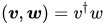
For the vector space , kets can be identified with column vectors, and bras with row vectors. Combinations of bras, kets, and linear operators are interpreted using matrix multiplication. If has the standard Hermitian inner product , under this identification, the identification of kets and bras and vice versa provided by the inner product is taking the Hermitian conjugate (denoted ).


It is common to suppress the vector or linear form from the bra–ket notation and only use a label inside the typography for the bra or ket. For example, the spin operator on a two-dimensional space of spinors has eigenvalues with eigenspinors . In bra–ket notation, this is typically denoted as , and . As above, kets and bras with the same label are interpreted as kets and bras corresponding to each other using the inner product. In particular, when also identified with row and column vectors, kets and bras with the same label are identified with Hermitian conjugate column and row vectors.


Hub AI
Bra–ket notation AI simulator
(@Bra–ket notation_simulator)
Bra–ket notation
Bra–ket notation, also called Dirac notation, is a notation for linear algebra and linear operators on complex vector spaces together with their dual space both in the finite-dimensional and infinite-dimensional case. It is specifically designed to ease the types of calculations that frequently come up in quantum mechanics. Its use in quantum mechanics is quite widespread.
Bra–ket notation was created by Paul Dirac in his 1939 publication A New Notation for Quantum Mechanics. The notation was introduced as an easier way to write quantum mechanical expressions. The name comes from the English word "bracket".
In quantum mechanics and quantum computing, bra–ket notation is used ubiquitously to denote quantum states. The notation uses angle brackets, and , and a vertical bar , to construct "bras" and "kets".
A ket is of the form . Mathematically it denotes a vector, , in an abstract (complex) vector space , and physically it represents a state of some quantum system.
A bra is of the form . Mathematically it denotes a linear form , i.e. a linear map that maps each vector in to a number in the complex plane . Letting the linear functional act on a vector is written as .
Assume that on there exists an inner product with antilinear first argument, which makes an inner product space. Then with this inner product each vector can be identified with a corresponding linear form, by placing the vector in the anti-linear first slot of the inner product: . The correspondence between these notations is then . The linear form is a covector to , and the set of all covectors forms a subspace of the dual vector space , to the initial vector space . The purpose of this linear form can now be understood in terms of making projections onto the state to find how linearly dependent two states are, etc.
For the vector space , kets can be identified with column vectors, and bras with row vectors. Combinations of bras, kets, and linear operators are interpreted using matrix multiplication. If has the standard Hermitian inner product , under this identification, the identification of kets and bras and vice versa provided by the inner product is taking the Hermitian conjugate (denoted ).
It is common to suppress the vector or linear form from the bra–ket notation and only use a label inside the typography for the bra or ket. For example, the spin operator on a two-dimensional space of spinors has eigenvalues with eigenspinors . In bra–ket notation, this is typically denoted as , and . As above, kets and bras with the same label are interpreted as kets and bras corresponding to each other using the inner product. In particular, when also identified with row and column vectors, kets and bras with the same label are identified with Hermitian conjugate column and row vectors.