



Community hub
Recent from talks
Contribute something
Nothing was collected or created yet.
Bracket
View on Wikipedia | This article needs additional citations for verification. (March 2022) |
| () | [] |
|---|---|
| brackets (BrE) | square brackets (BrE) |
| round brackets (BrE) | brackets (AmE) |
| parentheses (AmE) | |
| {} | ⟨⟩ |
| braces | angle brackets |
| curly braces | chevrons |
| curly brackets (BrE) |
A bracket is either of two tall fore- or back-facing punctuation marks commonly used to isolate a segment of text or data from its surroundings.[1] They come in four main pairs of shapes, as given in the box to the right, which also gives their names, that vary between British and American English.[2] "Brackets", without further qualification, are in British English the (...) marks and in American English the [...] marks.[2][1]
Other symbols are repurposed as brackets in specialist contexts, such as those used by linguists.[3]
Brackets are typically deployed in symmetric pairs, and an individual bracket may be identified as a "left" or "right" bracket or, alternatively, an "opening bracket" or "closing bracket",[4] respectively, depending on the directionality of the context.
In casual writing and in technical fields such as computing or linguistic analysis of grammar, brackets nest, with segments of bracketed material containing embedded within them other further bracketed sub-segments.[1] The number of opening brackets matches the number of closing brackets in such cases.[1]
Various forms of brackets are used in mathematics, with specific mathematical meanings, often for denoting specific mathematical functions and subformulas.
History
[edit]Angle brackets or chevrons ⟨ ⟩ were the earliest type of bracket to appear in written English. Erasmus coined the term lunula to refer to the round brackets or parentheses ( ) recalling the shape of the crescent moon (Latin: luna).[5]
Most typewriters only had the left and right parentheses. Square brackets appeared with some teleprinters.
Braces (curly brackets) first became part of a character set with the 8-bit code of the IBM 7030 Stretch.[6]
In 1961, ASCII contained parentheses, square, and curly brackets, and also less-than and greater-than signs that could be used as angle brackets.
Typography
[edit]In English, typographers mostly prefer not to set brackets in italics, even when the enclosed text is italic.[7] However, in other languages like German, if brackets enclose text in italics, they are usually also set in italics.[8]
Parentheses or round brackets
[edit] | This section possibly contains original research. (March 2022) |
Parenthesis | |
|---|---|
| In Unicode | |
Phonetic punctuation[18]
|

The marks ( and ) are parentheses /pəˈrɛnθɪsiːz/ (singular parenthesis /pəˈrɛnθɪsɪs/) in American English, and either round brackets or simply brackets in British English.[2][3]
In formal writing, "parentheses" is also used in British English.[20]
Uses of ( )
[edit]Parentheses contain adjunctive material that serves to clarify (in the manner of a gloss) or is aside from the main point.[21]
A comma before or after the material can also be used, though if the sentence contains commas for other purposes, visual confusion may result. A dash before and after the material is also sometimes used.
Parentheses may be used in formal writing to add supplementary information, such as "Senator John McCain (R - Arizona) spoke at length". They can also indicate shorthand for "either singular or plural" for nouns, e.g. "the claim(s)". It can also be used for gender-neutral language, especially in languages with grammatical gender, e.g. "(s)he agreed with his/her physician" (the slash in the second instance, as one alternative is replacing the other, not adding to it).
Parenthetical phrases have been used extensively in informal writing and stream of consciousness literature. Examples include the southern American author William Faulkner (see Absalom, Absalom! and the Quentin section of The Sound and the Fury) as well as poet E. E. Cummings.
Parentheses have historically been used where the em dash is currently used in alternatives, such as "parenthesis)(parentheses". Examples of this usage can be seen in editions of Fowler's Dictionary of Modern English Usage.
Parentheses may be nested (generally with one set (such as this) inside another set). This is not commonly used in formal writing (though sometimes other brackets [especially square brackets] will be used for one or more inner set of parentheses [in other words, secondary {or even tertiary} phrases can be found within the main parenthetical sentence]).
Language
[edit]A parenthesis in rhetoric and linguistics refers to the entire bracketed text, not just to the enclosing marks used (so all the text in this set of round brackets may be described as "a parenthesis").[22] Taking as an example the sentence "Mrs. Pennyfarthing (What? Yes, that was her name!) was my landlady.", the explanatory phrase between the parentheses is itself called a parenthesis. Again, the parenthesis implies that the meaning and flow of the bracketed phrase is supplemental to the rest of the text and the whole would be unchanged were the parenthesised sentences removed. The term refers to the syntax rather than the enclosure method: the same clause in the form "Mrs. Pennyfarthing – What? Yes, that was her name! – was my landlady" is also a parenthesis.[23] (In non-specialist usage, the term "parenthetical phrase" is more widely understood.[24])
In phonetics, parentheses are used for indistinguishable[25] or unidentified utterances. They are also seen for silent articulation (mouthing),[26] where the expected phonetic transcription is derived from lip-reading, and with periods to indicate silent pauses, for example (...) or (2 sec).
In some languages, such as the Nicodemus orthography for Coeur d’Alene, parentheses are used as phonemic symbols instead of punctuation.
Enumerations
[edit]An unpaired right parenthesis is often used as part of a label in an ordered list, such as this one:
a) educational testing,
b) technical writing and diagrams,
c) market research, and
d) elections.
Accounting
[edit]Traditionally in accounting, contra amounts are placed in parentheses. A debit balance account in a series of credit balances will have parentheses and vice versa.
Parentheses in mathematics
[edit]Parentheses are used in mathematical notation to indicate grouping, often inducing a different order of operations. For example: in the usual order of algebraic operations, 4 × 3 + 2 equals 14, since the multiplication is done before the addition. However, 4 × (3 + 2) equals 20, because the parentheses override normal precedence, causing the addition to be done first. Some authors follow the convention in mathematical equations that, when parentheses have one level of nesting, the inner pair are parentheses and the outer pair are square brackets. Example:
![{\displaystyle [4\times (3+2)]^{2}=400.}](https://wikimedia.org/api/rest_v1/media/math/render/svg/741361d84161ff52db06b8d548c55162f3b4ff1f)
Parentheses in programming languages
[edit]Parentheses are included in the syntaxes of many programming languages. Typically needed to denote an argument; to tell the compiler what data type the method/function needs to look for first in order to initialise. In some cases, such as in LISP, parentheses are a fundamental construct of the language. They are also often used for scoping functions and operators and for arrays. In syntax diagrams they are used for grouping, such as in extended Backus–Naur form.
In Mathematica and the Wolfram language, parentheses are used to indicate grouping – for example, with pure anonymous functions.
Taxonomy
[edit]If it is desired to include the subgenus when giving the scientific name of an animal species or subspecies, the subgenus's name is provided in parentheses between the genus name and the specific epithet.[27] For instance, Polyphylla (Xerasiobia) alba is a way to cite the species Polyphylla alba while also mentioning that it is in the subgenus Xerasiobia.[28] There is also a convention of citing a subgenus by enclosing it in parentheses after its genus, e.g., Polyphylla (Xerasiobia) is a way to refer to the subgenus Xerasiobia within the genus Polyphylla.[29] Parentheses are similarly used to cite a subgenus with the name of a prokaryotic species, although the International Code of Nomenclature of Prokaryotes (ICNP) requires the use of the abbreviation "subgen". as well, e.g., Acetobacter (subgen. Gluconoacetobacter) liquefaciens.[30]
Chemistry
[edit]Parentheses are used in chemistry to denote a repeated substructure within a molecule, e.g. HC(CH3)3 (isobutane) or, similarly, to indicate the stoichiometry of ionic compounds with such substructures: e.g. Ca(NO3)2 (calcium nitrate).
This is a notation that was pioneered by Berzelius, who wanted chemical formulae to more resemble algebraic notation, with brackets enclosing groups that could be multiplied (e.g. in 3(AlO2 + 2SO3) the 3 multiplies everything within the parentheses).[31][32]
In chemical nomenclature, parentheses are used to distinguish structural features and multipliers for clarity, for example in the polymer poly(methyl methacrylate).[33]
Square brackets
[edit]Square brackets | |||
|---|---|---|---|
| |||
| In Unicode | |||
Phonetic punctuation[18]
Quotation (East-Asian texts)[34]
| |||
[ and ] are square brackets in both British and American English, but are also more simply brackets in the latter.[2][1] An older name for these brackets is "crotchets".[35]
Uses of [ ]
[edit]Square brackets are often used to insert explanatory material or to mark where a [word or] passage was omitted from an original material by someone other than the original author, or to mark modifications in quotations.[36] In transcribed interviews, sounds, responses and reactions that are not words but that can be described are set off in square brackets — "... [laughs] ...".
When quoted material is in any way altered, the alterations are enclosed in square brackets within the quotation to show that the quotation is not exactly as given, or to add an annotation.[37] For example: The Plaintiff asserted his cause is just, stating,
[m]y causes is [sic] just.
In the original quoted sentence, the word "my" was capitalised: it has been modified in the quotation given and the change signalled with brackets. Similarly, where the quotation contained a grammatical error (is/are), the quoting author signalled that the error was in the original with "[sic]" (Latin for 'thus').
A bracketed ellipsis, [...], is often used to indicate omitted material: "I'd like to thank [several unimportant people] for their tolerance [...]"[38] Bracketed comments inserted into a quote indicate where the original has been modified for clarity: "I appreciate it [the honor], but I must refuse", and "the future of psionics [see definition] is in doubt". Or one can quote the original statement "I hate to do laundry" with a (sometimes grammatical) modification inserted: He "hate[s] to do laundry".
Additionally, a small letter can be replaced by a capital one, when the beginning of the original printed text is being quoted in another piece of text or when the original text has been omitted for succinctness— for example, when referring to a verbose original: "To the extent that policymakers and elite opinion in general have made use of economic analysis at all, they have, as the saying goes, done so the way a drunkard uses a lamppost: for support, not illumination", can be quoted succinctly as: "[P]olicymakers [...] have made use of economic analysis [...] the way a drunkard uses a lamppost: for support, not illumination." When nested parentheses are needed, brackets are sometimes used as a substitute for the inner pair of parentheses within the outer pair.[39] When deeper levels of nesting are needed, convention is to alternate between parentheses and brackets at each level.
Alternatively, empty square brackets can also indicate omitted material, usually single letter only. The original, "Reading is also a process and it also changes you." can be rewritten in a quote as: It has been suggested that reading can "also change[] you".[40]
In translated works, brackets are used to signify the same word or phrase in the original language to avoid ambiguity.[41] For example: He is trained in the way of the open hand [karate].
Style and usage guides originating in the news industry of the twentieth century, such as the AP Stylebook, recommend against the use of square brackets because "They cannot be transmitted over news wires."[42] However, this guidance has little relevance outside of the technological constraints of the industry and era.
In linguistics, phonetic transcriptions are generally enclosed within square brackets,[43] whereas phonemic transcriptions typically use paired slashes, according to International Phonetic Alphabet rules. Pipes (| |) are often used to indicate a morphophonemic rather than phonemic representation. Other conventions are double slashes (⫽ ⫽), double pipes (‖ ‖) and curly brackets ({ }).
In lexicography, square brackets usually surround the section of a dictionary entry which contains the etymology of the word the entry defines.
Proofreading
[edit]Brackets (called move-left symbols or move right symbols) are added to the sides of text in proofreading to indicate changes in indentation:
| Move left | [To Fate I sue, of other means bereft, the only refuge for the wretched left. |
|---|---|
| Centre | ]Paradise Lost[ |
| Move up | 
|
Square brackets are used to denote parts of the text that need to be checked when preparing drafts prior to finalising a document.
Law
[edit]Square brackets are used in some countries in the citation of law reports to identify parallel citations to non-official reporters. For example:
Chronicle Pub. Co. v Superior Court (1998) 54 Cal.2d 548, [7 Cal.Rptr. 109]
In some other countries (such as England and Wales), square brackets are used to indicate that the year is part of the citation and parentheses are used to indicate the year the judgment was given. For example:
National Coal Board v England [1954] AC 403
This case is in the 1954 volume of the Appeal Cases reports, although the decision may have been given in 1953 or earlier. Compare with:
(1954) 98 Sol Jo 176
This citation reports a decision from 1954, in volume 98 of the Solicitors Journal which may be published in 1955 or later.
They often denote points that have not yet been agreed to in legal drafts and the year in which a report was made for certain case law decisions.
Square brackets in mathematics
[edit]Brackets are used in mathematics in a variety of notations, including standard notations for commutators, the floor function, the Lie bracket, equivalence classes, the Iverson bracket, and matrices.
Square brackets may be used exclusively or in combination with parentheses to represent intervals as interval notation.[44] For example, [0,5] represents the set of real numbers from 0 to 5 inclusive. Both parentheses and brackets are used to denote a half-open interval; [5, 12) would be the set of all real numbers between 5 and 12, including 5 but not 12. The numbers may come as close as they like to 12, including 11.999 and so forth, but 12.0 is not included. In some European countries, the notation [5, 12[ is also used.[45][46] The endpoint adjoining the square bracket is known as closed, whereas the endpoint adjoining the parenthesis is known as open.[44]
In group theory and ring theory, brackets denote the commutator. In group theory, the commutator [g, h] is commonly defined as g −1 h −1 g h . In ring theory, the commutator [a, b] is defined as a b − b a .
Chemistry
[edit]Square brackets can also be used in chemistry to represent the concentration of a chemical substance in solution and to denote charge a Lewis structure of an ion (particularly distributed charge in a complex ion), repeating chemical units (particularly in polymers) and transition state structures, among other uses.
Square brackets in programming languages
[edit]Brackets are used in many computer programming languages, primarily for array indexing. But they are also used to denote general tuples, sets and other structures, just as in mathematics. There may be several other uses as well, depending on the language at hand. In syntax diagrams they are used for optional portions, such as in extended Backus–Naur form.
Double brackets ⟦ ⟧
[edit]Double brackets (or white square brackets or Scott brackets), ⟦ ⟧, are used to indicate the semantic evaluation function in formal semantics for natural language and denotational semantics for programming languages.[47][48] In the Wolfram Language, double brackets, either as iterated single brackets ([[) or ligatures (〚) are used for list indexing.[49]
The brackets stand for a function that maps a linguistic expression to its "denotation" or semantic value. In mathematics, double brackets may also be used to denote intervals of integers or, less often, the floor function. In papyrology, following the Leiden Conventions, they are used to enclose text that has been deleted in antiquity.[50]
Lenticular brackets【】
[edit]Some East Asian languages use lenticular brackets 【 】, a combination of square brackets and round brackets called 方頭括號 (fāngtóu kuòhào) in Chinese and 隅付き括弧 (sumitsuki kakko) in Japanese. They are used in titles and headings in both Chinese[51] and Japanese. On the Internet, they are used to emphasise a text. In Japanese, they are most frequently seen in dictionaries for quoting Chinese characters and Sino-Japanese loanwords.
Floor ⌊ ⌋ and ceiling ⌈ ⌉ corner brackets
[edit]Floor and ceiling | |||||
|---|---|---|---|---|---|
| |||||
| In Unicode | |||||
| |||||
The floor corner brackets ⌊ and ⌋, the ceiling corner brackets ⌈ and ⌉ (U+2308, U+2309) are used to denote the integer floor and ceiling functions.
Quine corners ⌜⌝ and half brackets ⸤ ⸥ or ⸢ ⸣
[edit]The Quine corners ⌜ and ⌝ have at least two uses in mathematical logic: either as quasi-quotation, a generalisation of quotation marks, or to denote the Gödel number of the enclosed expression.
Half brackets are used in English to mark added text, such as in translations: "Bill saw ⸤her⸥".
In editions of papyrological texts, half brackets, ⸤ and ⸥ or ⸢ and ⸣, enclose text which is lacking in the papyrus due to damage, but can be restored by virtue of another source, such as an ancient quotation of the text transmitted by the papyrus.[52] For example, Callimachus Iambus 1.2 reads: ἐκ τῶν ὅκου βοῦν κολλύ⸤βου π⸥ιπρήσκουσιν. A hole in the papyrus has obliterated βου π, but these letters are supplied by an ancient commentary on the poem. Second intermittent sources can be between ⸢ and ⸣. Quine corners are sometimes used instead of half brackets.[14]
Brackets with quills ⁅ ⁆
[edit]Known as "spike parentheses" (Swedish: piggparenteser), ⁅ and ⁆ are used in Swedish bilingual dictionaries to enclose supplemental constructions.[53]
Curly brackets
[edit]Curly brackets | |||
|---|---|---|---|
| |||
| In Unicode | |||
| |||
{ and } are curly brackets or braces in both American and British English.[2][1]
Uses of { }
[edit]
Curly brackets are used by text editors to mark editorial insertions[54] or interpolations.[55]
Braces used to be used to connect multiple lines of poetry, such as triplets in a poem of rhyming couplets,[56] although this usage had gone out of fashion by the 19th century.[57][58]
Another older use in prose was to eliminate duplication in lists and tables.[58] Two examples here from Charles Hutton's 19th century table of weights and measures in his A Course of Mathematics:
In this kingdom[59] The standard of ... ⎧ ⎪ ⎨ ⎪ ⎩
Length is a Yard. Surface is a Square Yard, the 1⁄4840 of an Acre. ⎰ Solidity is a Cubic Yard. ⎱ Capacity is a Gallon. Weight is a Pound.
Imperial measure of CAPACITY for coals, culm, lime, fish, potatoes, fruit,– and other goods commonly sold by heaped measure:[60] 2 Gallons = 1 Peck = 764 ⎱ Cubic Inches, nearly 8 Gallons = 1 Bushel = 2813+1⁄2 ⎰ 3 Bushels = 1 Sack = 4+8⁄9 ⎱ Cubic Feet, nearly 12 Sacks = 1 Chald. = 58+2⁄3 ⎰
As an extension to the International Phonetic Alphabet (IPA), braces are used for prosodic notation.
Music
[edit]In music, they are known as "accolades" or "braces", and connect two or more lines (staves) of music that are played simultaneously.[61]
Chemistry
[edit]The use of braces in chemistry is an old notation that has long since been superseded by subscripted numbers.[31] The chemical formula for water, H2O, was represented as .[31]

Curly brackets in programming languages
[edit]In many programming languages, curly brackets enclose groups of statements and create a local scope. Such languages (C, C#, C++ and many others) are therefore called curly bracket languages.[62] They are also used to define structures and enumerated type in these languages.
In various Unix shells, they enclose a group of strings that are used in a process known as brace expansion, where each successive string in the group is interpolated at that point in the command line to generate the command-line's final form.[63] The mechanism originated in the C shell and the string generation mechanism is a simple interpolation that can occur anywhere in a command line and takes no account of existing filenames.[64]
In syntax diagrams they are used for repetition, such as in extended Backus–Naur form.
In the Z formal specification language, braces define a set.
Curly brackets in mathematics
[edit]In mathematics they delimit sets, in what is called set notation.[65] Braces enclose either a literal list of set elements, or a rule that defines the set elements.[65] For example:
- S = {a, b} defines a set S containing a and b.[65]
- S = {x | x > 0} defines a set S containing elements (implied to be numbers) x0, x1, and so on where every xn satisfies the rule that it is greater than zero.[65]
They are often also used to denote the Poisson bracket between two quantities.
In ring theory, braces denote the anticommutator where {a, b} is defined as a b + b a .
Angle brackets
[edit] | This section needs additional citations for verification. (November 2012) |
Angle brackets | |
|---|---|
| In Unicode | |
Quotation (fullwidth East-Asian texts)[34]
|
The symbols ⟨ and ⟩ are angle brackets in both American and British English.[2][1] In (largely archaic) computer slang, they were sometimes known as "brokets".[66]
The ASCII characters less-than sign and greater-than sign < and > are widely substituted for angle brackets. In many cases, only these substituted characters are accepted by computer programs, and the Unicode angle brackets are not recognised (for instance, in HTML tags). The characters for "single" guillemets (‹ and ›) (single european style quote marks) are also occasionally used to indicate angle brackets, and normal guillemets (« and ») (double european style quote marks) used when 'nested' (ie, double) angle brackets are needed.
The angle brackets U+27E8 ⟨ MATHEMATICAL LEFT ANGLE BRACKET and U+27E9 ⟩ MATHEMATICAL RIGHT ANGLE BRACKET are for mathematical use and Western languages, whereas U+3008 〈 LEFT ANGLE BRACKET and U+3009 〉 RIGHT ANGLE BRACKET are double width forms for East Asian languages. The angle bracket symbols at U+2329 and U+232A are deprecated in favour of the U+3008 and U+3009 East Asian angle brackets. Unicode discourages their use for mathematics and in Western texts,[14] because they are canonically equivalent to the CJK code points U+300n and thus likely to render as double-width symbols.
(The word chevron is sometimes used for 'angle bracket', but chevrons are normally oriented horizontally rather than vertically.)
- ^ a b c d ⟨ and ⟩ were tied to the deprecated symbols U+2329 and U+232A in HTML4 and MathML2, but are being migrated to U+27E8 and U+27E9 for HTML5 and MathML3, as defined in XML Entity Definitions for Characters (Archived 27 January 2013 at the Wayback Machine).
Shape
[edit]Angle brackets are larger than 'less-than' and 'greater-than' signs, which in turn are larger than guillemets.

Uses of ⟨ ⟩
[edit]Angle brackets are infrequently used to denote words that are thought instead of spoken, such as:
- ⟨What an unusual flower!⟩
In textual criticism, and hence in many editions of pre-modern works, chevrons denote sections of the text which are illegible or otherwise lost; the editor will often insert their own reconstruction where possible within them.[67]
In linguistics, angle brackets identify graphemes (e.g., letters of an alphabet) or orthography, as in "The English word /kæt/ is spelled ⟨cat⟩."[68][69][67]
In epigraphy, they may be used for mechanical transliterations of a text into the Latin script.[69]
In East Asian punctuation, angle brackets are used as quotation marks. Angle bracket symbols are part of standard Chinese, Japanese, Korean punctuation, where they generally enclose the titles of books, as: 〈 ︙ 〉 or 《 ︙ 》 for traditional vertical printing — written in vertical lines — and as 〈 ... 〉 or 《 ... 》 for horizontal printing — in horizontal.
Angle brackets in mathematics
[edit]Angle brackets (or 'chevrons') are used in group theory to write group presentations, and to denote the subgroup generated by a collection of elements. In set theory, chevrons or parentheses are used to denote ordered pairs[70] and other tuples, whereas curly brackets are used for unordered sets.
Physics and mechanics
[edit]In physical sciences and statistical mechanics, angle brackets are used to denote an average (expected value) over time or over another continuous parameter. For example:
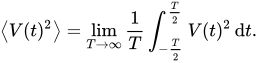
In mathematical physics, especially quantum mechanics, it is common to write the inner product between elements as ⟨a|b⟩, as a short version of ⟨a|·|b⟩, or ⟨a|Ô|b⟩, where Ô is an operator. This is known as Dirac notation or bra–ket notation, to note vectors from the dual spaces of the Bra ⟨A| and the Ket |B⟩. But there are other notations used.
In continuum mechanics, chevrons may be used as Macaulay brackets.
Angle brackets in programming languages
[edit]In C++ angle brackets (actually less-than and greater-than) are used to surround arguments to templates. They are also used to surround the names of header files; this usage was inherited from and is also found in C.
In the Z formal specification language, angle brackets define a sequence.
In HTML, angle brackets (actually 'greater than' and 'less than' symbols) are used to bracket meta text. For example <b> denotes that the following text should be displayed as bold. Pairs of meta text tags are required – much as brackets themselves are usually in pairs. The end of the bold text segment would be indicated by </b>. This use is sometimes extended as an informal mechanism for communicating mood or tone in digital formats such as messaging, for example adding "<sighs>" at the end of a sentence.
Unicode
[edit]Representations of various kinds of brackets in Unicode and their respective HTML entities, that are not in the infoboxes in preceding sections, are given below.
| Uses | Unicode/HTML | Sample |
|---|---|---|
| Quine corners[14] | U+231C ⌜ TOP LEFT CORNER (⌜, ⌜) | ⌜quasi-quotation⌝ ⌜editorial notation⌝ |
| U+231D ⌝ TOP RIGHT CORNER (⌝, ⌝) | ||
| U+231E ⌞ BOTTOM LEFT CORNER (⌞, ⌞) | ⌞editorial notation⌟ | |
| U+231F ⌟ BOTTOM RIGHT CORNER (⌟, ⌟) | ||
| Brackets with quill | U+2046 ⁆ RIGHT SQUARE BRACKET WITH QUILL | ⁅...⁆ |
| U+2045 ⁅ LEFT SQUARE BRACKET WITH QUILL | ||
| Fullwidth parentheses[10] | U+FF5F ⦅ FULLWIDTH LEFT WHITE PARENTHESIS | ⦅...⦆ |
| U+FF60 ⦆ FULLWIDTH RIGHT WHITE PARENTHESIS | ||
| Technical/mathematical (specialised)[14][15][16][17] |
U+23B8 ⎸ LEFT VERTICAL BOX LINE | ⎸boxed text⎹ |
| U+23B9 ⎹ RIGHT VERTICAL BOX LINE | ||
| U+23E0 ⏠ TOP TORTOISE SHELL BRACKET |
⏠ | |
| U+23E1 ⏡ BOTTOM TORTOISE SHELL BRACKET | ||
| U+27C5 ⟅ LEFT S-SHAPED BAG DELIMITER | ⟅...⟆ | |
| U+27C6 ⟆ RIGHT S-SHAPED BAG DELIMITER | ||
| U+27D3 ⟓ LOWER RIGHT CORNER WITH DOT | ⟓pullback...pushout⟔ | |
| U+27D4 ⟔ UPPER LEFT CORNER WITH DOT | ||
| U+27E6 ⟦ MATHEMATICAL LEFT WHITE SQUARE BRACKET | ⟦...⟧ | |
| U+27E7 ⟧ MATHEMATICAL RIGHT WHITE SQUARE BRACKET | ||
| U+27EC ⟬ MATHEMATICAL LEFT WHITE TORTOISE SHELL BRACKET (⟬) | ⟬white tortoise shell brackets⟭ | |
| U+27ED ⟭ MATHEMATICAL RIGHT WHITE TORTOISE SHELL BRACKET (⟭) | ||
| U+2987 ⦇ Z NOTATION LEFT IMAGE BRACKET | R⦇S⦈ | |
| U+2988 ⦈ Z NOTATION RIGHT IMAGE BRACKET | ||
| U+2989 ⦉ Z NOTATION LEFT BINDING BRACKET | ⦉x:Z⦊ | |
| U+298A ⦊ Z NOTATION RIGHT BINDING BRACKET | ||
| U+2993 ⦓ LEFT ARC LESS-THAN BRACKET (⦓) | ⦓inequality sign brackets⦔ | |
| U+2994 ⦔ RIGHT ARC GREATER-THAN BRACKET (⦔) | ||
| U+2995 ⦕ DOUBLE LEFT ARC GREATER-THAN BRACKET (⦕) | ⦕inequality sign brackets⦖ | |
| U+2996 ⦖ DOUBLE RIGHT ARC LESS-THAN BRACKET (⦖) | ||
| U+2997 ⦗ LEFT BLACK TORTOISE SHELL BRACKET | ⦗black tortoise shell brackets⦘ | |
| U+2998 ⦘ RIGHT BLACK TORTOISE SHELL BRACKET | ||
| U+29D8 ⧘ LEFT WIGGLY FENCE | ⧘...⧙ | |
| U+29D9 ⧙ RIGHT WIGGLY FENCE | ||
| U+29DA ⧚ LEFT DOUBLE WIGGLY FENCE | ⧚...⧛ | |
| U+29DB ⧛ RIGHT DOUBLE WIGGLY FENCE | ||
| U+301A 〚 LEFT WHITE SQUARE BRACKET | 〚...〛 | |
| U+301B 〛 RIGHT WHITE SQUARE BRACKET | ||
| Half brackets[13] | U+2E22 ⸢ TOP LEFT HALF BRACKET | ⸢editorial notation⸣ |
| U+2E23 ⸣ TOP RIGHT HALF BRACKET | ||
| U+2E24 ⸤ BOTTOM LEFT HALF BRACKET | ⸤editorial notation⸥ | |
| U+2E25 ⸥ BOTTOM RIGHT HALF BRACKET | ||
| Compatibility variants for CNS 11643[71] | U+FE59 ﹙ SMALL LEFT PARENTHESIS | ﹙...﹚ |
| U+FE5A ﹚ SMALL RIGHT PARENTHESIS | ||
| U+FE5B ﹛ SMALL LEFT CURLY BRACKET | ﹛...﹜ | |
| U+FE5C ﹜ SMALL RIGHT CURLY BRACKET | ||
| U+FE5D ﹝ SMALL LEFT TORTOISE SHELL BRACKET | ﹝...﹞ | |
| U+FE5E ﹞ SMALL RIGHT TORTOISE SHELL BRACKET | ||
| Dingbats[19] | U+2772 ❲ LIGHT LEFT TORTOISE SHELL BRACKET ORNAMENT (❲) | ❲light tortoise shell bracket ornament❳ |
| U+2773 ❳ LIGHT RIGHT TORTOISE SHELL BRACKET ORNAMENT (❳) | ||
| N'Ko[13] | U+2E1C ⸜ LEFT LOW PARAPHRASE BRACKET | ⸜ߒߞߏ⸝ |
| U+2E1D ⸝ RIGHT LOW PARAPHRASE BRACKET | ||
| Ogham[72] | U+169B ᚛ OGHAM FEATHER MARK | ᚛ᚑᚌᚐᚋ᚜ |
| U+169C ᚜ OGHAM REVERSED FEATHER MARK | ||
| Old Hungarian | U+2E42 ⹂ DOUBLE LOW-REVERSED-9 QUOTATION MARK | ⹂ |
| Tibetan[73] | U+0F3A ༺ TIBETAN MARK GUG RTAGS GYON | ༺དབུ་ཅན་༻ |
| U+0F3B ༻ TIBETAN MARK GUG RTAGS GYAS | ||
| U+0F3C ༼ TIBETAN MARK ANG KHANG GYON | ༼༡༢༣༽ | |
| U+0F3D ༽ TIBETAN MARK ANG KHANG GYAS | ||
| New Testament editorial marks[13] | U+2E02 ⸂ LEFT SUBSTITUTION BRACKET | ⸂...⸃ |
| U+2E03 ⸃ RIGHT SUBSTITUTION BRACKET | ||
| U+2E04 ⸄ LEFT DOTTED SUBSTITUTION BRACKET | ⸄...⸅ | |
| U+2E05 ⸅ RIGHT DOTTED SUBSTITUTION BRACKET | ||
| U+2E09 ⸉ LEFT TRANSPOSITION BRACKET | ⸉...⸊ | |
| U+2E0A ⸊ RIGHT TRANSPOSITION BRACKET | ||
| U+2E0C ⸌ LEFT RAISED OMISSION BRACKET | ⸌...⸍ | |
| U+2E0D ⸍ RIGHT RAISED OMISSION BRACKET | ||
| Medieval studies[12][13] | U+2E26 ⸦ LEFT SIDEWAYS U BRACKET | ⸦crux⸧ |
| U+2E27 ⸧ RIGHT SIDEWAYS U BRACKET | ||
| Indicate ellipsis in certain conventions for
Japanese transliteration[13] |
U+2E55 ⹕ LEFT SQUARE BRACKET WITH STROKE | ⹕optional ellipsis⹖ |
| U+2E56 ⹖ RIGHT SQUARE BRACKET WITH STROKE | ||
| U+2E57 ⹗ LEFT SQUARE BRACKET WITH DOUBLE STROKE | ⹗obligatory ellipsis⹘ | |
| U+2E58 ⹘ RIGHT SQUARE BRACKET WITH DOUBLE STROKE | ||
| Quotation (East-Asian texts)[34] |
U+3014 〔 LEFT TORTOISE SHELL BRACKET | 〔...〕 |
| U+3015 〕 RIGHT TORTOISE SHELL BRACKET | ||
| U+3016 〖 LEFT WHITE LENTICULAR BRACKET | 〖...〗 | |
| U+3017 〗 RIGHT WHITE LENTICULAR BRACKET | ||
| U+3018 〘 LEFT WHITE TORTOISE SHELL BRACKET | 〘...〙 | |
| U+3019 〙 RIGHT WHITE TORTOISE SHELL BRACKET | ||
| U+301D 〝 REVERSED DOUBLE PRIME QUOTATION MARK | 〝...〞 | |
| U+301E 〞 DOUBLE PRIME QUOTATION MARK[a] | ||
| Quotation (halfwidth East-Asian texts)[14][10] |
U+FF62 「 HALFWIDTH LEFT CORNER BRACKET | 「カタカナ」 |
| U+FF63 」 HALFWIDTH RIGHT CORNER BRACKET | ||
| Quotation (fullwidth East-Asian texts)[34] |
U+300C 「 LEFT CORNER BRACKET | 「表題」 |
| U+300D 」 RIGHT CORNER BRACKET | ||
| U+300E 『 LEFT WHITE CORNER BRACKET | 『表題』 | |
| U+300F 』 RIGHT WHITE CORNER BRACKET | ||
| U+3010 【 LEFT BLACK LENTICULAR BRACKET | 【表題】 | |
| U+3011 】 RIGHT BLACK LENTICULAR BRACKET | ||
| Vertical bracket presentation forms[74][75][b] | U+FE17 ︗ PRESENTATION FORM FOR VERTICAL LEFT WHITE LENTICULAR BRACKET | ︗︙︙︘ |
| U+FE18 ︘ PRESENTATION FORM FOR VERTICAL RIGHT WHITE LENTICULAR BRACKET[c] | ||
| U+FE35 ︵ PRESENTATION FORM FOR VERTICAL LEFT PARENTHESIS | ︵︙︙︶ | |
| U+FE36 ︶ PRESENTATION FORM FOR VERTICAL RIGHT PARENTHESIS | ||
| U+FE37 ︷ PRESENTATION FORM FOR VERTICAL LEFT CURLY BRACKET | ︷︙︙︸ | |
| U+FE38 ︸ PRESENTATION FORM FOR VERTICAL RIGHT CURLY BRACKET | ||
| U+FE39 ︹ PRESENTATION FORM FOR VERTICAL LEFT TORTOISE SHELL BRACKET | ︹︙︙︺ | |
| U+FE3A ︺ PRESENTATION FORM FOR VERTICAL RIGHT TORTOISE SHELL BRACKET | ||
| U+FE3B ︻ PRESENTATION FORM FOR VERTICAL LEFT BLACK LENTICULAR BRACKET | ︻︙︙︼ | |
| U+FE3C ︼ PRESENTATION FORM FOR VERTICAL RIGHT BLACK LENTICULAR BRACKET | ||
| U+FE3D ︽ PRESENTATION FORM FOR VERTICAL LEFT DOUBLE ANGLE BRACKET | ︽︙︙︾ | |
| U+FE3E ︾ PRESENTATION FORM FOR VERTICAL RIGHT DOUBLE ANGLE BRACKET | ||
| U+FE3F ︿ PRESENTATION FORM FOR VERTICAL LEFT ANGLE BRACKET | ︿︙︙﹀ | |
| U+FE40 ﹀ PRESENTATION FORM FOR VERTICAL RIGHT ANGLE BRACKET | ||
| U+FE41 ﹁ PRESENTATION FORM FOR VERTICAL LEFT CORNER BRACKET | ﹁︙︙﹂ | |
| U+FE42 ﹂ PRESENTATION FORM FOR VERTICAL RIGHT CORNER BRACKET | ||
| U+FE43 ﹃ PRESENTATION FORM FOR VERTICAL LEFT WHITE CORNER BRACKET | ﹃︙︙﹄ | |
| U+FE44 ﹄ PRESENTATION FORM FOR VERTICAL RIGHT WHITE CORNER BRACKET | ||
| U+FE47 ﹇ PRESENTATION FORM FOR VERTICAL LEFT SQUARE BRACKET | ﹇︙︙﹈ | |
| U+FE48 ﹈ PRESENTATION FORM FOR VERTICAL RIGHT SQUARE BRACKET |
- ^ This is fullwidth version of U+2033 ″ DOUBLE PRIME. In vertical texts, U+301F 〟 LOW DOUBLE PRIME QUOTATION MARK is preferred.
- ^ These characters are not used in typical documents. Instead the respective horizontal characters are used and the character that is rendered depends on the writing direction.
- ^ The original name of this character is "Presentation Form For Vertical Right White Lenticular Brakcet [sic]". Since Unicode character names cannot be changed, this character has the corrected name as an alias.
See also
[edit]References
[edit]- ^ a b c d e f g McArthur & McArthur 2005.
- ^ a b c d e f g h i Pointon & Clark 2014, p. 406.
- ^ a b Peters 2007, p. 101.
- ^ "Unicode Bidirectional Algorithm". Unicode Technical Reports. Unicode Consortium. § 3.1.3 Paired Brackets. Archived from the original on 3 October 2018. Retrieved 24 April 2018.
- ^ Truss, Lynne (2003). Eats, Shoots & Leaves. Penguin Publishing. p. 161. ISBN 1592400876.
- ^ Bob, Bemer. "The Great Curly Brace Trace Chase". Archived from the original on 3 September 2009. Retrieved 5 September 2009.
- ^ Bringhurst, Robert. The Elements of Typographic Style. §5.3.2.
- ^ Forsmann, Friedrich; DeJong, Ralf (2004). Detailtypografie [Detail Typography] (in German). Mainz: Herrmann Schmidt. p. 263. ISBN 9783874396424.
- ^ a b c d "C0 Controls and Basic Latin Code Chart" (PDF). The Unicode Standard. Unicode Consortium. Archived (PDF) from the original on 26 May 2016. Retrieved 27 February 2016.
- ^ a b c d e f "Halfwidth and Fullwidth Forms Code Chart" (PDF). The Unicode Standard. Unicode Consortium. Archived (PDF) from the original on 22 February 2016. Retrieved 7 February 2016.
- ^ "Arabic Presentation Forms-A Code Chart" (PDF). The Unicode Standard. Unicode Consortium. Archived (PDF) from the original on 28 April 2014. Retrieved 7 February 2016.
- ^ a b c "General Punctuation Code Chart" (PDF). The Unicode Standard. Unicode Consortium. Archived (PDF) from the original on 3 March 2016. Retrieved 1 March 2016.
- ^ a b c d e f g "Supplemental Punctuation Code Chart" (PDF). The Unicode Standard. Unicode Consortium. Archived (PDF) from the original on 24 November 2021. Retrieved 7 February 2016.
- ^ a b c d e f g h i j "Miscellaneous Technical Code Chart" (PDF). The Unicode Standard. Unicode Consortium. Archived (PDF) from the original on 30 December 2019. Retrieved 7 February 2016.
- ^ a b c d e "Superscripts and Subscripts Code Chart" (PDF). The Unicode Standard. Unicode Consortium. Archived (PDF) from the original on 13 April 2018. Retrieved 27 February 2016.
- ^ a b c d e "Miscellaneous Mathematical Symbols-A Code Chart" (PDF). The Unicode Standard. Unicode Consortium. Archived (PDF) from the original on 13 April 2018. Retrieved 7 February 2016.
- ^ a b c d e "Miscellaneous Mathematical Symbols-B Code Chart" (PDF). The Unicode Standard. Unicode Consortium. Archived (PDF) from the original on 12 November 2018. Retrieved 7 February 2016.
- ^ a b Miller, Kirk (11 January 2021). "L2/21-042: Unicode request for phonetic punctuation & diacritics" (PDF). Archived (PDF) from the original on 8 October 2022. Retrieved 19 November 2022.
- ^ a b c d "Dingbats Code Chart" (PDF). The Unicode Standard. Unicode Consortium. Archived (PDF) from the original on 17 April 2018. Retrieved 7 February 2016.
- ^ "Brackets". www.awelu.lu.se. Retrieved 31 August 2025.
- ^ Straus, Jane; Kaufman, Lester. "Parentheses—Punctuation Rules". The Blue Book of Grammar and Punctuation. Jossey Bass. Archived from the original on 19 April 2014. Retrieved 18 April 2014.
- ^ Aarts, Bas (2014). "Parenthesis". The Oxford Dictionary of English Grammar (2 ed.). Oxford University Press. ISBN 978-0-191-74444-0.
- ^ Matthews, P. H. (2014). "Parenthesis". The Concise Oxford Dictionary of Linguistics (3 ed.). Oxford University Press. ISBN 978-0-191-75306-0.
- ^ "parenthetical". The Free Online Dictionary. Archived from the original on 6 June 2011. Retrieved 13 February 2013.
- ^ IPA Handbook p. 175
- ^ IPA Handbook p. 191
- ^ "Names of subgenera". International Code of Zoological Nomenclature (4th ed.). International Commission on Zoological Nomenclature. 2012. Archived from the original on 7 June 2021. Retrieved 6 June 2021.
- ^ Welter-Schultes, Francisco W. (March 2013). "1.4.5.4 Species". Guidelines for the Capture and Management of Digital Zoological Names Information. Copenhagen: Global Biodiversity Information Facility. pp. 14–15. ISBN 9788792020444.
- ^ Welter-Schultes, Francisco W. (March 2013). "1.4.5.3 Genera". Guidelines for the Capture and Management of Digital Zoological Names Information. Copenhagen: Global Biodiversity Information Facility. p. 14. ISBN 9788792020444.
- ^ Parker, Charles T.; Tindall, Brian J.; Garrity, George M., eds. (2019). "International Code of Nomenclature of Prokaryotes: Prokaryotic Code (2008 Revision)". International Journal of Systematic and Evolutionary Microbiology. 69 (1A): S19. doi:10.1099/ijsem.0.000778. PMID 26596770.
- ^ a b c Watts 1877, pp. 140–141.
- ^ Ihde 1984, p. 115.
- ^ "R-0.1.5 Enclosing marks". ACDLabs.com. Archived from the original on 3 May 2023. Retrieved 3 May 2023.
- ^ a b c d "CJK Symbols and Punctuation Code Chart" (PDF). The Unicode Standard. Unicode Consortium. Archived (PDF) from the original on 7 April 2009. Retrieved 7 February 2016.
- ^ Smith, John. The Printer's Grammar p. 84.
- ^ The Chicago Manual of Style (15th ed.). University of Chicago Press. 2003. §6.104.
- ^ California Style Manual (4th ed.). §4:59.
- ^ Wilson, Kenneth G. (1993). "Brackets (Square, Angle)". The Columbia Guide to Standard American English. Columbia University Press. Archived from the original on 24 May 2008 – via Bartleby.com.
- ^ The Chicago Manual of Style (15th ed.). University of Chicago Press. 2003. §6.102, §6.106.
- ^ "How to Integrate Direct Quotations into Your Writing". Depts.Washington.edu. University of Washington. 2004. Archived from the original on 8 September 2021.
- ^ The Chicago Manual of Style (15th ed.). University of Chicago Press. 2003. §6.105.
- ^ Christian, Darrell; Froke, Paula Marie; Jacobsen, Sally A.; Minthorn, David, eds. (2014). "brackets []". Associated Press Stylebook 2014. Chapter "Punctuation Guide" (49th ed.). New York: Associated Press. p. 289. ISBN 9780917360589. LCCN 2002249088. OCLC 881182354.
- ^ The Chicago Manual of Style (15th ed.). University of Chicago Press. 2003. §6.107.
- ^ a b Achatz & Anderson 2005, pp. 165–166.
- ^ "Halboffenes Intervall". www.mathe-lexikon.at (in German). Retrieved 20 April 2024.
- ^ "Intervall Mathe • alle Arten & Schreibweisen". Studyflix (in German). Retrieved 20 April 2024.
- ^ Dowty, D., Wall, R. and Peters, S.: 1981, Introduction to Montague semantics, Springer.
- ^ Scott, D.; Strachey, C. (1971). Toward a Mathematical Semantics for Computer Languages. Oxford University Computing Laboratory, Programming Research Group.
- ^ "Part, Wolfram Language function". Reference.Wolfram.com. Wolfram Research. 2014 [1988]. Archived from the original on 31 March 2023.
In StandardForm and InputForm, expr[[spec]] can be input as expr〚spec〛.
- ^ "Text Leiden+ Documentation". Papyri.info. Archived from the original on 24 February 2020. Retrieved 5 March 2020.
- ^ GB/T 15834-2011 标点符号用法 (General rules for punctuation), 10 December 2011, 4.9.3.3, 4.9.3.5
- ^ M.L. West (1973) Textual Criticism and Editorial Technique (Stuttgart) 81.
- ^ Examples may be found under the corresponding entry at :sv:Parentes.
- ^ Yeshaya, Joachim J.M.S., ed. (2010). Medieval Hebrew Poetry in Muslim Egypt: The Secular Poetry of the Karaite Poet Moses Ben Abraham Dar'i. Karaite Texts and Studies. Vol. 3. Brill. p. 6. ISBN 9789004191303.
- ^ Hunt, Tim, ed. (1988). Textual Evidence and Commentary. The Collected Poetry of Robinson Jeffers. Vol. 5. Stanford University Press. p. 1053. ISBN 9780804738170.
- ^ Lennard, John (2006). The Poetry Handbook (2 ed.). Oxford: Oxford University Press. p. 122. ISBN 9780191532733.
- ^ Robertson 1785, p. 143.
- ^ a b Wilson 1850, p. 165.
- ^ Hutton 1836, p. 18.
- ^ Hutton 1836, p. 20.
- ^ "U+007B LEFT CURLY BRACKET". DecodeUnicode.org. Archived from the original on 2 December 2008. Retrieved 3 May 2009.
- ^ "Brace and Indent Styles and Code Convention". Programming with Style. Archived from the original on 24 September 2015 – via Riedquat.de.
- ^ Newham & Rosenblatt 1998, p. 14.
- ^ Sobell & Seebach 2005, p. 323.
- ^ a b c d Biggs 2002.
- ^ Raymond, Eric S. "broket". The Jargon File (ver. 4.4.7 ed.). Archived from the original on 10 February 2013. Retrieved 13 February 2013 – via CatB.org.
- ^ a b Trask, Robert Lawrence (2000). "Angle brackets". The Dictionary of Historical and Comparative Linguistics. Edinburgh University Press. p. 22. ISBN 9781579582180. Archived from the original on 31 October 2023. Retrieved 8 August 2015.
- ^ Bauer, Laurie (2007). "Notational conventions: Brackets". The Linguistics Student's Handbook. Edinburgh University Press. p. 99. ISBN 9780748627592. Archived from the original on 31 October 2023. Retrieved 8 August 2015.
- ^ a b Sampson, Geoffrey (2016). "Writing systems: methods for recording language". In Allan, Keith (ed.). The Routledge Handbook of Linguistics. Routledge. p. 60. ISBN 9781317513049. Archived from the original on 31 October 2023. Retrieved 8 August 2015.
- ^ Hefferon, Jim. Linear algebra (PDF) (Third ed.). Saint Michael's College. p. 121. Archived (PDF) from the original on 3 December 2020. Retrieved 26 March 2021.
- ^ "Small Form Variants" (PDF). The Unicode Standard. Unicode Consortium.
- ^ "Ogham Code Chart" (PDF). The Unicode Standard. Unicode Consortium. Archived (PDF) from the original on 12 August 2021. Retrieved 7 February 2016.
- ^ "Tibetan Code Chart" (PDF). The Unicode Standard. Unicode Consortium. Archived (PDF) from the original on 13 April 2018. Retrieved 7 February 2016.
- ^ "CJK Compatibility Forms" (PDF). The Unicode Standard. Unicode Consortium.
- ^ "Vertical Forms" (PDF). The Unicode Standard. Unicode Consortium.
Sources
[edit]- McArthur, Thomas Burns; McArthur, Roshan (2005). "Brackets". Concise Oxford Companion to the English Language. Oxford University Press. ISBN 9780192806376.
- Pointon, Graham; Clark, Stewart (2014). "Punctuation Guide". Words: A User's Guide. Routledge. ISBN 9781317864295.
- Peters, Pam (2007). The Cambridge Guide to Australian English Usage (2nd ed.). Cambridge University Press. ISBN 9781139465212.
- Watts, Henry (1877). "Notation". A Dictionary of Chemistry and the Allied Branches of Other Sciences. Vol. 4. Longmans, Green, and Company.
- Newham, Cameron; Rosenblatt, Bill (1998). Learning the Bash Shell. O'Reilly Media. ISBN 9781565923478.
- Sobell, Mark G.; Seebach, Peter (2005). A Practical Guide to UNIX for Mac OS X Users. Prentice Hall Professional. ISBN 9780321629982.
- Biggs, Norman (2002). "Set notation". Discrete Mathematics. OUP Oxford. ISBN 9780198507178.
- Ihde, Aaron J. (1984). The Development of Modern Chemistry. Dover Books on Chemistry. Courier Corporation. ISBN 9780486642352.
- Achatz, Thomas; Anderson, John G. (2005). McKenzie, Kathleen (ed.). Technical Shop Mathematics. Industrial Press. ISBN 9780831130862.
- Wilson, John (1850). Treatise on English Punctuation (2nd ed.). Boston: Published by the author.
- Robertson, Joseph (1785). An Essay on Punctuation. London: J. Walter.
- Hutton, Charles (1836). Gregory, Olinthus (ed.). A Course of Mathematics. Vol. 1 (11th ed.). London: Longman, Rees.
- Lennard, John (1991). But I Digress: The Exploitation of Parentheses in English Printed Verse. Oxford: Clarendon Press. ISBN 0198112475.
- Turnbull, Arthur T.; Baird, Russell N. (1964). The Graphics of Communication: Typography, Layout, Design. New York: Holt, Rinehart and Winston. States that what are depicted as brackets above are called braces and braces are called brackets. This was the terminology in US printing prior to computers.
External links
[edit]
Bracket
View on Grokipediaarray[0] in languages like Python or Java), curly brackets define blocks of code or objects (e.g., in C++ functions or JSON data), and angle brackets specify type parameters in generics (e.g., <T> in Java).[8] These uses highlight brackets' versatility across disciplines, evolving from typographic conventions in early printing to essential symbols in modern digital notation.[9]
Overview
Definition and Classification
Brackets are paired punctuation marks used to enclose additional or non-essential information within a sentence, to group elements together, or to denote specific notations in fields such as text, mathematics, and programming.[10][1] These delimiters typically consist of an opening mark and a corresponding closing mark, allowing the enclosed content to be set apart without altering the core meaning of the surrounding text if removed.[10] In writing, they facilitate clarity by isolating asides, explanations, or references, while in technical contexts, they serve to organize expressions or data.[1] The primary classification of brackets is based on their shape and conventional usage, dividing them into four main types: round brackets, also known as parentheses ( ), which are the most common for general parenthetical insertions; square brackets [ ], often employed for editorial clarifications within quotations; curly brackets, or braces { }, typically used in mathematical sets or programming; and angle brackets < >, which appear in linguistic or computational notations.[2][1] Other specialized forms, such as floor brackets ⌊ ⌋, are used in mathematics to denote the greatest integer function but are not considered standard punctuation brackets.[1] The term "bracket" derives from the Old French word braguette, a diminutive of brague meaning "codpiece" or knee-length breeches, originating from Gaulish braca possibly via Germanic roots like Old English broc.[11] By the 16th century, it had evolved in English to refer to an architectural support projecting from a wall, resembling the shape of modern brackets, and by 1750, this sense extended to typography for the paired marks due to their supportive, enclosing appearance.[11][12] Brackets are distinct from similar symbols like quotation marks, which primarily indicate direct speech, titles, or emphasis rather than non-essential enclosures, and dashes, which are unpaired linear marks used for interruptions or abrupt shifts in thought instead of symmetric grouping.[1][13] This differentiation ensures brackets maintain their role as precise delimiters without overlapping functions in standard usage.[1]Role in Punctuation and Notation
Brackets serve primary roles in punctuation and notation by grouping elements to clarify structure, inserting asides for additional explanation, denoting alternatives such as translations, and indicating revisions like changes in capitalization or emphasis within quoted material.[4] For instance, in editorial contexts, brackets insert clarifications within quotations, such as "She [Lucy] never called back," ensuring the reader understands ambiguous references without altering the original text.[4] These functions extend to denoting alternatives, as in providing translations like "je ne sais pas [I don’t know]," or marking revisions, such as "[T]his study has been widely cited" to adjust initial capitalization.[4] In complex sentences and expressions, brackets play a crucial role in disambiguating meaning, particularly in legal texts where precision prevents misinterpretation of statutes or contracts, and in formulas where they resolve operator precedence.[14] For example, in formal legal writing, brackets can clarify scope in ambiguous phrasing, such as inserting identifiers or corrections to avoid disputes over intent.[4] Similarly, in mathematical and logical notation, brackets group terms to eliminate ambiguity in hierarchical operations, as seen in expressions requiring layered enclosures to specify evaluation order.[15] Unlike commas, which separate clauses but struggle with deep nesting, or quotation marks, which enclose direct speech without easy embedding, brackets excel in their ability to nest multiple levels for hierarchical clarity.[16] This nesting capability allows for structured asides within asides, such as in "The policy covers (vehicles [including cars and trucks] but excluding (bicycles [except in urban areas]))" to organize conditional details without confusion. Various types of brackets—round, square, curly, and angle—support these roles across notations, enabling precise organization in diverse contexts.[4]History
Ancient and Medieval Origins
The concept of parenthesis as a rhetorical device for inserting explanatory asides originated in ancient Greek literature, where it was used to denote digressions or clarifications within speeches and texts, predating visual punctuation marks.[17] In Hellenistic scholarship around the 3rd century BCE, Aristophanes of Byzantium introduced the first systematic punctuation system using dots at varying heights to indicate pauses in continuous script, facilitating the reading of classical works; this system laid groundwork for marking insertions similar to later brackets.[18] By the 2nd century BCE, scholia—marginal annotations on Greek and Roman texts such as Homer's Iliad—employed symbols like the diple (a double oblique line, ›), often paired or repeated to delineate the start and end of comments, glosses, or quoted passages, serving a bracket-like function for supplementary material.[19] In Euclid's Elements (circa 300 BCE), the original Greek text lacked punctuation, relying on verbal connectors and layout for grouping axioms and propositions in scriptio continua; however, subsequent manuscripts from the Roman and early medieval periods incorporated interpuncts and marginal symbols to clarify logical structures, reflecting evolving scribal practices for mathematical notation.[20] During the medieval period, Byzantine manuscripts of liturgical texts, such as Gospel lectionaries from the 9th century onward, utilized elevated points, queries (ἐρωτηματικός), and curved marks resembling early parentheses to denote chants, rubrics, or glosses, enhancing rhythmic delivery in ecclesiastical readings.[21] These conventions drew partial influence from Semitic scripts: in Hebrew manuscripts since the 9th century, biblical quotations were marked by paired points (: :) above the text, while symbols like the inverted nun (a curved, bracket-like sign enclosing verses) indicated transpositions or special sections in Masoretic codices.[22] Similarly, medieval Arabic scripts employed paired dots or oblique lines for dividing verses and marking citations in Qur'anic and scholarly works, contributing to cross-cultural exchanges in manuscript traditions.[23]Development in Printing and Modern Typography
The invention of the movable-type printing press by Johannes Gutenberg around 1450 facilitated the widespread production of books and the gradual standardization of punctuation marks, including brackets. Round parentheses first appeared in printed legal and scholarly texts around 1500, often used to denote glosses, insertions, or parenthetical explanations, enhancing readability in complex documents such as canon law editions.[17] In the early 16th century, the scholar Desiderius Erasmus referred to these round brackets as lunulae (little moons) due to their shape and promoted their use in his editions of classical texts. Printers like Nicolas Jenson in Venice further popularized round parentheses by the late 15th century, integrating them into roman typefaces for broader use in printed works.[24] During the 16th to 18th centuries, typographers refined bracket designs to achieve greater clarity and visual balance within evolving type systems. Pierre Simon Fournier, a prominent French type designer, contributed to these advancements through his comprehensive type catalogs and punch-cutting techniques.[25] These efforts standardized bracket shapes, reducing variability seen in earlier hand-set types and ensuring consistency across European presses. By the 18th century, large curly braces (accolades) were commonly employed in scholarly encyclopedias, such as Diderot and d'Alembert's Encyclopédie (1751–1780), to structure hierarchical content like tree diagrams.[26] In the 19th and 20th centuries, national typographic styles introduced variations in bracket forms, reflecting linguistic and cultural preferences. In France, guillemets (« »)—angular variants of brackets—evolved into standard quotation marks by the late 19th century, replacing earlier rounded forms to prevent ink smearing in printing and improve legibility in dense prose. Other regions, such as Germany and Russia, developed distinct conventions, with angle brackets used for citations or omissions, while American and British styles favored straighter, more geometric square brackets in editorial contexts. These divergences were documented in typographic manuals and influenced the design of metal type families like Bodoni and Didot.[26] The advent of digital typography in the post-1980s era transformed bracket usage through vector-based fonts and encoding standards, enabling precise scaling and multi-script support. The release of Unicode 1.0 in 1991 incorporated essential bracket characters (such as U+0028 for left parenthesis and U+005B for left square bracket) into its Basic Latin block, promoting uniform rendering across computing platforms and eliminating discrepancies from proprietary code pages. This standardization supported the proliferation of brackets in digital documents, from word processors to web typography, while type designers like those behind the STIX font project extended variations for mathematical and multilingual needs.[27][26]Typography
Design Variations Across Scripts
Bracket designs exhibit significant aesthetic and structural variations across different linguistic scripts, influenced by the characteristics of the script and the typeface family. In Latin script typefaces, round brackets (parentheses) in serif fonts, such as those in Times New Roman, typically feature softly curved forms with symmetric contrast distribution and a subtle swelling toward the center, though they may appear disproportionately wide and light relative to surrounding letters.[26] In contrast, sans-serif typefaces like Helvetica present more geometric interpretations, with straighter, less organic curves that prioritize uniformity and minimalism, aligning with the overall clean lines of the font family.[28] Square brackets in Latin scripts often suffer from excessive darkness in modern fonts, requiring careful adjustment to integrate seamlessly with text flow.[26] Non-Latin scripts introduce further adaptations shaped by cultural and orthographic needs. In Cyrillic scripts, angle brackets (⟨ ⟩) serve specific functions like denoting omissions in quotations, with designs that echo the script's broader letterforms, often incorporating fuller, more robust curves to harmonize with the heavier strokes typical of Slavic typefaces.[26] East Asian scripts, particularly Japanese, employ distinctive forms such as lenticular brackets (【 】), which adopt a rounded, lens-shaped profile for enclosing titles or emphasis, contrasting with the simpler arcs of Latin parentheses; these are optimized for both horizontal and vertical writing modes, rotating seamlessly to maintain visual balance.[29] Corner brackets (「 」) in Japanese further emphasize angularity at the edges, providing a structured, book-like enclosure that reflects the script's emphasis on precise alignment in dense text layouts.[29] Proportional scaling ensures brackets align with the typeface's metrics, matching the weight and height of adjacent characters while adhering to kerning rules that account for optical illusions, such as tighter spacing around ascenders and descenders to prevent uneven visual rhythm.[26] In display typefaces, brackets may be rendered thinner and taller than in text variants, enhancing legibility at larger sizes without overwhelming the composition.[26] Historically, bracket designs have evolved from the irregular, hand-drawn lunulae and irregular curves in medieval manuscripts, where shapes varied by scribe and medium, to the standardized, low-contrast forms of Renaissance printing that appeared thinner than body text.[26] The transition to metal typesetting in the 18th century introduced composite constructions for complex braces, while 20th-century digital fonts shifted to precise vector-based outlines, enabling consistent curvature and scalability across resolutions, as seen in reconstructions like Garamond Premier Pro.[26] This progression reflects broader typographic advancements, from artisanal inconsistencies to algorithmic precision in contemporary design.[26]Spacing and Stylistic Conventions
In English typography, round brackets (parentheses) are placed without spaces immediately inside the opening or closing marks, as in (text), with a space preceding the opening mark when it follows a word and normal spacing after the closing mark depending on the sentence structure.[30] This convention ensures tight integration with the enclosed text, avoiding visual separation that could disrupt readability. Square brackets follow the same spacing rule in English, with no internal spaces, such as [example].[4] In French typography, parentheses and brackets also adhere to no-space-inside conventions, but require a non-breaking space before the opening mark and after the closing mark, exemplified by « ( texte ) » or « [ exemple ] », differing from the language's broader use of thin spaces before marks like colons, semicolons, exclamation points, and question marks.[31] These guidelines promote consistency across scripts, aligning with variations in bracket design such as curved forms in Latin alphabets. Brackets must always appear in matched pairs, with opening and closing symbols corresponding precisely to maintain structural clarity; nesting follows a hierarchical order, typically using round brackets for the outer pair and square brackets for inner content to distinguish levels, as in (outer [inner]).[10] This pairing prevents ambiguity in complex sentences and is a standard in formal writing. In academic writing, the contents of brackets adopt the formatting of the surrounding text, such as italics for emphasized phrases within italicized passages, while the brackets themselves remain in roman type unless set in italics to harmonize with enclosed italic material and avoid typographic clashes like overlapping descenders.[4] When adding emphasis to quoted material, square brackets indicate alterations, e.g., [emphasis added].[4] Regional differences in punctuation affect bracket usage indirectly; for instance, both American and British English employ round brackets for in-text citations like (Smith 2020), but American style places associated punctuation inside closing quotation marks more consistently, while British style often positions it outside, influencing citation placement within quoted text.[32]Round Brackets (Parentheses)
Uses in Language and Writing
Round brackets, also known as parentheses, are commonly employed in English writing to enclose asides, additional explanations, or clarifying details that are not essential to the main sentence structure. This usage allows writers to insert supplementary information without disrupting the primary flow of the text, such as providing context or elaboration. For instance, a sentence might read: "The conference (held annually in Chicago) attracts global experts."[3][33] Similarly, parentheses are used to include translations of foreign terms or phrases directly within the text, ensuring accessibility for readers unfamiliar with the original language, as in: "The term 'amigo' (friend) is widely used in Spanish-speaking cultures."[34] In academic, scientific, and formal writing, round brackets are standard for in-text citations in styles such as APA and MLA, providing author-date or numbered references without interrupting the narrative flow. For example, a sentence might include "(Smith, 2020)" to credit a source, allowing readers to consult the full reference list.[35] In enumerations and lists embedded within prose, round brackets facilitate clear numbering or lettering of items, particularly when the sequence is incidental to the narrative. This convention helps organize subpoints without resorting to full vertical lists, for example: "The report outlined key recommendations: (1) improve data collection; (2) enhance training programs; and (3) monitor outcomes regularly." Such formatting is standard in professional and academic writing to maintain readability.[36] In financial and accounting contexts, parentheses denote negative values or losses, a practice that originated from traditional ledger conventions to visually distinguish debits or deficits without using minus signs. For example, a balance sheet might show a net loss as ($5,000), signaling the amount as subtracted from the total. This method is widely adopted in financial statements to convey clarity and consistency, especially in electronic formats where red ink is no longer feasible.[37][38][39] Within quoted material, round brackets may appear as part of the original author's text to insert asides or parenthetical remarks, reflecting the writer's intent in literature or dialogue. However, to distinguish editorial additions by subsequent editors or transcribers from the author's original punctuation, square brackets are preferred for insertions into quotes, ensuring transparency in scholarly or journalistic reproductions. For example, an author's original quote might include "(as I recall)" in round brackets, while an editor's clarification would use [sic] in square brackets. This differentiation upholds the integrity of the source material in editorial practices.[40][41][42]Uses in Mathematics and Logic
In mathematics, round brackets, also known as parentheses, are primarily used to group terms within expressions to enforce a specific order of operations, overriding the standard precedence rules such as PEMDAS (Parentheses, Exponents, Multiplication and Division, Addition and Subtraction).[43] This grouping ensures that operations within the brackets are performed first, clarifying ambiguity in otherwise linear notations. For instance, the expression evaluates to , whereas yields , demonstrating how parentheses dictate the result and prevent misinterpretation in algebraic manipulations.[44] Parentheses also denote open intervals on the real number line, representing sets of numbers strictly between two endpoints without including them. The notation signifies all real numbers such that , contrasting with closed intervals that include the endpoints. This convention is standard in calculus and analysis for describing domains, ranges, and continuity properties, as seen in the open interval , which excludes 0 and 1.[45] In formal logic, particularly propositional logic, parentheses group atomic propositions and connectives to specify the scope and order of operations, avoiding ambiguity in compound statements. For example, indicates that the conjunction of and implies , whereas has a different truth table due to altered grouping. This nesting is essential for parsing complex formulas, following precedence rules where negation precedes conjunction and disjunction, but parentheses override such hierarchies for precision.[46] Round brackets must be distinguished from other mathematical delimiters, such as vertical bars used for absolute value, which denote a function computing distance from zero rather than mere grouping. Unlike parentheses, absolute value bars do not always behave as grouping symbols in order of operations and can alter the expression's evaluation, requiring careful differentiation in contexts like inequalities or norms.[47]Uses in Programming and Computing
In programming languages, round brackets, or parentheses, serve as essential syntactic delimiters for structuring code, a convention largely standardized by the ALGOL 60 report published in 1960.[48] This influential language defined parentheses to enclose actual parameters in function designators and to group expressions for precedence, influencing subsequent languages like C, Pascal, and Python.[48] For instance, in ALGOL 60, a function call such assin(a - b) uses parentheses to delimit the argument, ensuring unambiguous evaluation.[48]
A primary use of parentheses is in function calls and argument passing, where they enclose the list of arguments supplied to a procedure or function. In Python, for example, invoking the built-in print function requires parentheses around its arguments, as in print("hello"), which executes the function and outputs the string.[49] Similarly, in C, function prototypes and calls mandate parentheses to separate parameters, such as int add(int a, int b), promoting clear separation of function headers from bodies. This syntax traces back to ALGOL 60's parameter lists, like (actual parameter list), which separated arguments with commas for modularity in procedure calls.[48]
Parentheses also define conditions in control flow structures, particularly in conditional statements. In C-like languages, the if statement requires parentheses around the Boolean expression, as in if (x > 0) { ... }, to evaluate the condition before executing the associated block.[50] ALGOL 60 established this pattern with syntax like if ([Boolean expression](/page/Boolean_expression)) then statement, ensuring the condition is isolated for parsing.[48] While Python allows optional parentheses in if statements for readability, such as if x > 0:, the convention persists from ALGOL's influence to maintain consistency with expression grouping.
In languages like Lisp and Python, parentheses denote tuple-like structures for grouping ordered collections of values. Lisp's S-expressions use parentheses to represent lists or pairs, such as (A B) for an ordered pair, forming the basis of its homoiconic syntax where code and data share the same structure.[51] Python extends this for immutable tuples, defining them with parentheses like t = (1, 2, 3), which support unpacking and use in functions without altering the grouped elements.[52] This parallels their role in mathematics for grouping but adapts it to computational syntax for data encapsulation.
Square Brackets
Uses in Editing and Proofreading
Square brackets play a crucial role in editing and proofreading by indicating editorial interventions in quoted or reproduced text, distinguishing them from the original author's words. They are primarily used to insert clarifications, corrections, or annotations that were not present in the source material, ensuring transparency about any alterations. For instance, when quoting text with an obvious error, editors may insert [sic]—Latin for "thus"—immediately after the mistake to signal that the inaccuracy appears exactly as in the original, preventing readers from assuming it is an editorial oversight. This practice, rooted in scholarly and journalistic editing conventions, maintains the integrity of the source while providing necessary context.[53][54] In proofreading, square brackets denote proposed changes or additions to the manuscript, such as replacing a word with a suggested alternative enclosed in brackets, like [revised term], to highlight modifications without altering the original layout during review. They also facilitate the addition of explanatory notes, such as [see footnote 5] or translations like [French: explication], which guide readers or future editors without disrupting the flow of the primary text. According to the Chicago Manual of Style, square brackets are employed for substitutions within quotations, such as changing a verb tense (e.g., "approached" to [approach]) or silently correcting minor typos in brackets like (cost), offering a less intrusive alternative to [sic] for obvious errors. The Oxford University Style Guide similarly recommends square brackets for enclosing editorial comments, corrections, or references added by a subsequent editor, emphasizing their role in scholarly reproductions.[55][42][56] Unlike round brackets (parentheses), which typically enclose the author's own asides or supplementary information, square brackets explicitly mark non-original content introduced by an editor or proofreader, preserving the distinction between primary and secondary material in edited works. This convention is standard in major style guides, including the Australian Government Style Manual, which advises using square brackets for insertions in quoted material, such as paraphrased elements or added words, to indicate editorial responsibility. By employing square brackets judiciously, editors avoid misleading readers about the authenticity of the text while enhancing clarity and accuracy in publications.[10]Uses in Law and Documentation
In legal documents and legislation, square brackets are commonly employed to denote amendments, particularly for indicating deletions or repeals from existing text. For instance, in the drafting of bills, matter proposed for deletion is often enclosed in square brackets, such as [stricken language], to clearly mark changes without altering the original wording's visibility during review processes.[57] Similarly, notations like [Repealed] may appear within square brackets to signal the prospective removal of a provision, as seen in revised statutes where editorial amendments highlight such updates.[58] Inserted text in amendments is sometimes shown in square brackets to distinguish additions, akin to practices in general editing but adapted for statutory precision.[59] Square brackets also facilitate citations and references in legal writing, including case law and statutes. In case citations, they enclose the year when the law report series is organized chronologically rather than by volume, ensuring accurate identification of the source, as in R v Smith EWCA Crim 123.[60] For footnotes in judicial opinions and legal analyses, bracketed numbers like [61] or [62] may denote references to supporting authorities, providing a compact inline method distinct from superscript numbering in some styles.[63] In statutory references, such as those in the United States Code, square brackets can highlight cross-references or editorial notes, for example, 18 U.S.C. [§ 1001] in contexts emphasizing specific sections amid amendments.[64] In international treaties and diplomatic documents, square brackets have been used since the early 20th century to indicate optional or unresolved clauses during negotiation drafts. In United Nations documents, text within square brackets signifies provisions not yet agreed upon, allowing states to debate alternatives before final adoption, as in early drafts of human rights conventions where disputed language remained bracketed until consensus.[65] This practice, evident in works like the International Law Commission's Guide to Practice on Reservations to Treaties, ensures transparency in multilateral treaty formation by isolating tentative elements.[66]Uses in Mathematics, Chemistry, and Programming
In mathematics, square brackets are commonly employed to denote vectors and matrices in linear algebra and related fields. For instance, a column vector can be represented as , where the transpose symbol indicates the vertical orientation, and matrices are often enclosed in double square brackets, such as or compactly as . This notation facilitates clear representation of multi-dimensional arrays and transformations in computational and theoretical contexts.[67][68] Another significant application in mathematics is the Iverson bracket, which evaluates a logical proposition to 1 if is true and 0 otherwise, denoted . Introduced by Kenneth E. Iverson, this convention simplifies summations and indicator functions in combinatorial and probabilistic expressions, such as , which counts even integers up to . It promotes concise formulations in discrete mathematics and algorithm analysis.[69][70] In chemistry, square brackets denote the molar concentration of species, particularly ions, as in for the chloride ion concentration in solution. This standard convention is used in equilibrium expressions, rate laws, and solubility products, where represents moles of A per liter, enabling precise quantification of reaction dynamics and solution properties.[71][72] In programming, square brackets define array-like structures and enable indexing in many languages. For example, in Python, lists are created with square brackets, such asmy_list = [1, 2, 3], and elements are accessed via zero-based indexing like my_list[0], which retrieves the first item. This syntax supports data manipulation in scripts, supporting efficient handling of sequences in algorithms and data processing.[73]
Curly Brackets (Braces)
Uses in Music Notation
In music notation, curly brackets, commonly referred to as braces, serve to visually group multiple staves that represent parts performed by a single musician or instrument, such as the right-hand and left-hand staves for piano, harp, or organ. This grouping indicates that the music on those connected staves is to be played simultaneously, facilitating clear reading of polyphonic textures in keyboard or multi-voice works. For instance, in piano scores, the brace links the treble clef staff above with the bass clef staff below to form the grand staff, encompassing a wide pitch range suitable for the instrument's capabilities.[74][75] The brace is distinct from other notation elements like barlines, which are straight vertical lines marking measure divisions within individual staves, or straight brackets, which group staves for separate performers in ensemble scores such as orchestras. In organ notation, braces specifically connect staves for the manuals (hands) and pedals, emphasizing the instrument's independent lines while differentiating from simpler brackets used for sectional groupings like woodwinds. This convention ensures that performers quickly identify which staves belong to one part, avoiding confusion in complex scores.[76][77] Historically, the brace emerged in the 17th century alongside the development of figured bass practices in Baroque keyboard music, where it helped organize the continuo part's multiple lines for harpsichord or organ accompaniment. By the 18th century, composers like Johann Sebastian Bach standardized its use in works such as his Well-Tempered Clavier and organ compositions, employing braces to unite staves for hands and pedals in a cohesive visual system that supported intricate counterpoint and improvisation over the bass line.[78][79] In modern music software, tools like Finale and Sibelius automatically generate curly braces when users group staves for single-instrument parts, such as piano duets or vocal ensembles with accompaniment, and allow extension to multi-instrument sections like a conductor's piano reduction of orchestral parts. These programs enable customization of brace shape and extent, maintaining the symbol's traditional role while adapting to digital engraving needs.[74][80]Uses in Mathematics and Set Theory
In mathematics, curly brackets (braces) are primarily used in set theory to denote unordered collections of distinct elements, known as sets. This notation allows for the concise representation of mathematical objects without implying order or repetition among members. For instance, the set consisting of the first three positive integers is written as {1, 2, 3}, indicating an unordered collection where each element is unique. The use of curly brackets for this purpose was introduced by Georg Cantor in his foundational 1895 paper "Beiträge zur Begründung der transfiniten Mengenlehre," which established the rigorous framework for transfinite set theory and influenced modern mathematics profoundly.[81] Cantor's innovation enabled the formal treatment of infinite sets, such as the set of all real numbers between 0 and 1, denoted {x \mid 0 \leq x < 1, x \in \mathbb{R}}, though the basic roster form like {1, 2, 3} remains fundamental for finite sets.[82] Beyond sets, curly brackets serve to define piecewise functions, where a large left-pointing brace groups multiple expressions valid over distinct domains, providing a compact way to specify functions with conditional behavior. This is particularly useful in analysis and applied mathematics for describing functions like the absolute value or step functions. A representative example is the piecewise definition of the absolute value function: This notation emphasizes the partitioning of the domain and is widely adopted in textbooks and research for its clarity in expressing discontinuous or conditional mappings.[83] In number theory, curly brackets denote the fractional part of a real number , defined as , where is the greatest integer less than or equal to . This yields a value in the interval , capturing the non-integer remainder essential for studying uniform distribution, Diophantine approximation, and modular arithmetic. For example, if , then . The notation appears prominently in classic works on analytic number theory, facilitating proofs involving periodic functions and discrepancies in sequences.[84]Uses in Programming Languages
In programming languages, curly braces (also known as braces) serve primarily to delimit code blocks, which encapsulate groups of statements executed within control structures such as functions, loops, and conditional statements, thereby defining scope and structure. This syntax enables structured programming by clearly separating logical units of code, allowing for nested blocks and local variable declarations that are visible only within their enclosing braces.[85] The C programming language, developed in the early 1970s, employs curly braces to form compound statements or blocks, as in{ statements; }, which are essential for the bodies of functions, if-else constructs, and loops like for or while. For instance, in a function definition, the opening brace { initiates the block containing executable statements, while the closing brace } terminates it, with variables declared inside limited to that scope. This convention was inherited by many descendant languages, including C++ and Go. Java, introduced in 1995, follows a similar pattern, using braces to enclose the contents of classes, methods, and control structures, with style guidelines recommending braces even for single statements to enhance clarity and prevent errors from omitted delimiters.[85][86]
The adoption of curly braces for block delimitation traces back to BCPL (Basic Combined Programming Language), designed by Martin Richards in 1966 and first implemented in 1967, which pioneered this approach to replace keyword-based delimiters like begin/end in earlier languages such as ALGOL, promoting more concise structured programming. Due to hardware constraints on early terminals, BCPL often represented braces as ), but the conceptual use of paired delimiters for sections influenced subsequent languages like B and C. Beyond code blocks, curly braces denote objects in data serialization formats like JSON (JavaScript Object Notation), where they enclose unordered collections of name-value pairs, such as { "key": "value" }, facilitating structured data exchange in web applications and APIs.[87]
Not all languages rely on braces; Python, for example, defines blocks through consistent indentation levels using spaces (typically four per level), eschewing explicit delimiters to enforce readable, whitespace-sensitive code structure and reduce visual clutter from symbols. This indentation-based approach, while differing from brace usage, achieves similar scoping effects and has been praised for improving code maintainability in collaborative environments.[88]
Angle Brackets (Chevrons)
Physical and Geometric Description
Angle brackets, also known as chevrons and denoted as ⟨ ⟩, are punctuation marks consisting of two symmetrical, arrow-like symbols that point toward each other, forming a pair that encloses content. These symbols derive from the ancient Greek diple (⟩), an arrow-shaped marginal mark invented in the second century B.C. by Aristarchus of Samothrace, the librarian at the Library of Alexandria, to highlight repeated lines in Homeric poetry or draw attention to notable textual elements.[89] Over time, the diple and similar marks influenced variants like guillemets in typography, while modern single angle brackets ⟨ ⟩, retaining a linear, V-shaped form, are primarily used paired in mathematical and linguistic notation. In Unicode, mathematical angle brackets are encoded as U+27E8 (⟨) and U+27E9 (⟩), distinct from the inequality symbols < and >.[90] Geometrically, angle brackets exhibit bilateral symmetry, with each half comprising two straight lines meeting at an acute vertex, creating a chevron profile that converges inward. In typographic fonts, this design promotes readability by mimicking directional cues, such as arrows, while maintaining compactness within text lines; the precise angle can vary slightly across typefaces to harmonize with overall stroke weights and serifs, but the core V-form remains consistent for optical clarity.[91] [92] The term "chevron" originates from the late 14th-century Old French word chevron, meaning "rafter," derived from Vulgar Latin *capriōn-, related to Latin caper (goat), evoking the inverted V-shape of roof beams or rafters in architecture.[93] In the 17th century, this name extended to French military insignia, where chevrons denoted rank through V-shaped sleeve stripes, influencing their adoption into broader symbolic usage.[91] By the 16th century, these forms were adapted into European typography, particularly in French printing, where they transitioned from marginal annotations to structured punctuation, marking a shift from handwritten marginalia to printed enclosure symbols.[92] A key variant of angle brackets is the double form, known as guillemets (« »), which consists of two closely spaced chevrons side by side, creating a bolder, paired arrow effect. The name guillemet is a diminutive of the French name Guillaume, after the 16th-century printer Guillaume Le Bé (1525–1598), though he did not invent them. One of the earliest known uses dates to 1527 in a book printed by Josse Badius, as an innovation to denote quotations by doubling the single chevron for emphasis and nesting capability in nested text structures.[94] Unlike single angle brackets, which maintain a slender, mathematical profile, guillemets feature a wider span and are oriented outward (« ») in French and inward (› ‹) in other languages like German, adapting the geometric essence to regional typographic conventions while preserving the directional symmetry.[92][95]Uses in Mathematics and Physics
In mathematics, angle brackets denote the inner product of two vectors and in an inner product space, expressed as , which generalizes the dot product for Euclidean spaces and yields a scalar measuring their correlation or projection.[96] This notation emphasizes the bilinear, symmetric form that induces a geometry on the space, including orthogonality when .[96] In physics, angle brackets play a pivotal role in quantum mechanics through Dirac notation, where a bra vector is represented as and a ket as , with the inner product capturing the overlap between states. This formalism, introduced by Paul Dirac in 1939, abstracts quantum states from specific representations like wave functions, facilitating calculations in Hilbert spaces. The expectation value of an observable corresponding to operator in state is given by , representing the average measurement outcome over many trials.[97] This traces to the inner product's role in probability amplitudes, where normalization requires .[97] Angle brackets thus denote the inner product itself, distinct from the norm , which uses double vertical bars to signify the induced length without the bilinear structure.Uses in Linguistics and Computing
In linguistics, angle brackets ⟨ ⟩ are conventionally used to enclose orthographic representations of words or letters, distinguishing them from phonetic or phonemic transcriptions that employ slashes / / or square brackets [ ].[98] This notation highlights the written form as it appears in standard spelling, such as ⟨cat⟩ to denote the graphemes rather than their pronunciation.[99] For instance, in phonological analysis, ⟨knight⟩ might contrast with /naɪt/ to separate spelling from sound.[100] Historically, a variant known as guillemets « »—double-pointing angle brackets—has been employed in French typography to enclose titles of books and other works, such as «Le Petit Prince».[101] This practice, originating from earlier printing conventions, provides a visual cue for emphasis in formal writing without relying on italics.[102] In computing, angle brackets delimit tags in markup languages like HTML and XML, a convention adopted in the 1990s from the earlier Standard Generalized Markup Language (SGML).[103] For example, introduces a paragraph element, enabling structured document representation.[104] Similarly, in Java, angle brackets denote generic type parameters since the language's 5th edition in 2004, as in ListSpecialized Brackets
Floor, Ceiling, and Related Mathematical Brackets
In mathematics, the floor function, denoted by ⌊x⌋, maps a real number x to the greatest integer less than or equal to x. For example, ⌊3.7⌋ = 3 and ⌊−2.3⌋ = −3.[109] This function is also known as the greatest integer function and provides the integer part of x in a downward rounding manner.[109] The ceiling function, denoted by ⌈x⌉, maps a real number x to the smallest integer greater than or equal to x. For instance, ⌈3.7⌉ = 4 and ⌈−2.3⌉ = −2.[110] These notations for floor and ceiling were introduced by Kenneth E. Iverson in his 1962 book A Programming Language to distinguish them clearly from earlier notations like for the floor function, which originated with Carl Friedrich Gauss.[111] Floor and ceiling functions are fundamental in algorithms, particularly for integer division and modular arithmetic. The modulo operation for real numbers x and positive integer n can be expressed as x mod n = x − n ⌊x/n⌋, ensuring the result lies in [0, n).[112] This application is widely used in computing to handle remainders efficiently without fractional parts.[112]Rare and Historical Variants
Double square brackets, denoted as ⟦ and ⟧, are a rare variant used in the International Phonetic Alphabet (IPA) for extra-precise narrow phonetic transcriptions, indicating detailed realizations of sounds beyond standard phonetic notation. This distinguishes highly specific articulatory details from single square brackets for general phonetic transcriptions or slashes for phonemic representations.[98] Lenticular brackets, 【 and 】, known as sumitsukikakko or "ink-filled brackets" in Japanese, emerged in 19th-century printing practices during the Meiji era, when Western punctuation influences were adopted to modernize Japanese typography. They are used for emphasis, enclosing titles, headings, or key terms in advertisements, dictionaries, and promotional materials, providing a visually distinctive enclosure that fills the corners for aesthetic and structural highlighting in vertical text layouts. Their adoption coincided with the broader introduction of punctuation to Japanese writing, previously minimal, to facilitate readability in translated European texts and native publications.[113][114] Quine corners, ⌜ and ⌝, were introduced by philosopher and logician Willard Van Orman Quine in his 1940 book Mathematical Logic to denote quasi-quotation in metalogic. These symbols allow for the quoting of formulas while permitting embedded variables or expressions to be treated as part of the quoted material, avoiding the limitations of standard quotation marks in logical contexts. For example, ⌜φ(x)⌝ represents a formula with a free variable x, useful in discussions of syntax and semantics where direct substitution is required without full re-quotation. Quine continued employing them in later works, such as The Roots of Reference (1974), solidifying their role in formal philosophy and logic.[115][116] Brackets with quills, ⁅ and ⁆, are an obsolete form from 18th-century English printing, utilized for indexing and marginal references in books and manuscripts. Resembling square brackets adorned with a quill-like flourish, they served to mark entries or cross-references in indexes, aiding navigation in scholarly texts before standardized punctuation evolved. Now largely superseded, they persist in Unicode as historical artifacts of typographic tradition.[115]Unicode and Digital Representation
Code Points and Encoding
In Unicode, brackets are assigned specific code points to enable consistent digital representation across text processing systems. The standard defines these characters primarily within the Basic Latin block for common punctuation brackets and in other blocks for mathematical and technical variants. Many foundational bracket characters were introduced in Unicode 1.1, released in June 1993, which expanded the repertoire to include 34,168 characters and aligned with early ISO/IEC 10646 developments.[117][118] The most frequently used brackets—round (parentheses), square, and curly (braces)—are encoded in the Basic Latin block (U+0000–U+007F). These provide essential delimiting functions in programming, mathematics, and general text. Specialized mathematical brackets, such as floor and ceiling, appear in the Miscellaneous Technical block (U+2300–U+23FF), while angle brackets for advanced notation reside in the Miscellaneous Mathematical Symbols-A block (U+27C0–U+27EF). The following table summarizes key bracket code points:| Bracket Type | Left Character | Code Point | Right Character | Code Point |
|---|---|---|---|---|
| Round (Parentheses) | ( | U+0028 | ) | U+0029 |
| Square | [ | U+005B | ] | U+005D |
| Curly (Braces) | { | U+007B | } | U+007D |
| Angle (Mathematical) | ⟨ | U+27E8 | ⟩ | U+27E9 |
| Floor | ⌊ | U+230A | ⌋ | U+230B |
| Ceiling | ⌈ | U+2308 | ⌉ | U+2309 |
Rendering Challenges and Compatibility
One significant rendering challenge for brackets arises from font fallback mechanisms, where a font lacks the necessary glyph for a specific Unicode character, resulting in the display of a placeholder known as "tofu" (typically a square box □ or similar symbol). This issue is particularly prevalent in older systems or environments with limited font coverage, as applications may substitute a fallback glyph indicating the missing character, such as one displaying the code point value.[125] In East Asian contexts, compatibility issues emerge between full-width and half-width bracket variants, such as the full-width forms ( ) (U+FF08–U+FF09) and half-width forms 「 」 (U+FF62–U+FF63), which are compatibility characters designed for legacy encodings but can lead to inconsistent rendering across modern systems. These forms decompose to their narrow or wide equivalents, yet rendering engines may treat ambiguous-width characters differently—often as narrow in contemporary displays—contrasting with legacy East Asian systems that render them as wide, potentially causing layout shifts in mixed-script text.[126] Prior to Unicode, the ASCII standard of 1963 supported only basic bracket characters like square brackets [ ] (codes 5B–5D) and curly braces { } (codes 7B–7D), limiting representation to these half-width forms and excluding variants such as angle brackets or full-width equivalents essential for diverse typographic needs.[127] This restriction stemmed from ASCII's 7-bit design, which allocated just 128 positions primarily for English text and basic punctuation, hindering multilingual or specialized bracket usage until Unicode's introduction.[128] Modern solutions mitigate these challenges through CSS font fallbacks, where the font-family property specifies a sequence of fonts to ensure glyph availability, and variable fonts introduced in the OpenType 1.8 specification in 2016, which consolidate multiple glyph variations—including bracket widths—into single files for scalable, efficient rendering across devices.[129] These advancements, supported by browser implementations, reduce tofu occurrences and improve compatibility for Unicode bracket code points by allowing dynamic adjustments without multiple static font files.[130]References
- https://en.wikibooks.org/wiki/Unicode/Versions
- There are four types of brackets: parentheses ( ), square brackets [ ], braces { }, and angle brackets < >.
- Mar 29, 2022 · There are 4 types of brackets—parentheses and square, angle, and curly brackets. Learn how to use them in a sentence with these examples and ...