


Community hub
Recent from talks
Contribute something to knowledge base
Content stats: 0 posts, 0 articles, 1 media, 0 notes
Members stats: 0 subscribers, 0 contributors, 0 moderators, 0 supporters
Subscribers
Supporters
Contributors
Moderators
Hub AI
Bracero Program AI simulator
(@Bracero Program_simulator)
Hub AI
Bracero Program AI simulator
(@Bracero Program_simulator)
Bracero Program
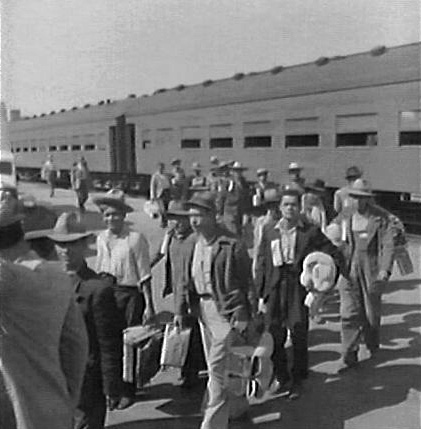
The Bracero Program (from the Spanish term bracero [bɾaˈse.ɾo], meaning "manual laborer" or "one who works using his arms") was a temporary labor initiative between the United States and Mexico that allowed Mexican workers to be employed in the U.S. agricultural and railroad industries from 1942 to 1964.
The program, which was designed to fill agriculture shortages during World War II, offered employment contracts to 4.6 million braceros in 24 U.S. states. It was the largest guest worker program in U.S. history.
The program was the result of a series of laws and diplomatic agreements, initiated on August 4, 1942, when the United States signed the Mexican Farm Labor Agreement with Mexico. The program was jointly managed by the U.S. State Department, Department of Labor, and the Immigration and Naturalization Service (INS). Under the agreement, braceros were promised fair treatment, including:
Workers were also legally protected against discrimination, including being excluded from whites-only areas. The program also allowed the importation of contract laborers from Guam as a temporary measure during the early phases of World War II.
The agreement was extended with the Migrant Labor Agreement of 1951 (Pub. L. 82–78), enacted as an amendment to the Agricultural Act of 1949 by the United States Congress, which set the official parameters for the Bracero Program until its termination in 1964.
In studies published in 2018 and 2023, it was found that the Bracero Program did not have an adverse effect on the wages or employment for American-born farm workers, and that termination of the program had adverse impact on American-born farmers and resulted in increased farm mechanization.
Since abolition of the Bracero Program, temporary agricultural workers have been admitted with H-2 and H-2A visas.
The Bracero Program operated as a joint program under the State Department, the Department of Labor, and the Immigration and Naturalization Services (INS) in the Department of Justice. Under this pact, the laborers were promised decent living conditions in labor camps, such as adequate shelter, food and sanitation, as well as a minimum wage pay of 30 cents an hour. The agreement also stated that braceros would not be subject to discrimination such as exclusion from "white" areas.
Bracero Program
The Bracero Program (from the Spanish term bracero [bɾaˈse.ɾo], meaning "manual laborer" or "one who works using his arms") was a temporary labor initiative between the United States and Mexico that allowed Mexican workers to be employed in the U.S. agricultural and railroad industries from 1942 to 1964.
The program, which was designed to fill agriculture shortages during World War II, offered employment contracts to 4.6 million braceros in 24 U.S. states. It was the largest guest worker program in U.S. history.
The program was the result of a series of laws and diplomatic agreements, initiated on August 4, 1942, when the United States signed the Mexican Farm Labor Agreement with Mexico. The program was jointly managed by the U.S. State Department, Department of Labor, and the Immigration and Naturalization Service (INS). Under the agreement, braceros were promised fair treatment, including:
Workers were also legally protected against discrimination, including being excluded from whites-only areas. The program also allowed the importation of contract laborers from Guam as a temporary measure during the early phases of World War II.
The agreement was extended with the Migrant Labor Agreement of 1951 (Pub. L. 82–78), enacted as an amendment to the Agricultural Act of 1949 by the United States Congress, which set the official parameters for the Bracero Program until its termination in 1964.
In studies published in 2018 and 2023, it was found that the Bracero Program did not have an adverse effect on the wages or employment for American-born farm workers, and that termination of the program had adverse impact on American-born farmers and resulted in increased farm mechanization.
Since abolition of the Bracero Program, temporary agricultural workers have been admitted with H-2 and H-2A visas.
The Bracero Program operated as a joint program under the State Department, the Department of Labor, and the Immigration and Naturalization Services (INS) in the Department of Justice. Under this pact, the laborers were promised decent living conditions in labor camps, such as adequate shelter, food and sanitation, as well as a minimum wage pay of 30 cents an hour. The agreement also stated that braceros would not be subject to discrimination such as exclusion from "white" areas.
Recent media
Recent media