


Community hub
Recent from talks
Contribute something
Nothing was collected or created yet.
Dielectric mirror
View on Wikipedia
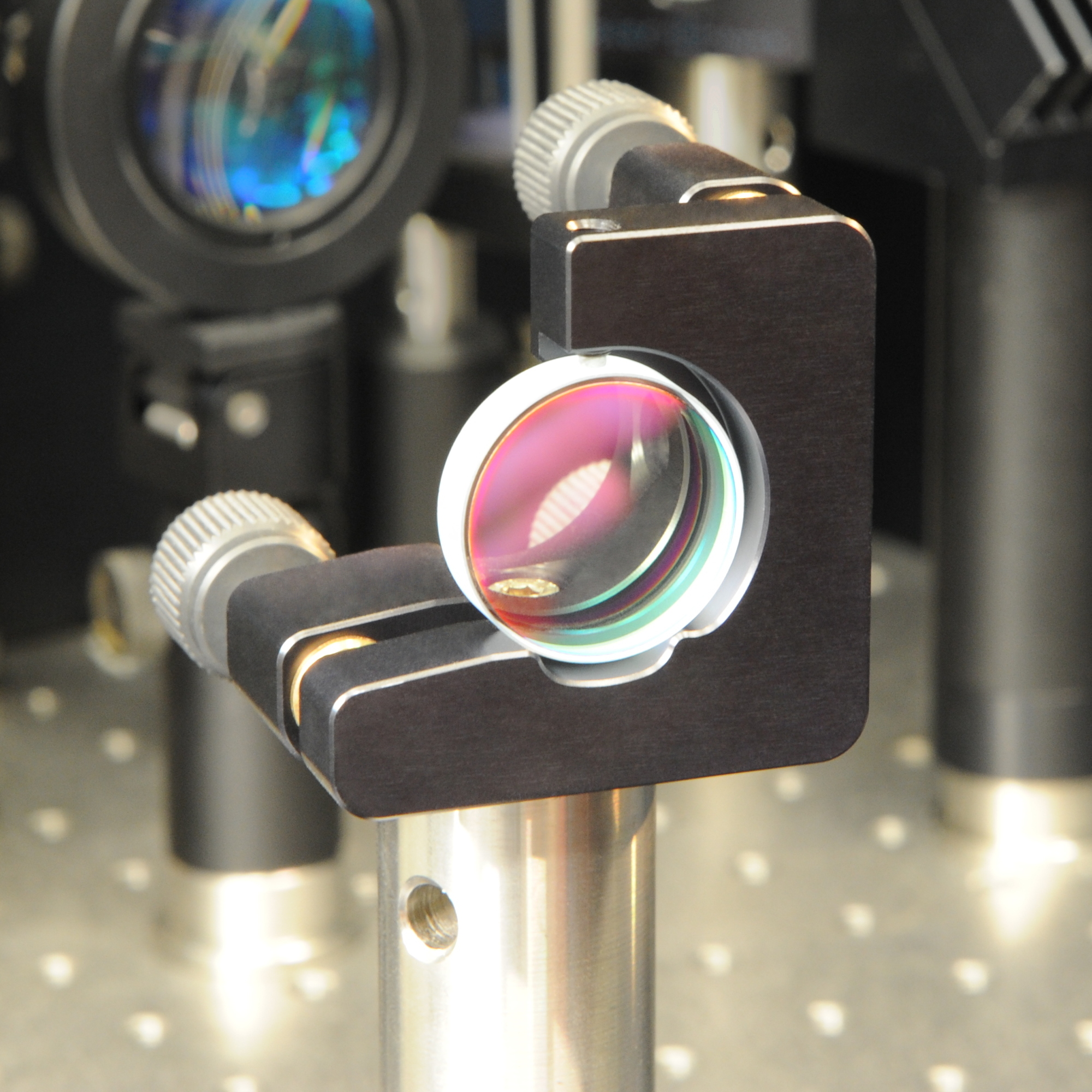
A dielectric mirror, also known as a Bragg mirror, is a type of mirror composed of multiple thin layers of dielectric material, typically deposited on a substrate of glass or some other optical material. By careful choice of the type and thickness of the dielectric layers, one can design an optical coating with specified reflectivity at different wavelengths of light. Dielectric mirrors are also used to produce ultra-high reflectivity mirrors: values of 99.999% or better over a narrow range of wavelengths can be produced using special techniques. Alternatively, they can be made to reflect a broad spectrum of light, such as the entire visible range or the spectrum of the Ti-sapphire laser.
Dielectric mirrors are very common in optics experiments, due to improved techniques that allow inexpensive manufacture of high-quality mirrors. Examples of their applications include laser cavity end mirrors, hot and cold mirrors, thin-film beamsplitters, high damage threshold mirrors, and the coatings on modern mirrorshades and some binoculars roof prism systems.
Mechanism
[edit]
The reflectivity of a dielectric mirror is based on the interference of light reflected from the different layers of a dielectric stack. This is the same principle used in multi-layer anti-reflection coatings, which are dielectric stacks which have been designed to minimize rather than maximize reflectivity. Simple dielectric mirrors function like one-dimensional photonic crystals, consisting of a stack of layers with a high refractive index interleaved with layers of a low refractive index (see diagram). The thicknesses of the layers are chosen such that the path-length differences for reflections from different high-index layers are integer multiples of the wavelength for which the mirror is designed. The reflections from the low-index layers have exactly half a wavelength in path length difference, but there is a 180-degree difference in phase shift at a low-to-high index boundary, compared to a high-to-low index boundary, which means that these reflections are also in phase. In the case of a mirror at normal incidence, the layers have a thickness of a quarter wavelength.

Other designs have a more complicated structure generally produced by numerical optimization. In the latter case, the phase dispersion of the reflected light can also be controlled (a chirped mirror). In the design of dielectric mirrors, an optical transfer-matrix method can be used. A well-designed multilayer dielectric coating can provide a reflectivity of over 99% across the visible light spectrum.[1]
Dielectric mirrors exhibit retardance as a function of angle of incidence and mirror design.[2]
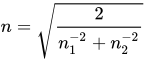
As shown in the GIF, the transmitted color shifts towards the blue with increasing angle of incidence. Regarding interference in the high reflective index medium this blueshift is given by the formula

- ,

where is any multiple of the transmitted wavelength and is the angle of incidence in the second medium. See thin-film interference for a derivation. However, there is also interference in the low refractive index medium. The best reflectivity will be at [3]


- ,

where is the transmitted wavelength under perpendicular angle of incidence and

- .
Manufacturing
[edit]
The manufacturing techniques for dielectric mirrors are based on thin-film deposition methods. Common techniques are physical vapor deposition (which includes evaporative deposition and ion beam assisted deposition), chemical vapor deposition, ion beam deposition, molecular beam epitaxy, sputter deposition, and sol-gel deposition.[4] Common materials are magnesium fluoride (n = 1.37), silicon dioxide (n = 1.45), tantalum pentoxide (n = 2.28) , zinc sulfide (n = 2.32), and titanium dioxide (n = 2.4).
Polymeric dielectric mirrors are fabricated industrially via co-extrusion of melt polymers,[5] and by spin-coating[6] or dip-coating[7] on smaller scale.
See also
[edit]References
[edit]- ^ Slaiby, ZenaE.; Turki, Saeed N. (November–December 2014). "Study the reflectance of dielectric coating for the visiblespectrum". International Journal of Emerging Trends & Technology in Computer Science. 3 (6): 1–4. ISSN 2278-6856. Retrieved 2024-08-12.[dead link]
- ^ Apfel, J. H. (1982). "Phase retardance of periodic multilayer mirrors". Applied Optics. 21 (4): 733–738. Bibcode:1982ApOpt..21..733A. doi:10.1364/AO.21.000733. PMID 20372527.
- ^ E, Huett (April 26, 2022). "Determination of 2D Plasma Parameters with Filtered Cameras. An Application to the X-Point Radiator Regime in ASDEX Upgrade". Max-Planck-Institut für Plasmaphysik. doi:10.17617/2.3379034.
- ^ Bertucci, Simone; Megahd, Heba; Dodero, Andrea; Fiorito, Sergio; Di Stasio, Francesco; Patrini, Maddalena; Comoretto, Davide; Lova, Paola (2022-05-04). "Mild Sol–Gel Conditions and High Dielectric Contrast: A Facile Processing toward Large-Scale Hybrid Photonic Crystals for Sensing and Photocatalysis". ACS Applied Materials & Interfaces. 14 (17): 19806–19817. doi:10.1021/acsami.1c23653. ISSN 1944-8244. PMC 9073830. PMID 35443778.
- ^ Comoretto, Davide, ed. (2015). Organic and Hybrid Photonic Crystals. doi:10.1007/978-3-319-16580-6. ISBN 978-3-319-16579-0. S2CID 139074878.
- ^ Lova, Paola; Giusto, Paolo; Stasio, Francesco Di; Manfredi, Giovanni; Paternò, Giuseppe M.; Cortecchia, Daniele; Soci, Cesare; Comoretto, Davide (9 May 2019). "All-polymer methylammonium lead iodide perovskite microcavities". Nanoscale. 11 (18): 8978–8983. doi:10.1039/C9NR01422E. hdl:11567/944564. ISSN 2040-3372. PMID 31017152. S2CID 129943931.
- ^ Russo, Manuela; Campoy-Quiles, Mariano; Lacharmoise, Paul; Ferenczi, Toby A. M.; Garriga, Miquel; Caseri, Walter R.; Stingelin, Natalie (2012). "One-pot synthesis of polymer/inorganic hybrids: toward readily accessible, low-loss, and highly tunable refractive index materials and patterns". Journal of Polymer Science Part B: Polymer Physics. 50 (1): 65–74. Bibcode:2012JPoSB..50...65R. doi:10.1002/polb.22373. ISSN 1099-0488.
External links
[edit]
Dielectric mirror
View on GrokipediaFundamentals
Definition and Principles
A dielectric mirror is an optical mirror composed of multiple thin layers of dielectric materials with alternating refractive indices, designed to achieve high reflectivity through constructive interference of light waves rather than metallic reflection.[8] Unlike metallic mirrors, which rely on free-electron absorption and typically offer reflectivities below 99%, dielectric mirrors can exceed 99.9% reflectivity over specific wavelength bands by exploiting wave interference at dielectric interfaces.[9] The foundational principles of dielectric mirrors stem from the interference of light waves reflected at multiple dielectric interfaces. Light incident on the multilayer stack undergoes partial reflection and transmission at each boundary, with the phase of reflected waves determined by the refractive indices of adjacent layers and the optical path lengths traversed. The refractive index governs the speed of light in each material, creating index contrasts (e.g., low-index SiO₂ with and high-index TiO₂ with ) that induce phase shifts upon reflection: a 180° shift occurs when light reflects from a higher-index medium, while no shift occurs from a lower-index one.[8] For a single interface, the amplitude reflection coefficient at normal incidence is given by where and are the refractive indices of the incident and transmitting media, respectively; this yields a reflectivity ranging from 0% (matched indices) to nearly 100% (large contrast).[10] In a multilayer dielectric mirror, these reflections coherently add, and reflectivity is amplified by stacking many layers, with the overall response approaching that of an ideal reflector for wavelengths where constructive interference dominates. To maximize reflectivity at a target wavelength , each layer is typically designed with a quarter-wave optical thickness, , where is the physical thickness. This ensures that round-trip phase delays within layers align reflected waves in phase, promoting constructive interference and a high-reflectivity stopband.[8] The concept evolved from early thin-film optics developed in the 1930s, with vacuum deposition techniques pioneered by John Strong at the California Institute of Technology for anti-reflection coatings, while the first multilayer high-reflectivity dielectric mirrors were invented in 1939 by Walter Geffcken at the Schott Glass company.[11][12]Reflection Mechanism
Dielectric mirrors achieve high reflectivity through the constructive interference of light waves reflected at multiple interfaces within a stack of alternating thin dielectric layers. Each layer typically has an optical thickness of one quarter wavelength () at the design wavelength, ensuring that the path length difference for reflections from adjacent interfaces results in a phase difference of radians (180 degrees), aligning the reflected waves in phase to add constructively. This interference amplifies the total reflected amplitude, leading to near-total reflection within a specific wavelength range known as the stopband, where transmittance is minimized.[1] The phase behavior at interfaces plays a critical role in this enhancement. When light reflects from a medium of lower refractive index to higher (low-to-high interface), it undergoes a radian phase shift, whereas reflection from higher to lower index (high-to-low) incurs no such shift. In a typical high-reflectivity stack starting with a high-index layer on a substrate, the alternating interfaces are arranged such that all major reflections experience effectively the same phase shift relative to the propagation delay, enabling coherent addition upon stacking multiple periods. This design maximizes the buildup of the electric field amplitude for the reflected wave.[13] Spectral selectivity arises from the periodic structure, creating a photonic stopband analogous to a one-dimensional photonic bandgap, where wavelengths within the band are strongly reflected due to the Bragg condition being satisfied. Outside this stopband (passband), the phase mismatches lead to destructive interference for reflections or high transmission. The stopband width increases with greater refractive index contrast between layers, providing tailored reflectivity over desired spectral regions.[1] The reflectivity of a multilayer stack can be rigorously derived using the characteristic matrix method, which models the propagation through each layer. For a single isotropic layer of thickness , refractive index , and wave number , the characteristic matrix is where is the phase thickness, is the refraction angle, and (or for TE/TM polarizations) is the admittance (with vacuum admittance normalized to 1). For a stack of layers, the total matrix is the product . The effective admittance seen from the incident side is , where is the substrate admittance and its index. The amplitude reflection coefficient is then , with incident medium admittance , yielding the power reflectivity For quarter-wave stacks () with high-low index pairs, this recursive matrix product simplifies to a high effective , approaching total reflection as periods increase. In ideal lossless dielectrics, such mirrors can achieve reflectivity exceeding 99.9% over narrow bandwidths, as demonstrated for stacks with index contrast like , using 8 periods.[14][1]Design and Materials
Layer Structure and Optimization
Dielectric mirrors are constructed with a multilayer stack featuring alternating layers of high-refractive-index (H) and low-refractive-index (L) dielectric materials, typically arranged in an H/L/H/L... configuration starting from a high-index layer adjacent to the substrate for optimal performance.[1] Each layer's optical thickness is set to λ/4n, where λ is the central design wavelength and n is the material's refractive index, creating a quarter-wave stack that promotes constructive interference of reflected waves at the target wavelength.[15] This periodic arrangement forms the basis of distributed Bragg reflectors (DBRs), which provide high reflectivity within a defined spectral band due to the Bragg condition for wave propagation.[16] Optimization of the layer structure requires careful consideration of trade-offs, particularly in the number of layer pairs. Greater numbers of pairs (e.g., 10–50 depending on index contrast) elevate peak reflectivity toward unity by enhancing interference effects, but they increase structural complexity, potential mechanical stress, and dispersion artifacts.[17] To broaden the reflection band without proportionally increasing layers, chirped DBRs vary the period gradually across the stack, while rugate filters approximate a continuous refractive index gradient for smoother, ripple-reduced spectra over extended wavelengths.[18] These chirped variations enable tailored bandwidths suitable for applications demanding wide spectral coverage, such as ultrafast lasers.[19] The reflection bandwidth, defined as the wavelength range of high reflectivity, is governed by the index contrast and approximated by .[20] This formula highlights how larger differences between and expand the operational band, with typical contrasts yielding 50–100 nm widths around visible or near-infrared centers. High-reflectivity designs must account for incidence angle: at normal incidence, the stack is symmetric, but oblique angles shift the effective period and introduce polarization dependence, requiring adjusted layer thicknesses for s- and p-waves to maintain performance.[1] Omnidirectional mirrors extend this optimization by incorporating graded-index profiles or one-dimensional photonic crystal variants, ensuring a persistent photonic band gap across incidence angles up to 90 degrees.[21] These structures mitigate angle-induced bandwidth narrowing through tailored index modulation, achieving angle-independent reflection for applications like optical isolators.[22]Material Choices
Dielectric mirrors rely on alternating layers of high- and low-refractive-index materials to achieve high reflectivity through constructive interference. Common high-index materials include titanium dioxide (TiO2), with a refractive index of approximately 2.4 in the visible spectrum, and tantalum pentoxide (Ta2O5), with n ≈ 2.1, both valued for their optical performance in multilayer stacks.[23][24] Low-index materials typically feature silicon dioxide (SiO2), n ≈ 1.46, and magnesium fluoride (MgF2), n ≈ 1.38, which provide the necessary contrast while maintaining transparency.[25][26]| Material | Index Type | Refractive Index (≈550 nm) | Typical Use |
|---|---|---|---|
| TiO2 | High | 2.4 | Broad visible reflectivity |
| Ta2O5 | High | 2.1 | High-reflectance mirrors |
| SiO2 | Low | 1.46 | Low-absorption layers |
| MgF2 | Low | 1.38 | UV-compatible coatings |