Hubbry Logo
Distributed Bragg reflectorDistributed Bragg reflectorMain
Open search
Distributed Bragg reflector
Community hub
Distributed Bragg reflector
logo
8 pages, 0 posts
0 subscribers
Be the first to start a discussion here.
Distributed Bragg reflector
from Wikipedia

Time-resolved simulation of a pulse reflecting from a Bragg mirror.

A distributed Bragg reflector (DBR) is a reflector used in waveguides, such as optical fibers. It is a structure formed from multiple layers of alternating materials with different refractive index, or by periodic variation of some characteristic (such as height) of a dielectric waveguide, resulting in periodic variation in the effective refractive index in the guide. Each layer boundary causes a partial reflection and refraction of an optical wave. For waves whose vacuum wavelength is close to four times the optical thickness of the layers, the interaction between these beams generates constructive interference, and the layers act as a high-quality reflector. The range of wavelengths that are reflected is called the photonic stopband. Within this range of wavelengths, light is "forbidden" to propagate in the structure.

Reflectivity

[edit]
Calculated reflectivity of a schematic DBR structure

The DBR's reflectivity, , for intensity is approximately given by [1]

where and are the respective refractive indices of the originating medium, the two alternating materials, and the terminating medium (i.e. backing or substrate); and is the number of repeated pairs of low/high refractive index material. This formula assumes the repeated pairs all have a quarter-wave thickness (that is , where is the refractive index of the layer, is the thickness of the layer, and is the wavelength of the light).

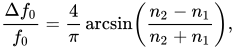
The frequency bandwidth of the photonic stop-band can be calculated by

where is the central frequency of the band. This configuration gives the largest possible ratio that can be achieved with these two values of the refractive index.[2][3]

Increasing the number of pairs in a DBR increases the mirror reflectivity and increasing the refractive index contrast between the materials in the Bragg pairs increases both the reflectivity and the bandwidth. A common choice of materials for the stack is titanium dioxide (n ≈ 2.5) and silica (n ≈ 1.5).[4] Substituting into the formula above gives a bandwidth of about 200 nm for 630 nm light.

Distributed Bragg reflectors are critical components in vertical cavity surface emitting lasers and other types of narrow-linewidth laser diodes such as distributed feedback (DFB) lasers and distributed bragg reflector (DBR) lasers. They are also used to form the cavity resonator (or optical cavity) in fiber lasers and free electron lasers.

TE and TM mode reflectivity

[edit]
Total reflection map as function of incident angle and dimensionless frequency. Parameters of the systems: ε = (11.4, 1.0), period of one layer is d = 0.2 + 0.8 = 1, total number of periods is 6. Left half represents TM reflection with a Brewster's angle showed as a white dashed line, right half represents TE reflection.

This section discusses the interaction of transverse electric (TE) and transverse magnetic (TM) polarized light with the DBR structure, over several wavelengths and incidence angles. This reflectivity of the DBR structure (described below) was calculated using the transfer-matrix method (TMM), where the TE mode alone is highly reflected by this stack, while the TM modes are passed through. This also shows the DBR acting as a polarizer.

For TE and TM incidence we have the reflection spectra of a DBR stack, corresponding to a 6 layer stack of dielectric contrast of 11.5, between an air and dielectric layers. The thicknesses of the air and dielectric layers are 0.8 and 0.2 of the period, respectively. The wavelength in the figures below, corresponds to multiples of the cell period.

This DBR is also a simple example of a 1D photonic crystal. It has a complete TE band gap, but only a pseudo TM band gap.

Bio-inspired Bragg reflectors

[edit]
Example of color change in Bragg reflector with change in humidity and comparison to biological structure.

Bio-inspired Bragg reflectors are 1D photonic crystals inspired by nature. Reflection of light from such a nanostructured matter results in structural colouration. When designed from mesoporous metal-oxides[5][6][7] or polymers,[8] these devices can be used as low-cost vapor/solvents sensors.[9] For example, colour of this porous multi-layered structures will change when the matter filling up the pores is replaced by another, e.g. replacing air with water.

See also

[edit]

References

[edit]
Revisions and contributorsEdit on WikipediaRead on Wikipedia
from Grokipedia
A distributed Bragg reflector (DBR) is a periodic optical structure consisting of alternating thin layers of two materials with different refractive indices, typically each layer one-quarter thick at the target , that achieves high reflectivity for through constructive interference of partial reflections at each interface. These reflectors operate on the principle of Bragg diffraction, where the periodic variation in creates a photonic bandgap that strongly reflects wavelengths within a specific bandwidth, with reflectivity approaching 100% for sufficient layer pairs and index contrast. The bandwidth of high reflection is proportional to the refractive index difference between the layers, while the center can be tuned by adjusting layer thicknesses or incidence angle. First demonstrated around 1940 using alternating layers for optical coatings, DBRs evolved significantly in the mid-20th century and were adapted for applications in the late and early 1980s, particularly in laser diodes. DBRs are classified into dielectric types, often made from materials like SiO₂ and TiO₂ for broad applicability, and epitaxial semiconductor types, such as AlGaAs/GaAs or AlN/GaN stacks grown via or metalorganic . Semiconductor DBRs face challenges like strain-induced cracking in high-contrast systems requiring 30–50 or more periods for >99% reflectivity, but innovations like lattice-matched AlInN/GaN or nanoporous structures have improved manufacturability, especially for and wavelengths. Key applications include serving as end mirrors in vertical-cavity surface-emitting lasers (VCSELs), where they enable compact, single-mode operation for and sensing; the global VCSEL market, dominated by GaAs-based devices, was valued at approximately $1.8 billion in 2024. In distributed Bragg reflector lasers, gratings integrated outside the gain region provide wavelength-selective feedback, yielding narrow linewidths (<4 MHz) and tunability over tens of nanometers for spectroscopy and metrology. Additionally, fiber Bragg gratings—etched DBRs in optical fibers—function as wavelength filters, sensors, and dispersion compensators in telecom networks. Emerging uses span bio-inspired reflectors in photonics and high-Q microcavities for quantum optics, with recent advancements including nanoporous GaN DBRs for enhanced UV performance as of 2025.

Fundamentals

Definition and Structure

A distributed Bragg reflector (DBR) is a periodic multilayer stack composed of alternating layers of materials with high and low refractive indices, engineered to reflect light at targeted wavelengths through the principle of constructive interference. This structure functions as an optical mirror by creating a photonic bandgap that prohibits propagation of light within a specific wavelength range, centered at the Bragg wavelength. The fundamental structure of a DBR consists of multiple repeating pairs (periods) of these contrasting layers, typically with each layer designed to have an optical thickness of one quarter-wavelength at the central operating wavelength, expressed as d=λ4nd = \frac{\lambda}{4n}, where dd is the physical thickness, λ\lambda is the wavelength in vacuum, and nn is the material's refractive index. The overall reflectivity increases with the number of periods NN, often ranging from several to tens of pairs depending on the desired performance. A key factor in optimizing DBR efficiency is the refractive index contrast Δn\Delta n between the alternating materials, as a larger Δn\Delta n enables higher reflectivity with fewer periods and broader bandwidths. Common material pairs for dielectric DBRs include silicon dioxide (SiO₂, low index) and titanium dioxide (TiO₂, high index), valued for their compatibility with thin-film deposition and high optical quality. In semiconductor applications, pairs such as aluminum gallium arsenide (AlGaAs) and gallium arsenide (GaAs) are widely used, leveraging their lattice matching and tunable bandgaps for integration in devices like vertical-cavity surface-emitting lasers. While standard DBRs are one-dimensional photonic structures with periodicity solely along the direction normal to the layers, higher-dimensional variants introduce periodicity in two or three spatial dimensions, creating more intricate lattice arrangements akin to full photonic crystals.

Historical Development

The theoretical foundations of distributed Bragg reflectors (DBRs) trace back to the late 19th century, with early investigations into the optical properties of periodic multilayer structures. In 1887, Lord Rayleigh analyzed the reflection characteristics of alternating thin films, demonstrating that such periodic dielectric stacks could achieve high reflectivity through constructive interference at specific wavelengths, laying the groundwork for modern DBR designs. This work on one-dimensional photonic structures highlighted the potential of multilayers as efficient mirrors, influencing subsequent research in optics despite the limitations of fabrication techniques at the time. The practical development and naming of DBRs occurred in the context of semiconductor optics during the early 1970s, driven by advances in laser technology. The term "distributed Bragg reflector" was introduced to describe periodic structures that provide wavelength-selective feedback in lasers, building on the Bragg diffraction condition for distributed reflections. In 1972, DBRs were proposed as key components for enhancing laser performance, particularly in distributed feedback configurations. The first practical semiconductor DBRs were realized around 1975 using GaAs/AlGaAs multilayer systems grown by molecular beam epitaxy (MBE), enabling high reflectivity in the near-infrared range and paving the way for integration into vertical-cavity surface-emitting lasers (VCSELs). The 1980s marked significant milestones in DBR evolution through improvements in epitaxial growth techniques, which allowed for the production of high-quality semiconductor mirrors with precise layer control. Advancements in MBE and metalorganic chemical vapor deposition (MOCVD) facilitated the growth of AlGaAs/GaAs DBRs with low optical losses, first demonstrated epitaxially in 1983 for VCSEL applications. These developments shifted DBRs from rudimentary dielectric stacks to robust components in integrated photonic devices, enabling room-temperature operation in lasers. By the 1990s, DBR technology expanded into broader photonic applications, including the emergence of photonic crystals where one-dimensional DBRs served as foundational elements for band-gap engineering. This period also saw growing interest in bio-mimicry, as natural multilayer reflectors—such as those in iridescent beetle shells and pearl nacre—inspired engineered DBRs with enhanced tunability and structural diversity. The evolution continued toward integrated systems, transitioning DBRs from standalone mirrors to essential parts of microcavities and optoelectronic devices.

Physical Principles

Wave Interference Basics

Light is fundamentally described as electromagnetic waves, which propagate through space as transverse oscillations of electric and magnetic fields perpendicular to the direction of travel. In free space, these waves are often idealized as plane waves, characterized by a uniform wavefront and a wavelength λ\lambda that determines the spatial period of the oscillation. The refractive index nn of a medium influences the propagation by reducing the phase velocity vp=c/nv_p = c / n, where cc is the speed of light in vacuum, thereby shortening the wavelength within the medium to λ/n\lambda / n while preserving the frequency. When electromagnetic waves encounter interfaces or superimpose, interference occurs, arising from the superposition of their electric field components. Constructive interference happens when waves are in phase, meaning their crests and troughs align, resulting in enhanced amplitude; destructive interference occurs when they are out of phase, leading to cancellation of the fields. A key aspect in reflection at dielectric interfaces is the phase shift: upon reflection from a boundary where light travels from a lower refractive index to a higher one, the reflected wave experiences a π\pi phase shift (equivalent to half a wavelength), while no such shift occurs for reflection from higher to lower index. In periodic structures, such as one-dimensional lattices with alternating refractive indices, wave propagation is governed by diffraction effects that can lead to strong interference. The Bragg condition specifies the wavelengths and angles at which constructive interference occurs for waves diffracted by the periodic planes: mλ=2nΛcosθm \lambda = 2 n \Lambda \cos \theta where mm is the diffraction order (a positive integer), λ\lambda is the vacuum wavelength, nn is the average refractive index, Λ\Lambda is the lattice period, and θ\theta is the angle of incidence relative to the normal of the planes. This condition arises from the path length difference between waves scattered from adjacent periods being an integer multiple of the wavelength, enabling efficient backscattering without specific application to device structures. The concept of a photonic bandgap emerges from these periodic variations in refractive index, analogous to electronic bandgaps in solid-state crystals where periodic atomic potentials forbid certain electron energies. In photonic materials, the spatial modulation of nn creates frequency ranges where electromagnetic waves cannot propagate, as the Bragg scattering prevents Bloch modes from existing, leading to evanescent decay instead of transmission. This analogy, first drawn in the context of dielectric structures, highlights how periodicity can control photon behavior similarly to how it governs electrons in semiconductors.

Reflection Mechanism

The reflection mechanism in a distributed Bragg reflector (DBR) relies on the periodic alternation of dielectric layers with contrasting refractive indices, which induces multiple partial reflections at each interface. Each interface contributes a small reflection amplitude determined by the Fresnel reflection coefficient for normal incidence, approximated as rn1n2n1+n2r \approx \frac{n_1 - n_2}{n_1 + n_2}, where n1n_1 and n2n_2 are the refractive indices of the adjacent layers. These distributed reflections interfere coherently through multiple scattering within the structure, resulting in constructive interference for wavelengths satisfying the Bragg condition and destructive interference elsewhere, thereby achieving high reflectivity over a specific spectral band. The core of this mechanism is the formation of a photonic stopband, where light propagation is suppressed due to the periodicity. The central wavelength of the stopband, known as the Bragg wavelength λB\lambda_B, is given by λB=2neffΛ,\lambda_B = 2 n_\text{eff} \Lambda, where neffn_\text{eff} is the effective refractive index of the period and Λ\Lambda is the grating period (sum of the thicknesses of one high-index and one low-index layer). The width of the stopband Δλ\Delta \lambda depends on the index contrast and is approximated for high-contrast structures as Δλ4πΔnnavgλB,\Delta \lambda \approx \frac{4}{\pi} \frac{\Delta n}{n_\text{avg}} \lambda_B, where Δn=nHnL\Delta n = |n_H - n_L| is the refractive index difference between the high-index (nHn_H) and low-index (nLn_L) materials, and navg=(nH+nL)/2n_\text{avg} = (n_H + n_L)/2 is the average index; higher contrast broadens the stopband, enhancing the range of reflected wavelengths. The mechanism also exhibits angular dependence, as oblique incidence alters the effective path length within the layers. As the angle of incidence increases, the reflectivity peaks narrow, and the Bragg wavelength shifts toward shorter values due to a cosθ\cos \theta factor in the phase-matching condition, where θ\theta is the angle inside the medium; this effect limits broadband performance at large angles but can be exploited for angle-selective applications. For a finite number of periods NN, the peak reflectivity within the stopband approaches unity as NN increases, quantified for normal incidence by R=[1(nLnH)2N1+(nLnH)2N]2,R = \left[ \frac{1 - \left( \frac{n_L}{n_H} \right)^{2N}}{1 + \left( \frac{n_L}{n_H} \right)^{2N}} \right]^2,
Add your contribution
Related Hubs
User Avatar
No comments yet.