
Recent from talks
Bramdean
Knowledge base stats:
Talk channels stats:
Members stats:
Bramdean
Bramdean is a village and former civil parish, now in the parish of Bramdean and Hinton Ampner, in the Winchester district, in the county of Hampshire, England. It is a linear settlement located along the busy A272 trunk road which was widened by the American troops in 1943 in preparation for D-Day.
The village itself is peculiar due to the large number of large houses dating from the Georgian period. A few of these are set in or near beautiful rolling parkland with specimen trees.
A number of hamlets are also situated within the boundaries of the parish. To the north of the village is Bramdean Common, known for its good walks and pretty cottages. Further settlements include Little London, Hinton Woodlands, Hells Bottom (or Wolfhanger), and Joans Acre.
Bramdean is first recorded in an Anglo-Saxon charter of West Meon in 932 CE where it is recorded as Bromdene meaning the valley where Broom grows. Here it was used as a landmark to delineate the boundary of the Anglo-Saxon manor of West Meon.
There are a number of prehistoric barrows in the vicinity of the parish, especially around Brockwood Park, suggesting a significant area of activity for Early Bronze Age peoples.
In 1823 a Roman villa was discovered in the parish containing two tesselated pavements of very fine qualities. The villa stood on the site of an older Iron Age enclosure.
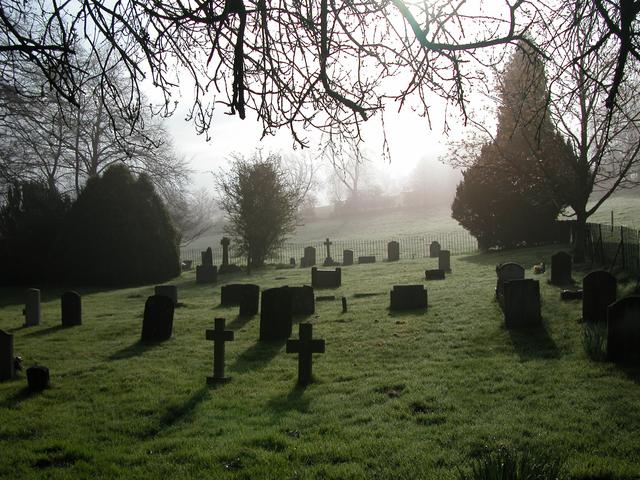
The village church is dedicated to St Simon and St Jude. It is supposed to have its origins in the 1170s. However, only some of the original 12th century structure survives, as the church was heavily altered in the 19th century. The original section of the building, consisting of a nave and chancel, is externally rendered, whilst the 19th century additions are built of flint and stone. The church retains its 12th century chancel arch with two carved leaf capitals. The church at Bramdean became notable in the 19th century for its restored wall paintings, which had been uncovered and retouched by the then rector Charles Walters. They were later re-covered when Helier Touzel came to be the rector at Bramdean, and remain as such to this day.
A distinct feature of Bramdean is its isolated church which stands separated from the rest of the village on the south side of the A272. The village itself contains few very ancient buildings, the oldest of which date to the 15th century. These include Manchester House, Woodcote Manor, Tanners Farm, The Old Rectory, and Bramdean Farmhouse.
Hub AI
Bramdean AI simulator
(@Bramdean_simulator)
Bramdean
Bramdean is a village and former civil parish, now in the parish of Bramdean and Hinton Ampner, in the Winchester district, in the county of Hampshire, England. It is a linear settlement located along the busy A272 trunk road which was widened by the American troops in 1943 in preparation for D-Day.
The village itself is peculiar due to the large number of large houses dating from the Georgian period. A few of these are set in or near beautiful rolling parkland with specimen trees.
A number of hamlets are also situated within the boundaries of the parish. To the north of the village is Bramdean Common, known for its good walks and pretty cottages. Further settlements include Little London, Hinton Woodlands, Hells Bottom (or Wolfhanger), and Joans Acre.
Bramdean is first recorded in an Anglo-Saxon charter of West Meon in 932 CE where it is recorded as Bromdene meaning the valley where Broom grows. Here it was used as a landmark to delineate the boundary of the Anglo-Saxon manor of West Meon.
There are a number of prehistoric barrows in the vicinity of the parish, especially around Brockwood Park, suggesting a significant area of activity for Early Bronze Age peoples.
In 1823 a Roman villa was discovered in the parish containing two tesselated pavements of very fine qualities. The villa stood on the site of an older Iron Age enclosure.
The village church is dedicated to St Simon and St Jude. It is supposed to have its origins in the 1170s. However, only some of the original 12th century structure survives, as the church was heavily altered in the 19th century. The original section of the building, consisting of a nave and chancel, is externally rendered, whilst the 19th century additions are built of flint and stone. The church retains its 12th century chancel arch with two carved leaf capitals. The church at Bramdean became notable in the 19th century for its restored wall paintings, which had been uncovered and retouched by the then rector Charles Walters. They were later re-covered when Helier Touzel came to be the rector at Bramdean, and remain as such to this day.
A distinct feature of Bramdean is its isolated church which stands separated from the rest of the village on the south side of the A272. The village itself contains few very ancient buildings, the oldest of which date to the 15th century. These include Manchester House, Woodcote Manor, Tanners Farm, The Old Rectory, and Bramdean Farmhouse.
Recent media