


Community hub
Recent from talks
Contribute something
Nothing was collected or created yet.
Tumulus
View on Wikipedia


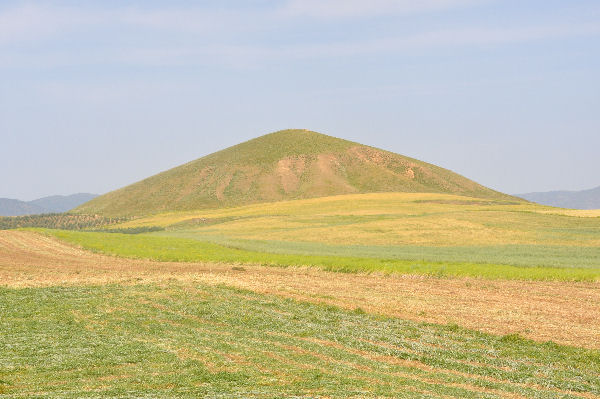
A tumulus (pl.: tumuli) is a mound of earth and stones raised over a grave or graves. Tumuli are also known as barrows, burial mounds, mounds, howes, or in Siberia and Central Asia as kurgans, and may be found throughout much of the world. A cairn, which is a mound of stones built for various purposes, may also originally have been a tumulus.
Tumuli are often categorised according to their external apparent shape. In this respect, a long barrow is a long tumulus, usually constructed on top of several burials, such as passage graves. A round barrow is a round tumulus, also commonly constructed on top of burials. The internal structure and architecture of both long and round barrows have a broad range; the categorization only refers to the external apparent shape.
The method of inhumation may involve a dolmen, a cist, a mortuary enclosure, a mortuary house, or a chamber tomb. Examples of barrows include Duggleby Howe and Maeshowe.
Etymology
[edit]The word tumulus is Latin for 'mound' or 'small hill', which is derived from the Proto-Indo-European root *teuh2- with extended zero grade *tum-, 'to bulge, swell' also found in tomb, tumor, tumescent, thumb, thigh, and thousand.[4] Its synonym "howe" is derived from Old Norse: haugr.[5]
Burial accounts
[edit]The funeral of Patroclus is described in book 23 of Homer's Iliad. Patroclus is burned on a pyre, and his bones are collected into a golden urn in two layers of fat. The barrow is built on the location of the pyre. Achilles then sponsors funeral games, consisting of a chariot race, boxing, wrestling, running, a duel between two champions to the first blood, discus throwing, archery and spear throwing.
Beowulf's body in the Anglo-Saxon poem Beowulf is taken to Hronesness, where it is burned on a funeral pyre. During cremation, the Geats lament the death of their lord, a widow's lament being mentioned in particular, singing dirges as they circumambulate the barrow. Afterwards, a mound is built on top of a hill, overlooking the sea, and filled with treasure. A band of twelve of the best warriors ride around the barrow, singing dirges in praise of their lord.
Parallels have also been drawn to the account of Attila's burial in Jordanes' Getica.[6] Jordanes tells that as Attila's body was lying in state, the best horsemen of the Huns circled it, as in circus games.
An Old Irish Life of Columcille reports that every funeral procession "halted at a mound called Eala, whereupon the corpse was laid, and the mourners marched thrice solemnly round the spot."
Types
[edit]Archaeologists often classify tumuli according to their location, form, and date of construction (see also mound). Some British types are listed below:
- Bank barrow
- Bell barrow
- Bowl barrow
- D-shaped barrow – round barrow with a purposely flat edge at one side often defined by stone slabs.
- Disc barrow
- Fancy barrow – generic term for any Bronze Age barrows more elaborate than a simple hemispherical shape.
- Long barrow
- Oval barrow – a Neolithic long barrow consisting of an elliptical, rather than rectangular or trapezoidal mound.
- Platform barrow – The least common of the recognised types of round barrow, consisting of a flat, wide circular mound that may be surrounded by a ditch. They occur widely across southern England with a marked concentration in East and West Sussex.
- Pond barrow – a barrow consisting of a shallow circular depression, surrounded by a bank running around the rim of the depression, from the Bronze Age.
- Ring barrow – a bank that encircles a number of burials.
- Round barrow – a circular feature created by the Bronze Age peoples of Britain and also the later Romans, Vikings, and Saxons. Divided into subclasses such as saucer and bell barrow – the Six Hills are a rare Roman example.
- Saucer barrow – a circular Bronze Age barrow that features a low, wide mound surrounded by a ditch that may have an external bank.
- Square barrow – burial site, usually of Iron Age date, consisting of a small, square, ditched enclosure surrounding a central burial, which may also have been covered by a mound.
Modern practices
[edit]
There is a contemporary revival in barrow building in the UK.[7] In 2015 the first long barrow in thousands of years, the Long Barrow at All Cannings, inspired by those built in the Neolithic era, was built on land just outside the village of All Cannings.[8] The barrow was designed to have a large number of private niches within the stone and earth structure to receive cremation urns.
This was followed by new barrows at:
- The Willow Row Barrow at St Neots.[9]
- The Soulton Long Barrow at Soulton in Shropshire.[10][11][12][13][14]
- Higher Ground Meadow in Dorset[15]
- Mid-England Barrow, Oxfordshire.[16]
Plans have also been announced for a barrow in Milton Keynes[17] and in Powys.[18]
Sites
[edit]Australia
[edit]
Burial mounds are one of several funerary forms practiced by Indigenous Australians.[19] Burial mounds were once practiced by some Aboriginals across Australia, the most elaborate burial mounds are recorded in New South Wales, South Australia, Victoria and Western Australia. Most notable burials in New South Wales and Western Australia were studied and excavated by John Oxley (1820), Atkinson (1853), Pearce (1897), and Davidson (1949) and were termed Aboriginal tumulus.[19]
Early records indicate the burial mounds as neat and rounded in form. However, dimensions and precise form could vary widely based on rank of the individuals, smallest mounds being 2 to 3 m in diameter and 2 m in height to largest mounds described as an earthen oblong mound resembling ‘a large hillock some 100 feet long, and 50 in height’.[19] Some special or high-standing individuals mound were semi-circular, while most were round. Traditionally, the preparation of the burial site, the carving of trees facing the mound and internment was done by initiated men. Occasionally, long raised mourning seats were constructed along one side of the burial mound.[19][20] Many of these mounds today have undergone much change in appearance due to erosion, weathering, wildfires, agriculture, land development and deliberate destruction.[20]
Bodies were buried either in a seated-position or in a crouched fetal-position, they were wrapped in layers of pelt-cloaks. Grave goods often included weapons, stone axes, ochre, white clay, stone flakes, bonepoints, necklaces, gridles, headbands and items of ceremonial clothing.[19][20]
An early published account of John Oxley's excavation describes a high-standing Aboriginal man's burial mound and associated carved trees; these carvings on the trees were made around the mound, facing the burial.[20]
.jpg)
"The form of the whole was semi-circular. Three rows of seats occupied one half, the grave and an outer row of seats the other; the seats formed segments of circles of fifty, forty-five, and forty feet each, and were formed by the soil being trenched up from between them. The centre part of the grave was about five feet high, and about nine long, forming an oblong pointed cone. On removing the soil from one end of the tumulus, and about two feet beneath the solid surface of the ground, we came to three or four layers of wood, lying across the grave, serving as an arch to bear the weight of the earthy cone or tomb above. On removing one end of those layers, sheet after sheet of dry bark was taken out, then dry grass and leaves in a perfect state of preservation, the wet or damp having apparently never penetrated even to the first covering of wood … the body deposited about four feet deep in an oval grave, four feet long and from eighteen inches to two feet wide. The feet were bent quite up to the head, the arms having been placed between the thighs. The face was downwards, the body being placed east and west, the head to the east. It had been very carefully wrapped in a great number of opossum [sic] skins, the head bound round with the net usually worn by the natives, and also the girdle: it appeared after being enclosed in those skins to have been placed in a larger net, and then deposited in the manner before mentioned … to the west and north of the grave were two cypress-trees distant between fifty and sixty feet; the sides towards the tomb were barked, and curious characters deeply cut upon them, in a manner which, considering the tools they possess, must have been a work of great labour and time."
Traditionally, a sheet of bark was removed from trees and the bare surface was carved to face the burial mound. In some cases, up to five trees were carved around the mound for high standing individuals. It has been suggested that the carvings were associated with the culture heroes admired by man in life and were thought to provide a pathway for his spirit to return to the sky world.[20] According to Alfred William Howitt these carved trees served both as transit points to allow cultural heroes to ascend to, and descend from, the firmament as well as a means for the deceased to return to the sky world.[21]
Some mounds do not contain burials, these mounds are associated with settlement debris. In Northern Territory and in several regions both forms are known.[22] Recently, several mounds in Queensland were investigated with ground-penetrating radar. These mounds were previously associated with settlement debris. Radar study revealed some mounds contained mortuary remains, while other mounds were built over places where ceremonial fires had taken place. Further research is proposed to understand nature of burial mounds in this part of Australia.[23]
Africa
[edit]Horn of Africa
[edit]Salweyn in Northern Somalia contains a very large field of cairns, which stretches for a distance of around 8 km.[24] An excavation of one of these tumuli by Georges Révoil in 1881 uncovered a tomb, beside which were artefacts pointing to an ancient, advanced civilization. The interred objects included pottery shards from Samos, some well-crafted enamels, and a mask of Ancient Greek design.[25]
The Sahel
[edit]Preceded by assumed earlier sites in the Eastern Sahara, tumuli with megalithic monuments developed as early as 4700 BC in the Saharan region of Niger.[26] Fekri Hassan (2002) indicates that the megalithic monuments in the Saharan region of Niger and the Eastern Sahara may have served as antecedents for the mastabas and pyramids of ancient Egypt.[26]
The prehistoric tradition of monarchic tumuli-building is shared by both the West African Sahel and the Middle Nile regions.[27] Ancient Egyptian pyramids of the early dynastic period and Meroitic Kush pyramids are recognized by Faraji (2022) as part of and derived from an earlier architectural "Sudanic-Sahelian" tradition of monarchic tumuli, which are characterized as "earthen pyramids" or "proto-pyramids."[27] Faraji (2022) characterized Nobadia as the "last pharaonic culture of the Nile Valley" and described mound tumuli as being "the first architectural symbol of the sovereign's return and reunification with the primordial mound upon his death."[27] Faraji (2022) indicates that there may have been a cultural expectation of "postmortem resurrection" associated with tumuli in the funerary traditions of the West African Sahel (e.g., northern Ghana, northern Nigeria, Mali) and Nile Valley (e.g., Ballana, Qustul, Kerma, Kush).[27] Based on artifacts found in the tumuli from West Africa and Nubia, there may have been "a highly developed corporate ritual in which the family members of the deceased brought various items as offerings and tribute to the ancestors" buried in the tumuli and the tumuli may have "served as immense shrines of spiritual power for the populace to ritualize and remember their connection to the ancestral lineage as consecrated in the royal tomb."[27]
The "Classical Sudanese" monarchic tumuli-building tradition, which lasted in Sudan (e.g., Kerma, Makuria, Meroe, Napata, Nobadia) until the early period of the 6th century CE as well as in West Africa and Central Africa until the 14th century CE, notably preceded the spread of Islam into the West African and Sahelian regions of Africa.[27] According to al-Bakrī, "the construction of tumuli and the accompanying rituals was a religious endeavor that emanated from the other elements" that he described, such as "sorcerers, sacred groves, idols, offerings to the dead, and the "tombs of their kings.""[27] Faraji (2022) indicated that the early dynastic period of ancient Egypt, Kerma of Kush, and the Nobadian culture of Ballana were similar to al-Bakrī's descriptions of the Mande tumuli practices of ancient Ghana.[27] In the Inland Niger Delta, 11th century CE and 15th century CE tumuli at El Oualedji and Koï Gourrey contained various bones (e.g., human, horse), human items (e.g., beads, bracelets, rings), and animal items (e.g., bells, harnesses, plaques).[28] Cultural similarities were also found with a Malinke king of Gambia, who along with his senior queen, human subjects within his kingdom, and his weapons, were buried in his home under a large mound the size of the house, as described by V. Fernandes.[28] Levtzion also acknowledged the cultural similarities between the monarchic tumuli-building traditions and practices (e.g., monumental Senegambian megaliths) of West Africa, such as Senegambia, Inland Niger Delta, and Mali, and the Nile Valley; these monarchic tumuli-building practices span the Sudanian savanna as manifestations of a trans-Sahelian common culture and heritage.[27] From the 5th millennium BCE to the 14th century CE, earthen and stone tumuli were developed between Senegambia and Chad.[27] Among 10,000 burial mounds in Senegambia, 3,000 megalithic burial mounds in Senegambia were constructed between 200 BCE and 100 CE, and 7,000 earthen burial mounds in Senegal were constructed in the 2nd millennium CE.[27] Between 1st century CE and 15th century CE, megalithic monuments without tumuli were constructed.[27] Megalithic and earthen Senegambian tumuli, which may have been constructed by the Wolof people (Serer people) or Sosse people (Mande peoples).[27] Sudanese tumuli (e.g., Kerma, C-Group), which date to the mid-3rd millennium BCE, share cultural similarities with Senegambian tumuli.[27] Between the 6th century CE and 14th century CE, stone tumuli circles, which at a single site usually encircle a burial site of half-meter that is covered by a burial mound, were constructed in Komaland; the precursors for this 3rd millennium BCE tumuli style of Komaland, Ghana and Senegambia are regarded by Faraji (2022) to be Kerma Kush and the A-Group culture of ancient Nubia.[27] While the stele-circled burial mounds of C-Group culture of Nubia are regarded as precursors for the megalithic burial mounds of Senegambia, Kerma tumuli are regarded as precursors for the stone tumuli circles of Komaland.[27] The tumuli of Durbi Takusheyi, which have been dated between the 13th century CE and the 16th century CE, may have connection to tumuli from Ballana and Makuria.[27] Tumuli have also been found at Kissi, in Burkina Faso, and at Daima, in Nigeria.[27]
In Niger, there are two monumental tumuli – a cairn burial (5695 BP – 5101 BP) at Adrar Bous, and a tumulus covered with gravel (6229 BP – 4933 BP) at Iwelen, in the Aïr Mountains.[29] Tenerians did not construct the two monumental tumuli at Adrar Bous and Iwelen.[29] Rather, Tenerians constructed cattle tumuli at a time before the two monumental tumuli were constructed.[29]
The Tichitt Tradition of eastern Mauritania dates from 2200 BC[30][31] to 200 BC.[32][33] Within the settled areas of Tichitt Culture (e.g., Dhar Tichitt, Dhar Tagant, Dhar Walata), with stone walls, which vary in scale from (e.g., 2 hectares, 80 hectares), there were walled agricultural land used for livestock or gardening as well as land with granaries and tumuli.[33] Based on the hundreds of tumuli present in Dhar Tichitt, compared to a dozen tumuli present in Dhar Walata, it is likely that Dhar Tichitt was the primary center of religion for the people of Tichitt culture.[34]
At Wanar, Senegal, megalithic monolith-circles and tumuli (1300/1100 BC – 1400/1500 AD) were constructed by West Africans who had a complex hierarchical society.[35] In the mid-region of the Senegal River Valley, the Serer people may have created tumuli (before 13th century AD), shell middens (7th century AD – 13th century AD) in the central-west region, and shell middens (200 BC – Present) in the southern region.[36] The funerary tumuli-building tradition of West Africa was widespread and a regular practice amid 1st millennium AD.[37] More than ten thousand large funerary tumuli exist in Senegal.[37]
At the Inner Niger Delta, in the Mali Lakes Region, there are two monumental tumuli constructed in the time period of the Trans-Saharan trade for the Sahelian kingdoms of West Africa.[38] The El Oualadji monumental tumulus, which dates between 1030 AD and 1220 AD and has two human remains buried with horse remains and various items (e.g., horse harnesses, horse trappings with plaques and bells, bracelets, rings, beads, iron items), may have been, as highlighted by al-Bakri, the royal burial site of a king from the Ghana Empire.[38] The Koï Gourrey monumental tumulus, which may date prior to 1326 AD and has over twenty human remains that were buried with various items (e.g., iron accessories, an abundant amount of copper bracelets, anklets and beads, an abundant amount of broken, but whole pottery, another set of distinct, intact, glazed pottery, a wooden-beaded bone necklace, a bird figurine, a lizard figurine, a crocodile figurine), and is situated within the Mali Empire.[38]
Asia
[edit]Central Asia
[edit]The word kurgan is of Turkic origin, and derives from Proto-Turkic *Kur- ("to erect (a building), to establish"). In Ukraine and Russia, there are royal kurgans of Varangian chieftains, such as the Black Grave in Ukrainian Chernihiv (excavated in the 19th century), Oleg's Grave in Russian Staraya Ladoga, and vast, intricate Rurik's Hill near Russian Novgorod. Other important kurgans are found in Ukraine and South Russia and are associated with much more ancient steppe peoples, notably the Scythians (e.g., Chortomlyk, Pazyryk) and early Indo-Europeans (e.g., Ipatovo kurgan) The steppe cultures found in Ukraine and South Russia naturally continue into Central Asia, in particular Kazakhstan.
It is constructed over a grave, often characterized by containing a single human body along with grave vessels, weapons and horses. Originally in use on the Pontic–Caspian steppe, kurgans spread into much of Central Asia and Eastern, Southeast, Western and Northern Europe during the 3rd millennium BC.[39]
The earliest kurgans date to the 4th millennium BC in the Caucasus,[40] and researchers associate these with the Indo-Europeans.[41] Kurgans were built in the Eneolithic, Bronze, Iron, Antiquity and Middle Ages, with ancient traditions still active in Southern Siberia and Central Asia.
Near East
[edit]Turkey
[edit]
On the Anatolian peninsula, there are several sites where one can find the biggest specimens of these artificial mounds throughout the world. Three of these sites are especially important. Bin Tepe (and other Lydian mounds of the Aegean inland), Phrygian mounds in Gordium (Central Anatolia), and the famous Commagene tumulus on Mount Nemrut (Southeastern Anatolia).
This is the most important of the enumerated sites with the number of specimens it has and with the dimensions of certain among them. It is in the Aegean inland of Turkey. The site is called "Bintepeler" or "Bin Tepe" (a thousand mounds in Turkish) and it is in the northwest of Salihli district of Manisa province. The site is very close to the southern shoreline of Lake Marmara (Lake Gyges or Gygaea). Bin Tepeler is a Lydian necropolis that dates back to 7th and 6th centuries BC. These mounds are called "the pyramids of Anatolia", as a giant specimen among them is 355 metres in diameter, 1115 metres in perimeter and 69 metres high. According to Herodotus, this giant tumulus belongs to the famous Lydian King Alyattes who ruled between 619 and 560 BC. There is also another mound belonging to King Gyges. The Gyges mound was excavated but the burial chamber has not been found yet. On this site, there are 75 tumuli dating back to Lydian period that belong to the nobility. A large number of smaller artificial mounds can also be observed on the site. There are other Lydian tumuli sites around Eşme district of Uşak province. Certain mounds on these sites had been plundered by raiders in the late 1960s, and the Lydian treasures found in their burial chambers were smuggled to the United States, which later returned them to Turkish authorities after negotiations. These artifacts are now exhibited in the Archaeological Museum of Uşak.

Gordium (Gordion) was the capital of the ancient kingdom of Phrygia. Its ruins are in the immediate vicinity of Polatlı, near the Turkish capital Ankara. At this site, approximately 80–90 tumuli date back to the Phrygian, Persian and Hellenistic periods. Around 35 tumuli have been excavated so far, ranging in date from the 8th century BC to the 3rd or 2nd century BC. The biggest tumulus at the site is believed to have covered the burial of the famous Phrygian King Midas or that of his father. This mound, called Tumulus MM (for "Midas Mound"), was excavated in 1957 by a team from the University of Pennsylvania Museum, led by Rodney Young and his graduate students. Among the many fine bronze artifacts recovered from the wooden burial chamber were 170 bronze vessels, including numerous "omphalos bowls", and more than 180 bronze "Phrygian fibulae" (ancient safety pins). The wooden furniture found in the tomb is especially noteworthy, as wood seldom survives from archaeological contexts: the collection included nine tables, one of them elaborately carved and inlaid, and two ceremonial serving stands inlaid with religious symbols and geometric patterns. Important bronze and wooden artifacts were also found in other tumulus burials at the site.
Mount Nemrut is 86 km in the east of Adıyaman province of Turkey. It is very close to Kahta district of the same province. The mountain has, at its peak, 3050 metres of height above sea level. A tumulus that dates to the 1st century BC is at the peak of the mountain. This artificial mound has 150 metres in diameter and a height of 50 metres, which was originally 55 metres. It belongs to the Commagene King Antiochus I Theos of Commagene who ruled between 69 and 40 BC. This tumulus is made of broken stone pieces, which renders excavation attempts almost impossible. The tumulus is surrounded by ceremonial terraces in the east, west, and north. The east and west terraces have tremendous statues (reaching 8 to 10 meters in height) and bas reliefs of gods and goddesses from the Commagene pantheon where divine figures used to embody the Persian and Roman perceptions together.
Bahrain
[edit]
The Dilmun Burial Mounds comprising necropolis areas on the main island of Bahrain dating back to the Dilmun civilization and the Umm al-Nar culture.[42]
Each of the tumuli is composed of a central stone chamber that is enclosed by a low ring-wall and covered by earth and gravel. The size of the mounds varies, but the majority of them measure 15 by 30 ft (4.5 by 9 m) in diameter and are 3–6 ft (1–2 m) high. The smaller mounds usually contain only one chamber. The chambers are usually rectangular with one or two alcoves at the northeast end. Occasionally there are additional pairs of alcoves along the middle of the larger chambers.[43]
Although the chambers usually contained one burial each, some contain several people and the secondary chambers often contain none. The deceased were generally laid with their heads in the alcove end of the chamber and lying on their right sides. The bodies were accompanied by few items. There were a few pieces of pottery and occasionally shell or stone stamp seals, baskets sealed with asphalt, ivory objects, stone jars, and copper weapons. The skeletons are representative of both sexes with a life expectancy of approximately 40 years. Babies were generally buried at and outside the ring-wall. The average number of children per family was 1.6 persons.[43]
Syria, Palestine and Israel
[edit]

A tumulus forms the center of the ancient megalithic structure of Rujm el-Hiri in Golan Heights, Syria.[44] Rujm in Arabic can mean tumulus, cairn or stone heap.[45] Dating from the 4th or 3rd millennium, the megalithic structure is also known as the “Wheel of Ghosts,” or the “Wheel of Giants,” and some have even called it “Stonehenge of the East”. It previously was thought to be a prehistoric astronomical observatory, however more recent research challenges that theory.[45]
Near the western city limits of modern Jerusalem, 19 tumuli have been documented (Amiran, 1958). Though first noticed in the 1870s by early surveyors, the first one to be formally documented was Tumulus #2 in 1923 by William Foxwell Albright, and the most recent one (Tumulus #4) was excavated by Gabriel Barkay in 1983. These tumuli are sometimes associated with the Judean kings who ruled Jerusalem, but no such connection has yet been substantiated, nor have any inscriptions naming any specific Judean king been excavated from a tumulus. More than half of these ancient Israelite structures have now been threatened or obliterated by modern construction projects, including Tumulus #4, which was excavated hastily in a salvage operation. The most noteworthy finds from this dig were two LMLK seal impressions and two other handles with associated concentric circle incisions, all of which suggests this tumulus belonged to either King Hezekiah[46] or his son Manasseh.[47]
South Asia
[edit]

India
[edit]Round mound burials are associated with megalithic burials in India.[48] Most megalithic mounds with chambers found today have been disturbed over centuries and their original form was badly disturbed. Examination of other lesser disturbed monuments shows that the chamber was surrounded by a packing of earth, chipped rubble blocks and covered on the outside with inclined stone slabs whose top ends rested on the periphery of the capstone creating a mound.[49] These pre-historic megalithic mound burials with chambers likely influenced later devolvement of mound burials called "Stupa" mounds, Similarities of the stupa with early megalithic mounds are noted with structural and functional features of the stupa (including its general mound shape and the practice of surrounding stupas with a stone, relic chamber, or wooden railing) with both pre-Mauryan era cairns and pre-historic megalithic "round mound" burials with chambers found in India, which likely represents a "proto-stupa".[50]
In Dholavira, an archeological site associated with Indus Valley Civilization, there are several large and high "hemispherical monuments" mounds with brick masonry found with burial chambers inside. Among them, Tumulus-1 and Tumulus-2 mounds were excavated. They consist of a deep and wide rock-cut chamber, surrounded on the ground by a massive circular mud-brick structure made in two tiers, and filled in and topped with random earth to form a domical shape.[51] There is also evidence of plastering on the exterior of Tumulus-1 mound, bearing a 10- mm thick plaster of pinkish-white clay over brick masonry.[51] The offering in Tumulus-1 consisted of one full necklace of steatite stringed in a copper wire with hooks for interlocking, solid gold bangle with incurved ends, ageta and gold beads, along with a considerable assemblage of pottery.[51]
Another type of mound burial is Maidam in Assam, India. The Ahom kingdom in medieval Assam built octagonal-shaped tumuli called Maidams for their kings and high officials. The kings were buried in a hillock at Charaideo in Sibsagar district of Assam, whereas other Maidams are found scattered more widely.[52]
Pakistan
[edit]The damb was a type of mound, or small stone structure, found in Balochistan, including the coastal areas of Makran.
East Asia
[edit]China
[edit]The Chinese pyramids house the remains of some of China's former emperors.
Before the expansion of Shang and Zhou culture through the region, many hundreds of tumuli were also constructed by the "Baiyue" peoples of the Yangtze Valley and southeastern China.
Japan
[edit]

In Japan, powerful leaders built tumuli, known as kofun. The Kofun period of Japanese history takes its name from these burial mounds.[53] The largest is Daisen-ryo Kofun, or more commonly Nintoku-ryo Kofun, with a length of 840 metres. In addition to other shapes, kofun includes a keyhole shape, typically seen in Daisen Kofun. Foreign museums possess some grave goods.
Korea
[edit]
The first burial mounds in Korea were dolmens, which contained material from cultures of the 1st millennium AD, such as bronze-ware, pottery, and other symbols of the society elite. The most famous tumuli in Korea, dating around 300 AD, are those left behind by the Korean Baekje, Goguryeo (Kogyuro/Koguryo), Silla and Gaya states and are clustered around ancient capital cities in modern-day Pyongyang, Ji'an, Jilin, Seoul and Gyeongju. The Goguryeo tombs, shaped like pyramids, are famous for the well-preserved wall murals like the ones at Anak Tomb No. 3, which depict the culture and artistry of the people. The base of the tomb of King Gwanggaeto is 85 meters on each side, half of the size of the Great Pyramids.[54] Goguryeo Silla tombs are most noted for the fabulous offerings that have been excavated such as delicate golden crowns and glassware and beads that probably made their way to Korea via the Silk Road.
Europe
[edit]Southeast Europe
[edit]Albania
[edit]Tumuli are one of the most prominent types of prehistoric monuments spread throughout northern and southern Albania. Some well-known local tumuli are:
Bosnia and Herzegovina
[edit]More than 50 burial mounds were found in Kupres. Man from Kupres – the skeleton found in one of the tumuli is believed to be more than 3000 years old and it is kept in Gorica museum in Livno. Glasinac has many tumuli. During the Bronze and Iron Age it was a place of strong Glasinac culture, who buried their dead in tumulus.
Bulgaria
[edit]


On the territory of Bulgaria there are over 60,000 ancient Thracian mounds, of which only about 1,000 have been studied. There are also Roman and Thraco-Roman burial tombs. Those tumuli over ancient tombs, temples and sanctuaries are found throughout the whole territory of Bulgaria. Some of the world's most significant and famous being the Kazanlak and Sveshtari tombs, UNESCO World Heritage sites. Located near the ancient Thracian capital cities of Seuthopolis (of the Odrysian kingdom) and Daosdava or Helis (of the Getae), perhaps they represented royal burials. Other notable tumuli are the Thracian tomb of Aleksandrovo, Thracian tomb Golyama Arsenalka, Thracian tomb Shushmanets, Thracian tomb Griffins, Thracian tomb Helvetia, Thracian tomb Ostrusha, Tomb of Seuthes III and the other tombs around Starosel, others contained offerings such as the Panagyurishte and Rogozen treasures. Some of the sites are located in the Valley of the Thracian Rulers. The mound of the Tomb of Seuthes III "Golyama Kosmatka" is among the largest mounds in Thrace, with a maximum height of 23 m. and a diameter of 130 m.
Croatia
[edit]There are thousands of tumuli throughout all Croatia, built of stone (Croatian: gomila, gromila) in the karst areas (by the Adriatic Sea) or made of earth (Croatian: humak) in the inland plains and hills. Most of these prehistoric structures were built in the 2nd and 1st millennium BC, from the middle Bronze Age to the end of the Iron Age, by the Illyrians or their direct ancestors in the same place; the Liburnian inhumation of dead under tumuli was certainly inherited from the earlier times, as early as the Copper Age. Smaller tumuli were used as the burial mounds, while bigger (some up to 7 metres high with 60 metres long base) were the cenotaphs (empty tombs) and ritual places.[55]
Greece
[edit]Some of the world's most prominent Tumuli, the Macedonian tombs and a cist-grave at Vergina include the tomb of Philip II (359–336 BC), father of Alexander the Great (336–323 BC), as well as the tomb of Alexander IV (323–309 BC), son of Alexander the Great. A very large tumulus has been discovered in Amphipolis. Known as the Kasta Tomb, the tomb's occupant is presently unknown. Also numerous Mycenaean Greek Tombs are in all essence Tumuli, notably Agamemnon's site in Mycenae, and other sites in Tiryns, near Olympia and Pylos, and mostly in the Peloponnese peninsula near Mycenaean sites and Bronze Age settlements. Moreover, in Central Greece there are numerous Tumuli, some excavated, others not. A notable one is in Marathon, serving as a burial for the ones who fell during battle.
As of October 2014 there are ongoing excavations at the Kasta Tomb in Amphipolis, Macedonia, Greece with the tumulus having a perimeter of 497 meters. The tomb within is assessed to be an ancient Macedonian burial monument of the last quarter of the 4th century BC.
Hungary
[edit]There are over 40,000 tumuli in the Great Hungarian Plain; the highest is Gödény-halom, near the settlement of Békésszentandrás in Békés county.[56]
Sírhalom origins and forms are diverse: tells, graves, border barrows, watcher barrows.[57]
Serbia
[edit]- Mrčajevci, several prehistoric tumuli
- Bukovac, Illyrian tumuli and necropolis
- Five prehistoric tumuli in the Morava valley.
- Gromile, Serbian tumuli in Ravna Gora.[58]
- Kinđa
Western and Central Europe
[edit]Austria
[edit].JPG)
- Burgstallkogel (Sulm valley)
- Großmugl (Lower Austria)
- Pillichsdorf (Lower Austria)
- Niederhollabrunn (Lower Austria)
- Gaisruck[59] (in Niederösterreich)
- Langenlebarn[60] (in Niederösterreich)
- Deutsch-Altenburg[61] (in Niederösterreich)
- Bernhardsthal[62] (Lower Austria)
- Siegendorf (Burgenland)
- Schandorf[63] (Burgenland)
- Kleinklein[64] (Styria)
- Niederfellabrunn (Lower Austria))
- Oberhofen am Irrsee (Upper Austria)
- Obermallebarn (Lower Austria)
- Unterzögersdorf (Lower Austria)
Belgium
[edit]- Two Tumuli of Ambresin (Liège Province)
- Tumulus of Avernas in Hannut (Liège): height: 8 m; circumference: 100 m
- Tumulus of the "champ de la Tombe" in Braives (Liège), 1st century AD Roman tomb.
- Tumulus of Court-Saint-Étienne (Walloon Brabant), around 3,000 BC.
- Two tumuli of Gingelom
- Three tumuli of Gingelom
- Tumulus of Glimes in Incourt (Walloon Brabant), Gallo-Roman period: height: 11 m; diameter: 50 m
- Tumulus of Hottomont in Ramillies (Walloon Brabant), tomb of [who?]: height: 11.5 m; diameter: 50 m
- Tumulus of Oleye (Liek) (Liège)[65]
- Tumulus of Pepin of Landen in Landen (Flemish Brabant)
- Tumuli of the Sonian Forest (Brussels), 1st millennium BC.
- Three Tumuli of Grimde in Tienen (Flemish Brabant), 1st century BC Gallo-Roman tombs.[66]
- Tumulus of Koninksem (Paardsweidestraat, Tongeren)
- Tumulus of Koninksem (Romeinse Kassei, Tongeren)
- Tumulus of Herstappe or Herstappeltombe, Herstappe
- Tumulus of Beukenberg, Tongeren
- Tumulus of Trou de Billemont in Antoing (Hainaut Province), 6th and 7th-century Merovingian tombs.
- Tumulus of Walhain (Walloon Brabant)
- Two Tumuli of Waremme (Liège)
- Tumuli of Wéris (Belgian Luxembourg), 4th and 3rd millennium BC.
United Kingdom
[edit]
In the United Kingdom, barrows of a wide range of types were in widespread use for burying the dead from the late Neolithic until the end of the Bronze Age, 2900–800 BC. Square barrows were occasionally used in the Iron Age (800 BC–43 AD) in the east of England. The traditional round barrow experienced a brief resurgence following the Anglo-Saxon conquests, with the introduction of northern Germanic burial practices from continental Europe. These later barrows were often built near older Bronze Age barrows. They included a few instances of ship burial. Barrow burial fell out of use during the 7th century as a result of the spread of Christianity. Early scholarly investigation of tumuli and theorising as to their origins was undertaken from the 17th century by antiquaries, notably John Aubrey, and William Stukeley. During the 19th century in England the excavation of tumuli was a popular pastime amongst the educated and wealthy upper classes, who became known as "barrow-diggers". This leisure activity played a key role in laying the foundations for the scientific study of the past in Britain but also resulted in untold damage to the sites.
Notable British barrows include:
- West Kennet Long Barrow – Neolithic long barrow in Wiltshire
- Wayland's Smithy – Neolithic long barrow and chamber tomb in Oxfordshire (historically Berkshire)
- Belas Knap – Neolithic long barrow in Gloucestershire
- Maeshowe – Neolithic chambered cairn and passage grave on Mainland, Orkney
- Duggleby Howe – Neolithic round barrow in the East Riding of Yorkshire
- Sutton Hoo – 7th-century East Anglian ship burial with exceptionally rich grave goods in Suffolk
- Devil's Humps – Bronze Age barrow group on Bow Hill in West Sussex
- Devil's Jumps – Bronze Age barrow group on the South Downs of West Sussex
- Seamer Beacon – Bronze Age barrow near Scarborough, North Yorkshire
Czech Republic
[edit]During the early Middle Ages, Slavic tribesmen inhabiting what is now the Czech Republic used to bury their dead under barrows. This practice has been widespread in southern and eastern Bohemia and some neighbouring regions, like Upper Austria and Lusatia, which at that time have been also populated with Slavic people. There are no known Slavic barrows in the central part of the country (around Prague), nor are they found in Moravia. This has led some of the archaeologists to speculations about at least three distinct waves of Slavic settlers, who colonized Czech lands separately from each other, each wave bringing its customs with it (including burial rituals).
At places where barrows have been constructed, they are usually found in groups (10 to 100 together), often forming several clearly distinct lines going from the west to the east. Only a few of them have been studied scientifically so far; in them, both burials by fire (with burnt ashes) and unburned skeletons have been found, even on the same site. It seems that builders of the barrows have at some time switched from burials by fire to burying of unburned corpses; the reason for such change is unknown. The barrows date too far back in history (700 AD to 800 AD) to contain any Christian influences.

As Czech barrows usually served for burials of poor villagers, only a few objects are found in them except for cheap pottery. Only one Slavic barrow is known to have contained gold.
Most of the Czech burial barrows have been damaged or destroyed by intense agriculture in the densely populated region. Those that remain are usually in forests, especially at hilltops in remote places. Therefore, there is no general knowledge about burial barrows among Czech population.
The best Slavic barrow sites can be found near to Vitín, a small village close to České Budějovice. There are two groups of barrows close to Vitín, each containing about 80 barrows ordered in lines. Some of the barrows are as much as 2 metres high.
There are also some prehistoric burial barrows in Czech Republic, built by unknown people. Unlike Slavic barrows, they can be found all across the country, though they are scarce. Distinguishing them from Slavic ones is not an easy task for the unskilled eye. Perhaps the most famous of them forms the top of the Žuráň hill near Slavkov u Brna; it is from here that Napoleon commanded his forces during the Battle of Austerlitz.
France
[edit]
- Bougon (Deux-Sèvres) tumuli are a set of five tumuli all at one site: the building and using took place over a long period from 4,500 to 3,000 BC. This set is considered to be one of the oldest western European megalithic necropolis.[67]
- The Bussy-le-Château commune (Marne) has five Roman, Visigoth and Burgundian tumuli: three of them remain relatively intact along the Noblette river.[68]
- The neolithic Saint-Michel de Carnac tumulus in Carnac was built between 5,000 and 3,400 BC.
- A few kilometers from Carnac are the 140 by 20 metres (459 ft × 66 ft) neolithic Er-Grah tumuli near the famous broken Menhir.[69]
- The five Tumulus de champ Châlons in the Benon forest form a neolithic necropolis in the Courçon commune (Charente-Maritime).[70]
- Dissignac tumulus is a neolithic monument located about 5 kilometres west of Saint-Nazaire (Loire-Atlantique).[71]
- The tumulus of Lamalou dolmen is situated at the headwaters of the Lamalou river.[72]
- Tumulus and burial chamber (dolmen) of Bergerie de Panissière is located near Alès (Gard).[73]
- Tanouëdou tumulus is located near Bourbriac (Côtes d'Armor, Brittany).[74]
- Péré Tumulus on Prissé-la-Charrière commune (Deux-Sèvres): a neolithic long barrow with tumulus 100 by 20 metres (328 ft × 66 ft), dating from 4,450 to 4,000 BC.[75]
- Saint-Fiacre tumulus, on the Melrand commune (Morbihan), is listed as monument historique since 1972.[76]
- Appenwihr tumuli on the Appenwihr commune (Haut Rhin) are a set of nine small tumuli (about 1.50 metres (4.9 ft) tall and one higher at 4 to 5 metres (13 to 16 ft)), not far to the north-west. The results of the excavations are exposed in the Unterlinden Museum in Colmar.
- Tumulus des Hogues, neolithic monuments located in Habloville.[77]
Germany
[edit]Hügelgrab ("barrow", "burial mound" or "tumulus") sites in Germany dating to the Early and Middle Bronze Age.
Barrows or tumuli sites in Germany dating to the Late Bronze and Iron Age.
Barrows or tumuli sites in Germany dating to the Stone Age.
| Name | Place | Region | Bundesland | Type | Date | Era |
|---|---|---|---|---|---|---|
| Grave fields of Grabau | Grabau (Stormarn) | Kreis Stormarn | Schleswig-Holstein | 9 grave-hills | 6500–5500 BC | Young Stone Age |
| Mansenberge | Groß Berßen | Landkreis Emsland | Lower Saxony | Great stone grave | 3600–2800 BC | Megalith Culture |
Other Barrows/tumuli in Germany of unstated date.
| Name | Place | Region | Bundesland | Type | Date | Era |
|---|---|---|---|---|---|---|
| Beckdorf | Beckdorf | Landkreis Stade | Lower Saxony | Hilly-grave | ||
| Heidelberg | Wiera | Schwalm-Eder-Kreis | Hesse | Hill-grave | Bronze Age | |
| Mellingstedt | Lemsahl-Mellingstedt | Wandsbek | Hamburg | Hilly-grave | ||
| Höltinghausen | Höltinghausen | Landkreis Cloppenburg | Lower Saxony | Hilly-grave field | ||
| Plankenheide | Nettetal | Kreis Viersen | North Rhine-Westphalia | Hill-grave | ||
| Kranzberger Forst | Kranzberg | Landkreis Freising | Bavaria | 19 Hilly-graves | Bronze Age | |
| Maaschwitz | Maaschwitz | Muldentalkreis | Saxony | Hilly-graves | ||
| Plaggenschale | Plaggenschale | Landkreis Osnabrück | Lower Saxony | |||
| Tumulus von Nennig | Nennig | Landkreis Merzig-Wadern | Saarland | Grave-hill | Bronze Age | |
| Winckelbarg | Landkreis Stade | Lower Saxony |
Ireland
[edit]A tumulus can be found close to the Grianán of Aileach in County Donegal. It has been suggested by historians such as George Petrie, who surveyed the site in the early 19th century, that the tumulus may predate the ringfort of Aileach by many centuries possibly to the Neolithic age. Surrounding stones were laid horizontally, and converged towards the centre. The mound had been excavated in Petrie's time, but nothing explaining its meaning was discovered. It was subsequently destroyed, but its former position is marked by a heap of broken stones. Similar mounds can be found at The Hill of Tara and there are several prominent tumuli at Brú na Bóinne in County Meath.

Italy
[edit]
Some large tumulus tombs can be found especially in the Etruscan culture, carved directly into the local limestone (tufa), and covered by a limestone dome and a layer of dirt and grass (see image to the right). From the outside, they resemble burial mounds.
The interior of these tumuli, however, is what makes them so unique. Most tombs have one central corridor, where sarcophagi and urns house the cremated[78] remains of the deceased were found, and the various rooms to either side of the corridor which contain the deceased's various belongings.[79]
Many tombs also hold paintings, or frescos, that in many cases represent the funeral, scenes of real life, or the afterlife. The most significant necropolises with tumulus tombs are Veio, Cerveteri, Vetulonia, and Populonia. The tumulus of Montopoli is relative of archaic center Colli della Città along paratiberina way in Tiber Valley.
Smaller barrows are dated to the Villanova period (ninth-eighth centuries BC), but the biggest were used in the following centuries (from the seventh century afterwards) by the Etruscan aristocracy[citation needed].

Netherlands
[edit]
Burial mounds are the most numerous archaeological monuments in the Netherlands. In many places, these prehistoric graves are still clearly visible as low hills. The oldest tumuli (grafheuvels) in the Netherlands were built near Apeldoorn about 5,000 years ago. Concentrations of tumuli from the Bronze Age are located on the Veluwe and Drenthe.
Early scholarly investigation of tumuli and hunebedden and theorising as to their origins was undertaken from the 17th century by notably Johan Picardt. Although many have disappeared over the centuries, some 3000 tumuli are known of which 636 are protected as Rijksmonument.[81] The largest tumulus in the Netherlands is the grave of a king near Oss. Rijksmuseum van Oudheden, Drents Museum, and Huis van Hilde have findings from tumuli in their collections.
Portugal
[edit]
One of the densest manifestations of the megalithic phenomenon in Europe occurred in Portugal. In the north of the country there are more than 1000 late prehistoric barrows. They generally occur in clusters, forming a necropolis. The method of inhumation usually involves a dolmen. The tumuli, dated from c. 4450 to 1900 BC, are up to 3 metres high, with diameters from 6 to 30 metres. Most of them are mounds of earth and stones, but the more recent ones are composed largely or entirely of stones (cairns). In Portuguese, barrows are called mamoas, from the Latin mammulas, given to them by the Romans because of their shape, similar to the breast of a woman.
Scandinavia
[edit]
Burial mounds were in use from the Stone Age until the 11th century in Scandinavia and figure heavily in Norse paganism. In their original state they usually appear as small, man-made hillocks, though many examples have been damaged by ploughing or plundering so that little visible evidence remains.
The tumuli of Scandinavia is of a great variety of designs, depending on the cultural traditions of the era in which they were constructed. The tumuli tombs may contain single graves, collective graves and both inhumation and cremation was practiced, again depending on the era, but also on geography. Many tumuli in Scandinavia shows a continuation of use from Stone Age to Viking Age. In the Viking Age (and perhaps in earlier times as well) burning the deceased, was believed to transfer the person to Valhalla by the consuming force of fire. Archaeological finds testifies that the cremation fire could reach temperatures of up to 1500 °C. The remains were often covered with cobblestones and then a layer of gravel and sand and finally a thin layer of turf or placed in urns. The tumuli were used for ancestral worshipping, an important practice in Norse culture and many places shows continuation of use for millennia.
Thus he (Odin) established by law that all dead men should be burned, and their belongings laid with them on the pile, and the ashes be cast into the sea or buried in the earth. Thus, said he, every one will come to Valhalla with the riches he had with him upon the pile, and he would also enjoy whatever he himself buried in the earth. For men of consequence a mound should be raised to their memory, and for all other warriors distinguished for manhood, a standing stone. This custom remained long after Odin's time. [...] It was their faith that the higher the smoke arose in the air, the higher he would be raised whose pile it was, and the richer he would be, the more property that was consumed with him.
Sweden
[edit]
- Anundshög, located just outside the City of Västerås, is Sweden's largest burial mound.
- Gamla Uppsala, The Royal mounds (Swedish: Kungshögarna) is the name for the three large barrows which are located in Gamla Uppsala. According to ancient mythology and folklore, it would be the three gods Thor, Odin and Freyr lying in Kungshögarna or Uppsala högar.
- Gravhög Gårdstånga, situated in Eslöv Municipality, Skåne County, is the site of a Bronze Age burial mound, (Swedish: Gravhög).
- Hågahögen, King Björn's barrow in Håga (Old Norse word: haugr) near Uppsala has a very strong connection with Björn at Haugi.
- Kungshögar, an archaeological site on the Lake Mälaren island of Adelsö in Ekerö Municipality, contains five large burial mounds.
- Skalunda hög in Västergötland, the site of Skalunda Barrow, an historic burial mound.
Norway
[edit]
Credit: Tore Schrøder
- Raknehaugen (in Romerike), dated to c. 550 AD, is the largest tumulus in Northern Europe, measuring at 77 metres (253 ft) in diameter and a height of 15 metres (49 ft).[82]
- Jellhaugen (in Halden Municipality, Østfold county), considered the 2nd biggest in Norway, and dated back to around 500 AD.
- Gokstadhaugen (in Sandefjord Municipality, Vestfold county), a burial mound with a ship burial containing the Gokstad ship, a Viking era ship dating to the 9th century. The ship is the largest in the Viking Ship Museum in Bygdøy, Oslo.
- Oseberghaugen, the Oseberg burial mound at Oseberg near Tønsberg in Vestfold county, contained the Oseberg ship, a well-preserved Viking era ship dating from around 800 AD.
- Borrehaugene (Borre mound cemetery) forms part of the Borre National Park in Horten Municipality, Vestfold county. The park covers 45 acres (180,000 m2) and its collection of burial mounds includes, seven large mounds and one 25 small cairns.
- Båthaugen (in Sarpsborg Municipality, Østfold county), a boat burial mound found at Rolvsøy which contained the Tune ship, a Viking Age ship of the "karv" type. The ship was built around AD 900 and is made of clinkered oak planks.
- Storhaug (Great Mound) ship's burial mound Avaldsnes in Karmøy Municipality in Rogaland County, which contained a ship made of oak.
- Grønhaug (Green Mound), a ship burial at Avaldsnes, contained an approximately 15-metre (49-foot) long boat with remains of a man's grave from the 10th century.
- Flagghaugen (Flag Hill Mound) at Avaldsnes, one of Norway's richest grave dating from the pre-Viking Period, contained a neck ring of 600 grams (21 ounces)t) of pure gold, weapons, bandoleer mountings and various tubs of silver and bronze.
- Karnilshaugen, in Gloppen Municipality in Vestland county, is Karnil's tumulus.
- Osneshaugen (in Ulsteinvik in Møre og Romsdal county), a tumulus overlooking the Osnes beach. It is believed to have been sacked, and has not been excavated in modern times. It has been dated to the Bronze Age.
Denmark
[edit]
Denmark has about 20,000 preserved tumuli, with the oldest being around 5,000 years old. A great number of tumuli in Denmark has been destroyed in the course of history, ploughed down for agricultural fields or used for road or dyke constructions. Tumuli have been protected by law since 1937 and is officially supervised by the Danish Agency for Culture.[84] Examples of tumuli in Denmark are:[85][86][87]
- Yding Skovhøj in Horsens Municipality, Jutland is one of Denmark's Bronze Age burial mounds built on the top of the hill.
- Hov Dås in Thisted Municipality, North Jutland is one of Denmark's neolithic burial mounds built on the top of the hill.
- Klekkende Høj is a megalithic passage grave constructed in the Stone Age on the island of Møn. It takes its name from the nearby village of Klekkende.
- Lindholm Høje is a major Viking and Iron Age burial site and former settlement, situated to the north of and overlooking the city of Aalborg.
- Grønjægers Høj, meaning "the mound of Green Hunter", dates to the Nordic Bronze Age and is located near Fanefjord Church on the Danish island of Møn.
- Gorm and Thyra's Høje, two huge burial mounds at Jelling.
North America
[edit]
Canada
[edit]
L'Anse Amour is an archaeological site located in the Strait of Belle Isle in Newfoundland and Labrador, Canada. This site consists of a single burial mound that is 8 meters in diameter. The remains of a juvenile were found at the site along with a variety of artifacts, including tools and points made from stone and animal bones, a bone whistle, and red ochre colored stones. The juvenile is oriented with their head facing north and their body fully extended. This site has been dated to 8,300 years ago.[88]
This site has been pointed to as an early example of the burial traditions characteristic of the Maritime Archaic Community. Similar sites are located throughout this region, although this tradition seems to have reached its peak around 1,000 years after the construction of the site at L'Anse Amour. Many of these Maritime Archaic burial sites are removed from areas of habitation and may have acted as meeting places for people from across wide areas. The Innu people, who inhabit this area today, were sometimes fearful that the souls of the dead could do harm to the living and therefore buried them in isolated areas under stones. While archaeologists are unsure of the intentions behind the location and construction of this site, these more recent beliefs may suggest that the juvenile at L'Anse Amour may have been buried in this way to protect the living.[88]
The Augustine Mound is an important Mi'kmaq burial site in New Brunswick.
Taber Hill is a Haudenosaunee burial mound in Toronto, Ontario.
In the southern regions of Manitoba and Saskatchewan, evidence of ancient mound builders was discovered by archaeologists, beginning with excavations by Henry Youle Hind in 1857.[89][90][91]
In Southwestern British Columbia, several types of burial mounds are known from the Salishan region (Hill-Tout 1895).
United States
[edit]
,_circa_1876_-_DPLA_-_fd9cf4e1f3cae2a47fea5873b13fd50f.jpg)
Mound building was a central feature of the public architecture of many Native American and Mesoamerican cultures from Chile to Minnesota. Thousands of mounds in the United States have been destroyed as a result of farming, pot-hunting, amateur and professional archaeology, road-building and construction. Surviving mounds are still found in river valleys, especially along the Mississippi, Tennessee and Ohio Rivers, and as far west as Spiro Mounds in Oklahoma.
Mounds were used for burial, to support residential and religious structures, to represent a shared cosmology, and to unite and demarcate community. Common forms include conical mounds, ridge-top mounds, platform mounds, and animal effigy mounds, but there are many variations. Mound building in the US is believed to date back to at least 3400 BC in the Southeast (see Watson Brake). The Adena and the Mississippian cultures are principally known for their mounds, as is the Hopewell tradition. The largest mound site north of Mexico is Cahokia Mounds, a vast World Heritage Site located just east of St. Louis, Missouri.
South America
[edit]Uruguay
[edit]
The Cerritos de Indios (Spanish for: Indian Mounds or Indian Little Hills) are a collection of more than 3000 tumulus or earth mounds found mainly in the eastern region of Uruguay.
Of different sizes and shapes, some of them date back 4000–5000 years, being among the oldest examples of tumulus building in the new world. The identity of the people group responsible for their construction is unknown, as they left no written records.[92]
It is believed that mounds were used for burial, as well for living and practicing agriculture in the flat marshlands and plains of eastern Uruguay.[93]
See also
[edit]- King asleep in mountain
- Barrow-downs, in Tolkien's Middle-earth
- Muranë
References
[edit]- ^ Ratte, Philippe (1993). "The Tomb of Atyattes". Publications de l'Institut Français d'Études Anatoliennes (in French). 3 (1): 1–12.
- ^ Taylor, Richard P. (2000). Death and the Afterlife: A Cultural Encyclopedia. ABC-CLIO. p. 381. ISBN 978-0874369397.
- ^ Fergusson, James. Rubinde Stone Monuments. pp. 31–32.
- ^ Calvert Watkins, American Heritage Dictionary of Indo-European Roots, 2000, p. 92.
- ^ "how | howe". OED. Retrieved 1 January 2025.
- ^ Frederick Klaeber, Attila's and Beowulf's funeral, PMLA (1927); Martin Puhvel, The Ride around Beowulf's Barrow, Folklore (1983).
- ^ Kennedy, Maev (26 October 2016). "Burial mounds make a comeback in 21st-century Britain". The Guardian. ISSN 0261-3077. Retrieved 20 May 2020.
- ^ Middleton, Christopher (13 November 2014). "Stonehenge steward builds his own burial chamber". Telegraph.co.uk. Retrieved 19 August 2017.
- ^ Makey, Julian (23 October 2016). "First burial barrow in thousands of years is completed at Hail Weston". Cambridge-news.co.uk. Retrieved 19 August 2017.
- ^ Wainwright, Oliver (18 March 2019). "Tomb with a view: why burial mounds are a better way to go". The Guardian. ISSN 0261-3077. Retrieved 20 May 2020.
- ^ "Countryfile, Shropshire". BBC One. Retrieved 20 May 2020.
- ^ "Congregation: An exhibition of secular and sacred architecture". London Architecture Diary. Archived from the original on 28 February 2020. Retrieved 20 May 2020.
- ^ Heathcote, Edwin (2 March 2020). "In praise of new sacred buildings". Financial Times. Archived from the original on 10 December 2022. Retrieved 20 May 2020.
- ^ Buxton, Pamela (27 February 2020). "Faith buildings extend inclusivity in changing times". www.ribaj.com. Retrieved 20 May 2020.
- ^ Jones, Ivor (2 September 2017). "'A beautiful place for loved ones to rest': New round barrow to be built at Higher Ground Meadow near Beaminster". Bridport and Lyme Regis News. Retrieved 27 April 2018.
- ^ "Mid-England Barrow – are you looking to store cremation ashes/urns, an alternative to natural burial and funeral venue". Mid-England Barrow – are you looking to store cremation ashes/urns, an alternative to natural burial and funeral venue. Retrieved 20 May 2020.
- ^ Tooley, David (18 May 2020). "'Stone-Age Style' long barrow for people to leave ashes in planned for Milton Keynes". MKFM. Retrieved 20 May 2020.
- ^ "20/0249/FUL | Construction of a neolithic style passage tomb and covering mound | Neolithic Barn Pantmawr Llanidloes Powys". pa.powys.gov.uk. Retrieved 20 May 2020.
- ^ a b c d e F. Oxenham, Marc; Knight, Tom; Westaway, Michael (2008). "Identification of Australian Aboriginal Mortuary Remains". Forensic Approaches to Death, Disaster and Abuse. Australian Academic Press: 43–45. ISBN 978-1-875378-90-6.
- ^ a b c d e Spry, Caroline; Armstrong, Brian; Ingram (Wiradjuri Elder), Neil; Williams (Wiradjuri Elder), Alice; Williams (Wiradjuri Knowledge Holder), James; Ingram (Wiradjuri Traditional Custodian), Greg; Sutherland (Wiradjuri and Kamilaroi Traditional Custodian), Ian ‘Doug’; Ngullubul Men’s Corporation, Yarrawula; Hines, Michelle; Potts, Tracey; Conyers, Lawrence (2 September 2023). "Investigating Wiradjuri marara (carved trees or dendroglyphs) and dhabuganha (burials) in the Central Tablelands, southeastern Australia". Australian Archaeology. 89 (3): 209–226. doi:10.1080/03122417.2023.2219378.
- ^ McCarthy, Frederick D. (1 June 1940). "The Carved Trees of New South Wales". Australian Museum Magazine. pp. 161–166.
- ^ Brockwell, Sally (December 2006). "Earth Mounds In Northern Australia: A Review". Australian Archaeology. 63 (1): 47–56. doi:10.1080/03122417.2006.11681837. hdl:1885/21244.
- ^ Fenton, Bruce (14 February 2018). "Ancient mound builder culture of northern Australia revealed, with many mounds containing human remains | The Vintage News". thevintagenews. Archaeologist Mary-Jean Sutton said, "They could be 6,000 years old. They could be tens of thousands of years old. We believe potentially 5,000 to 6,000 years old, but they could be much, much older and potentially also younger, and we need to carry out more research to date them."
- ^ Somali Studies International Association (1992). Charles L. Geshekter; Hussein M. Adam (eds.). The Proceedings of the First International Congress of Somali Studies. Scholars Press. pp. 39–40. ISBN 0-89130-658-7. Retrieved 13 October 2014.
- ^ Proceedings of the Royal Geographical Society of London. Royal Geographical Society of London. 1881. p. 571. Retrieved 18 October 2014.
- ^ a b Hassan, Fekri (2002). "Palaeoclimate, Food And Culture Change In Africa: An Overview". Droughts, Food and Culture. Springer. pp. 11–26. doi:10.1007/0-306-47547-2_2. ISBN 0-306-46755-0.
- ^ a b c d e f g h i j k l m n o p q r Faraji, Salim (September 2022). "Rediscovering the Links between the Earthen Pyramids of West Africa and Ancient Nubia: Restoring William Leo Hansberry's Vision of Ancient Kush and Sudanic Africa". Journal of Ancient Egyptian Interconnections. 35: 49–67. ISBN 9780964995864. OCLC 1343909954.
- ^ a b Faraji, Salim (September 2022). "Rediscovering the Links between the Earthen Pyramids of West Africa and Ancient Nubia: Restoring William Leo Hansberry's Vision of Ancient Kush and Sudanic Africa". Journal of Ancient Egyptian Interconnections. 35: 49–67. ISBN 9780964995864. OCLC 1343909954.
- ^ a b c Garcea, Elena A. A. (2013). Gobero The No-return Frontier : Archaeology and Landscape at the Saharo-Sahelian Borderland. Africa Magna Verlag. p. 258. ISBN 9783937248349.
- ^ McDougall, E. Ann (2019). "Saharan Peoples and Societies". Oxford Research Encyclopedia of African History. doi:10.1093/acrefore/9780190277734.013.285. ISBN 978-0-19-027773-4.
- ^ Holl, Augustin F.C. (2009). "Coping with uncertainty: Neolithic life in the Dhar Tichitt-Walata, Mauritania, (ca. 4000–2300 BP)" (PDF). Comptes Rendus Geoscience. 341 (8–9): 703–712. Bibcode:2009CRGeo.341..703H. doi:10.1016/j.crte.2009.04.005.
- ^ MacDonald, K.; Vernet, R. (2007). Early domesticated pearl millet in Dhar Nema (Mauritania): evidence of crop processing waste as ceramic temper. Netherlands: Barkhuis. pp. 71–76. ISBN 9789077922309.
- ^ a b Kay, Andrea U. (2019). "Diversification, Intensification and Specialization: Changing Land Use in Western Africa from 1800 BC to AD 1500". Journal of World Prehistory. 32 (2): 179–228. doi:10.1007/s10963-019-09131-2. hdl:10230/44475. S2CID 134223231.
- ^ Monroe, J. Cameron (2017). ""Elephants for Want of Towns": Archaeological Perspectives on West African Cities and Their Hinterlands". Journal of Archaeological Research. 26 (4): 387. doi:10.1007/s10814-017-9114-2. S2CID 254609731.
- ^ Holl, Augustin F. C. "Megaliths and Cultural Landscape: Archaeology of the Petit Bao Bolon Drainage". Academia.
- ^ Sall, Moustapha. "Academic Research In West Africa: The Case Of Senegal". Academia. Field Manual for African Archaeology.
- ^ a b Coutros, Peter R. "The Malian Lakes Region redefined:archaeological survey of the Gorbi Valley" (PDF). Cambridge University Press. Antiquity Publications.
- ^ a b c Marot, Laurence Garenne; Mille, Benoît. "Copper-based metal in the Inland Niger delta: metal and technology at the time of the Empire of Mali". ResearchGate. Archetype Publications.
- ^ Random House Unabridged Dictionary (2019). "Kurgan". Dictionary.com. Random House.
- ^ Kipfer, Barbara Ann (2000). Encyclopedic Dictionary of Archaeology. New York: Kluwer Academic/Plenum. p. 291. ISBN 0-306-46158-7.
- ^ Mallory, James P.; Adams, Douglas Q., eds. (1997). Encyclopedia of Indo-European Culture. Fitzroy Dearborn. p. 339. ISBN 1-884964-98-2.
- ^ "Seven cultural sites inscribed on UNESCO's World Heritage List". UNESCO. 6 July 2019.
- ^ a b Crawford, 2016, Dilmun Temple At Saar.
- ^ Brinkhof, Tim. "What Was the True Purpose of the 'Stonehenge of the East'?". ArtNet. Retrieved 3 September 2025.
- ^ a b Radley, Dario. "Rujm el-Hiri mystery: Golan stone circle may not be an astronomical observatory". Archaeology Magazine. Retrieved 3 September 2025.
- ^ Barkay 2003, p. 68.
- ^ Grena 2004, p. 326.
- ^ M. Menon, Srikumar (16 September 2016). "The 'Round Mound' and its Structural Requirements: A Possible Scenario for the Evolution of the Form of the Stupa" (PDF). National Institute of Advanced Studies. Retrieved 16 September 2016.
- ^ M. Menon, Srikumar (16 September 2016). "The 'Round Mound' and its Structural Requirements: A Possible Scenario for the Evolution of the Form of the Stupa" (PDF). National Institute of Advanced Studies. Retrieved 16 September 2016.
- ^ M. Menon, Srikumar (16 September 2016). "The "Round Mound" and its Structural Requirements: A Possible Scenario for the Evolution of the Form of the Stupa" (PDF). National Institute of Advanced Studies. Retrieved 16 September 2016.
- ^ a b c Singh Bisht, Ravindra. "How the Harappans Honoured Death at Dholavira – Chapter VI. Hemispherical monument or tumulus". Archaeological Survey of India: 271–284. Retrieved 21 March 2011.
- ^ ASI (2007). "Group of Maidams, Charaideo". Archaeological Survey of India, Government of India. Archived from the original on 10 April 2009. Retrieved 30 November 2007.
- ^ 前橋市教育委員会 (29 February 2016). "赤城山南麓の古墳". Comprehensive Database of Archaeological Site Reports in Japan. Retrieved 2 September 2016.
- ^ Nelson, Sarah M. (1993). The Archaeology of Korea. Cambridge University Press. ISBN 978-0521407830.
- ^ Goran Majetić (9 July 2008). "Tumulusi u Hrvatskoj – veličanstvene prapovijesne "piramide"" (in Croatian). udruga-kameleon.ht. Archived from the original on 13 May 2010. Retrieved 8 October 2010.
- ^ "Picture of "Gödény-halom"". Archived from the original on 11 December 2008.
- ^ A. Puszta (1999). "A Kunhalmok Védelmé és Megmentésük Lehetőségei" [The Possibilities of Protecting and Rescuing Mounds] (PDF). www.nimfea.hu (in Hungarian). pp. 240–287.
- ^ Prof. dr Ljubisa Folic. "Crucified Heritage". kosovo.net. Retrieved 8 October 2010.
- ^ BEd, Herbert Kalser. "Pettendorf > Kulturdenkmäler". Hausleiten (in Austrian German). Retrieved 15 July 2018.
- ^ "Die hallstattzeitlichen Hügelgräber von Langenlebarn, Niederösterreich (FÖMat A 12)" (in German). Retrieved 15 July 2018.
- ^ "Österreichische Nationalbibliothek – Deutsch Altenburg". www.bildarchivaustria.at. Retrieved 15 July 2018.
- ^ Szameit, Erik (1993). "Zu den frühmittelalterlichen Funden aus dem Tumulus I von Bernhardsthal, Niederösterreich" [On the early medieval finds from Tumulus I at Bernhardsthal, Lower Austria] (PDF). museumbernhardsthal.at (in Austrian German). ArchA77/1993. Archived from the original (PDF) on 11 August 2016.
- ^ "Die Hügelgräber – Schandorf". schandorf.at (in Austrian German). Retrieved 15 July 2018.
- ^ Koerbler. "Marktgemeinde Großklein: Die Fürstengräber von Kleinklein". www.grossklein.gv.at (in German). Retrieved 15 July 2018.
- ^ List of Dutch exonyms for places in Belgium
- ^ "Wikimapia – Let's describe the whole world!". wikimapia.org.
- ^ Bougon Tumulus on Megalithic Portal Map Search
- ^ P.-H. Letaudin (1869). Etude historique sur La Cheppe, le camp d'Attila, et ses environs (in French). Le Roy. pp. 5–. Retrieved 27 April 2013.
- ^ Locmariaquer tumuli on Megalithic Portal Map Search
- ^ Nécropole de Champ-Châlons on Megalithic Portal Map Search
- ^ Dissignac tumulus on Megalithic Portal Map Search
- ^ Dolmen Bergerie de Lamalou on Megalithic Portal Map Search
- ^ Bergerie de Panissière on Megalithic Portal Map Search
- ^ Tanouëdou tumulus on Megalithic Portal Map Search
- ^ Péré Tumulus on Megalithic Portal Map Search
- ^ Base Mérimée: PA00091440, Ministère français de la Culture. (in French)
- ^ "Tumulus dit des Hogues". www.pop.culture.gouv.fr.
- ^ Dr. Jeffrey A. Becker, "Sarcophagus of the Spouses (Rome)," in Smarthistory, August 8, 2015, accessed November 3, 2022, https://smarthistory.org/sarcophagus-of-the-spouses-rome/ .
- ^ Fabrizi, Mariabruna (13 September 2015). "The Etruscan Tumuli: Underground Cities for the Dead – SOCKS". socks-studio.com. Retrieved 31 October 2022.
- ^ Cultuurhistorisch Beheer: chbeheer.nl
- ^ Bourgeois, Quentin (2008). "Grafheuvelonderzoek in Nederland: een gedane zaak?" [Burial mound research in the Netherlands: a done deal?]. grafheuvels.nl (in Dutch). Universiteit Leiden. Archived from the original on 21 February 2014. Retrieved 3 February 2014.
- ^ "Raknehaugen, Norway (by Google translate)".
- ^ Inge Adriansen. Nationale symboler i det Danske Rige, 1830–2000, Vol. 2, 2003, p. 123. ISBN 978-87-7289-794-3.
- ^ "Fredede Fortidsminder" (in Danish). Danish Agency for Culture. 28 January 2015. Archived from the original on 21 August 2014. Retrieved 2 September 2015.
- ^ "gravhøj | Gyldendal – Den Store Danske". www.denstoredanske.dk (in Danish). Retrieved 10 December 2017.
- ^ "Tusinder af gravhøje | Gyldendal – Den Store Danske". www.denstoredanske.dk (in Danish). Retrieved 10 December 2017.
- ^ "Professor: Vi risikerer, at gravplyndrere røver hele vores historie". DR (in Danish). Retrieved 10 December 2017.
- ^ a b Pauketat, Timothy; Sassaman, Kenneth (2020). The Archaeology of Ancient North America (illustrated ed.). Cambridge: Cambridge University Press (published 27 February 2020). p. 262. ISBN 978-0521762496.
- ^ (Manitoba History) The Manitoba Mound Builders: The Making of an Archaeological Myth, 1857–1900. Gwen Rempel. 1994. Retrieved 6 February 2017.
- ^ Aboriginal Mounds in Southern Manitoba: An Evaluative Overview. E. Leigh Syms. 1978. Retrieved 6 February 2017.]
- ^ History of Archaeology, Encyclopedia of Saskatchewan. Retrieved 6 February 2017.
- ^ "The Earthen Mounds (Cerritos) of Southern Brazil and Uruguay". Research Gate.
- ^ López Mazz, José M. (September 2001). "Las Estructuras Tumulares (Cerritos) del Litoral Atlantico Uruguayo" [The Tumular Structures (Cerritos) of the Uruguayan Atlantic Coastline] (PDF). Latin American Antiquity (in Spanish). 12 (3). Cambridge University Press: 231–255. doi:10.2307/971631. JSTOR 971631. S2CID 163375789.
Sources
[edit]- Albright, William F. (1923). "Interesting finds in tumuli near Jerusalem". Bulletin of the American Schools of Oriental Research. 10 (April). The American Schools of Oriental Research: 1–3. doi:10.2307/1354763. JSTOR 1354763. S2CID 163409706.
- Amiran, Ruth (1958). "The tumuli west of Jerusalem, Survey and Excavations, 1953". Israel Exploration Journal. 8 (4): 205–227.
- Barkay, Gabriel (2003). "Mounds of mystery: where the kings of Judah were lamented". Biblical Archaeology Review. 29 (3): 32–39, 66, 68.
- Grena, G. M. (2004). LMLK – A Mystery Belonging to the King vol. 1. Redondo Beach, California: 4000 Years of Writing History. ISBN 0-9748786-0-X.
- Grinsell, L.V., 1936, The Ancient Burial-mounds of England. London: Methuen.
- Nelson, Sarah Milledge (1993). The Archaeology of Korea. New York: Cambridge University Press. ISBN 0-521-40783-4.
External links
[edit]

- . Encyclopædia Britannica (11th ed.). 1911.
- English Heritage Monument Class Descriptions
- The Victorian Barrow Diggers of Wales
- Location Tumuli of Grimde Tienen
- Comprehensive Database of Archaeological Site Reports in Japan
- Heritage Quest, research project using LiDAR data
- Llewellynn Jewitt (1870), Grave-mounds and Their Contents, London: Groombridge and Sons.

| International | |
|---|---|
| National | |
| Other | |

Tumulus
View on GrokipediaEtymology and Terminology
Etymology
The word tumulus originates from Latin tumulus, meaning "mound" or "hillock," which is derived from the verb tumēre, signifying "to swell" or "to mound up."[5][6] This etymological root reflects the physical form of an elevated earth or stone heap, often associated with sepulchral structures in ancient contexts.[7] In classical Roman literature, tumulus was employed to describe burial mounds and commemorative heaps, particularly those linked to ancient Italic traditions. For instance, Livy in his History of Rome (Book 36) refers to a tumulus formed by piled bones from a battlefield, evoking the imagery of a raised mound over the dead, while the epitome of his work (Epitome 106) mentions the Tumulus Iuliae, the burial mound of Julia in the Campus Martius.[8][9] Similarly, Pliny the Elder in Natural History (Book 5) alludes to the tumulus Magni Pompei, a mound honoring Pompey the Great, underscoring its use for elite funerary monuments. These references highlight tumulus as a term for artificial elevations marking significant deaths in Roman and pre-Roman Italic practices. The term entered modern archaeological discourse in the late 16th century through European antiquarians, with English adoption facilitated by scholars like William Camden in his Britannia (1586), which cataloged ancient British sites including burial mounds described as tumuli.[10] By the 18th and 19th centuries, it became standardized in scholarly literature as excavation and classification of prehistoric sites advanced, influencing systematic studies of mound burials across Europe. Linguistic variations persisted in Romance and Germanic languages, with French retaining tumulus directly from Latin for prehistoric mounds, while German developed Hügelgrab ("hill grave") to denote similar structures, particularly Bronze Age barrows. These terms, disseminated through antiquarian texts, contributed to the English usage of tumulus in archaeological contexts, distinguishing it from broader mound terminology.[11]Related Terms
In archaeological contexts, the term "tumulus" is often synonymous with "barrow," particularly in the British Isles, where "barrow" originates from the Old English word beorg, meaning a hill or mound, and refers to earthen burial mounds prevalent from the Neolithic period onward.[12] Similarly, "kurgan" is the equivalent term used for such mounds in the Eurasian steppes, derived from Turkic languages where it denotes a fortified or burial mound, reflecting nomadic pastoralist traditions.[13] In Scotland, variants include "how" (or "howe"), an Old Norse-influenced term for a mound or barrow, and "cairn," which specifically applies to stone-built variants rather than earth ones, due to the region's rocky terrain and prevalence of megalithic constructions.[14] Key distinctions exist among these terms based on form and period; for instance, long barrows are elongated earthen mounds associated with Neolithic communal burials (ca. 4000–2500 BCE), while round barrows are circular and typically linked to individual or small-group inhumations or cremations in the Bronze Age (ca. 2500–1500 BCE).[15] In contrast, a "tell" refers to artificial mounds in the Near East formed by layered settlement debris over millennia, primarily representing accumulated habitation rather than dedicated burial structures, though some incorporate graves.[16] The terminology has evolved in academic discourse, notably with "tumulus culture" denoting a Middle Bronze Age (ca. 1600–1200 BCE) archaeological complex in Central Europe, characterized by single-grave tumuli and linked to Indo-European migrations and metallurgical advancements.[17] Regional adaptations further diversify the lexicon, such as "tumulo" in Iberian archaeology for prehistoric burial mounds integrated into local Bronze Age practices, or "dolina" in Slavic contexts, often denoting sites with tumuli in riverine valleys like those along the Sava, associated with Late Bronze Age urnfield traditions.[18][19] These terms, while overlapping with the Latin-derived "tumulus" meaning a raised mound, highlight cultural and linguistic specificities in describing similar monumental earthworks.Physical Characteristics and Construction
Structural Features
A tumulus typically consists of a mound constructed from earth, stones, or a combination thereof, erected over a burial chamber or grave pit to form a prominent artificial hill. The core structure often includes a central burial area covered by the mound, which may be enclosed by a kerb—a circular or oval arrangement of stones at the base to define and stabilize the perimeter. Surrounding ditches, from which earth was excavated for the mound, are common, sometimes accompanied by an external bank or a revetment wall of stones or timber to retain the mound's slope and prevent erosion.[20][21] Sizes vary significantly depending on regional and temporal contexts, ranging from modest cists—small stone-lined graves with diameters of 1-2 meters—to massive monuments exceeding 100 meters in diameter and 30 meters in height. For instance, the Tumulus of Alyattes in Lydia (modern-day Turkey) stands at 63 meters tall with a base diameter of approximately 355 meters, exemplifying the upper scale of prehistoric engineering. Smaller examples, such as simple pit burials under low mounds, contrast with these giants, highlighting adaptations to local resources and communal efforts.[22] Internally, tumuli frequently feature a central grave pit or cist, a box-like stone enclosure for the deceased, sometimes extended by passageways leading to a chamber. These chambers could be built of wood, stone slabs, or dry-stone walls, often capped with large flat stones known as capstones to seal the space; in certain British examples, sarsen stones—massive sandstone blocks—were incorporated for structural support or roofing. Evidence of layered construction, such as turf stacks or compacted soil beds, appears in many sites, providing stability without formal entrances in simpler forms.[23][1] Materials are predominantly local and practical, with soil, turf, and chalk forming the bulk of earth-based mounds, while rubble or gravel fills interstices for compaction. In stone-heavy variants like cairns, boulders and smaller stones predominate, sometimes interspersed with organic elements such as timber revetments for reinforcement during erection. Chalk rubble, as seen in some British tumuli, was layered with turf coverings to weatherproof the exterior, demonstrating resourceful use of nearby geology.[24]Building Techniques
The construction of tumuli generally proceeded in distinct phases, starting with site preparation where the ground was leveled and surrounding ditches were excavated to supply earth and stones while marking the mound's boundary.[25] This foundation work ensured a stable base, often incorporating natural topography such as hilltops to minimize material transport and enhance visibility.[26] Following preparation, the mound was built up through layering, typically alternating soils, turves, and stones to promote structural integrity and prevent shifting; turves were frequently inverted to expose their roots downward for better cohesion.[27] The process culminated in capping the summit with additional soil or larger stones to seal the structure and resist weathering.[28] Archaeological evidence indicates that tumulus building required organized communal labor, often involving hundreds or thousands of participants coordinated in chains to transport earth in baskets or on sledges over extended periods.[29] For instance, analyses of mound volumes suggest that large Neolithic examples demanded thousands of work hours, reflecting seasonal or ritual gatherings where labor was mobilized through social networks rather than coercion.[30] Innovations in transport, such as wooden ramps and rollers, are inferred from wear patterns on nearby artifacts and the uniformity of deposited layers, allowing efficient movement of heavy materials without metal tools.[31] Tools employed included antler picks for digging and breaking ground, stone maces for shaping stones, and wooden implements for hauling, as evidenced by tool marks on excavated materials from pre-metal sites.[32] These methods highlight adaptive engineering, with prehistoric builders relying on organic and lithic resources to achieve monumental scale. To enhance durability against erosion and subsidence, tumuli incorporated features like compacted layers achieved through watering or trampling, internal retaining walls of stones, and thatch or turf interleaving observed in cross-sectional excavations.[33] Such techniques, visible in stratigraphic profiles, allowed many structures to endure for millennia by distributing weight and channeling water away from the core.[34]Types and Classifications
By Shape and Form
Tumuli exhibit a variety of shapes and forms that reflect morphological adaptations to construction materials, terrain, and structural needs. Primary shapes include round, long, and keyhole configurations, each defined by their plan view and profile. Round tumuli, the most common primary shape, possess a circular plan with a typically hemispherical or domed profile, forming a symmetrical mound that rises gradually or steeply from the base. These structures often measure 10 to 30 meters in diameter and 1 to 3 meters in height, with the profile providing inherent stability through even weight distribution across the base.[20] Long tumuli feature an elongated rectangular or trapezoidal plan, extending 30 to 100 meters in length while maintaining a relatively low height of 1 to 2 meters, with a linear or slightly arched profile along the length. This form allows for extended coverage, potentially accommodating multiple alignments, and its narrow profile enhances longitudinal stability on linear landscapes.[35] Keyhole tumuli consist of a rear circular mound attached to a forward-projecting rectangular platform, creating a distinctive keyhole outline in plan, with the circular portion often domed and the platform flat or slightly raised; total lengths range from 20 to 100 meters or more. The composite profile combines the stability of the rounded rear with the extended visibility of the projecting front.[36] Composite forms build upon these primary shapes by incorporating additional elements like ditches, berms, or platforms. Bell barrows modify the round shape with a central mound separated from an encircling ditch by a wide berm, resulting in a bell-like cross-section that increases overall diameter to 20-40 meters while the berm aids in soil retention and erosion control. Disc barrows present a low, flat circular platform surrounding a small central mound, typically 10-20 meters across with minimal height (under 1 meter for the mound), emphasizing a broad, even profile that may enhance landscape integration and visual prominence from afar. Saucer barrows feature a shallow, bowl-shaped mound with gently sloping sides, encircled by a low bank and wide ditch, forming a saucer-like depression in profile; diameters reach 15-30 meters with heights rarely exceeding 0.5 meters, where the low profile promotes surface stability against weathering. Distinctions in size and profile further diversify tumuli, with steep-sided variants achieving greater heights (up to 5-10 meters) for enhanced visibility across distances, while gradual slopes (angles under 30 degrees) prioritize long-term structural stability on softer soils. Flat-topped platform mounds, often rectangular or circular, contrast with peaked heaps by offering a level summit surface, potentially up to several meters across, which could support additional coverings or markers without compromising the mound's base integrity.[37] The choice of form carries functional implications, as round shapes often suit solitary central placements due to their compact footprint and balanced load distribution for stability, whereas linear or extended forms like long and keyhole types facilitate sequential or grouped arrangements, amplifying visibility along axes in open terrains.[37] These morphological traits underscore how shape influences both durability and perceptual impact in the landscape.[38]By Cultural or Temporal Context
Tumuli have been constructed by diverse societies across prehistoric and ancient periods, reflecting variations in social organization, beliefs about the afterlife, and environmental adaptations. In Neolithic Europe, these structures often served as collective burial sites, incorporating megalithic elements such as passage graves that housed multiple interments over generations. For instance, the Barnenez Cairn in Brittany, France, dating to around 4850 BCE, exemplifies this tradition with its multi-chambered design covered by an earthen mound, indicating communal rituals focused on ancestral veneration.[39] Similarly, the Dissignac Passage Tomb, built between 4700 and 4500 BCE, features a double-entranced tumulus approximately 28 meters in diameter, underscoring the widespread use of such monuments for group burials during the early Neolithic.[40] During the Bronze Age in Central and Western Europe, tumuli evolved to emphasize individual elite burials, marking a shift toward hierarchical societies. The Tumulus culture, spanning roughly 1600 to 1200 BCE, is characterized by single-grave mounds containing high-status individuals accompanied by grave goods like bronze weapons and ornaments, as seen in sites across the Carpathian Basin and Rhine region.[41] This period's barrow burials intensified suddenly, symbolizing emerging social stratification and warrior ideologies.[42] Nomadic groups like the Scythians in the Eurasian steppes constructed kurgans as prominent warrior tombs from the 8th to 3rd centuries BCE, often featuring wooden chambers with horses, weapons, and gold artifacts to honor elite horsemen. These earthen mounds, sometimes reaching heights of 20 meters, reflected the mobile lifestyle and militaristic values of these Indo-Iranian peoples.[43] In the Americas, the Mississippian culture (ca. 800–1600 CE) built platform mounds primarily for ceremonial purposes, though their classification as tumuli remains debated due to their flat summits used for temples rather than direct burial coverings; examples like those at Cahokia included secondary interments but prioritized ritual platforms over mound tombs.[44] In East Asia, the Jōmon period in Japan (ca. 14,000–300 BCE) featured shell middens that occasionally incorporated burial mounds, blending refuse heaps with human remains in coastal settlements. Sites such as Ubayama Shell Mound yielded 143 interments alongside shellfish deposits, suggesting these earthen accumulations served dual roles in disposal and commemoration during a hunter-gatherer era.[45] Iron Age Celtic societies in Europe, particularly from the 5th to 1st centuries BCE, integrated tumulus elements into larger fortified oppida, where burial mounds flanked settlements to denote elite lineages, as evidenced by associated grave goods in La Tène contexts.[46] Over time, tumulus construction exhibited evolutionary patterns, transitioning from megalithic hybrids in the Neolithic—combining stone chambers with earthen coverings—to predominantly earthen forms in the Bronze Age and later, driven by resource availability and shifting cosmological views that emphasized natural landscapes over permanent stonework.[1] This progression highlights adaptations to local materials and beliefs, from collective ancestral enclosures to individualized status markers.[47]Cultural and Historical Significance
Role in Burial Practices
Tumuli functioned primarily as grave structures designed to enclose and protect single or multiple burials, accommodating either inhumations of intact bodies or cremations of ashes, while safeguarding remains from exposure to the elements and predation by animals.[48] These mounds provided a durable covering of earth and stones over subterranean chambers or pits, ensuring the long-term preservation of the deceased and their associated artifacts.[49] Associated rituals during tumulus construction included deliberate orientations, with many mounds aligned east-west to correspond with solar movements, possibly evoking themes of renewal or the daily path of the sun.[50] Grave goods such as weapons, pottery vessels, and jewelry were routinely deposited alongside the deceased, serving practical purposes in the afterlife while reflecting social status through their quality and quantity.[49] Archaeological evidence also points to ceremonial activities at the site, including feasts marked by food remains and animal sacrifices, such as horses buried near the mound to accompany the interred.[51] Variations in interment practices within tumuli encompassed primary burials of original, undisturbed remains; secondary burials involving rearranged or reburied bones from prior cremations or exhumations; and cenotaphs as empty monuments symbolizing honor for individuals whose bodies were unavailable.[52] These differences highlight adaptive rituals tailored to cultural needs, with primary interments often centered in the mound and secondary ones added peripherally over time.[52] Gender and status distinctions are evident in burial arrangements, where elite males frequently occupied prominent tumuli featuring chariots, weapons, and rich accoutrements to denote warrior or leadership roles.[53] In contrast, smaller or communal tumuli more commonly contained female or child burials, sometimes in groups suggesting familial or collective rites rather than individual prominence.[54]Symbolic and Social Functions
Tumuli served profound symbolic roles in ancient societies, often embodying ancestor veneration and a perceived connection to the afterlife or landscape spirits. In contexts such as the Speckhau Tumulus in southwest Germany, ceramic curation practices within the mound indicate rituals honoring ancestors, where preserved artifacts linked the living community to deceased forebears, reinforcing spiritual continuity and collective memory.[55] Similarly, in European prehistory, tumuli functioned as structures to house the soul, symbolically covering the body while providing a protective enclosure for the spirit in the afterlife, as evidenced by their widespread use across diverse cultures from the Neolithic onward.[42] These mounds were sometimes conceptualized as artificial mountains, bridging the earthly realm and the celestial or spiritual domains, a motif observed in various prehistoric landscapes where their elevated form evoked a vertical axis mundi linking human existence to cosmic forces.[56] Socially, tumuli acted as markers of territory and lineage, delineating communal boundaries and asserting group identity. In late Bronze and early Iron Age Europe, clustered tumuli formed visible landmarks that signified territorial claims and social landscapes, with their placement along ridges or plains reinforcing lineage ties and communal ownership of land. In West Africa, earthen tumuli similarly represented collective tombs that mediated social structures, often positioned to highlight lineage prestige and territorial extent within prehistoric communities.[49] The scale of these monuments also enabled elite display of wealth and power; larger tumuli, constructed with vast resources, symbolized the status of high-ranking individuals or families, distinguishing them within hierarchical societies and perpetuating social stratification across generations.[57] The construction and reuse of tumuli fostered communal bonds and reinforced social hierarchies through collective labor and ongoing rituals. Building these massive earthworks required coordinated efforts from entire communities, serving as events that strengthened social cohesion while underscoring the authority of leaders who orchestrated the projects, as seen in monumental funerary landscapes of southeastern Mauritania where labor mobilization reflected organized social networks.[58] Over generations, tumuli were frequently reused, with emerging elites inserting new burials into existing mounds to claim ancestral legitimacy, particularly during transitional periods like the Late Middle Helladic to Early Late Helladic in Greece, where this practice integrated old monuments into new power structures and sustained ritual activities.[59] Tumuli profoundly influenced mythology and folklore, often reimagined as enchanted sites inhabited by supernatural beings. In Irish and Scottish traditions, these mounds were known as fairy hills or síthean, viewed as portals to the Otherworld and homes of the aos sí or Tuatha Dé Danann, shaping narratives of spiritual encounters and cultural identity through taboos and legends that preserved their sacred aura.[60] In broader European folklore, tumuli appeared as dragon lairs or guardians of hidden treasures, as in tales from England where barrows were protected by serpentine creatures, embedding the mounds in stories of peril and ancient wisdom that echoed their role as thresholds between worlds.Modern Interpretations and Preservation
Contemporary Uses
In the 20th and 21st centuries, tumuli have inspired modern memorial designs that incorporate earthen mounds to evoke themes of remembrance and landscape integration. The Vietnam Veterans Memorial in Washington, D.C., designed by Maya Lin and dedicated in 1982, features two black granite walls sunken into an earthen mound, symbolizing a wound in the earth while blending the structure harmoniously with its surroundings.[61] Similarly, in Japan, companies like Takeda Kofun Design have revived kofun-style burial mounds—keyhole-shaped earthworks reminiscent of ancient tumuli—for contemporary use, offering communal graves up to 20 meters long that accommodate multiple unrelated individuals as perpetual resting places.[62] In Britain, natural burial grounds such as those developed by Tim Daw in Wiltshire and Sacred Stones in Cambridgeshire have reintroduced barrow-style mounds since the early 2000s, allowing families to inter cremated remains in biodegradable urns within earthworks that promote ecological restoration and avoid traditional embalming.[63] Cultural revivals among Indigenous groups have seen tumulus-like structures reconstructed for repatriation and ceremonial purposes, reconnecting communities with ancestral practices. In the United States, Native American tribes have engaged in efforts to restore or emulate mound-building traditions, as seen in artist Santiago X's projects that reconstruct earthen platforms inspired by pre-Columbian mound cities like Cahokia, using these forms in public art to reclaim Indigenous urban histories and facilitate cultural healing.[64] Such initiatives often align with repatriation under the Native American Graves Protection and Repatriation Act (NAGPRA), where returned ancestors' remains are reinterred in recreated or restored mound sites to honor traditional burial landscapes. Artistic and symbolic applications of tumulus forms appear in contemporary landscaping and eco-art, where earth mounds serve as metaphors for impermanence and environmental harmony. British land artist Andy Goldsworthy frequently draws on ancient barrow landscapes for his site-specific works, such as the Hanging Stones series in the North York Moors (2023–2025), where balanced stone forms and earthen interventions echo prehistoric tumuli to explore memory and the passage of time within natural settings.[65] These creations, often temporary, highlight tumuli's enduring role in evoking human-nature connections without permanent alteration. Replicating tumuli raises legal and ethical concerns, particularly regarding cultural permission and appropriation of sacred sites. In the U.S., NAGPRA prohibits unauthorized excavation or disturbance of Native American burial mounds, extending to debates over non-Indigenous replications that could commodify or misrepresent Indigenous heritage, as critiqued in discussions of repatriation ethics. Internationally, similar issues arise in protecting ancient tumuli under UNESCO conventions, where modern adaptations must navigate community consent to avoid desecration of ancestral landscapes.Archaeological Approaches
Archaeological approaches to tumuli emphasize a combination of invasive and non-invasive methods to minimize site disturbance while maximizing data recovery. Stratigraphic excavation, which involves removing layers of earth in sequence to preserve the chronological order of deposits, has been a standard technique since the mid-20th century for uncovering burial chambers and associated artifacts within tumuli. This method allows archaeologists to document the vertical and horizontal relationships between features, such as grave goods and structural elements, ensuring that contextual integrity is maintained during digs. Complementing this, non-invasive geophysical surveys, particularly ground-penetrating radar (GPR) introduced in the 1980s, enable the detection of subsurface anomalies like chambers or voids without excavation, as demonstrated in studies of European and Asian tumuli where GPR identified tomb locations prior to digging.[66][67][68] Dating tumuli relies on absolute methods applied to organic and inorganic materials recovered from excavations. Radiocarbon dating of organic remains, such as bone, charcoal, or wood, provides calibrated ages often spanning the Neolithic to Iron Age, as seen in analyses from tumuli in the Balkans and Mediterranean where dates confirm multi-phase use over centuries.[69][70] For sites with preserved timbers in construction or coffins, dendrochronology offers precise annual resolution by cross-matching ring patterns against regional chronologies, particularly effective in Eurasian tumuli like those of the Andronovo culture. Thermoluminescence dating, used on ceramics or heated stones, measures the last heating event to establish construction or deposition timelines, applied successfully to pottery from Near Eastern and Jordanian cairn-tumuli complexes.[71][72] Preservation strategies for tumuli focus on legal protections and physical interventions to combat environmental degradation. UNESCO World Heritage status, as granted to sites like Newgrange in Ireland's Brú na Bóinne ensemble in 1993, enforces international standards for monitoring and conservation, including restricted access and periodic surveys to safeguard passage tombs and surrounding mounds. Erosion control measures, such as re-turfing exposed surfaces with native grasses to stabilize soil and fencing to deter foot traffic and vegetation overgrowth, have been implemented at Phrygian tumuli in Gordion, Turkey, where mudbrick linings in erosion channels further prevent structural collapse.[73][74][75] Key challenges in tumuli archaeology include preventing looting, mitigating climate change effects, and addressing ethical repatriation. Looting, driven by black market demand for grave goods, has devastated tumuli worldwide, with organized groups targeting unexcavated mounds in regions like Mongolia and the Middle East, necessitating enhanced surveillance and community involvement. Climate change exacerbates organic remains' decay through increased erosion, permafrost thaw, and flooding, as observed in northern Eurasian kurgans where rising temperatures accelerate timber deterioration. Ethical repatriation of artifacts, often held in Western museums from colonial-era excavations, involves negotiations under frameworks like the 1970 UNESCO Convention, prioritizing indigenous claims while balancing global research access.[76][77][78][79]Distribution and Notable Sites
Europe
In the British Isles, tumuli are prominent features of prehistoric landscapes, particularly in southern England. During the Bronze Age around 2500 BCE, round barrows associated with Stonehenge formed one of the densest concentrations of burial mounds in Britain, serving as sites for individual elite burials containing artifacts like beakers and bronze tools.[80] These barrows, often clustered in groups, reflect a shift toward single-grave inhumations amid broader ceremonial complexes. Earlier, in the Neolithic period, long barrows near Avebury, such as West Kennet Long Barrow constructed around 3650 BCE, exemplify chambered tombs with multiple burials; excavations revealed remains of nearly 50 individuals, including human bones and animal offerings, within a structure of sarsen stones and earth mound covering about 100 meters in length.[81] Central Europe's tumuli include those of the Early Bronze Age Únětice culture, exemplified by the Leubingen site in Germany dating to approximately 1940 BCE, and later the Middle Bronze Age Tumulus culture. This "princely" grave, part of the Leubingen I burial ground, featured a central tumulus over 30 meters wide enclosing an oak coffin burial of a male adult accompanied by elaborate bronze goods, including axes, daggers, and jewelry indicative of high social status and trade networks.[82] The site's construction involved a stone cairn and surrounding ditch, highlighting advanced organizational skills in mound-building traditions that spanned from the Danube to the North Sea regions. Scandinavian tumuli showcase a progression from Neolithic megalithic structures to later Viking-era mounds. Passage graves in Denmark, such as those from the early Neolithic around 3500 BCE, typically consist of dolmen chambers covered by round or long mounds, with examples featuring granite orthostats and capstones forming accessible burial spaces for collective inhumations.[83] In Sweden, Viking-age tumuli at Birka on Björkö Island, dating to the 9th century CE, include over 3,000 grave mounds in surrounding cemeteries, many containing boat burials, weapons, and trade items that underscore Birka's role as a major commercial hub linking Scandinavia to Europe and beyond.[84] Southeastern Europe's tumuli blend prehistoric and classical influences, with notable examples in Bulgaria and Greece. The Thracian tomb at Kazanlak, built in the 4th century BCE, is a vaulted chamber tomb renowned for its well-preserved frescoes depicting ritual scenes, banquets, and mythological figures, executed in Hellenistic style and revealing Thracian elite funerary art.[85] In Greece, Mycenaean tholos tombs like the Treasury of Atreus near Mycenae, constructed around 1250 BCE, represent monumental beehive-shaped structures over 14 meters in diameter, with corbelled domes and dromos entrances leading to a main chamber for royal burials, exemplifying the architectural prowess of the Late Bronze Age palatial society.[86]Asia
In Central Asia, tumuli known as kurgans were prominent among nomadic groups like the Scythians, serving as elite burial mounds that reflected their mobile warrior culture. The Issyk kurgan, located in southeastern Kazakhstan and dated to the 5th century BCE, exemplifies this tradition; excavated in 1969, it contained the remains of a warrior adorned with over 4,000 gold pieces, including scale armor and a headdress, highlighting the Scythians' mastery of metalworking and equestrian lifestyle.[87][88] Further east in the Altai Mountains, the Pazyryk burials from around 400 BCE represent frozen tumuli preserved by permafrost, yielding mummified elites with intricate tattoos, horse sacrifices, and textiles that reveal Scythian-Siberian interactions and ritual practices.[89][90] In East Asia, tumuli evolved into more structured forms tied to emerging states. Japanese kofun, keyhole-shaped earthen mounds constructed between the 3rd and 7th centuries CE, marked the tombs of imperial elites during the Kofun period, symbolizing centralized authority. The Daisen Kofun in Osaka, built in the 5th century CE for Emperor Nintoku, spans 486 meters in length and remains Japan's largest, surrounded by moats and clay haniwa figures that guarded the deceased.[91] In Korea, dolmens—known locally as goindol or "supported stone" tombs—date to around 1000 BCE in the Bronze Age, featuring massive capstones atop megalithic supports for communal or elite burials. Sites like those at Gochang, Hwasun, and Ganghwa, part of over 30,000 dolmens on the peninsula, demonstrate advanced stone-working and served ritual functions in prehistoric societies.[92][93] In the Indus Valley Civilization, hemispherical tumuli in the cemetery at Dholavira (c. 2600–1900 BCE) served mortuary functions, associated with nearby graves and offerings.[94] Extending into the Near East, Armenian sites bridge Asian and European tumulus styles. The Lchashen tumuli near Lake Sevan, dated to circa 2000 BCE in the Late Bronze Age, contained well-preserved oak wagons and two-wheeled chariots—among the earliest evidence of such vehicles—buried with elites, underscoring mobility and status in the Lchashen-Metsamor culture.[95][96]Africa and Middle East
In the Horn of Africa, stone cairns served as prominent burial structures among nomadic pastoralist communities, particularly in present-day Somaliland, where they date back to approximately 3000 BCE and consist of piled stones forming mounds over graves.[97] These cairns, known locally as araweelooyin, reflect adaptive funerary practices suited to mobile lifestyles, often clustered in groups to mark significant individuals or kin groups within the landscape.[98] Further south in Ethiopia, the Aksumite kingdom from the 1st century CE incorporated monumental stelae fields marking elite royal tombs with underground chambers, symbolizing political power.[99] These structures combined megalithic traditions with emerging state ideologies, as evidenced by excavations revealing chamber tombs.[100] Moving westward to the Sahel region, the Senegambian stone circles represent tumulus-like megalithic complexes spanning from around 1500 BCE to 1500 CE, featuring upright stones encircling burial mounds in dense clusters across modern Senegal and Gambia.[101] These monuments, totaling over 1,000 sites with associated tumuli, enclosed collective inhumations and grave goods, indicating communal rituals tied to territorial and social organization among Iron Age societies.[102] In central Nigeria, the Nok culture around 500 BCE utilized earthen mounds for burials within settlement contexts, where terracotta figures and iron artifacts accompanied the deceased in pit graves sometimes covered by low mounds, highlighting early West African metallurgical and artistic traditions.[103] In the Middle East, Jordan's dolmens from circa 4000 BCE functioned as table-like tombs, comprising megalithic slabs forming chambers often covered by tumuli of earth and stones, associated with Chalcolithic pastoralist communities in the Levant.[104] These structures, concentrated in fields like Juffain, served as family or communal burial sites, with over 20,000 documented across the region, reflecting widespread megalithic practices linked to early sedentism and herding economies. Medieval extensions of tumulus traditions appear in Mauritania under Almoravid influence during the 11th century CE, where Islamic Berber dynasties adapted pre-existing mound burials, as exemplified by the Columns Tomb at Kumbi Saleh, a large stone-and-earth structure dated to this period through radiocarbon analysis.[105] This monument, featuring aligned stone columns atop a tumulus base, blends Sahelian megalithic forms with emerging Islamic funerary symbolism, marking the transition toward mosque-integrated cemeteries in the Ghana Empire's decline.[106]Americas
In North America, the Hopewell tradition, flourishing in the Ohio River Valley from approximately 200 BCE to 500 CE, is renowned for its construction of conical earthen mounds used as burial sites and ceremonial centers. These mounds often contained elaborate grave goods, including large sheets of mica placed over the deceased's face and chest, symbolizing prestige and ritual significance.[107][108] The Adena culture, predating and influencing the Hopewell in regions like West Virginia from around 1000 BCE to 200 BCE, built similar earthen mounds featuring log-lined tombs for elite burials, covered with earth to form prominent landscape features.[109][110][111] In Canada, the Maritime Archaic tradition in Newfoundland, dating to about 2400–1300 BCE, produced burial mounds associated with cemeteries at sites like Port au Choix, where red ochre was liberally applied to graves, accompanying bone tools and ornaments in a practice emphasizing ritual preparation of the dead.[112][113] Further inland in Ontario, Laurentian Iroquoian groups around 500 CE incorporated burial mounds into their practices, as seen in Middle Woodland sites along the Rice Lake and Lower Trent River, where communal interments in earthen elevations reflected emerging social hierarchies and influences from broader Woodland traditions.[114][115] In South America, the Moche culture of northern Peru (100–700 CE) constructed huacas—massive adobe platform mounds serving as elite tombs and ritual spaces, often multi-tiered and aligned with ceremonial complexes to honor high-status individuals.[116][117] In Uruguay, pre-Columbian mound-builders of the early Formative period (circa 1000 BCE) raised cerritos such as those at Cerro de las Piedras, earthen tumuli sometimes capped with stones, functioning as multifunctional sites for burials, feasting, and landscape markers in wetland environments.[118][119][120] Archaeologists distinguish true tumuli in the Americas—primarily conical or domed earthen burial mounds like those of the Hopewell or Adena—from pyramidal structures, such as Mayan temple platforms with stairways and summits for rituals, which served architectural rather than solely sepulchral purposes.[121] This differentiation highlights functional variations, with tumuli emphasizing enclosed interments and pyramidal forms integrating public ceremonies, though some huacas blur the lines as hybrid elite mausolea.[122]Oceania
In Australia, Indigenous Aboriginal peoples constructed stone arrangements and earthen mounds that sometimes functioned as burial sites or memorials. For instance, in western Victoria, stones were deliberately placed around large oven mounds, some of which contained human burials, reflecting ceremonial practices associated with death rituals. The Wurdi Youang site near Little River, Victoria, features an egg-shaped arrangement of over 100 basalt boulders forming a mound-like structure, estimated to date back approximately 11,000 years based on geological and archaeological analysis, though its primary purpose appears astronomical rather than funerary.[123] In north-western Victoria, larger earthen mounds, investigated through excavation, served explicitly as burial locations and date from about 3,500 to 600 years before present.[124] Wurundjeri Woi-wurrung people in south-eastern Victoria maintained burial practices involving ochre, often applied to remains or grave goods in natural or constructed chambers such as rock shelters or shallow pits, emphasizing spiritual connections to Country.[125] These sites, integrated into the landscape near water sources, highlight the diversity of mortuary traditions across Aboriginal groups. Across the Pacific Islands, tumulus-like structures appear in indigenous architectures adapted for chiefly burials. In Hawaii, pre-1800 CE heiau platforms, built as elevated earth mounds reinforced with stone, often served as tombs for high-ranking ali'i (chiefs); the Hanakao'o Heiau on Maui exemplifies this, functioning as a dedicated burial platform overlooking the sea.[126] In the Marquesas Islands, paepae—rectangular stone bases elevated up to several feet—frequently overlaid with earth or additional stones formed tumulus elements for elite interments, as seen in sites where chiefs' families used these platforms for secondary burials.[127] Colonial influences in the 19th century introduced European-style barrows and cemeteries to Māori communities in New Zealand, blending with traditional practices for rangatira (leaders); urupā near marae adopted mound-like enclosures and fenced plots, marking a shift toward formalized grave memorials.[128] Recent archaeological surveys have uncovered potential ancient coastal sites off Australia's northwest coast, now submerged underwater due to post-glacial sea-level rise; artifacts at these locations, including stone tools from Cape Bruguieres dated to at least 7,000 years ago, suggest early mound or hearth structures may lie preserved on the seabed, offering insights into pre-inundation habitation.[129] Preservation of such sites faces challenges from marine erosion and development, as noted in broader archaeological methodologies.References
- https://en.wiktionary.org/wiki/tumulus