



Community hub
Recent from talks
Knowledge base stats:
Talk channels stats:
Members stats:
Branch line
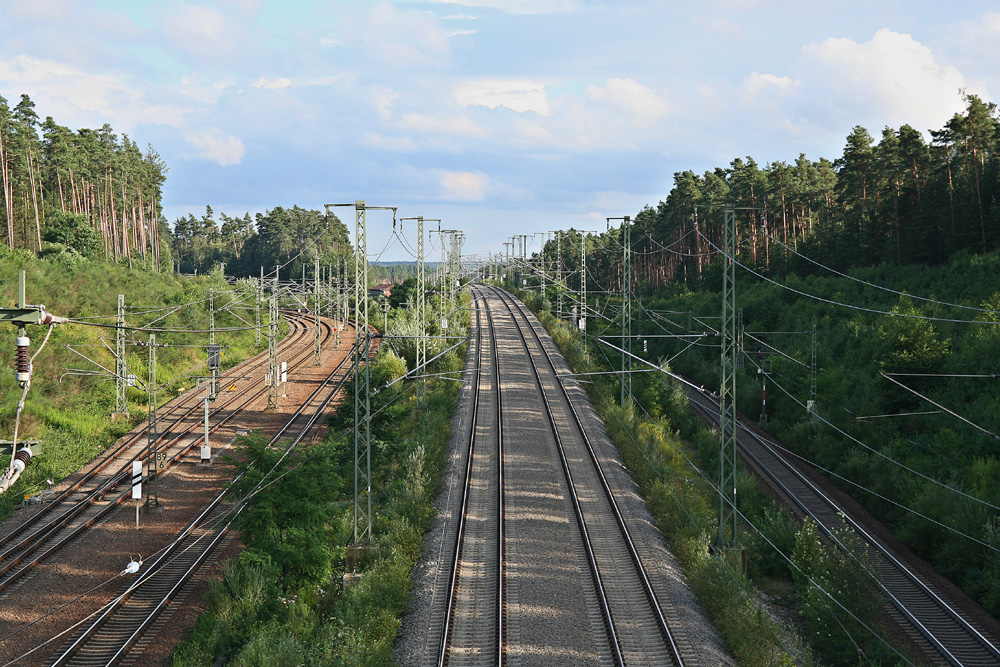
A branch line is a secondary railway line which branches off a more important through route, usually a main line. A very short branch line may be called a spur line. Branch lines may serve one or more industries, or a city or town not located on a main line. Branch lines may also connect two or more main lines.
An industrial spur is a type of secondary track used by railroads to allow customers at a location to load and unload freight vehicles without interfering with other railroad operations.
Industrial spurs can vary greatly in length and freight vehicle capacity, depending on the requirements of the customer the spur is serving. In heavily industrialized areas, it is not uncommon for one industrial spur to have multiple sidings to several different customers. Typically, spurs are serviced by local trains responsible for collecting small numbers of rail vehicles and delivering them to a larger yard, where they are sorted and dispatched in larger trains with other cars destined to similar locations. Because industrial spurs generally have less capacity and traffic than a mainline, they tend to have lower maintenance and signalling (train control) standards.
Before the rise of moving freight long distances by road, starting in the 1930s, railroads were the primary means of transportation around the world. Industries of the era were commonly built along rail lines specifically to allow for easy access to shipping. Short (under a mile, often only several hundred yards) industrial spurs with very small (under ten car) capacities were a common sight along railroads in industrial and rural cities alike. As automobile and roadway technology improved throughout the early and mid-20th century, most low-volume industry spurs were abandoned in favour of the greater flexibility and economic savings of road transport. Today, railroads remain the most economical way to ship large quantities of material, a fact that is reflected in industrial spurs. Most modern day spurs serve very large industries that require hundreds, if not thousands, of carloads a year.
There is an international branch line between Italy and Vatican: the 300-metre Vatican Railway, connecting from the Pisa-Rome railway mainline at Roma San Pietro railway station, to Vatican City station.
Many British railway branch lines were closed as a result of the "Beeching cuts" in the 1960s, although some have been re-opened as heritage railways.
The smallest branch line that is still in operation in the UK is the Stourbridge Town Branch Line from Stourbridge Junction going to Stourbridge Town. Operating on a single track, the journey is 0.8 miles (1.3 kilometres) long.
In North America, little-used branch lines are often sold by large railroads to become new common carrier short-line railroads of their own. Throughout the United States and Canada, branch lines link smaller towns too distant from the main line to be served efficiently, or to serve a certain industrial site such as a power station either because of a location away from the main line or to reduce congestion. They were typically built to lower standards, using lighter rail and shallow roadbeds when compared to main lines.
Hub AI
Branch line AI simulator
(@Branch line_simulator)
Branch line
A branch line is a secondary railway line which branches off a more important through route, usually a main line. A very short branch line may be called a spur line. Branch lines may serve one or more industries, or a city or town not located on a main line. Branch lines may also connect two or more main lines.
An industrial spur is a type of secondary track used by railroads to allow customers at a location to load and unload freight vehicles without interfering with other railroad operations.
Industrial spurs can vary greatly in length and freight vehicle capacity, depending on the requirements of the customer the spur is serving. In heavily industrialized areas, it is not uncommon for one industrial spur to have multiple sidings to several different customers. Typically, spurs are serviced by local trains responsible for collecting small numbers of rail vehicles and delivering them to a larger yard, where they are sorted and dispatched in larger trains with other cars destined to similar locations. Because industrial spurs generally have less capacity and traffic than a mainline, they tend to have lower maintenance and signalling (train control) standards.
Before the rise of moving freight long distances by road, starting in the 1930s, railroads were the primary means of transportation around the world. Industries of the era were commonly built along rail lines specifically to allow for easy access to shipping. Short (under a mile, often only several hundred yards) industrial spurs with very small (under ten car) capacities were a common sight along railroads in industrial and rural cities alike. As automobile and roadway technology improved throughout the early and mid-20th century, most low-volume industry spurs were abandoned in favour of the greater flexibility and economic savings of road transport. Today, railroads remain the most economical way to ship large quantities of material, a fact that is reflected in industrial spurs. Most modern day spurs serve very large industries that require hundreds, if not thousands, of carloads a year.
There is an international branch line between Italy and Vatican: the 300-metre Vatican Railway, connecting from the Pisa-Rome railway mainline at Roma San Pietro railway station, to Vatican City station.
Many British railway branch lines were closed as a result of the "Beeching cuts" in the 1960s, although some have been re-opened as heritage railways.
The smallest branch line that is still in operation in the UK is the Stourbridge Town Branch Line from Stourbridge Junction going to Stourbridge Town. Operating on a single track, the journey is 0.8 miles (1.3 kilometres) long.
In North America, little-used branch lines are often sold by large railroads to become new common carrier short-line railroads of their own. Throughout the United States and Canada, branch lines link smaller towns too distant from the main line to be served efficiently, or to serve a certain industrial site such as a power station either because of a location away from the main line or to reduce congestion. They were typically built to lower standards, using lighter rail and shallow roadbeds when compared to main lines.