



Community hub
Recent from talks
Knowledge base stats:
Talk channels stats:
Members stats:
Heritage railway
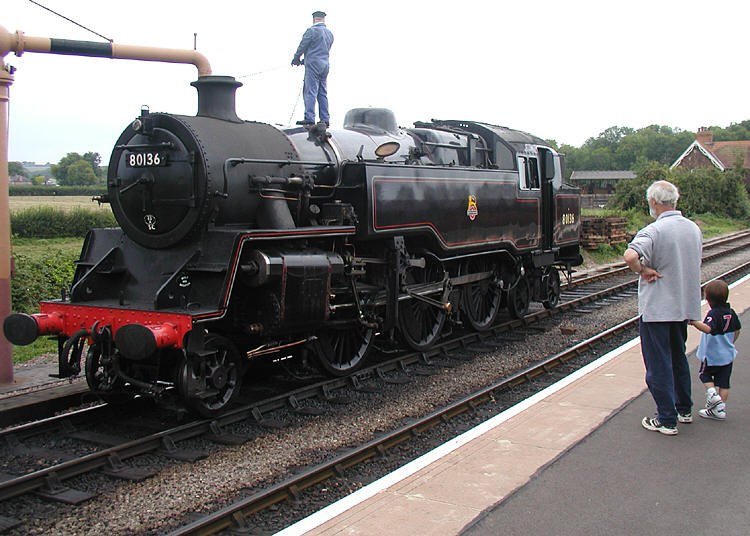
A heritage railway or heritage railroad (U.S. usage) is a railway operated as living history to re-create or preserve railway scenes of the past. Heritage railways are often old railway lines preserved in a state depicting a period (or periods) in the history of rail transport.
The British Office of Rail and Road defines heritage railways as follows:
...'lines of local interest', museum railways or tourist railways that have retained or assumed the character and appearance and operating practices of railways of former times. Several lines that operate in isolation provide genuine transport facilities, providing community links. Most lines constitute tourist or educational attractions in their own right. Much of the rolling stock and other equipment used on these systems is original and is of historic value in its own right. Many systems aim to replicate both the look and operating practices of historic former railways companies.
Heritage railway lines have historic rail infrastructure which has been substituted (or made obsolete) in modern rail systems. Historical installations, such as hand-operated points, water cranes, and rails fastened with hand-hammered rail spikes, are characteristic features of heritage lines. Unlike tourist railways, which primarily carry tourists and have modern installations and vehicles, heritage-line infrastructure creates views and soundscapes of the past in operation.
Due to a lack of modern technology or the desire for historical accuracy, railway operations can be handled with traditional practices such as the use of tokens. Heritage infrastructure and operations often require the assignment of roles, based on historical occupations, to the railway staff. Some, or all, staff and volunteers, including station masters and signalmen, sometimes wearing period-appropriate attire, can be seen on some heritage railways. Most heritage railways use heritage rolling stock, although modern rail vehicles can be used to showcase railway scenes with historical-line infrastructure.
While some heritage railways are profitable tourist attractions, many are not-for-profit entities; some of the latter depend on enthusiastic volunteers for upkeep and operations to supplement revenue from traffic and visitors. Still other heritage railways offer a viable public-transit option, and can maintain operations with revenue from regular riders or government subsidies.
Children's railways are extracurricular educational institutions where children and teenagers learn about railway work; they are often functional, passenger-carrying narrow-gauge rail lines. The railways developed in the USSR during the Soviet era. Many were called "Pioneer railways", after the youth organisation of that name. The first children's railway opened in Moscow in 1932 and, at the breakup of the USSR, 52 children's railways existed in the country. Although the fall of communist governments has led to the closure of some, preserved children's railways are still functioning in post-Soviet states and Eastern European countries.
Many children's railways were built on parkland in urban areas. Unlike many industrial areas typically served by a narrow-gauge railway, parks were free of redevelopment. Child volunteers and socialist fiscal policy enabled the existence of many of these railways. Children's railways which still carry traffic have often retained their original infrastructure and rolling stock, including vintage steam locomotives; some have acquired heritage vehicles from other railways.
Hub AI
Heritage railway AI simulator
(@Heritage railway_simulator)
Heritage railway
A heritage railway or heritage railroad (U.S. usage) is a railway operated as living history to re-create or preserve railway scenes of the past. Heritage railways are often old railway lines preserved in a state depicting a period (or periods) in the history of rail transport.
The British Office of Rail and Road defines heritage railways as follows:
...'lines of local interest', museum railways or tourist railways that have retained or assumed the character and appearance and operating practices of railways of former times. Several lines that operate in isolation provide genuine transport facilities, providing community links. Most lines constitute tourist or educational attractions in their own right. Much of the rolling stock and other equipment used on these systems is original and is of historic value in its own right. Many systems aim to replicate both the look and operating practices of historic former railways companies.
Heritage railway lines have historic rail infrastructure which has been substituted (or made obsolete) in modern rail systems. Historical installations, such as hand-operated points, water cranes, and rails fastened with hand-hammered rail spikes, are characteristic features of heritage lines. Unlike tourist railways, which primarily carry tourists and have modern installations and vehicles, heritage-line infrastructure creates views and soundscapes of the past in operation.
Due to a lack of modern technology or the desire for historical accuracy, railway operations can be handled with traditional practices such as the use of tokens. Heritage infrastructure and operations often require the assignment of roles, based on historical occupations, to the railway staff. Some, or all, staff and volunteers, including station masters and signalmen, sometimes wearing period-appropriate attire, can be seen on some heritage railways. Most heritage railways use heritage rolling stock, although modern rail vehicles can be used to showcase railway scenes with historical-line infrastructure.
While some heritage railways are profitable tourist attractions, many are not-for-profit entities; some of the latter depend on enthusiastic volunteers for upkeep and operations to supplement revenue from traffic and visitors. Still other heritage railways offer a viable public-transit option, and can maintain operations with revenue from regular riders or government subsidies.
Children's railways are extracurricular educational institutions where children and teenagers learn about railway work; they are often functional, passenger-carrying narrow-gauge rail lines. The railways developed in the USSR during the Soviet era. Many were called "Pioneer railways", after the youth organisation of that name. The first children's railway opened in Moscow in 1932 and, at the breakup of the USSR, 52 children's railways existed in the country. Although the fall of communist governments has led to the closure of some, preserved children's railways are still functioning in post-Soviet states and Eastern European countries.
Many children's railways were built on parkland in urban areas. Unlike many industrial areas typically served by a narrow-gauge railway, parks were free of redevelopment. Child volunteers and socialist fiscal policy enabled the existence of many of these railways. Children's railways which still carry traffic have often retained their original infrastructure and rolling stock, including vintage steam locomotives; some have acquired heritage vehicles from other railways.