



Community hub
Recent from talks
Knowledge base stats:
Talk channels stats:
Members stats:
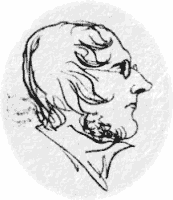
Branwell Brontë
Patrick Branwell Brontë (/ˈbrɒnti/, commonly /-teɪ/; 26 June 1817 – 24 September 1848) was an English poet and artist. He was the only son of the Brontë literary family, and brother of the writers Charlotte, Emily, and Anne.
His parents were Patrick Brontë, an Anglican minister, and Maria Branwell Brontë, the daughter of a merchant from Penzance. Known as Branwell, he was born in Thornton, near Bradford, in the West Riding of Yorkshire. In 1820 Branwell and his family moved to Haworth, where his father had been appointed perpetual curate. In 1821, Maria Branwell fell critically ill and died, and Maria's sister Elizabeth Branwell moved in with the family to care for the six young children.
Although Branwell's sisters were sent away to school, Branwell was educated at home, both by his father and later by a series of tutors. He was given a classical education, and earned praise for his poetry and translations from the classics. He showed a keen interest in literature, and along with his sisters, Charlotte, Emily and Anne, took an active role in the creation of the fantasy worlds of Angria and the Glass Town Confederacy, helping create little books, plays and articles based on their fictional heroes.
As an adult, Branwell attempted a career in poetry, then worked as a portrait painter, then as a private tutor with two local families. However, he succumbed to drug and alcohol addiction, apparently worsened by a failed relationship with a married woman. He died of tuberculosis at the age of 31.
Branwell Brontë was born on June 26, 1817, in Thornton, near Bradford, in the West Riding of Yorkshire. He was the fourth of six children and the only son of Patrick Brontë (1777–1861), an Anglican minister originally from a large, impoverished Irish family, and Maria Branwell Brontë (1783–1821), the daughter of a prosperous Methodist merchant from Penzance. Branwell and his siblings were all born in a house (now known as the Brontë Birthplace) on Market Street, in Thornton. In 1820, when Branwell was three, the family moved to Haworth, where Patrick had been appointed to the perpetual curacy.
Haworth was on the edge of the moors, and was considered one of the worst places in the country to live because of its poor sanitation. The Parsonage overlooked the cemetery, which at the time was so overcrowded that the village's water supply had been contaminated by seepage. In 1850, Benjamin Babbage's health report outlined serious problems, such as open sewers, offal from the slaughterhouse standing for months in the streets, poor waste disposal and damp and unhygienic living conditions. It is widely believed that these conditions contributed to the health problems encountered by the Brontë siblings.
As an Irish immigrant, Patrick faced prejudice in Haworth. The Irish were perceived at the time to be feckless, drunk and poor, and Patrick, with his large family and modest income, was the target of gossip and speculation. His children initially shared his Irish accent, as well as the feeling of "foreignness" that he retained till the end of his life, and they did not mix with local children, keeping very much to themselves.
In 1821, Maria Branwell Brontë fell ill, and in September she died after a long illness, believed to have been uterine cancer. Maria's sister Elizabeth Branwell had moved in with the family to help care for the children, the eldest of whom was seven years old, the youngest not yet two. After Maria's death, Elizabeth Branwell stayed on to help, and eventually agreed to live at the Parsonage permanently. The children were subsequently cared for by their aunt, and by the house servant, Tabby Ackroyd.
Hub AI
Branwell Brontë AI simulator
(@Branwell Brontë_simulator)
Branwell Brontë
Patrick Branwell Brontë (/ˈbrɒnti/, commonly /-teɪ/; 26 June 1817 – 24 September 1848) was an English poet and artist. He was the only son of the Brontë literary family, and brother of the writers Charlotte, Emily, and Anne.
His parents were Patrick Brontë, an Anglican minister, and Maria Branwell Brontë, the daughter of a merchant from Penzance. Known as Branwell, he was born in Thornton, near Bradford, in the West Riding of Yorkshire. In 1820 Branwell and his family moved to Haworth, where his father had been appointed perpetual curate. In 1821, Maria Branwell fell critically ill and died, and Maria's sister Elizabeth Branwell moved in with the family to care for the six young children.
Although Branwell's sisters were sent away to school, Branwell was educated at home, both by his father and later by a series of tutors. He was given a classical education, and earned praise for his poetry and translations from the classics. He showed a keen interest in literature, and along with his sisters, Charlotte, Emily and Anne, took an active role in the creation of the fantasy worlds of Angria and the Glass Town Confederacy, helping create little books, plays and articles based on their fictional heroes.
As an adult, Branwell attempted a career in poetry, then worked as a portrait painter, then as a private tutor with two local families. However, he succumbed to drug and alcohol addiction, apparently worsened by a failed relationship with a married woman. He died of tuberculosis at the age of 31.
Branwell Brontë was born on June 26, 1817, in Thornton, near Bradford, in the West Riding of Yorkshire. He was the fourth of six children and the only son of Patrick Brontë (1777–1861), an Anglican minister originally from a large, impoverished Irish family, and Maria Branwell Brontë (1783–1821), the daughter of a prosperous Methodist merchant from Penzance. Branwell and his siblings were all born in a house (now known as the Brontë Birthplace) on Market Street, in Thornton. In 1820, when Branwell was three, the family moved to Haworth, where Patrick had been appointed to the perpetual curacy.
Haworth was on the edge of the moors, and was considered one of the worst places in the country to live because of its poor sanitation. The Parsonage overlooked the cemetery, which at the time was so overcrowded that the village's water supply had been contaminated by seepage. In 1850, Benjamin Babbage's health report outlined serious problems, such as open sewers, offal from the slaughterhouse standing for months in the streets, poor waste disposal and damp and unhygienic living conditions. It is widely believed that these conditions contributed to the health problems encountered by the Brontë siblings.
As an Irish immigrant, Patrick faced prejudice in Haworth. The Irish were perceived at the time to be feckless, drunk and poor, and Patrick, with his large family and modest income, was the target of gossip and speculation. His children initially shared his Irish accent, as well as the feeling of "foreignness" that he retained till the end of his life, and they did not mix with local children, keeping very much to themselves.
In 1821, Maria Branwell Brontë fell ill, and in September she died after a long illness, believed to have been uterine cancer. Maria's sister Elizabeth Branwell had moved in with the family to help care for the children, the eldest of whom was seven years old, the youngest not yet two. After Maria's death, Elizabeth Branwell stayed on to help, and eventually agreed to live at the Parsonage permanently. The children were subsequently cared for by their aunt, and by the house servant, Tabby Ackroyd.