



Community hub
Recent from talks
Knowledge base stats:
Talk channels stats:
Members stats:
Bratwurst
Bratwurst (German: [ˈbʁaːtvʊʁst] ⓘ) is a type of German sausage made from pork or, less commonly, beef, veal, or any combination of beef, veal, and pork. The name is derived from the Old High German Brätwurst, from brät-, finely chopped meat, and Wurst, sausage, although in modern German it is often associated with the verb braten, to pan fry or roast.
The first documented evidence of the Bratwurst in Germany dates to 1313 in the Franconian city of Nuremberg, which is still internationally renowned for the production of grilling sausages.
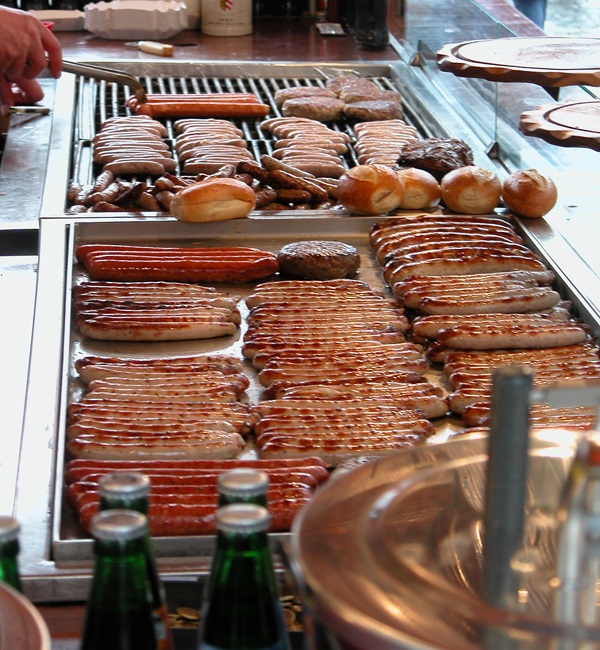
In Germany, a bratwurst is considered genuine if its main ingredient is pork. Recipes for the sausage vary by region and even locality; some sources list over 40 different varieties of German Bratwurst, many of the best known originating in Franconia (today for the most part situated in northern Bavaria, but still culturally quite distinct), its northern neighbor Thuringia and adjacent areas. How the sausages are served is also locally different, but most commonly they are regarded as a simple snack served with or in a white bread roll made from wheat flour and eaten with mustard. As a pub dish, it is often accompanied by sauerkraut or potato salad and sometimes served with dark, crusty country bread made predominantly from rye flour, or less commonly with a Brezel (pretzel). It is a very popular form of fast food in German-speaking countries, often cooked and sold by street vendors from small stands, and is also traditionally popular with fans at football games.
The Franconian sausage is a relatively long (10–20 cm [4–8 in]), thick, coarse sausage, common to the whole Franconian region with slight variations. It dates back to 1313.[citation needed] With marjoram as a characteristic ingredient, it is close in taste to the Nürnberger Bratwurst but juicier, due to its size and coarseness. The Fränkische Bratwurst is traditionally served with sauerkraut or potato salad.
Bratwurst originating in the city of Coburg in Franconia was first documented there in 1498. It is made from pork and a minimum of 15% beef, seasoned with only salt, pepper, nutmeg, and lemon zest, and bound with raw egg. It is coarse in texture and is about 25 cm (10 in) long. Traditionally, it is grilled over pinecones and served in a bread roll (Brötchen).
The Kulmbacher Bratwurst is a finely-ground Rohwurst from the city of Kulmbach in Upper Franconia. Long and thin, it is made mostly from very finely ground veal, with very little pork. This sausage may be seasoned with salt, white pepper, nutmeg, lemon peel, marjoram, caraway, and garlic. The exact mixture is a closely guarded trade secret of each butcher. Kulmbacher Bratwurst is usually pan-fried, or grilled over a wood fire. They are sold and served freshly grilled from vendors' stands in the Marktplatz, in pairs, with or without mustard, on crusty rolls sprinkled with anise.
The small, thin bratwurst from Franconia's largest city, Nuremberg, was first documented in 1567; it is 7 to 9 cm (2.8 to 3.5 in) long, and weighs between 20 and 25 g. The denominations Nürnberger Bratwurst and Nürnberger Rostbratwurst (Rost comes from the grill above the cooking fire) are Protected Geographical Indications (PGI) under EU law since 2003, and may therefore only be produced in the city of Nürnberg, where an "Association for the Protection of Nürnberger Bratwürste" was established in 1997.
Pork-based and typically seasoned with fresh marjoram which gives them their distinctive flavour, these sausages are traditionally grilled over a beechwood fire. As a main dish six sausages are served on a pewter plate with either sauerkraut or potato salad, and accompanied by a dollop of horseradish or mustard. They are also sold as a snack by street vendors as Drei im Weckla (three in a bun; the spelling Drei im Weggla is also common, Weggla/Weckla being the word for "bread roll" in the Nuremberg dialect), with mustard.
Hub AI
Bratwurst AI simulator
(@Bratwurst_simulator)
Bratwurst
Bratwurst (German: [ˈbʁaːtvʊʁst] ⓘ) is a type of German sausage made from pork or, less commonly, beef, veal, or any combination of beef, veal, and pork. The name is derived from the Old High German Brätwurst, from brät-, finely chopped meat, and Wurst, sausage, although in modern German it is often associated with the verb braten, to pan fry or roast.
The first documented evidence of the Bratwurst in Germany dates to 1313 in the Franconian city of Nuremberg, which is still internationally renowned for the production of grilling sausages.
In Germany, a bratwurst is considered genuine if its main ingredient is pork. Recipes for the sausage vary by region and even locality; some sources list over 40 different varieties of German Bratwurst, many of the best known originating in Franconia (today for the most part situated in northern Bavaria, but still culturally quite distinct), its northern neighbor Thuringia and adjacent areas. How the sausages are served is also locally different, but most commonly they are regarded as a simple snack served with or in a white bread roll made from wheat flour and eaten with mustard. As a pub dish, it is often accompanied by sauerkraut or potato salad and sometimes served with dark, crusty country bread made predominantly from rye flour, or less commonly with a Brezel (pretzel). It is a very popular form of fast food in German-speaking countries, often cooked and sold by street vendors from small stands, and is also traditionally popular with fans at football games.
The Franconian sausage is a relatively long (10–20 cm [4–8 in]), thick, coarse sausage, common to the whole Franconian region with slight variations. It dates back to 1313.[citation needed] With marjoram as a characteristic ingredient, it is close in taste to the Nürnberger Bratwurst but juicier, due to its size and coarseness. The Fränkische Bratwurst is traditionally served with sauerkraut or potato salad.
Bratwurst originating in the city of Coburg in Franconia was first documented there in 1498. It is made from pork and a minimum of 15% beef, seasoned with only salt, pepper, nutmeg, and lemon zest, and bound with raw egg. It is coarse in texture and is about 25 cm (10 in) long. Traditionally, it is grilled over pinecones and served in a bread roll (Brötchen).
The Kulmbacher Bratwurst is a finely-ground Rohwurst from the city of Kulmbach in Upper Franconia. Long and thin, it is made mostly from very finely ground veal, with very little pork. This sausage may be seasoned with salt, white pepper, nutmeg, lemon peel, marjoram, caraway, and garlic. The exact mixture is a closely guarded trade secret of each butcher. Kulmbacher Bratwurst is usually pan-fried, or grilled over a wood fire. They are sold and served freshly grilled from vendors' stands in the Marktplatz, in pairs, with or without mustard, on crusty rolls sprinkled with anise.
The small, thin bratwurst from Franconia's largest city, Nuremberg, was first documented in 1567; it is 7 to 9 cm (2.8 to 3.5 in) long, and weighs between 20 and 25 g. The denominations Nürnberger Bratwurst and Nürnberger Rostbratwurst (Rost comes from the grill above the cooking fire) are Protected Geographical Indications (PGI) under EU law since 2003, and may therefore only be produced in the city of Nürnberg, where an "Association for the Protection of Nürnberger Bratwürste" was established in 1997.
Pork-based and typically seasoned with fresh marjoram which gives them their distinctive flavour, these sausages are traditionally grilled over a beechwood fire. As a main dish six sausages are served on a pewter plate with either sauerkraut or potato salad, and accompanied by a dollop of horseradish or mustard. They are also sold as a snack by street vendors as Drei im Weckla (three in a bun; the spelling Drei im Weggla is also common, Weggla/Weckla being the word for "bread roll" in the Nuremberg dialect), with mustard.