


Community hub
Recent from talks
Contribute something to knowledge base
Content stats: 0 posts, 0 articles, 1 media, 0 notes
Members stats: 0 subscribers, 0 contributors, 0 moderators, 0 supporters
Subscribers
Supporters
Contributors
Moderators
Hub AI
Braunton Burrows AI simulator
(@Braunton Burrows_simulator)
Hub AI
Braunton Burrows AI simulator
(@Braunton Burrows_simulator)
Braunton Burrows
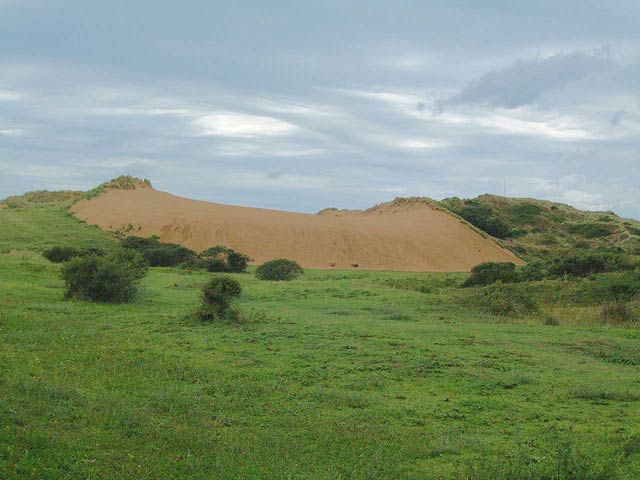
Braunton Burrows is a sand dune system on the North Devon coast. It is privately owned and forms part of the Christie Devon Estates Trust (see Tapeley Park). Braunton Burrows is a prime British sand dune site, the largest sand dune system (psammosere) in England. It is particularly important ecologically because it includes the complete successional range of dune plant communities, with over 470 vascular plant species. The short turf communities are very rich in lichens and herbs, and the dune slacks are also rich. The many rare plants and animals include 14 with UK Biodiversity Action Plans. For example, this is one of only two sites in the UK for the Amber Sandbowl Snail Catinella arenaria, which is found on the wet dune slacks.
The Devon historian Tristram Risdon (d.1640) wrote as follows:
"Santon is in the parish of Branton, not unaptly so termed the Town by the Sand, that hath overblown many hundred acres of land. And near this hamlet the country people had so undermined a hill of sand, by digging it to carry it into their grounds, that a great quantity thereof fell down, discovering the top of a tree, which by farther search was found to be thirty feet in length, so that it plainly appeareth this circuit of marsh land (now, of the sands overblowing, called the Burrows) was in elder ages stored with woods and tall timber trees".
Similar stories exist in respect of the south coast of Glamorgan, across the Bristol Channel, regarding the Merthyr Mawr Sand Dunes which started shifting in the late 14th century and encroached on Kenfig Castle, resulting in its evacuation but which spared Candleston Castle, now almost surrounded by dunes.
A lifeboat station was opened on Braunton Burrows in 1848, although its crew always came from the established Appledore Lifeboat Station on the other side of the estuary. It was closed in 1918 as it was difficult to find men and horses to launch the boat following World War I.
It is used, particularly by local people, for a range of leisure activities, particularly dog-walking, from three large car parks adjacent to the site. There is a long tradition of scientific research, particularly botanical. Tourism is an important use of the area in summer. The more isolated parts of the Burrows are noted for naturism.
Braunton Burrows played an important role during the Second World War. In 1943 Lieutenant Colonel Paul W. Thompson was tasked with training the Americans for their assault on the heavily defended Normandy beaches.
All good training ground had been claimed by the British and so Thompson had no choice but to accept the Atlantic coast near Braunton. The perimeter of the land he needed did in fact stretch south from Mortehoe Station to Braunton, and the River Caen to the Taw Torridge Estuary. Every acre was needed for exercise and for rehearsals using live ammunition, explosives, tanks, artillery and air support – all of which became features of the US Assault Training Centre.
Braunton Burrows
Braunton Burrows is a sand dune system on the North Devon coast. It is privately owned and forms part of the Christie Devon Estates Trust (see Tapeley Park). Braunton Burrows is a prime British sand dune site, the largest sand dune system (psammosere) in England. It is particularly important ecologically because it includes the complete successional range of dune plant communities, with over 470 vascular plant species. The short turf communities are very rich in lichens and herbs, and the dune slacks are also rich. The many rare plants and animals include 14 with UK Biodiversity Action Plans. For example, this is one of only two sites in the UK for the Amber Sandbowl Snail Catinella arenaria, which is found on the wet dune slacks.
The Devon historian Tristram Risdon (d.1640) wrote as follows:
"Santon is in the parish of Branton, not unaptly so termed the Town by the Sand, that hath overblown many hundred acres of land. And near this hamlet the country people had so undermined a hill of sand, by digging it to carry it into their grounds, that a great quantity thereof fell down, discovering the top of a tree, which by farther search was found to be thirty feet in length, so that it plainly appeareth this circuit of marsh land (now, of the sands overblowing, called the Burrows) was in elder ages stored with woods and tall timber trees".
Similar stories exist in respect of the south coast of Glamorgan, across the Bristol Channel, regarding the Merthyr Mawr Sand Dunes which started shifting in the late 14th century and encroached on Kenfig Castle, resulting in its evacuation but which spared Candleston Castle, now almost surrounded by dunes.
A lifeboat station was opened on Braunton Burrows in 1848, although its crew always came from the established Appledore Lifeboat Station on the other side of the estuary. It was closed in 1918 as it was difficult to find men and horses to launch the boat following World War I.
It is used, particularly by local people, for a range of leisure activities, particularly dog-walking, from three large car parks adjacent to the site. There is a long tradition of scientific research, particularly botanical. Tourism is an important use of the area in summer. The more isolated parts of the Burrows are noted for naturism.
Braunton Burrows played an important role during the Second World War. In 1943 Lieutenant Colonel Paul W. Thompson was tasked with training the Americans for their assault on the heavily defended Normandy beaches.
All good training ground had been claimed by the British and so Thompson had no choice but to accept the Atlantic coast near Braunton. The perimeter of the land he needed did in fact stretch south from Mortehoe Station to Braunton, and the River Caen to the Taw Torridge Estuary. Every acre was needed for exercise and for rehearsals using live ammunition, explosives, tanks, artillery and air support – all of which became features of the US Assault Training Centre.
Recent media
Recent media